Article
How to Start a NEMT Business in Tennessee (2026)
Tennessee's Medicaid rides go through two vendors picked by each rider's health plan, and most for-hire vans need $1.5 million of insurance. Here's the order.
By James O'Donnell, Cofounder and COO, Duet ·

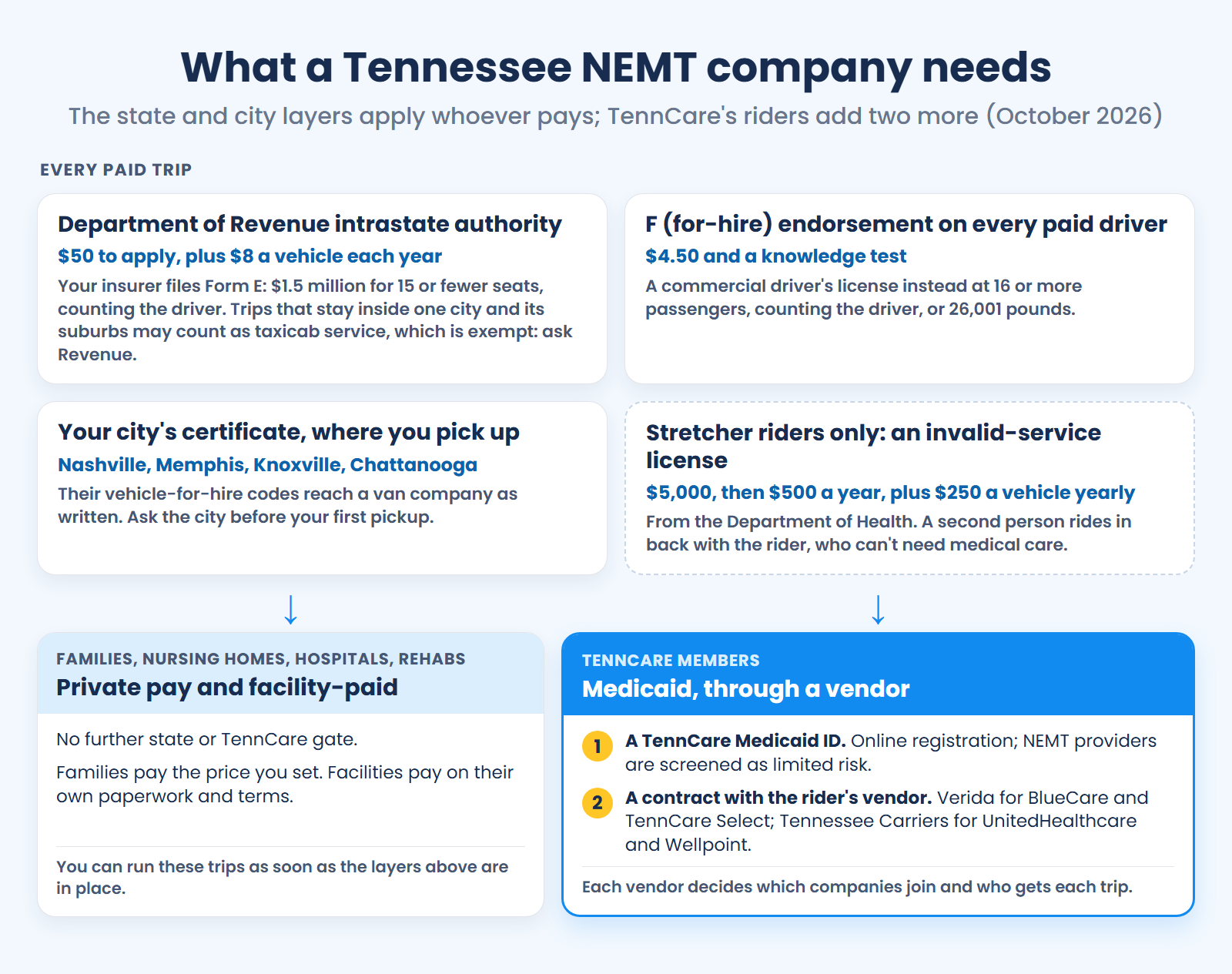
To start a NEMT business in Tennessee, form an LLC ($300), get the Department of Revenue’s intrastate authority, its permit to carry passengers for pay, and put every paid driver on an F (for-hire) license endorsement. Most companies paid to carry riders need that authority, whoever pays, with $1.5 million of insurance on file. Trips for members of TennCare, Tennessee’s Medicaid program, add a Medicaid ID and a contract with Verida or Tennessee Carriers, whichever the rider’s health plan uses. Budget about $22,700 to $50,400 for one used wheelchair van and six months of fixed bills, more with insurance at $1.5 million.
Tennessee at a glance:
- Two ride vendors, by plan: Verida for BlueCare and TennCare Select members, Tennessee Carriers for UnitedHealthcare and Wellpoint members, whose plans held about 59 percent of TennCare’s members in July 2026 [1][2].
- Medicaid ID before any vendor: TennCare registers transportation companies online in its limited-risk tier, with no site visit and no fee named [3]. Then each vendor runs its own application [4][5].
- Revenue’s authority: $50 to apply plus $8 a vehicle a year, with your insurer’s Form E, its proof of your coverage, at $1.5 million for 15 or fewer seats counting the driver and $5 million at 16 or more [6][7][8].
- Drivers: the $4.50 F endorsement for every paid driver, or a commercial driver’s license (CDL), which starts at 16 passengers counting the driver or 26,001 pounds [9][10].
- Stretcher riders: the Department of Health’s invalid-service license, written for riders lying down who need no medical care on the way: $5,000, then $500 a year, plus $250 a vehicle each year [11][12].
- Cities: Nashville’s code licenses a “disability transport service” [13]. The vehicle-for-hire codes of Memphis, Knoxville and Chattanooga are worded broadly enough to reach a NEMT van.
- The field: an NPI, or national provider identifier, is a provider’s federal ID, and Tennessee has 1,230 active ones under the NEMT van code, 343900000X, by our count [14].
- Rates: TennCare publishes none, and each health plan keeps its own fee schedules [15].
A Tennessee owner told me on a June demo that the company had been in business “Exactly one year.” It was already running five vehicles, and stretcher trips were the main goal. The owner doesn’t usually run Google Ads, but said, “I receive a lot of calls from patients, even from the hospitals and clinics.” I told the owner, “I rarely see people growing that quickly.”
Calls that come straight to you from riders, families and facilities are the part of Tennessee you control. TennCare’s rides sit behind a Medicaid ID and two vendors that decide who gets trips, so get Revenue’s authority and build on facility and private-pay trips first. The checklist below runs in that order, your own trips before TennCare and its two vendors. After it come who pays, the vendors, the rules, costs and timing.
I run Duet, which builds dispatch software and runs growth services for non-emergency medical transportation (NEMT) companies, and I talk to NEMT owners on demos every week, Tennessee operators included. This is the Tennessee edition of our national guide on how to start a NEMT business. Requirements change, so confirm against the linked sources before you spend money.
The one-page checklist: how to start a medical transportation business in Tennessee
Decide your riders, vehicles and city first and the vendors last, because in Tennessee that order wastes the least money. Each phase ends with what it puts at risk and the running total.
Phase 0: pick your riders, your vehicles and your city
- Seats: the insurance tiers count the driver. Fifteen or fewer seats take $1.5 million on file under Revenue’s authority, and 16 or more take $5 million and a driver with a CDL [8][9].
- Stretchers: riders who travel lying down need a company with the invalid-service license and a second person riding in back with them [11].
- Your city: Nashville, Memphis, Knoxville and Chattanooga each have a certificate rule worded broadly enough to reach a NEMT van, so where you pick up decides whether you’ll need one.
- The field: by our count, Davidson County (Nashville) and Shelby County (Memphis) have about five times as many NEMT registrations per TennCare member as Knox County (Knoxville) [14][2]. In a crowded county, plan on facilities and families for your first year.
- Three calls this week: ask Revenue’s Motor Carrier office (615-399-4265 or Motor.Carrier@tn.gov), in writing, whether your trips need intrastate authority or fit the taxicab exemption [7]. Ask the five nearest nursing homes, rehabs or discharge planners who books and pays for the rides their residents’ plans don’t cover. Ask your city’s vehicle-for-hire office whether your vans need its certificate.
- Money at risk: none yet.
Phase 1: form the company and line up your first customers
- File articles of organization with the Secretary of State: $300 for an LLC with one to six members, and each annual report costs the same [16].
- Get a free employer identification number (EIN) and a free NPI under the NEMT van taxonomy, 343900000X [4].
- Pay the county clerk $15 for a business license once your receipts pass $3,000 a year, plus $15 more inside a city with the business tax [17].
- Put up a website a family can book a ride on and a Google Business Profile.
- Visit nursing homes, rehab centers and hospital discharge planners now. They’re your first trips.
- Money at risk: about $600: $300 for the LLC, $15 for the county license and about $300 for a phone and basic marketing.
Phase 2: quote insurance at $1.5 million before you buy the van
- Get quotes on the exact van at $1.5 million of auto liability. Your insurer files the Form E that Revenue’s application needs [8][18].
- Ask each agent whether it writes for-hire passenger work and files Forms E and H in Tennessee.
- If you’ll take TennCare trips, have the same agents quote the general liability and workers’ comp that TennCare’s contract with its health plans asks of every company in their networks [19].
- Money at risk: nothing new (about $600 so far).
Phase 3: buy and insure the van, then file with Revenue and your city
- Title and register the van with your county clerk. A vehicle that carries passengers for hire registers by its passenger seats: $47.13 a year with up to seven, or $96.63 with eight to 15, before county fees [20].
- Pay sales tax of 7%, plus local tax on the first $1,600 and a state single-article tax on the next $1,600: about $2,398 on a $33,000 van [21].
- File Revenue’s application with a USDOT number (a free federal carrier ID), a designated agent for service of process (a Tennessee representative who can accept court papers for your company), your insurer’s forms and the fees. Revenue issues a permit card for each vehicle [6][7].
- Apply for your city’s certificate where it applies. Nashville’s is $200 for a company with one to five vehicles, $50 a vehicle, $50 a driver and a $75 background check [22].
- Money at risk: about $14,500 more with the van financed, so about $15,100 in. That’s $6,600 down on our national model’s $33,000 wheelchair van (2016-2019), $2,398 of sales tax, $4,350 of insurance at signing, about $1,000 for equipment, $58 for Revenue and $47.13 for registration. The insurance is the model’s price at about $1 million of coverage; city fees, stretcher licensing and the higher premium at $1.5 million come on top.
Phase 4: put every driver on the F endorsement and screen them
- Every paid driver, you included, adds the F endorsement: $4.50, a vision screening and a knowledge test [9].
- Screen and train before the first trip. For TennCare riders, TennCare’s contract wants 32 hours of training before a driver’s first trip [19].
- Money at risk: about $1,000 more for one driver’s screening and training in our model, so about $16,100 in, then about $1,934 a month of fixed bills until your trips cover them.
Phase 5: run facility and private-pay trips, then register with TennCare and apply to both vendors
- Run facility and private-pay trips once your permit cards, and any city certificate, are in hand.
- Register with TennCare for a Medicaid ID once your first facility account is running [3].
- Then send Tennessee Carriers its form with four screenshots from TennCare’s portal, and ask Verida about its orientation and vehicle inspection [4][5].
- Money at risk: six months of fixed bills, about $11,600 with the van financed, for a total of about $27,700.
A company that never carries a TennCare rider can skip Phase 5’s last two steps. It can’t skip Revenue unless an exemption fits, and one already running without the authority should quote the coverage and file now.
Who pays for NEMT rides in Tennessee?
Three payers matter most to a new Tennessee company: TennCare’s health plans, through two vendors; facilities; and families paying privately. Of the three, only TennCare’s riders have to reach you through a vendor.
TennCare is the volume, and two vendors arrange it
TennCare counted 1,357,979 members in July 2026, and its four health plans send their members’ non-emergency rides through Verida or Tennessee Carriers [2][1]. Only 79,698 of those members were 65 or older, while Tennessee had 1,273,979 residents that age in the Census Bureau’s 2024 survey [2][23]. Most Tennessee seniors aren’t TennCare members at all, and Original Medicare pays for no van ride, so their trips land with families, facilities and the Medicare Advantage plans that offer a ride benefit [24].
Some of those plans name their vendor. UnitedHealthcare’s three Tennessee plans for people on both Medicare and TennCare offer 100 or 120 one-way trips through Tennessee Carriers, and Wellpoint’s dual plans offer unlimited one-way trips [25].
Facilities are the stability
Facilities pay on their own paperwork and terms, and they don’t wait on a vendor’s network decision: a rehab sending a patient home, a nursing home sending a resident to a specialist, a hospital clearing a discharge. When the Tennessee owner and I talked stretcher work in June, I said the facility is more often the one arranging a stretcher trip. An operations lead at a Knoxville company said in a 2026 podcast interview that about three quarters of its work outside the brokers is paid by facilities and a quarter by riders and their families, adding, “that’s not a hard number.”
Don’t count on dialysis clinics as facility accounts, though. In my experience most dialysis riders are on Medicaid, so in Tennessee their trips come through Verida or Tennessee Carriers, not the clinic.
One local rule before you court a facility in Nashville: Metro’s code makes it unlawful to pay a hospital, convalescent home, clinic or any other business for the right to pick up its passengers [13].
Private pay is the margin
Private-pay riders and their families call you directly and pay up front, at the price you set. Harry Chambers, a digital marketing expert, told us on our 2025 podcast episode on private-pay marketing that after the Bay Area, his favorite market to advertise in was “a tie between Texas and Tennessee,” for their big highway systems and spread-out areas. His screen for steady ad-driven rides is “at least a million people or more in your marketplace,” so expect ad-driven private pay to build slower in a rural county.
Take the card at booking. Most owners I talk to charge it at least 24 hours before pickup, or send a payment link that’s due by then, and an unpaid ride doesn’t get a van.
Who is the NEMT broker in Tennessee?
No single broker serves all of Tennessee: Verida arranges rides for BlueCare and TennCare Select members, and Tennessee Carriers for UnitedHealthcare Community Plan and Wellpoint members. Each is the ride vendor its plans pay, what most owners call a broker, and TennCare’s member page sends each rider to the one for their plan, as of October 2026 [1]:
| Health plan | TennCare members, July 2026 | Ride vendor | Member booking line |
|---|---|---|---|
| BlueCare | 529,180 | Verida | 1-855-735-4660 |
| TennCare Select | 27,331 | Verida | 1-866-473-7565 |
| UnitedHealthcare Community Plan | 401,086 | Tennessee Carriers | 1-866-405-0238 |
| Wellpoint (formerly Amerigroup) | 395,463 | Tennessee Carriers | 1-866-680-0633 |
The other 4,919 of TennCare’s members were in PACE or a disability program outside the four plans [2]. The plans’ own 2026 manuals agree on the vendors: BlueCare’s names Verida for BlueCare and TennCare Select members, and UnitedHealthcare’s and Wellpoint’s point to Tennessee Carriers [5][26][27].
Verida is the company formerly called Southeastrans, and Wellpoint was Amerigroup, so older pages and videos still carry both names [28][1]. Modivcare and MTM arrange none of these rides. You’ll see both named as TennCare brokers online, but TennCare’s pages and the plans’ manuals name only Verida and Tennessee Carriers. Next door, Verida is Georgia’s one statewide Medicaid ride broker; in Tennessee it serves two plans. Our state-by-state map of who arranges Medicaid rides shows how other states split the job.
How does a Medicaid trip reach your company?
A rider calls the vendor for their plan at least two business days ahead, and the vendor picks the company [29]. Riders can’t choose: TennCare’s provider FAQ says providers “are assigned based on availability, the Member’s needs, and cost-effectiveness” [30]. The plans aren’t “required to use a particular NEMT provider or driver requested by the member,” and Verida’s manual says the same of itself: a rider can ask for your company, but the vendor still decides [19][5]. So when a TennCare rider calls you directly, what I told the Tennessee owner in June holds: “you can’t book that ride, they need to book through the broker.”
Once you’re in a network, the NEMT attachment of TennCare’s contract, in its July 1, 2026 version, sets the rules your trips run on [19]:
- Urgent trips: hospital discharges count as urgent, and the vendor has to get a company there within three hours of the call in an urban area and four hours elsewhere [19][29].
- Will-calls: a return trip with no set time gets picked up within one hour of the call [19].
- Manifests: newly requested trips reach your manifest before 5 p.m. on the business day they’re requested. Verida’s manual says it usually sends manifests two days ahead and takes rejections until 12:30 p.m. the day before [19][5].
- Waiting and no-shows: the driver waits at least five minutes past the pickup time, a rider who isn’t there by then is a no-show, and “Members shall not be charged for no-shows” [19].
- On time: riders wait no more than 10 minutes past the pickup time and arrive at least 15 minutes before the appointment [19].
Can I bill TennCare directly for NEMT rides?
No: TennCare runs its health plans’ NEMT rides through two vendors, which pay only companies in their networks, so TennCare registration gets you a Medicaid ID, not a payer. Wellpoint’s October 2026 manual is plain about it: “Transporters must have a separate contract with Tennessee Carriers,” and NEMT claims not coordinated through Tennessee Carriers “will be denied” [27]. On the BlueCare side, Verida pays nothing without the confirmation number it issues for each trip [5].
TennCare publishes no NEMT rate, and each plan “maintains their own fee schedules” [15]. The vendors pay companies under their own agreements, and Verida’s manual says its policy is to pay “within thirty (30) days of undisputed (clean) invoice submissions” [5]. Tennessee Carriers publishes no rate or pay schedule, so ask both vendors for their rates in writing before you buy a second van.
Two more contract lines shape what a trip pays. An escort riding along isn’t paid separately, and neither is an adult riding with a child under 18 [19]. And the mileage money you’ll see quoted for TennCare is the rider’s, paid when the rider, a friend or a family member does the driving, not a company rate [29][30].
What licenses and requirements does a NEMT business need in Tennessee?
Tennessee has no license called a NEMT license, but a company paid to carry riders needs the Department of Revenue’s intrastate authority under T.C.A. 65-15-107, whoever pays, unless an exemption fits. The statute bars a motor carrier from carrying persons on Tennessee’s highways “without first having received a permit from the department,” and the department is Revenue [31][32]. Every paid driver also needs the F endorsement or a CDL, and two more layers apply to some companies: stretcher service needs the Department of Health’s invalid-service license, and four cities’ certificate rules reach vans as written.
Here’s what circulates about Tennessee, next to what the state actually requires:
| The claim you’ll read elsewhere | What Tennessee actually requires |
|---|---|
| No state license is needed “beyond TennCare enrollment and Modivcare credentialing” | A for-hire carrier needs Revenue’s intrastate authority unless an exemption fits, and Modivcare arranges no TennCare plan’s rides [31][1] |
| Medicaid trips under a broker contract are “generally exempt from the for-hire permit” | The exemptions name taxicab, sedan, limousine and shuttle service, charter trips and ambulances, and nothing for NEMT or Medicaid [32] |
| Modivcare as the “NEMT logistics manager for most TennCare MCO plans” | Verida serves BlueCare and TennCare Select, and Tennessee Carriers serves UnitedHealthcare and Wellpoint [1] |
| You register as a Medicaid provider “through the Tennessee Department of Human Services” | You register with the Division of TennCare for a Medicaid ID [3] |
| Commercial auto liability of “often a minimum of $1 million” | $1 million is TennCare’s contract floor for providers; the state’s floor under Revenue’s authority is $1.5 million for 15 or fewer seats counting the driver [19][8] |
| A “Valid Tennessee driver’s license for vehicle class being operated” | A Class D license with the $4.50 F endorsement, or a CDL [9] |
| Stretcher transport as one more vehicle choice | A company carrying stretcher riders needs the invalid-service license, $5,000 the first year [11] |
| A TennCare rate of $0.84 to $1.08 a mile for a wheelchair van, or about $30 an ambulatory trip | TennCare publishes no NEMT rate, and each plan keeps its own fee schedules [15] |
Does your van need Revenue’s authority?
If you’re paid to carry riders on trips inside Tennessee, assume yes. The exemptions in T.C.A. 65-15-103 cover taxicab, sedan, limousine and shuttle service, charter trips, ambulances and hearses, school and church vehicles and commuter vans. None of them names non-emergency medical or Medicaid transportation [32]. Who pays doesn’t change it. The permit covers a company that carries the public for pay and one that drives under contract, so a vendor’s trip, a facility’s and a family’s all count [32][31].
The exemption that could fit a NEMT van is the taxicab one, or the sedan one, which uses the same city test for a vehicle built for five or fewer riders. Tennessee defines a taxicab as a vehicle built for “not more than nine (9) passengers for hire, exclusive of the driver,” with no fixed route, whose principal operation is “confined to the area within the corporate limits of cities and suburban territory adjacent thereto” [32]. On those words, a wheelchair van whose trips stay mostly inside one city and its suburbs could qualify. One whose trips mostly run beyond them, on rural runs for example, doesn’t, and a 15-passenger van is too big. Revenue’s guide and forms don’t say how it reads this for NEMT, or for contract-only work that stays inside one city and its suburbs, so ask its Motor Carrier office in writing.
The charter exemption is narrower than it sounds. It covers “casual trips on call or under contract, solicited by the party served,” with no pickups along the route, which a standing weekly ride or a shared van fits badly [32].
Knowingly running without authority is a Class B misdemeanor, a crime, with minimum fines of $25, $50 and $100 for the first three offenses, and each day counts as a separate offense [31].
What does Revenue’s application take?
Revenue’s process has five parts:
- A USDOT number: the application asks for it [6].
- The application: form RV-F1315501, filed online through the Tennessee Taxpayer Access Point (TNTAP) or on paper [18].
- A process agent: named on Revenue’s designated-agent form, it’s “a Tennessee representative upon who court papers may be served” in a case against your company [7].
- Insurance: your insurer files Form E, at $1.5 million for vehicles seating 15 or fewer counting the driver, and Revenue’s guide asks every bus account, its class for passenger vehicles, for a Form H too [6][7].
- Fees: $50 to apply and $8 a vehicle each calendar year. Revenue issues an Intrastate Permit Card for each vehicle [7].
A vehicle already filed under the Unified Carrier Registration Agreement, which interstate carriers file, doesn’t need intrastate authority too [7]. Revenue’s guide and forms give no processing time, so ask when you file.
What do Nashville, Memphis, Knoxville and Chattanooga require?
Each of the four cities requires a certificate of public convenience and necessity (its permit to run vehicles for hire), and each code’s words reach a NEMT van. State law lets every city and county license each private passenger vehicle for hire operating inside it [33]. Nashville’s code even names the service: a “Disability transport service” is “a special-purpose passenger vehicle for hire that provides transportation using disability transport vehicles,” and no vehicle for hire may pick up in Metro without a certificate [13].
| City | Who issues it | Company | Each vehicle | Each driver | Insurance in the code |
|---|---|---|---|---|---|
| Nashville, whose certificate Franklin requires and Hendersonville accepts [22][34] | Metropolitan Transportation Licensing Commission | $200 for 1 to 5 vehicles | $50 a year | $50, plus a $75 background check | $1 million general liability and a $1 million master auto policy |
| Memphis [35] | Memphis Transportation Commission, after a public hearing (apply at the Permits Office) | $200 | $125 a year | $35 | State minimums, plus $5,000 a seat over five |
| Knoxville [36] | Knoxville Police Department | $250, then $50 a year | $100 or $200 inspection, by class | $20, plus $48 for fingerprints | State minimums |
| Chattanooga [37] | Passenger Vehicle For Hire Board | $1,000 plus $50 a vehicle | $50 privilege | $10 | State minimums |
Memphis’s and Chattanooga’s codes point to Tennessee’s financial-responsibility floor for every driver, $25,000 per injury, $50,000 per accident and $25,000 of property damage, and Knoxville’s to the minimums Tennessee law sets [38]. A van under Revenue’s authority carries $1.5 million either way.
The certificates aren’t automatic. Nashville’s commission issues one only “If the MTLC determines that further passenger vehicle for hire services are required,” and Chattanooga’s board grants privileges only if it “finds that further vehicle for hire services in Chattanooga is required” [13][37]. Nashville’s licensing director decides which class of vehicle for hire yours is, and in Knoxville the police department does, which sets your inspection fee there [13][36].
The codes were written mostly for taxis and limousines, and we found no city ruling on a NEMT van, so get your city’s reading in writing before your first pickup: Nashville’s Transportation Licensing office at 615-862-6777, or Memphis’s Permits Office at 901-636-6711. If you’ll pick up or drop off at Nashville’s airport more than twice a month, the airport authority wants its own permit too, $50 plus $50 a vehicle, and says a new one takes at least 30 days [39].
What if you drive riders into another state?
A paid trip across a state line is interstate, and crossings come up: Memphis sits on the Mississippi and Arkansas lines, Chattanooga on Georgia’s, Clarksville near Kentucky’s and Bristol on Virginia’s. Interstate work usually means operating authority from the Federal Motor Carrier Safety Administration (FMCSA), a USDOT number and $1.5 million of liability for a vehicle seating 15 or fewer counting the driver [40]. Our licensing guide covers what federal authority a paid crossing takes.
TennCare adds its own line: its rules exclude a non-emergency out-of-state trip the rider’s health plan hasn’t approved in advance [41].
What are the NEMT insurance requirements in Tennessee?
Plan on $1.5 million of auto liability, Tennessee’s floor for a for-hire passenger vehicle seating 15 or fewer counting the driver once you hold Revenue’s authority. The rule, in its March 2026 compilation, sets $1,500,000 for 15 or fewer seats “including the driver” and $5,000,000 at 16 or more, and no permit issues until the policy is on file [8].
TennCare’s contract adds a floor for every NEMT provider in a plan’s network: $1 million of auto liability per occurrence, general liability of $1 million per occurrence and $2 million aggregate, and workers’ comp with at least $1 million of employers’ liability [19]. Verida’s manual wants the auto policy written for “any-auto,” not a schedule of vehicles, from an insurer A.M. Best rates A-IX or better (an “A” grade and a financial size of Class IX or larger), with no exclusions for sexual abuse and molestation [5]. Tennessee Carriers publishes no bar of its own, so ask for it before you buy. If Metro’s certificate reaches your vans in Nashville, its code adds $1 million of general liability and a $1 million master auto policy [13].
When should you bind the policy?
When you’re ready to file with Revenue, not months before. Your insurer’s Form E goes in with the application, so a policy bound early pays premiums, about $1,305 a month at our national model’s price, on a van that can’t take a paid trip yet [7]. Get the quotes in Phase 2, then buy the van, bind the policy and file in the same week.
What will insurance cost a new Tennessee company?
Expect quotes above our national model’s $17,400 a year, because Tennessee’s $1.5 million floor sits above the model’s basis. The model prices a new company’s wheelchair van at about $1 million of liability, built from operators’ quotes of $1,200 to $1,800 a month: about $4,350 at signing, then ten installments of $1,305. Our guide to what a brand-new company pays for coverage shows where those numbers come from, and in my experience stretcher vans run higher still.
Do you need workers’ comp in Tennessee?
Not until you have five employees, outside construction, and an LLC’s owners don’t count toward the five [42]. Part-timers, minors and working family members do. Calling a driver a contractor doesn’t settle it: the Bureau of Workers’ Compensation uses a seven-factor test, and a 1099 instead of a W-2 “does not mean they are properly classified” [42]. TennCare’s contract and Verida’s manual both require workers’ comp of every network provider, with no exception for small companies [19][5]. So plan on it before your first vendor trip, and ask your vendor what it accepts from an owner-only company.
What do NEMT drivers need in Tennessee?
Every paid NEMT driver in Tennessee, owner included, needs a Class D license with the $4.50 F (for-hire) endorsement, or a CDL. The endorsement takes a vision screening and a knowledge test, and the driver has to be 18 or older with two years of unrestricted driving [9]. The statute requires it to drive a Class D vehicle “as a chauffeur,” and a chauffeur includes “every person who drives a motor vehicle while in use as a public or common carrier of persons.” That reaches an owner driving their own van for pay. Volunteer drivers don’t need it.
A CDL starts at a vehicle designed for 16 or more passengers counting the driver, or 26,001 pounds, so a typical wheelchair van doesn’t need one [9][10].
Once you hire, one full-time driver costs more each month than all the fixed bills in our budget, which assumes you drive. A Nashville-area owner who had run mostly broker trips told me in June that drivers there make “about 17 to 20 an hour,” going by what the owner had heard. At 40 hours a week, that’s about $2,900 to $3,500 a month for one driver, before payroll taxes.
What do TennCare’s contract and Verida require of drivers?
If you’ll carry TennCare riders, TennCare’s contract sets the driver file, and Verida’s manual repeats most of it [19][5]:
- Age and license: 18 or older under the contract, with the F endorsement or a CDL. Verida’s own minimum is 21 [19][5].
- Training: 32 hours before a driver’s first trip and 15 hours a year after, covering topics like passenger assistance, wheelchair securement and defensive driving [19].
- Physical: an exam at least as extensive as the federal medical exam for commercial drivers [19].
- Drug and alcohol tests: before service, after an accident, on reasonable suspicion and at random, with at least 20 percent of drivers tested each year [19].
- Background checks: a check under T.C.A. 38-6-109 and a national one before service and every five years after, plus the sex-offender registries and exclusion lists [19].
- Driving record: no conviction for a major moving violation such as driving under the influence in the past 10 years, and none for reckless driving in the past 36 months [19].
Can a NEMT company run stretcher van trips in Tennessee?
Yes, with the Health Department’s invalid-service license: $5,000 the first year, then $500 a year, plus $250 a vehicle each year [11]. In the EMS Board’s words, invalid services “only provide stretcher transportation for those who do not need medical care or monitoring while being transported” [12]. The rule describes riders whose impairments make a regular taxi impractical and who need no medical attention before or during the trip, which fits many wheelchair riders too, but its vehicle rules are written around stretchers. If you’ll run only wheelchair vans, confirm with the Office of EMS that you don’t need it.
The rules that come with it:
- A second person rides in back: “Each person transported shall be accompanied in the patient compartment.” [11]
- Every vehicle gets inspected: each must pass the EMS Office’s inspection and carry its own permit, renewed by July 1 each year [12].
- A license for each base: you need a separate service license for each county where you keep a base of operations [12].
- No ambulance look: no flashing lights, sirens or emergency markings, never the word “ambulance” on the van or in your ads, and the notice “INVALID TRANSPORT - THIS SERVICE DOES NOT PROVIDE MEDICAL CARE” on a placard on the van and on every ad [11].
- Insurance of its own: vehicle liability of $300,000 per person, $700,000 per accident and $100,000 of property damage, plus $300,000 of general or professional liability [11][43].
- No trips before the license: “Patients shall not be transported until a license has been issued.” [11]
Both vendors follow the state. TennCare’s contract and Verida’s manual require stretcher vehicles to be run by a company the Department of Health licenses for invalid services, with a ground invalid vehicle permit on each one [19][5]. In Knox County, also ask the county health department whether its emergency medical service provider certificate reaches an invalid service; the county code doesn’t say [44].
When the Tennessee owner told me the company does stretcher trips, I said, “The higher-margin stuff is usually a better way to run the business.” The second person in back is a second wage on every trip, so price for it. And put the line in your intake script: a rider who needs medical care or monitoring on the way belongs in an ambulance.
How do you become a TennCare transportation provider?
Register with TennCare for a Medicaid ID, then apply to Tennessee Carriers and to Verida separately; each vendor decides which companies join and who gets each trip.
Step one: register with TennCare
TennCare’s FAQ is direct: “Without a valid, active Medicaid ID, providers cannot be considered for contracting with any TennCare Managed Care Organization” [3].
Companies register online through TennCare’s provider registration portal, and TennCare wants a separate NPI for each service location and provider type, so a second base in another city takes its own NPI [3]. Its screening policy puts NEMT providers in the limited-risk tier, so there’s no site visit and no fingerprinting. TennCare’s registration pages and policies name no application fee, and providers revalidate at least every three years.
Registration doesn’t put you in a network: “Enrollment alone does not guarantee participation in a Managed Care Organization (MCO) network” [3]. Each vendor still has to take you. Questions go to TennCare Provider Registration at 1-800-852-2683, option 5, or Provider.Registration@tn.gov.
How do you become a Tennessee Carriers provider?
Tennessee Carriers, which calls itself “a successful and respected TennCare provider since 1994,” takes applications by email [45]. Download the form from its transportation providers page, complete every section and send it to NEMTOnboarding@tenncarriers.com. Its own warning: “Not all who apply will be accepted. Tennessee Carriers, Inc. will select new vendors based on network needs, vendor capabilities, experience and location.” Its “vendors” are transportation companies like yours [46].
The seven-page form asks for [4]:
- Your IDs: tax ID, NPI, whether that NPI is registered with TennCare, and your TN Medicaid Provider ID.
- Your specialty code: the state code that goes with your taxonomy, 264 for ambulatory only and 265 for wheelchair, or wheelchair and ambulatory.
- Four screenshots from TennCare’s registration portal, with all seven sections of your provider file showing a green checkmark.
- Your fleet and counties: vehicle counts by type, your garage address and the counties where you’ll run trips at contracted rates.
The form names no insurance amount, fee, fleet minimum, rate, pay schedule or timeline, so ask for each at (901) 795-7055, along with whether it needs companies in your counties, before you sign anything.
How do you become a Verida provider in Tennessee?
Before Verida enrolls you in its network, you submit “evidence of compliance with all TENNCARE NEMT requirements,” and you and your staff complete its provider orientation “before they are authorized to enter into a service agreement.” Each vehicle passes an initial inspection, then yearly ones, and carries a Verida sticker. Those rules sit in Verida’s Tennessee rulebook, printed inside BlueCare’s provider manual as Attachment I [5].
You run Verida’s trips in your own owned or leased vehicles: the manual bars handing them to anyone else. It doesn’t say how Verida decides where it needs new companies, so ask its Tennessee office in Chattanooga, 423-893-8282, whether it’s adding companies in your counties.
How crowded is your county?
By registrations, Memphis and Nashville are crowded and Knoxville is thin. Shelby and Davidson counties hold 61 percent of Tennessee’s active NEMT-van NPIs and 26 percent of TennCare’s members, by our count of the federal NPI file for July 2026 against TennCare’s July enrollment [14][2]:
| County (main city) | Active NEMT-van NPIs | TennCare members, July 2026 | NPIs per 10,000 members |
|---|---|---|---|
| Davidson (Nashville) | 287 | 126,835 | 22.6 |
| Shelby (Memphis) | 468 | 230,511 | 20.3 |
| Hamilton (Chattanooga) | 82 | 63,058 | 13.0 |
| Rutherford (Murfreesboro) | 63 | 60,383 | 10.4 |
| Montgomery (Clarksville) | 32 | 43,728 | 7.3 |
| Knox (Knoxville) | 31 | 73,996 | 4.2 |
| Tennessee | 1,230 | 1,357,979 | 9.1 |
An NPI is a registration, not a company running trips: one company can hold several and some sit idle, so the counts can run ahead of the companies actually working. The county figures count only NPIs listing a city in that county, so they can miss a few registrations. Still, a thin county is where a vendor is likelier to need you; in a crowded one, your first year rests on facilities and families.
How long does credentialing take?
None of the TennCare pages or vendor documents we read gives a time for a new company’s credentialing. The “no longer than 30 days” on TennCare’s revalidation page is for revalidation reviews, not new registrations [3]. What the documents do fix is the work before your first trip: Verida’s orientation before any agreement, and 32 hours of training for each driver under TennCare’s contract [5][19].
The vendors want companies that can run their trips, and the paperwork has no end date, so run facility and private-pay trips while you wait. Our guides on landing a nursing home or rehab as an account, turning a facility’s yes into its first booked ride and pricing and collecting private-pay fares cover that stretch. Our state-by-state guide to becoming a Medicaid ride provider shows how other states order these steps.
Don’t build the whole schedule on one payer
The rider’s plan picks the vendor, the vendor picks the company, and no TennCare network guarantees a trip. Even a company in both networks gets only the trips Verida and Tennessee Carriers choose to send, at their rates. And the trips that come don’t always fit your day: the Nashville-area owner who had run mostly broker trips told me that sometimes “they now need you on the other side of the state.”
Plans can change vendors too, and our 2026 log of broker changes shows how fast trips move when they do. As I told a pre-launch founder in Michigan, “it’s never too early to start private pay work.”
Vendor volume is real, though, and a vendor short on companies in your county is a real customer. The goal is a spot in both networks plus trips of your own.
Then keep every lane on one schedule. Dispatch software like Duet puts your vendor trips on one board with your facility and private-pay rides. Verida’s trips come in by trip file import, any other trip list by import or bulk upload, and each trip bills at the rate its contract sets. Your TennCare registration, each vendor’s credentialing and rates, and invoicing each payer through its own process stay with you.
How much does it cost to start a NEMT business in Tennessee?
Budget about $22,700 to $50,400 for one used wheelchair van and six months of fixed bills in Tennessee, before city fees and stretcher licensing, with insurance priced at about $1 million of coverage. The typical case, a 2016-2019 van at our national model’s $33,000, financed, takes about $27,700: the $6,600 down payment, about $9,500 of one-time costs and about $11,600 for six months of fixed bills. Paying cash for the same van takes about $50,400, and an older $20,000 van, financed, about $22,700.
Tennessee’s inputs are its fees and its sales tax. Everything else, insurance included, comes from our national one-van startup budget, and our look at what a NEMT van costs in 2026 has the price spread behind the van line.
| Line item | Tennessee amount | Note |
|---|---|---|
| LLC articles of organization | $300 | One to six members; each annual report costs the same [16] |
| EIN, USDOT number, NPI | $0 | Free from the agencies that issue them |
| “NEMT license” | $0 | No state license by that name |
| Revenue’s intrastate authority | $58 | $50 to apply plus $8 a vehicle, renewed each year [6] |
| County business license | $15 | Once receipts pass $3,000 a year; another $15 inside a city with the business tax [17] |
| F endorsement | $4.50 | One driver [9] |
| TennCare registration | None named | TennCare’s pages name no fee [3] |
| Used wheelchair van, 2016-2019 | About $33,000, or $6,600 down if financed | National model: 80% financed at 14% over 60 months, $614 a month |
| Sales tax | $2,398 | 7% of the price, plus local tax on the first $1,600 and single-article tax on the next $1,600, at the top local rate [21] |
| Registration | $47.13 a year | For hire, up to seven passenger seats ($96.63 for eight to 15); county fees and wheel taxes are extra [20] |
| Insurance due at signing | About $4,350 | A quarter of the model’s $17,400 year at about $1 million; Tennessee’s $1.5 million floor costs more |
| Equipment and lettering | About $1,000 | National model |
| Screening and training | About $1,000 | National model; one driver |
| Phone and basic marketing | About $300 | National model |
| Six months of fixed bills | About $11,600 financed, $7,920 bought outright | $1,934 a month financed: a $1,305 insurance installment, a $614 van payment and $15 for a phone |
| Total, owner driving | About $27,700 financed, $50,400 bought outright | An older $20,000 van, financed, comes to about $22,700 |
City certificates sit outside the totals. For one van and one driver, the city table’s fees come to about $375 in Nashville, $360 in Memphis, $418 to $518 in Knoxville and $1,110 in Chattanooga, where the codes reach you. Stretcher service adds $5,250 the first year for one vehicle and $750 a year after [11].
After year one, the state’s yearly items for one van come to $455.13: the $300 annual report, the $100 minimum franchise tax, $8 for Revenue and $47.13 for registration. An LLC isn’t exempt from franchise and excise tax in Tennessee, and the excise tax takes 6.5% of net earnings [16][47].
Insurance is already the biggest cost in the financed case, about $12,200 of the $27,700, and Tennessee’s floor only makes it bigger. Skip the per-van revenue numbers you’ll see online, like one guide’s $70,000 to $120,000 a vehicle a year, which cites nothing; what a NEMT business actually makes depends on your payer mix.
How do you fund a NEMT startup in Tennessee?
Small Business Administration (SBA) 7(a) loans, up to $5 million, and microloans, up to $50,000 through nonprofit intermediaries, are the main federal options [48]. Tennessee adds Fund Tennessee, whose LendTN program lends through participating lenders listed on its website, with the Tennessee Small Business Development Center as its technical assistance partner [49]. None of them speeds up a vendor’s network decision, so borrow for the months you’ll actually wait.
How long does it take to start a NEMT business in Tennessee?
Your own steps take weeks, but none of the Revenue, city, TennCare or vendor documents we read gives a processing time for a new company, so plan your first trips around facility and private-pay work. Two lead times do appear: Knoxville’s code wants your certificate application 30 days before you start, and Nashville’s airport says its permit takes at least 30 days [36][39].
Run the checklist’s phases in order, starting this week with Phase 0’s three calls, and file with Revenue and your city the week you buy the van. From the week you buy the van and bind the policy, about $1,934 a month of fixed bills runs until your trips cover them. TennCare and the two vendors come once a facility account is running.
The first months can be quiet. A one-van owner outside Nashville, about a month in and running mostly cash-paying riders, told me in September, “It’s been really slow.” My advice was to make friends with an established operator nearby, because everybody has spillover trips, and “You could be that somebody.” Keep that to private-pay and facility trips, since Verida’s manual bars handing its trips to another company [5].
The owner at the top of this guide got to five vehicles in a year, mostly without Google Ads, with calls coming in from patients, hospitals and clinics. The Knoxville company in the who-pays section “Started with one facility,” and about 90 percent of its business now comes from outside the brokers, most of it facility-paid, with “a select few brokers.” Its home county, Knox, has the fewest NEMT registrations per TennCare member of the six we counted, and the company still built on facilities.
Crowded in Memphis and Nashville or thin in Knoxville, the order doesn’t change: Revenue’s authority, then a facility, then the vendors. Before you list your counties on Tennessee Carriers’ form, name the facility in them that will call you first.
Tennessee NEMT FAQ
Do I need a license to start a NEMT business in Tennessee?
Not one called a NEMT license. A company paid to carry riders needs the Department of Revenue’s intrastate authority unless an exemption fits, such as taxicab service confined to a city and its suburbs [31][32]. It costs $50 to apply plus $8 a vehicle a year, with $1.5 million of insurance on file [6]. Every paid driver needs the F endorsement or a CDL, stretcher service needs the Health Department’s invalid-service license, and Nashville, Memphis, Knoxville and Chattanooga have certificate rules that reach vans as written.
Is Southeastrans, Modivcare or MTM a TennCare ride vendor?
Southeastrans is Verida’s old name: the company changed it effective January 1, 2023, and Verida arranges rides for BlueCare and TennCare Select [50][28]. Modivcare and MTM arrange rides for none of TennCare’s plans; TennCare’s member page and the plans’ 2026 manuals name only Verida and Tennessee Carriers. Older pages and videos still print all three names.
Does registering with TennCare cost anything?
TennCare’s registration pages and screening policies name no application fee, and NEMT providers sit in the limited-risk tier, with no site visit or fingerprinting [3]. Tennessee Carriers’ published form names no fee either. Ask TennCare Provider Registration to confirm before you count on paying nothing; the real costs of joining are the insurance, training and screening the vendors require.
Is the F endorsement the same as a chauffeur’s license?
It does the same job: the F endorsement on a regular Class D license is what lets a driver work “as a chauffeur” [9]. Ride-hail drivers are the exception: the statute says a transportation network company driver isn’t a chauffeur, so the rule that reaches your NEMT driver skips the Uber driver in the next lane [51].
Does a wheelchair-only van need an EMS license in Tennessee?
Not as Tennessee’s EMS Board describes its licenses: the invalid-service license is for stretcher transportation of riders who need no medical care on the way [12]. The statute’s definition of an invalid vehicle reads wider, covering people who are “convalescent, or otherwise nonambulatory” [52]. For certainty on a wheelchair fleet, ask the Office of EMS at 615-741-2584.
Can I start a NEMT business in Tennessee with a minivan or SUV?
Yes, for riders who can walk, and a ramp minivan can carry a wheelchair rider. A vehicle built for nine or fewer riders besides the driver, on trips mostly inside one city and its suburbs, may fit Revenue’s taxicab exemption, or its sedan exemption at five or fewer, though that’s Revenue’s call [32]. If you do need the authority, the $1.5 million floor covers a minivan as much as a 15-passenger van [8]. In Nashville, if Metro’s code reaches your vans, its licensing director decides which class of vehicle for hire yours is, so ask before you buy [13].
Is the $0.725 a mile TennCare pays the rate a NEMT company gets?
No. Tennessee Carriers’ mileage page says that since January 1, 2026, TennCare’s mileage benefit has paid eligible members up to $0.725 a mile for trips to medical appointments when they have their own way to get there [45]. Only one member per household is reimbursed for same-day trips to the same facility. A company’s pay is whatever its vendor agreement says, and neither vendor publishes a rate.
Does Medicare pay for NEMT rides in Tennessee?
Original Medicare doesn’t. CMS’s claims manual says Medicare covers no “non-ambulance forms of transportation, such as ambulette, wheelchair van, or litter van” [24]. Some Medicare Advantage plans do, including the dual plans UnitedHealthcare and Wellpoint run in Tennessee for people on both Medicare and TennCare [25]. Ask each plan who runs its rides.
Is Tennessee a good state to start a NEMT business?
It can be, if you start with trips you control. Most of Tennessee’s 1,273,979 residents 65 or older aren’t TennCare members, so their rides land with families, facilities and Medicare Advantage plans [23][2]. The catch is that TennCare’s rides go through two vendors that decide which companies join and who gets each trip [46][30].
Key official sources
[1] TennCare, Transportation page for members (page dated July 24, 2026; read October 22, 2026): rides for members who don’t have access to transportation, scheduled at least two business days ahead; BlueCare and TennCare Select members book with Verida and UnitedHealthcare and Wellpoint (formerly known as Amerigroup) members with Tennessee Carriers, with each plan’s booking line. https://www.tn.gov/tenncare/members-applicants/non-emergency-medical-transportation-benefit.html
[2] TennCare, Enrollment Report for July 2026 (Excel file posted September 3, 2026; read October 22, 2026): 1,357,979 members in all, each health plan’s members by region, PACE and a Department of Intellectual and Developmental Disabilities program outside the plans, members 65 and older, and members by county. https://www.tn.gov/content/dam/tn/tenncare/archive/fte_072026.xlsx
[3] TennCare provider registration pages (Provider Registration, How to Apply, Provider Enrollment FAQs and Revalidation, dated September 10 to October 1, 2026) and policy PRO 16-001, Rev. 4 (September 3, 2026), all read October 22, 2026: a Medicaid ID before any health plan contract, entity registration through the portal, an NPI for each service location and provider type, NEMT providers in the limited-risk screening tier, with no site visit or fingerprinting, revalidation at least every three years and the review time for revalidations, “Enrollment alone does not guarantee participation” in a plan’s network, Provider Registration’s phone and email, and no application fee named on any of them. https://www.tn.gov/tenncare/providers/provider-registration.html, https://www.tn.gov/tenncare/providers/provider-registration/provider-enrollment-frequently-asked-questions—faqs-.html, https://www.tn.gov/tenncare/providers/revalidation.html and https://www.tn.gov/content/dam/tn/tenncare/documents2/pro16001.pdf
[4] Tennessee Carriers, Inc., Provider Information Form v.2019-2 (seven pages, the application its transportation providers page links; read October 22, 2026): tax ID, NPI, whether the NPI is registered with TennCare, TN Medicaid Provider ID, taxonomy and state specialty code (264 for ambulatory only, 265 for wheelchair or wheelchair and ambulatory), fleet counts by vehicle type, the counties where you provide contracted rate services, and four screenshots from TennCare’s registration portal; no insurance amount, fee, fleet minimum, rate, pay schedule or timeline appears in it. https://tenncarriers.com/wp-content/uploads/2022/07/Provider-Information-Packet.pdf
[5] BlueCare Tennessee Provider Administration Manual (changes effective October 1, 2026; read October 22, 2026), its transportation section and Attachment I, the Verida NEMT Transportation Provider Manual for BlueCare and TennCare Select: Verida managing all NEMT for those members and assigning each trip, payment only on Verida confirmation numbers, the orientation program before any service agreement, initial and annual vehicle inspections with a Verida sticker, the ban on subletting trips, the Department of Health permit for stretcher vehicles, drivers 21 and older, manifests two days ahead and rejections by 12:30 p.m. the day before, insurance limits and terms, payment within 30 days of clean invoices, and Verida’s Tennessee office in Chattanooga. https://content.bcbst.com/api/public/content/bct_pam.pdf?v=f393a24f
[6] Tennessee Department of Revenue, Application for Intrastate Authority, form RV-F1315501 (10/25; read October 22, 2026): the USDOT number field, the $50 new-application fee and $8 a vehicle for new and renewal accounts, and the insurance tiers for vehicles seating 15 or fewer passengers including the driver ($1.5 million) and 16 or more ($5 million). https://www.tn.gov/content/dam/tn/revenue/documents/forms/motorcarrier/f1315501.pdf
[7] Tennessee Department of Revenue, Vehicle Services Division, Motor Carrier Education Guide (March 2026; read October 22, 2026): the office’s phone and email, the intrastate authority requirements (the application, the designated agent for service of process, Form E from the insurer, and Form H for every bus account), the $50 application and $8 vehicle fees, an Intrastate Permit Card for each vehicle, and no separate filing for a vehicle already under the Unified Carrier Registration. https://www.tn.gov/content/dam/tn/revenue/documents/motorcarrier/motorcarriermanual.pdf
[8] Tennessee Department of Safety and Homeland Security rules, chapter 1340-06-01, official Secretary of State compilation (March 2026, amendments effective March 9, 2026; read October 22, 2026): no permit issued until insurance is filed, and the passenger-carrier limits of $1,500,000 for vehicles seating 15 or fewer including the driver and $5,000,000 for 16 or more. https://publications.tnsosfiles.com/rules/1340/1340-06/1340-06-01.20260309.pdf
[9] Tennessee Department of Safety and Homeland Security, Class D with (F) For-Hire Endorsement page, the Tennessee Highway Patrol’s F Endorsement Criteria page, and T.C.A. 55-50-102 on FindLaw (current as of January 2, 2024), all read October 22, 2026: the $4.50 fee, vision screening and knowledge test, age 18 and two years of unrestricted driving, the exception for volunteers, the endorsement as what permits a Class D licensee to drive as a chauffeur, the definition of a chauffeur, and the passenger endorsement for vehicles designed to carry 16 or more passengers including the driver; and rule 1340-01-13-.04 (compilation September 2021): the F endorsement not required of a commercial driver’s license holder. https://www.tn.gov/safety/driver-services/classd/classf.html, https://www.tn.gov/safety/tnhp/cvemain/f-endorsement.html , https://codes.findlaw.com/tn/title-55-motor-and-other-vehicles/tn-code-sect-55-50-102/ and https://publications.tnsosfiles.com/rules/1340/1340-01/1340-01-13.20210928.pdf
[10] 49 CFR 383.5, definitions (GovInfo, 10-1-24 edition; read October 6, 2026): a commercial motor vehicle at 26,001 pounds or more, or designed to transport 16 or more passengers, including the driver. https://www.govinfo.gov/content/pkg/CFR-2024-title49-vol5/pdf/CFR-2024-title49-vol5-part383.pdf
[11] Tennessee Department of Health, Division of Emergency Medical Services rules, chapter 1200-12-01, official Secretary of State compilation (June 2026; read October 22, 2026): license and vehicle permit fees, insurance for invalid vehicle services, the invalid vehicle standards (who counts as an invalid, no ambulance markings, the required placard, design and equipment, each person accompanied in the patient compartment), and the license required before any patient is transported. https://publications.tnsosfiles.com/rules/1200/1200-12/1200-12-01.20260623.pdf
[12] Tennessee Department of Health, Emergency Medical Services Board page (read October 22, 2026): invalid services as the license for stretcher transportation of people who need no medical care or monitoring, each vehicle inspected by the EMS Office and separately permitted, a separate service license for each county with a base of operations, renewals by July 1 each year, and the Office of EMS phone line. https://www.tn.gov/health/licensure/ems.html
[13] Code of Ordinances, Metropolitan Government of Nashville and Davidson County, chapter 6.74, Other Passenger Vehicles for Hire, on Municode (Supplement 53, online June 23, 2026; read October 22, 2026): the disability transport service definition, the certificate of public convenience and necessity required before any pickup in Metro, the director’s classification of each service, certificates issued only when more service is required, insurance, driver age, vehicle age, and the ban on paying a business or facility for the right to its pickups. https://library.municode.com/tn/metro_government_of_nashville_and_davidson_county/codes/code_of_ordinances?nodeId=CD_TIT6BULIRE_DIVIGERE_CH6.74OTPAVEHI
[14] CMS, NPPES Data Dissemination file of July 13, 2026 (downloaded August 7, 2026), from the NPI files page: active NPIs carrying the NEMT taxonomy 343900000X with a Tennessee practice location, by practice city, which we grouped into counties and compared with TennCare’s July 2026 enrollment (our count of the full file, primary or secondary taxonomy, organizations and individuals). https://download.cms.gov/nppes/NPI_Files.html
[15] TennCare, Managed Care Contractors page (read October 22, 2026): each health plan creates its own contracts with providers, maintains its own fee schedules and processes its own claims. https://www.tn.gov/tenncare/providers/managed-care-contractors.html
[16] Tennessee Secretary of State, Business Forms and Fees page, and T.C.A. 48-249-1007 on FindLaw (current as of January 2, 2024), read October 22, 2026: articles of organization for an LLC at $300, and the per-member fee’s $300 floor and $3,000 ceiling, on the same scale for annual reports. https://sos.tn.gov/businesses/services/business-forms-fees and https://codes.findlaw.com/tn/title-48-corporations-and-associations/tn-code-sect-48-249-1007/
[17] Tennessee Department of Revenue, business tax registration and licensing page and Business Tax Manual (June 2026; read October 22, 2026): the $15 business license fee paid to the county or city clerk, and the minimal activity license for gross receipts over $3,000 and under $100,000. https://www.tn.gov/revenue/taxes/business-tax/registration-and-licensing.html
[18] Tennessee Department of Revenue, Intrastate Authority page (read October 22, 2026): what intrastate authority allows, applying online through TNTAP or on the paper application, the designated agent for service of process, and the insurer’s Form E. https://www.tn.gov/revenue/motor-carrier/intrastate-authority.html
[19] TennCare, Statewide Contract with Amendment 25 (July 1, 2026), its main body and Attachment XI, NEMT Requirements (read October 22, 2026): escorts not paid separately, two business days’ notice, urgent trips and hospital discharges within 3 hours in urban areas and 4 in non-urban ones, no duty to use a provider a member requests, manifests by 5 p.m., the five-minute wait, will-call pickups within an hour, pickup and drop-off windows, no-shows and no charge to members for them, stretcher vehicles under a Department of Health invalid-service license, driver training, license, physical, drug-test, background, registry and driving-record rules, provider agreements and insurance minimums. https://www.tn.gov/content/dam/tn/tenncare/documents/MCOStatewideContract.pdf
[20] Tennessee Department of Revenue, Initial Registration page, and T.C.A. 55-4-112 on FindLaw (current as of January 2, 2024), read October 22, 2026: registration applications processed only through the county clerk, and the registration fees for vehicles operating for hire that carry passengers, by passenger seats: $47.13 for up to seven and $96.63 for eight to 15. https://www.tn.gov/revenue/title-and-registration/vehicle-registration/initial-registration.html and https://codes.findlaw.com/tn/title-55-motor-and-other-vehicles/tn-code-sect-55-4-112/
[21] Tennessee Department of Revenue, County Clerk Sales and Use Tax Manual for Automobiles and Boats (June 2025; read October 22, 2026): the 7% state rate, the local option tax on the first $1,600 of a single article, and the 2.75% state single-article tax on the next $1,600. https://www.tn.gov/content/dam/tn/revenue/documents/tax_manuals/june-2025/County-Clerk-Tax-Manual.pdf
[22] Metropolitan Transportation Licensing Commission, Rules and Procedures (filed September 16, 2026; read October 22, 2026): section 503 fees for other passenger vehicles for hire, $200 for a company with one to five vehicles, $50 a vehicle a year, $50 a driver permit and a $75 background check. https://www.nashville.gov/sites/default/files/2026-10/TLC_Rules_9-16-2026.pdf?ct=1791385958
[23] Census Bureau, American Community Survey 2024 1-year, table B01001, via Census Reporter (read October 22, 2026): Tennessee residents 65 and older. https://api.censusreporter.org/1.0/data/show/latest?table_ids=B01001&geo_ids=04000US47
[24] CMS, Medicare Claims Processing Manual, chapter 6, section 20.3.1 (read October 2, 2026): Medicare covers no non-ambulance transportation, such as an ambulette, wheelchair van or litter van. https://www.cms.gov/Regulations-and-Guidance/Guidance/Manuals/downloads/clm104c06.pdf
[25] TennCare, Tennessee D-SNP Options page (2026 plan tables; read October 22, 2026): the non-emergency transportation each dual special needs plan offers, including UnitedHealthcare’s 100 or 120 one-way trips through Tennessee Carriers and Wellpoint’s unlimited one-way trips. https://www.tn.gov/tenncare/long-term-services-supports/dual-eligible-special-needs-plan—d-snp-/tennessee-d-snp-options.html
[26] UnitedHealthcare Community Plan of Tennessee, Care Provider Manual (Doc# PMI 07202026-080017; read October 22, 2026): call Tennessee Carriers to schedule non-emergent transportation, two business days in advance. https://www.uhcprovider.com/content/dam/provider/docs/public/admin-guides/comm-plan/TN-TennCare-Care-Provider-Administrative-Manual.pdf
[27] Wellpoint Tennessee Provider Manual (October 2026; read October 22, 2026): NEMT benefits managed by Tennessee Carriers, a separate contract with Tennessee Carriers for transporters, denial of NEMT claims not coordinated through Tennessee Carriers, and facility discharges coordinated through it. https://www.provider.wellpoint.com/docs/gpp/TN_WLP_CAID_ProviderManual.pdf
[28] Tennessee Department of Commerce and Insurance, TennCare Oversight Division, Prompt Pay Compliance Summary, results detailed by processor (report dated June 4, 2026; read October 22, 2026): Volunteer State Health Plan, Inc. doing business as both BlueCare and TennCare Select, Verida (formerly Southeastrans) as the non-emergency transportation processor for those two plans, and Tennessee Carriers for UnitedHealthcare and Wellpoint. https://www.tn.gov/content/dam/tn/tenncare/documents/PromptPayResultsDetailedByProcessor2026.pdf
[29] TennCare, Non-Emergency Medical Transportation Benefit: How to Schedule A Ride (Rev. 06/2026; read October 1, 2026, and still the posted file on October 22): two business days’ notice, the plan-to-vendor split, the broker choosing the method of transportation, no guaranteed preferred provider, mileage reimbursement when a friend or family member drives, and pickup within 3 hours of a discharge in urban locations and 4 in non-urban ones. https://www.tn.gov/content/dam/tn/tenncare/documents/NEMTHowToScheduleARide.pdf
[30] TennCare, NEMT Provider Frequently Asked Questions (Rev. 11/2025; read October 1, 2026): members can’t select the transportation provider, providers are assigned based on availability, the member’s needs and cost-effectiveness, rideshare is used only as a last resort arranged by the broker, and a member with a car but no gas money can ask for the trip as mileage reimbursement. https://www.tn.gov/content/dam/tn/tenncare/documents/NonEmergencyMedicalTransportationProviderFAQs.pdf
[31] T.C.A. 65-15-107, 65-15-109 and 65-15-113 on FindLaw (current as of January 2, 2024; read October 22, 2026): the permit required to carry persons for hire on Tennessee highways, the $50 application and $8 a vehicle each calendar year, and the Class B misdemeanor for knowingly running without one, with minimum fines of $25, $50 and $100 for the first three offenses, each day a separate offense. https://codes.findlaw.com/tn/title-65-public-utilities-and-carriers/tn-code-sect-65-15-107/, https://codes.findlaw.com/tn/title-65-public-utilities-and-carriers/tn-code-sect-65-15-109/ and https://codes.findlaw.com/tn/title-65-public-utilities-and-carriers/tn-code-sect-65-15-113/
[32] T.C.A. 65-15-102 and 65-15-103 on FindLaw (current as of January 2, 2024; read October 22, 2026): “department” meaning the Department of Revenue, the definitions of motor carrier, contract hauler, sedan and taxicab, and the exemptions for taxicab, sedan, limousine and shuttle service, charter trips, ambulances and hearses, school and church vehicles and commuter vans. https://codes.findlaw.com/tn/title-65-public-utilities-and-carriers/tn-code-sect-65-15-102/ and https://codes.findlaw.com/tn/title-65-public-utilities-and-carriers/tn-code-sect-65-15-103/
[33] T.C.A. 7-51-1003, Tennessee Passenger Transportation Services Act, on FindLaw (current as of January 2, 2024; read October 22, 2026): every municipality or other governmental entity may license and regulate each private passenger-for-hire vehicle operating in its jurisdiction. https://codes.findlaw.com/tn/title-7-consolidated-governments-and-local-governmental-functions-and-entities/tn-code-sect-7-51-1003/
[34] Franklin and Hendersonville codes of ordinances, vehicles for hire and taxicab chapters, on Municode (read October 22, 2026): Franklin requiring a certificate from the Metropolitan Transportation Licensing Commission of Nashville, and Hendersonville accepting that certificate in place of its own franchise. https://library.municode.com/tn/franklin/codes/code_of_ordinances?nodeId=PTIICOOR_TIT9BUPESOET_CH4VEHI and https://library.municode.com/tn/hendersonville/codes/code_of_ordinances?nodeId=TIT9BUPESOET_CH3TA
[35] City of Memphis Code of Ordinances, chapter 6-44, Limousines, Shuttles and Other Vehicles for Hire, articles 1, 2 and 4, and chapter 6-46, Memphis Transportation Commission, on Municode (Supplement 32, online July 2, 2026; read October 22, 2026): the certificate of public convenience and necessity for any passenger vehicle carrying persons for compensation, the $200 application to the permits office, the public hearing, the commission’s power to issue or deny certificates, insurance tied to the state financial responsibility law with $5,000 more a seat over five, the $125 yearly vehicle fee and the $35 driver permit. https://library.municode.com/tn/memphis/codes/code_of_ordinances?nodeId=TIT6BULIRE_CH6-44LISHOTVEHI_ART2CEPUCO , https://library.municode.com/tn/memphis/codes/code_of_ordinances?nodeId=TIT6BULIRE_CH6-44LISHOTVEHI_ART4FEPE and https://library.municode.com/tn/memphis/codes/code_of_ordinances?nodeId=TIT6BULIRE_CH6-46METRCO
[36] City of Knoxville Code of Ordinances, chapter 26, Vehicles for Hire, on Municode (Supplement 81, online September 9, 2026; read October 22, 2026): vehicles for hire including any other mode of transportation for hire, the police department’s discretion over classification, the $250 certificate and $50 renewal, applications 30 days before operating, $100 or $200 vehicle inspections, the $20 driver permit and $48 fingerprint check, and Tennessee’s legal minimums for insurance. https://library.municode.com/tn/knoxville/codes/code_of_ordinances?nodeId=PTIICOOR_CH26VEHI_ARTIINGE
[37] City of Chattanooga Code of Ordinances, chapter 35, Vehicles for Hire, on Municode (Supplement 40, online September 9, 2026; read October 22, 2026): the vehicle-for-hire definition and its exclusions, the certificate and per-vehicle privilege from the Passenger Vehicle For Hire Board, privileges only when the board finds more service is required, the $1,000 plus $50 a vehicle application, the $50 privilege and $10 driver permit, and insurance at the state’s financial responsibility minimums. https://library.municode.com/tn/chattanooga/codes/code_of_ordinances?nodeId=CH35VEHI_ARTIIIRETALISHMOVETRPAHI
[38] Tennessee Department of Revenue, Financial Responsibility Law page (read October 22, 2026): the minimum liability limits of $25,000 per injury, $50,000 per accident and $25,000 of property damage. https://www.tn.gov/revenue/title-and-registration/drive-insured-tennessee/why-you-should-have-insurance.html
[39] Metropolitan Nashville Airport Authority, Policies and Permits page (read October 22, 2026): a permit for any operator accessing the airport more than two times in a month, the $50 application and $50 vehicle fees, and at least 30 days to complete a new permit. https://flynashville.com/policy-and-permits
[40] 49 USC 13501 (GovInfo, 2023 edition; read October 6, 2026) and 49 CFR 387.33T (LII; read September 25, 2026): federal jurisdiction over passenger trips between states, and the $1.5 million floor for vehicles seating 15 or fewer including the driver. https://www.govinfo.gov/content/pkg/USCODE-2023-title49/pdf/USCODE-2023-title49-subtitleIV-partB-chap135-subchapI-sec13501.pdf and https://www.law.cornell.edu/cfr/text/49/387.33T
[41] Tennessee rules, chapter 1200-13-13, TennCare Medicaid, official Secretary of State compilation (January 2026; read October 22, 2026): the exclusion of non-emergency out-of-state transportation not prior authorized by the health plan. https://publications.tnsosfiles.com/rules/1200/1200-13/1200-13-13.20260126.pdf
[42] Tennessee Department of Labor and Workforce Development, Bureau of Workers’ Compensation, Who Must Carry Insurance, Non-Construction page (read October 22, 2026): coverage at five or more employees outside construction, who counts, LLC owners left out of the count, and the seven-factor contractor test. https://www.tn.gov/workforce/injuries-at-work/employers/employers/who-must-carry-insurance/non-construction.html
[43] T.C.A. 29-20-403(b)(4) on FindLaw (current as of January 2, 2024; read October 22, 2026): the $300,000, $700,000 and $100,000 minimum limits that the EMS rules apply to invalid vehicles. https://codes.findlaw.com/tn/title-29-remedies-and-special-proceedings/tn-code-sect-29-20-403/
[44] Knox County Code of Ordinances, chapter 22, article III, Emergency Medical Services Providers, on Municode (Supplement 23, online April 1, 2026; read October 22, 2026): the county certificate required to operate or advertise as an emergency medical service provider. https://library.municode.com/tn/knox_county/codes/code_of_ordinances?nodeId=PTIICO_CH22EMSE_ARTIIIEMMESEPR
[45] Tennessee Carriers, About Us and Mileage Reimbursement pages (modified January 15 and June 17, 2026; read October 22, 2026): its description of itself as a TennCare provider since 1994, its phone number, and TennCare’s mileage reimbursement for members of up to $0.725 a mile from January 1, 2026, one member per household for same-day trips to the same facility. https://tenncarriers.com/about/ and https://tenncarriers.com/mileage-reimbursement/
[46] Tennessee Carriers, Transportation Providers page (modified January 15, 2026; read October 22, 2026): the application to download, every section completed, the form returned to NEMTOnboarding@tenncarriers.com, and “Not all who apply will be accepted”, with new vendors selected by network needs, capabilities, experience and location. https://tenncarriers.com/nemt/
[47] Tennessee Department of Revenue, Franchise and Excise Tax Manual (June 2026; read October 22, 2026): LLCs not disregarded for franchise and excise tax, the $100 minimum franchise tax each year and the 6.5% excise tax on net earnings. https://www.tn.gov/content/dam/tn/revenue/documents/tax_manuals/june-2026/franchise-tax.pdf
[48] U.S. Small Business Administration, 7(a) loans and microloans pages (read September 25, 2026): 7(a) loans up to $5 million, and microloans up to $50,000 through nonprofit intermediary lenders. https://www.sba.gov/funding-programs/loans/7a-loans and https://www.sba.gov/funding-programs/loans/microloans
[49] Tennessee Department of Economic and Community Development, Fund Tennessee (SSBCI) page (updated March 3, 2026; read October 22, 2026): Fund Tennessee’s LendTN debt program, its lenders posted on the Fund Tennessee site, and the Tennessee Small Business Development Center as the program’s technical assistance partner. https://www.tn.gov/ecd/small-business/ssbci.html
[50] Indiana Health Coverage Programs banner page BR202252 (December 27, 2022; read September 27, 2026): “Effective Jan. 1, 2023, Southeastrans will officially change its name to Verida, Inc.,” with Tennessee among the states named. https://www.in.gov/medicaid/providers/files/banner-pages/BR202252.pdf
[51] T.C.A. 65-15-302 on FindLaw (current as of January 2, 2024; read October 22, 2026): a transportation network company driver is not a chauffeur as defined in 55-50-102. https://codes.findlaw.com/tn/title-65-public-utilities-and-carriers/tn-code-sect-65-15-302/
[52] T.C.A. 68-140-302 on FindLaw (current as of January 2, 2024; read October 22, 2026): an invalid vehicle carries persons who are convalescent, or otherwise nonambulatory, and need no medical treatment in transit. https://codes.findlaw.com/tn/title-68-health-safety-and-environmental-protection/tn-code-sect-68-140-302/
Last verified against the sources above in October 2026. Tennessee requirements, health plans, ride vendors and rates change; check the primary sources before acting, and treat this guide as education, not legal advice.
About the author
James O'Donnell cofounded Duet and leads its sales, partnerships, and growth services. He talks with NEMT operators every week, hosts the NEMT Growth podcast, and answers Duet's sales line himself. More about Duet's founders →
Starting in a nearby state?
Want more trips and less busywork?
See how Duet runs and grows NEMT businesses in a 30-minute demo.