Article
How to Start a NEMT Business in Wisconsin (2026)
MTM books Wisconsin's BadgerCare Plus and Medicaid rides, and the state has named Verida next with no date. Here's what to file and build first.
By James O'Donnell, Cofounder and COO, Duet ·
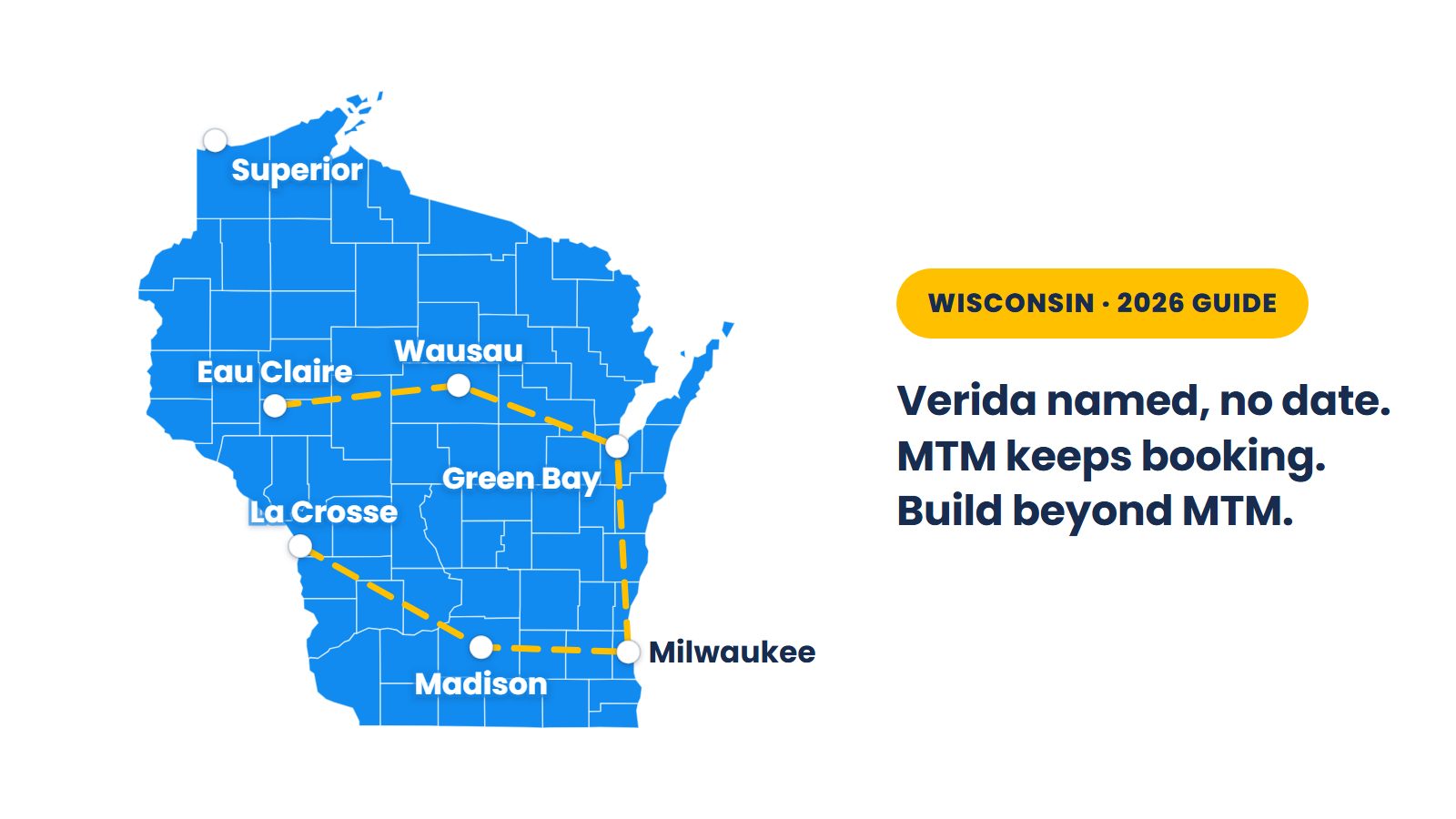
Wisconsin has no state NEMT license. To start, form an LLC and, unless an exception fits, get the state’s $50 passenger carrier certificate with at least $500,000 of insurance on file. A Medicaid wheelchair van adds specialized medical vehicle (SMV) certification and a yearly State Patrol inspection. MTM books BadgerCare Plus and Medicaid rides, so your fastest paid trips are private pay and facilities. Budget about $22,400 to $49,900 for one used wheelchair van and six months of fixed bills.
Wisconsin at a glance:
- No NEMT license: for-hire passenger work takes the Wisconsin Department of Transportation’s (WisDOT’s) certificate instead, unless an exception fits, after your insurer files a Form E showing $500,000 of coverage [1][2].
- Medicaid rides: MTM, the Department of Health Services’ (DHS’s) statewide ride manager, books them for BadgerCare Plus and Wisconsin Medicaid members, including health plan (HMO) members and people in IRIS, Medicaid’s self-directed long-term care program [3][4].
- Rides outside DHS’s MTM contract: members of Medicaid’s managed long-term care programs, Family Care, Family Care Partnership and PACE (the Program of All-Inclusive Care for the Elderly), ride through their managed care organization (MCO) [3][5]. Medicaid nursing-home residents ride mostly through the home, and families who pay call you directly [6].
- Wheelchair vans for MTM’s riders: SMV certification, with high-risk screening and an application fee, plus an unexpired State Patrol decal [5][7].
- Insurance: MTM wants a $1,000,000 combined single limit (one limit for injuries and property damage together) for general and auto liability. WisDOT’s floor is $500,000 for a van seating 15 or fewer, counting the driver [8][1].
- Cities: Milwaukee licenses every driver ($75 for two years), Madison licenses the company whoever pays ($2,200 for two years), and Green Bay licenses each vehicle and driver [9][10][11].
- Time: WisDOT and MTM publish no end-to-end processing times. MTM says it reviews each driver’s credentials in 3-5 business days [12].
In 2008, Rachel Scholler needed rides to treatment for her grandfather, and the one NEMT company in her rural county turned her down. “They told me they wouldn’t service me that far out and they suggested I sell my home,” she said on our podcast about selling her company. “There weren’t brokers.” Within four weeks she had given notice at her job and bought two vans. Her company, Lakeshore Transportation in Plymouth, Wisconsin, ran 17 years on what she described in an earlier episode as work for “managed care organizations or MCOs that are county specific,” carrying some riders “5 days a week for 17 years.”
Today one company, MTM, books BadgerCare Plus and Medicaid rides under DHS’s contract, and on May 21, 2026, DHS named Verida, Inc. its intended next vendor [3][13][14]. A Milwaukee owner who’d started a company two months earlier, after about three years of driving NEMT trips, told me on a demo in August that they’d already put “an application in with … MTM and another company.” That’s the right instinct. Wisconsin named Verida but set no switch date, so don’t wait for it: get WisDOT’s certificate, take MTM’s trips for volume, and build on the rides MTM doesn’t book.
The checklist below follows the work: what every paid trip needs, then what Medicaid wheelchair work adds. After it come who pays, MTM and Verida, the rules, MTM’s network, the long-term care MCOs, cost and timing.
I run Duet, which builds dispatch software and runs growth services for non-emergency medical transportation (NEMT) companies, and I talk to NEMT owners on demos every week, Wisconsin operators included. This is the Wisconsin edition of our national guide on how to start a NEMT business. Requirements change, so confirm against the linked sources before you spend money.
The one-page checklist: how to start a medical transportation business in Wisconsin
Line up riders before you buy the van, then go in Wisconsin’s order: the company, an insured van, WisDOT’s $50 certificate and plates, drivers, then Medicaid. Each phase ends with the money it puts at risk.
Phase 0: pick your riders, your vehicles and your city
- Riders first: families, nursing homes, county programs, Family Care MCOs and MTM each book rides their own way. Please don’t buy a vehicle before you have trips lined up.
- Seats: a regular Class D license covers a van seating 15 or fewer, counting the driver, and WisDOT’s insurance floor doubles at 16 [15][1].
- Ramp or no ramp: a van with a permanently installed ramp or lift needs specialized medical vehicle (SMV) certification, with its own inspection and insurance, to carry MTM’s Medicaid riders; for Family Care riders, ask the MCO [6][16][5].
- Your city: decide where you’ll pick up first, because Milwaukee, Madison, Green Bay and some other cities add their own licenses, as the city table below shows [9][10][11][17].
- Three calls this week: ask WisDOT Motor Carrier Services, (608) 266-9900, whether your trips need the passenger carrier certificate [2]. Ask two Family Care MCOs that cover your county, from DHS’s MCO contact list, how they add a transportation provider [18]. Ask the five nearest nursing homes who arranges their residents’ rides.
- Money at risk: none yet.
Phase 1: form the company and line up your first trips
- File articles of organization with the Department of Financial Institutions (DFI): $130 online or $170 on paper, then a $25 annual report online each year after the first [19].
- Get a free employer identification number (EIN) from the IRS. A national provider identifier (NPI) is free too. ForwardHealth, Wisconsin Medicaid’s provider system, doesn’t require one for SMV enrollment, so ask MTM and each MCO whether they want one [5].
- Put up a website a family can book tomorrow’s ride from and a Google Business Profile. When I told that Milwaukee owner in August that a lot of new providers “walk into … care facilities like assisted living, skilled nursing,” I added one condition: get the website live first, so they can look you up.
- Visit nursing homes, assisted living, rehab centers and senior centers, and line up who’ll call you once your van is legal.
- Money at risk: about $430: $130 for the LLC and about $300 for a phone and basic marketing.
Phase 2: buy and insure the van, file with WisDOT and plate it
- Quote insurance on the exact van at MTM’s $1,000,000 combined single limit, even if you’ll start with private pay [8].
- Have your insurer file a Form E with WisDOT, then mail form MV2843 with the $50 fee [2].
- Title and plate the van: $214.50 for the title, $10 more for a lien if you finance, and $85 a year for registration, which WisDOT grants a for-hire carrier only once its insurance is on file [20][21].
- Pay the 5% state sales tax plus 0.5% where your county adds it: $1,815 on a $33,000 van. Milwaukee County’s rate is 0.9%, and a van kept in the City of Milwaukee adds the city’s 2%, for 7.9% in all, $792 more [22][23].
- Money at risk: about $14,100 more with the van financed, so about $14,560 in. That’s $6,600 down on the 2016-2019 wheelchair van in our national one-van startup budget, $1,815 of sales tax, about $365 for the title, lien, plates, certificate and permit, $4,350 of insurance at signing and about $1,000 of equipment.
Phase 3: license and screen your drivers, and meet your city’s rules
- Screen every driver before the first trip: a background check, a drug test and a driving record, the checks DHS and the MCOs expect [24][25].
- In Milwaukee, put every driver through the city’s public passenger vehicle license: $75 for two years, fingerprints and a police check. Drivers of the city’s Class H vehicles, its category for vans for hire suited to riders with disabilities or seniors, take a passenger assistance techniques course first [9].
- In Madison, budget $2,260 for the specialized transportation license, one vehicle permit and one driver permit, and leave time for the Transportation Commission and the Common Council to review it [10].
- In Green Bay, budget $100 a year to license and inspect one van and license one driver [11].
- If you’ll carry Medicaid wheelchair riders, train every driver in first aid, CPR, defibrillator (AED) use, seizure care and your ramps, lifts and restraints before the first trip [16][26].
- Money at risk: about $1,000 more for one driver’s screening and training in our model, so about $15,560 in, plus your city’s fees.
Phase 4: open the Medicaid doors you want
- Email MTM’s Wisconsin network team at providerswi@mtm-inc.net. Its page says it’s recruiting statewide [8].
- For Medicaid wheelchair riders, apply to ForwardHealth for SMV certification, one enrollment for the company with each van on your vehicle list [16][5]. Send a notarized affidavit (form F-11237), proof of insurance, a workers’ comp certificate and each driver’s CPR card from the American Heart Association or the American Red Cross. ForwardHealth lists an application fee, so budget the 2026 federal fee of $750 [5][27].
- Have that van inspected before its first Medicaid trip. The rule makes the owner responsible for asking, so call the State Patrol’s Motor Carrier Section at 1-844-847-1234 or your regional post [7][28].
- For Family Care, Partnership and PACE riders, add these programs’ transportation service to a Wisconsin Medicaid enrollment (your SMV one, or a no-fee one without SMV certification), then ask each MCO to authorize you [5].
- Money at risk: the SMV application fee and a notary, only for Medicaid wheelchair work. An ambulatory company running MTM’s trips skips SMV certification entirely [6].
Phase 5: run the trips you control
- Run the facility and private-pay trips you lined up in Phase 1 the week your certificate and plates arrive.
- Take payment the way most owners I talk to do: a card at booking, charged at least 24 hours before pickup, or a payment link due by then. No payment, no van.
- Money at risk: $1,934 a month of fixed bills with the van financed, until your trips cover them.
Every company works through Phases 0 to 3 and 5. Phase 4 is a choice: a private-pay-only company skips Medicaid, but not WisDOT’s certificate (unless WisDOT confirms an exception fits) and not the city’s rules.
Who pays for NEMT rides in Wisconsin?
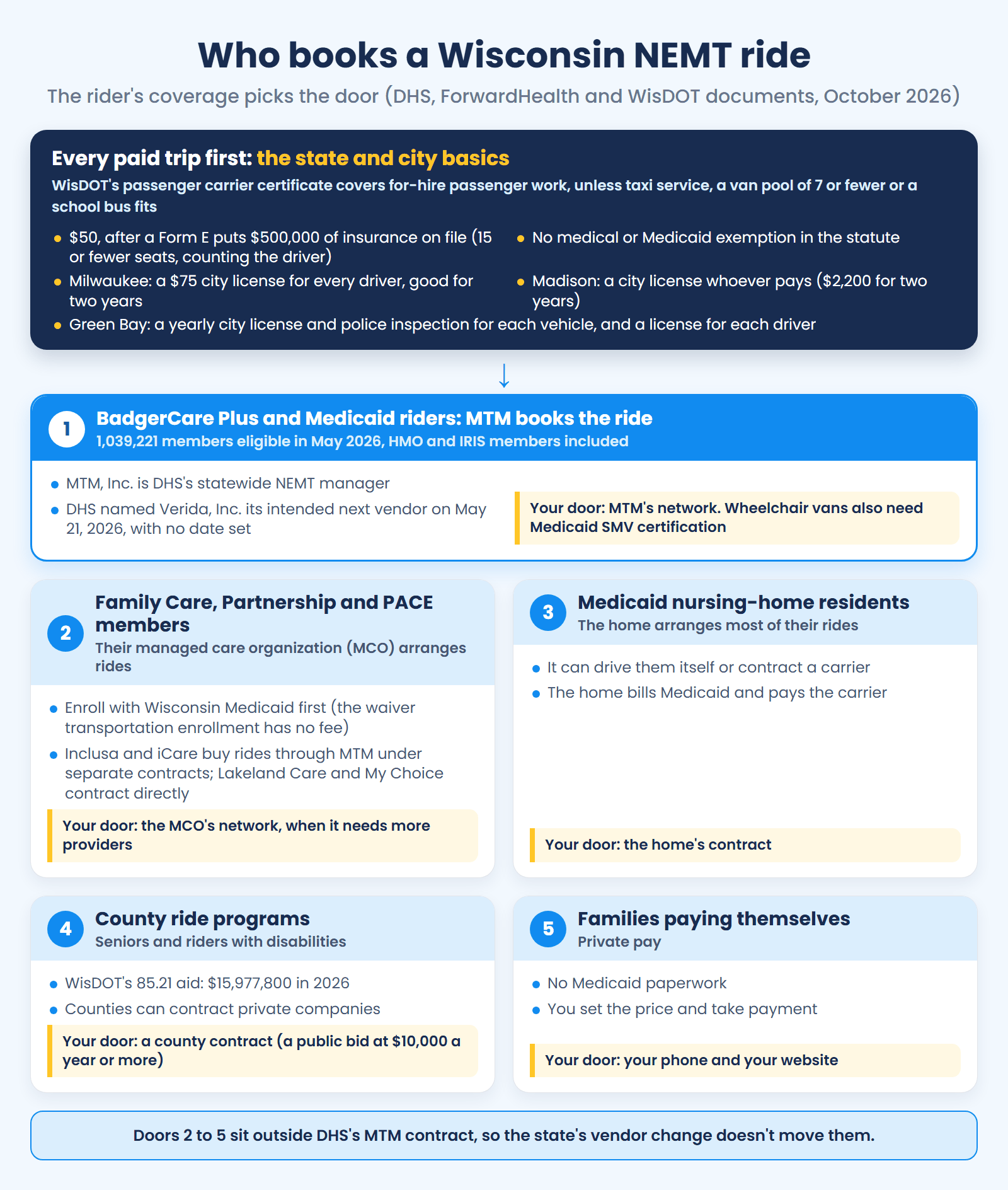
Wisconsin NEMT rides come through five main doors: MTM for BadgerCare Plus and Medicaid members, MCOs for Family Care, Partnership and PACE members, nursing homes for their Medicaid residents, counties, and families paying for themselves.
- BadgerCare Plus and Medicaid members: MTM. DHS’s member handbook says “Medical Transportation Management (MTM), Inc. is the transportation manager for BadgerCare Plus and Wisconsin Medicaid,” and members of “Wisconsin Medicaid (including IRIS)” book through MTM too [3]. HMO members, over 90% of BadgerCare Plus, ride through MTM as well, because these rides are “not included in the HMO contract” [4]. Your door is MTM’s network; a wheelchair van also needs SMV certification.
- Family Care, Partnership and PACE members: their MCO. “If you are enrolled in Family Care, Family Care Partnership, or PACE, you will get your rides through your managed care organization” [3]. Inclusa and iCare buy rides through MTM under contracts separate from DHS’s, while Lakeland Care and My Choice Wisconsin contract providers directly [12][29][25]. Your door is the MCO’s network, when it needs more providers.
- Medicaid nursing-home residents: the home. These residents, unless they’ve elected hospice, “have their NEMT services coordinated by the nursing home,” and exceptions are available for HMO and dual-eligible members [6]. The home can drive them itself or use a “common carrier such as bus or taxi,” then bills Medicaid and pays the carrier [30]. Your door is the home’s contract.
- County ride programs: the county. WisDOT’s 85.21 aid for county rides for seniors and riders with disabilities totals $15,977,800 in 2026, and “Private for-profit or private non-profit organizations may provide service for counties through contractual agreements with the county” [31]. Your door is a county contract, which goes to a competitive public bid at $10,000 a year or more.
- Families paying for themselves: you. Private-pay riders call you, pay you and need no Medicaid paperwork. You set the price and take payment. Your door is your phone and your website.
MTM’s door is the biggest by volume. In May 2026, 1,039,221 members were eligible for its rides and 26,178 rode at least once. The program completed 301,246 trip legs (a leg is one way): 55.9% by sedan, van or taxi, 29.1% as mileage paid to members who arranged their own ride, 2.3% by wheelchair van and 0.16% by stretcher. The rest went by owner-operators (volunteer drivers included), bus or ambulance. Two-thirds were standing orders for recurring appointments, and 31% started in Milwaukee County [32]. For a wheelchair van, the statewide count was 6,832 legs that month. The report also counts all completed legs by county of origin, so look up yours [32].
The MCO door holds more than medical trips. The 2026 Family Care contract covers NEMT plus community transportation, which takes members to “waiver services, a place of employment, and other community services” in their care plans [33]. Relationships fill that kind of schedule: Rachel credits her steady referrals to “a really good working relationship with the social workers in the county.”
Don’t count on dialysis clinics as facility accounts, though. In my experience most dialysis riders are on Medicaid, so in Wisconsin their trips come through MTM or their MCO.
The family door is bigger than it looks. Wisconsin had 1,171,042 residents 65 or older in 2024, 19.6% of the state [34]. I know owners who’ve built whole businesses in Minnesota and Wisconsin on private pay alone, without touching a Medicaid trip. Some markets support only a few pure private-pay vans, though, so size your plan to yours.
Only the first of those five doors runs through DHS’s contract with MTM. The other four sit outside it, so the vendor change doesn’t move them. Pick two doors before you buy the van.
Who is the NEMT broker in Wisconsin?
MTM, Inc. (Medical Transportation Management) is Wisconsin’s statewide NEMT manager for BadgerCare Plus and Wisconsin Medicaid, and on May 21, 2026, DHS named Verida, Inc. its intended next vendor without setting a date. A broker is the company a state pays to arrange Medicaid rides and hand them to transportation companies; DHS calls the job manager or vendor. Our map of who arranges Medicaid rides in every state counts Wisconsin among the states with one statewide broker.
DHS’s vendor page, last revised August 25, 2026, says “Verida, Inc. had the highest-scoring proposal among all vendors who submitted to provide NEMT services.” MTM’s contract, in DHS’s words, “will continue throughout the procurement period,” and “At this time, DHS does not have a time frame established for when this transition will take place” [14]. DHS says state law requires it to procure vendors on a regular schedule, and it has told its advisory council the switch “will not change the NEMT services that members are eligible for” [14][13].
Rachel’s “There weren’t brokers” checks out. Before July 2011, apart from HMO members in Milwaukee County, counties managed Medicaid rides by bus, sedan, van or taxi, and DHS managed the SMV trips [35]. LogistiCare took over most of the state in July 2011 and all of it in September 2012. MTM replaced it in August 2013, after LogistiCare asked to end its contracts [35]. Veyo replaced MTM on November 1, 2021 [36]. MTM bought Veyo in August 2022, and on February 1, 2024, “Veyo started their transition to MTM in Wisconsin,” with MTM using “the same transportation companies and drivers as Veyo” [37]. So MTM has run the program since February 2024, not since 2013.
The last handoff is the closest thing to a clock. DHS announced its intent to award Veyo on February 28, 2020, and Veyo took over on November 1, 2021, about 20 months later [38][36]. The procurement before that ended in 2019, when the Department of Administration upheld a protest and DHS had to rescind its intent to contract with LogistiCare [38]. A notice of intent isn’t a start date.
What happens to MTM’s providers when Verida takes over?
DHS hasn’t said whether MTM’s transportation providers carry over, re-credential or sign new contracts. Its message so far is “Members and providers do not need to do anything differently right now” [13]. So keep running MTM’s trips and sign up for DHS’s NEMT emails. Put December 3, 2026 on your calendar too: DHS’s Transportation Advisory Council meets that day, as it does the first Thursday of March, June, September and December [39]. The week Verida opens a Wisconsin provider application, apply. Our tracker of 2026 broker changes follows the handoff.
Can I bill Wisconsin Medicaid directly for NEMT rides?
Not for MTM’s riders: MTM books them and pays the companies in its network [8]. Even a certified SMV running MTM’s trips submits its claims to the manager, not to ForwardHealth [6].
The same logic shapes your marketing. When the Milwaukee owner asked me about Google Ads, I suggested filtering out searches for MTM, because those riders “can’t book through you they have to call MTM.”
Outside MTM, Medicaid money reaches a van company three main ways:
- Nursing homes bill ForwardHealth for the residents’ rides they arrange, under codes A0120 and S0215, and pay the carrier they contract with [30].
- Certified SMVs bill ForwardHealth for a few trips outside MTM, such as rides for nursing-home residents who are in an HMO or on both Medicare and Medicaid [30]. DHS pays “the lesser of a provider’s usual and customary charge or the maximum allowable fee established by DHS” [40]. ForwardHealth’s fee-schedule download opens behind a license agreement, so ask Provider Services at (800) 947-9627 for the current SMV maximums [41].
- Family Care MCOs pay their own providers. Lakeland Care, for one, pays “Lakeland Care’s contracted rate negotiated with similar providers” [29].
Each payer sets its own rate, so ask MTM what it pays for your level of service, and get it in writing before you sign for a van. Rates bend where providers are scarce: Rachel, who ran her company in a rural area, said she had room to negotiate “because there wasn’t a lot of options in my area.”
What licenses and requirements does a NEMT business need in Wisconsin?
Wisconsin has no NEMT license, but paid rides take WisDOT’s $50 passenger carrier certificate unless an exception fits, and a Medicaid wheelchair van adds SMV certification and a State Patrol decal.
Chapter 194 of the state’s statutes says no one may operate “any motor vehicle as a common motor carrier unless the person first obtains a certificate,” and its exemptions say nothing about medical, Medicaid or wheelchair work [1]. Running without the certificate, or without the required insurance, carries a forfeiture of $500 to $5,000 [1]. Our licensing guide covers the NEMT licenses that don’t exist. Here’s what pages ranking for this and related searches, and the AI answers built on them, say about Wisconsin:
| The claim you’ll read elsewhere | What Wisconsin actually requires |
|---|---|
| “you need a Wisconsin NEMT Provider License” costing “approximately $850 initial, $510 renewal” | No license has that name. Paid rides take WisDOT’s $50 passenger carrier certificate unless an exception fits [1][2] |
| “Enroll as a provider through ForwardHealth” | Medicaid enrollment is for SMVs, for Family Care, Partnership and PACE work, and for community rides an IRIS budget pays for. Common carriers (cars and vans without a permanent ramp or lift) “are not required to be enrolled in Wisconsin Medicaid but must be under contract with the NEMT manager” [6][5] |
| “Veyo is the state of Wisconsin’s non-emergency medical transportation (NEMT) manager” | MTM bought Veyo in August 2022 and took over its program on February 1, 2024 [37] |
| “the upcoming transition from MTM to the new company in the coming months” | DHS named Verida on May 21, 2026 and “does not have a time frame established” for the switch [14] |
| “$25,000 per person / $50,000 per accident / $25,000 property damage” | MTM wants a $1,000,000 combined single limit, WisDOT’s floor is $500,000, a Medicaid SMV needs $250,000/$500,000/$10,000, and the basic minimum for any driver is $25,000/$50,000/$10,000 [8][1][16][42] |
| Drivers need a “Chauffeur / Class D or CDL” license | Wisconsin has no chauffeur class. A Class D covers a van seating 15 or fewer, counting the driver [15] |
| Contract “directly with … Managed Care Organizations (MCOs) under programs like Family Care or IRIS” | IRIS members’ medical rides go through MTM. Family Care, Partnership and PACE MCOs arrange their own, two of them through MTM under separate contracts [3][12] |
Does your company need WisDOT’s passenger carrier certificate?
Plan on WisDOT’s certificate if anyone pays you to carry riders, and get WisDOT’s answer in writing if you think you’re exempt. The statute’s test is holding yourself out “to the public as willing to undertake for hire to transport passengers,” and WisDOT’s form reads that as “any For Hire passenger operation within Wisconsin” [1][2]. The form’s three exceptions are taxi service, a commuter car pool or van pool of 7 or fewer counting the driver, and a school bus [2]. Neither the form nor chapter 194 defines taxi service, so don’t assume a wheelchair van fits it.
WisDOT’s form and pages don’t say whether the statute’s for-hire test reaches a company paid only by MTM, either. Ask Motor Carrier Services, at (608) 266-9900 or irp-ifta@dot.wi.gov, before you count on skipping the certificate [2]. If you need it, the steps run in this order:
- Insurance on file: your insurer files a Form E for at least $500,000 for each van seating 15 or fewer, counting the driver, or $1,000,000 at 16 or more [1][21]. It “must be on file with the Motor Carrier Service Unit prior to the submission of the application” [2]. WisDOT’s table also lists $1,000,000 for “Vehicles with gross weight over 10,000 lbs.,” so ask which row fits a heavy van [21].
- The application: form MV2843 and a $50 check payable to Registration Fee Trust, mailed to the Wisconsin Motor Carrier Unit, PO Box 7955, Madison WI 53707. Use the same legal name as your DFI filing and Form E. The form asks for a USDOT number only if you operate over 10,000 pounds [2]. Your certificate number will carry the letters PC [43].
- The permit: the statute adds $5 a year for each vehicle a passenger carrier runs only inside Wisconsin. WisDOT’s form doesn’t mention it, so ask [1].
What is a human service vehicle, and does yours need the State Patrol inspection?
A human service vehicle (HSV) is a van that carries seniors or riders with disabilities “in connection with any transportation assistance program” [44]. WisDOT reads that narrowly: “Only those that receive some form of transportation assistance grants issued by WisDOT are human service vehicles” [45]. Those vans “undergo annual inspections by the State Patrol” [45]. By WisDOT’s reading, a private-pay van with no WisDOT grant isn’t one.
A Medicaid wheelchair van needs the inspection either way: keep an unexpired State Patrol decal on every van you list for SMV trips. Wisconsin’s SMV law and DHS’s SMV rule tie certification to the HSV standard [26][16]. The HSV code says no vehicle DHS’s rule requires to be inspected “may be operated on any highway unless it displays … an unexpired certificate of inspection decal” [7]. ForwardHealth’s handbook adds that HSVs working MTM’s trips as common carriers “must maintain a current State Patrol HSV inspection” [6].
When Rachel started in 2008, “We had the state patrol come out and do inspections,” she said, and a lapse in insurance got a van’s registration suspended immediately. She calls that era “much stricter than what we see today.” Today’s rule puts the scheduling on you: the owner must have the van inspected every year, and after you ask, the department tries to inspect it at the earliest time its other duties allow [7]. No fee appears in the statute or the rule [46][7].
The SMV rule adds its own checks. A driver or mechanic inspects each van and documents it “at least every 7 days.” The van carries a flashlight, a first aid kit, a fire extinguisher, a lift or ramp, and restraints for both the rider and the wheelchair, cot or stretcher [16]. The HSV code adds a two-way communication system, a 10 BC fire extinguisher (no CO2) and, on a power lift, at least 700 pounds of capacity [7]. Check the van against both lists before you book the inspection.
What do Milwaukee, Madison and other cities require?
Milwaukee licenses every driver, Madison licenses the company whoever pays, and the other large cities vary: some license each vehicle, and some leave medical or state-regulated vans out. Here’s how their codes read:
| City | What a paid wheelchair van company needs | Fees |
|---|---|---|
| Milwaukee | A city license for every driver, human service vehicles included, with a passenger assistance course for those drivers; a vehicle permit unless the van is a state human service vehicle | $75 per driver for two years; $325 for two years where a permit applies [9] |
| Madison | A specialized transportation license, vehicle permits and driver permits, whoever pays | $2,200 for two years or $1,200 for one, then $1,000; $35 a vehicle and $25 a driver each year [10] |
| Green Bay | A public vehicle license and police inspection for each vehicle, and an operator’s license for each driver | $25 a vehicle, $25 for inspection and $50 a driver, each year [11] |
| Racine | Nothing for a state-regulated human service vehicle; otherwise a provider license and city driver licenses | City fee schedule [17] |
| Kenosha | Unclear: the taxicab rule’s carve-out points to a section that no longer exists | Ask the City Clerk [17] |
| Appleton | Nothing for medical transport vehicles, which its taxicab rules leave out | None [17] |
| La Crosse | A license for each vehicle and each driver, unless the van runs under a government agency’s contract | $150 plus $25 a vehicle [17] |
| Wausau and Janesville | A license for any vehicle carrying passengers for hire | City fee schedules [17] |
| Waukesha | No license category found in the city code | None [17] |
Milwaukee’s code licenses anyone driving a public passenger vehicle in the city, “including a human service vehicle licensed or otherwise regulated by the state of Wisconsin” [9]. The vehicle permit is murkier. The code exempts vans “licensed by the Wisconsin department of transportation as human service vehicles,” while the License Division’s page skips the permit only “if the licensee is being reimbursed by State issued insurance” [9]. Read side by side, a Medicaid trip in a state-licensed human service vehicle needs no permit either way, while private-pay work may. Before you budget the $325, ask the License Division at (414) 286-2238 whether a certified SMV counts as a state human service vehicle; Racine’s license turns on the same question.
Madison counts “demand-responsive transportation by a specialized transportation vehicle” as carrying passengers for hire, and its carve-out for riders like yours covers only volunteers, staff of bona fide nonprofit agencies and ambulances [10]. A new license goes from the City Clerk to the Director of Traffic Engineering, the Transportation Commission and the Common Council, with proof of $1,000,000 of auto liability per accident. Ask Mobility & Infrastructure at 608-266-4761 how long that takes.
What if you drive riders into Minnesota, Illinois, Michigan or Iowa?
A paid trip across a state line is interstate, and it usually takes operating authority from the Federal Motor Carrier Safety Administration (FMCSA), a USDOT number and $1.5 million of liability for a van seating 15 or fewer, counting the driver [47][48]. Federal law sets aside taxicab service, but whether a NEMT trip counts is FMCSA’s call. These trips happen: MTM’s May 2026 report shows 720 completed legs starting in Minnesota, 100 in Illinois, 67 in Michigan and 35 in Iowa [32].
The pull runs the other way too. New owners of a small company north of Chicago told me on a demo in September, “There’s lots of rides that go up into Wisconsin,” though they were “only licensed with the state of Illinois.” Our Illinois guide covers what an Illinois company needs to carry riders into Wisconsin. Wisconsin’s certificate rule excuses a carrier “registered by another state under the unified carrier registration system,” and WisDOT accepts an FMCSA insurance filing in place of its own, so an out-of-state company should ask WisDOT what it needs [1][21].
What are the NEMT insurance requirements in Wisconsin?
Plan on MTM’s bar: a $1,000,000 combined single limit for general and auto liability, with MTM as certificate holder and additional insured [8]. That’s MTM’s contract, not the law. The law’s numbers, for the record:
| Who sets it | What it covers | Minimum |
|---|---|---|
| MTM’s contract | General and auto liability | $1,000,000 combined single limit [8] |
| WisDOT | A for-hire van seating 15 or fewer, counting the driver, on Wisconsin-only trips | $500,000 [1][21] |
| WisDOT | A for-hire vehicle seating 16 or more, on Wisconsin-only trips | $1,000,000 [1] |
| Medicaid’s SMV rule | Each wheelchair van carrying Medicaid riders | $250,000 per person, $500,000 per occurrence, $10,000 property damage [16] |
| Human service vehicle law | Grant-funded vans for seniors and riders with disabilities | $75,000 per person; $150,000 per accident at 7 or fewer seats, $200,000 at 8 to 15; $10,000 property damage [42] |
| Federal law | Paid trips across a state line, 15 or fewer seats counting the driver | $1,500,000 [47] |
| Madison | A licensed specialized transportation company | $1,000,000 per accident [10] |
| Green Bay | A licensed public vehicle | $500,000 combined single limit [11] |
| Any Wisconsin driver | The basic minimum | $25,000/$50,000/$10,000 [42] |
When should you bind the policy?
Bind the policy as late as you can and still file on time. The Form E has to be on file before WisDOT takes your certificate application and before it registers the van, and MTM wants its name on the policy [2][21][8]. I’ve seen new owners paying $3,000 a month to insure two empty vehicles. So collect quotes early on the exact van, and bind when the van, the WisDOT filing and your first trips line up.
What will insurance cost a new Wisconsin company?
For a new company’s wheelchair van at about $1 million of liability, our national model uses $17,400 a year, from new-company quotes of $1,200 to $1,800 a month: about $4,350 at signing, then ten installments of $1,305. Our guide to what NEMT insurance costs a new company shows where those numbers come from. In my experience, a wheelchair vehicle can easily cost more than $1,000 a month to insure, and stretchers can be even higher.
Rachel’s number is an established fleet’s: about $500 a month per vehicle when she sold in 2025, after 17 years with the same NEMT-specialist agent, through “rollovers” and totaled vehicles. A new company shouldn’t expect it.
Do you need workers’ comp in Wisconsin?
You’ll need workers’ comp soon after your first paycheck, or on the day you hire a third employee. Wisconsin’s law covers every employer of 3 or more, and a smaller one starting the 10th day of the month after a calendar quarter in which it paid $500 or more in wages [49]. ForwardHealth’s SMV checklist asks for a workers’ comp certificate too [5].
What do NEMT drivers need in Wisconsin?
A regular Class D license covers a van seating 15 or fewer, counting the driver; a commercial driver’s license (CDL) starts at 16 passengers including the driver, or a single vehicle over 26,000 pounds [15]. Wisconsin’s license classes are A, B, C, D and M, so the “chauffeur” license some pages mention doesn’t exist here.
The rest of a driver’s file comes from whoever pays for the ride:
- MTM: “Providers must meet credentialing qualifications. They must also complete training,” and an MTM employee walks you through both [8]. MTM told DHS’s advisory council in March that it approves or denies a driver “within 3-5 business days” once complete, legible credentials are uploaded [12].
- DHS: NEMT drivers “are required to get” background checks, regular drug tests and training [24]. On the road they wear a company ID badge, drive a vehicle marked with the company name, use phones only hands-free and help riders door to door when asked [50].
- MCOs: their own credentialing. My Choice Wisconsin’s 2023 provider orientation, for one, lists caregiver background checks and wants a driving record abstract for every driver, updated at least once a year [25].
Many of Rachel’s staff were “retired policemen, retired firemen, people looking to serve the community.” Before hiring, she’d let candidates “ride along with us for half a day at my cost so they could actually see what the job entails.”
What do Medicaid wheelchair-van drivers need?
Before driving or attending, a Medicaid wheelchair-van driver needs “Basic Red Cross or equivalent training in first aid and cardiopulmonary resuscitation (CPR),” instructions on caring for a passenger having a seizure, and instructions on every ramp, lift and restraint you use. First aid gets a refresher at least every 3 years, CPR stays current, and state law adds “current proficiency in the use of an automated external defibrillator” [16][26]. DHS’s SMV rule also requires a valid, unrestricted license, though a vision restriction can be waived if corrective lenses bring the driver’s vision to 20/30 or better and the driver wears them while carrying riders [16].
Can a NEMT company run stretcher van trips in Wisconsin?
Yes. Wisconsin Medicaid covers stretcher trips in a specialized medical vehicle when a physician, physician assistant, nurse midwife or nurse practitioner prescribes them, and the rider must be medically stable [51].
The rule secures the cot or stretcher “to the side and the floor of the vehicle,” and “no monitoring or administration of non-emergency medical services or procedures may be done by SMV personnel” [51]. ForwardHealth adds that the rider must “require transport in a supine position” [6]. Put that no-care line in your intake script: a rider who needs monitoring on the way is an ambulance’s trip. Wisconsin’s EMS law defines an ambulance as “an emergency vehicle … designed, constructed or equipped to transport sick, disabled or injured individuals” and licenses ambulance service providers, so ask the DHS EMS Office about anything past the SMV rule [52].
Stretcher work is a small slice: 496 of the 301,246 completed legs in May 2026, or 0.16% [32]. Add a stretcher once your wheelchair work runs smoothly.
How do you become an MTM provider in Wisconsin?
You become an MTM provider through an application, credentialing and a contract you work out with an MTM employee, and MTM’s page says it “is currently recruiting and contracting with transportation providers throughout the state” [8]. The Milwaukee owner at the top of this guide had applied by month two.
What does MTM ask for?
- Insurance: the $1,000,000 combined single limit from the insurance section [8].
- Trips: sent through the MTM Link Provider Portal, or by API “for those providers who use their own dispatching software,” with every trip “electronically tracked and documented” [8].
- The day before: “confirm the transport and pick-up time with the member on the day prior to the scheduled trip” [8].
- No-shows: “MTM does not reimburse transportation providers for member no shows” [8].
- Rates and pay: rates set “on an individual basis,” and “Payment is provided weekly via direct deposit” [8].
Should you wait for Verida?
No. MTM is still adding companies: it reported 277 transportation providers for 2025, 294 in the first quarter of 2026 and 314 in the second [53][54][55]. Most of what you build to qualify doesn’t depend on the vendor, either. WisDOT’s certificate, ForwardHealth’s SMV certification and the State Patrol decal are the state’s. MTM’s contract and credentialing are MTM’s, and DHS hasn’t said what Verida will ask for [13][14]. So apply to MTM once your certificate and plates are in hand.
How do you get Family Care, Partnership and PACE riders in Wisconsin?
Enroll with Wisconsin Medicaid first, then win each MCO’s authorization: “Providers must enroll with Wisconsin Medicaid and then have services authorized through a managed care organization” [5]. The MCOs’ contract lets them use only providers “enrolled in Wisconsin Medicaid” with “a current and valid Medicaid ID allowable for the service to be rendered” [33]. ForwardHealth gives a wheelchair company two main routes in:
- With SMV certification: add the Family Care, Partnership and PACE transportation service to your SMV enrollment [5].
- Without it: enroll as a waiver transportation provider in the common carrier category, which means meeting chapter 194, the WisDOT certificate’s law, with limited-risk screening and no application fee, then add the same service [5].
Which route an MCO will take for a wheelchair rider’s medical trip is the MCO’s call, so ask before you skip SMV certification.
DHS’s October 2026 contact list names six MCOs and the counties each serves: Anthem, Community Care, iCare, Inclusa, Lakeland Care and My Choice Wisconsin [18]. Inclusa (Family Care) and iCare (Partnership) buy rides through MTM under contracts that are “separate and distinct” from DHS’s [12]. For those riders, Inclusa lists MTM’s Network Development Team at providerswi@mtm-inc.net and a Provider Helpdesk at (888) 595-1180 [56]. Ask which programs your MTM contract covers. Lakeland Care adds providers when “Network capacity indicates a need for additional providers,” and it wants “positive references that demonstrate competency and quality services” [29]. For Anthem’s and Community Care’s members, ask each MCO’s provider relations how it buys rides.
References come from running trips. When Rachel started with no clients, she drove her van everywhere and stopped in at nursing homes and senior centers with “homemade brochures and business cards” until people knew her. Our guides on winning facility contracts, turning a facility meeting into a first trip and building private-pay work cover that stretch, and our rundown of how brokers and states admit new companies shows how other states order these steps.
Don’t build the whole schedule on one payer
Take MTM’s trips for volume, but keep them to part of your schedule: Verida has no start date, and the riders MTM doesn’t book won’t move when the contract does.
Wisconsin’s ride manager has changed hands three times since 2011: LogistiCare to MTM in 2013, MTM to Veyo in 2021 and back to MTM in 2024 [35][36][37]. Rachel’s company ran through all of it on its own contracts. When she did take broker work, she said, “I only set my availability at 10% so it just sort of filled in my schedule.”
MTM’s own terms point the same way. It pays nothing for member no-shows, and its May 2026 report counted 8,566 of them [8][32].
I told the Milwaukee owner that “the broker work is fine to bring in volume,” but “you’re going to be a lot happier long term” with good word of mouth, a private-pay base and facility contracts.
Then run every lane from one schedule. Dispatch software like Duet keeps MTM’s trips on one board with your Family Care, facility and private-pay rides. MTM is one of Duet’s direct integrations and Verida’s trips come in by trip file import, so the board doesn’t change if the contract does. Each trip bills at the rate its contract sets. Your WisDOT certificate, your ForwardHealth enrollment, each vendor’s credentialing and rates, and invoicing each payer through its own process stay your job.
How much does it cost to start a NEMT business in Wisconsin?
Budget about $22,400 to $49,900 for one used wheelchair van in Wisconsin, counting six months of fixed bills; the typical financed van comes to about $27,200.
That typical case is a 2016-2019 van at our national model’s $33,000, financed: the $6,600 down payment, about $8,960 of one-time costs and six months of fixed bills. Paying cash for the same van takes about $49,900, and an older $20,000 van, financed, about $22,400. Wisconsin’s own inputs are its fees and sales tax. The rest is our national model, with insurance at about $1 million of liability, which matches MTM’s $1,000,000 combined single limit. The totals leave out fuel, your own pay, Medicaid wheelchair certification and city licenses.
| Line item | Wisconsin amount | Note |
|---|---|---|
| LLC articles of organization | $130 online | $170 on paper; $25 annual report online after the first year [19] |
| EIN and NPI | $0 | Free from the agencies that issue them |
| USDOT number | $0 | WisDOT’s form asks for one only over 10,000 pounds [2] |
| “NEMT license” | $0 | No state license by that name |
| ForwardHealth enrollment for ambulatory MTM work | $0 | Common carriers contract with MTM without enrolling [6] |
| WisDOT passenger carrier certificate | $50 | One time, plus the statute’s $5 a vehicle a year [1] |
| Title and registration | $299.50 | A $207 title, a $7.50 supplemental fee and $85 a year for plates; $10 more for a lien if financed [20] |
| Used wheelchair van, 2016-2019 | About $33,000, or $6,600 down if financed | National model: 80% financed at 14% over 60 months, $614 a month |
| Sales tax | $1,815 | 5% state plus 0.5% county; a van kept in the City of Milwaukee pays 7.9%, $792 more [22][23] |
| Insurance due at signing | About $4,350 | A quarter of the national model’s $17,400 year, at about $1 million of liability |
| Equipment and lettering | About $1,000 | National model |
| Screening and training | About $1,000 | National model; one driver |
| Phone and basic marketing | About $300 | National model |
| Six months of fixed bills | About $11,600 financed, $7,920 bought outright | $1,934 a month financed: a $1,305 insurance installment, a $614 van payment and $15 for a phone; $1,320 with no van payment |
| Medicaid SMV certification | Not in the totals | An application fee (the 2026 federal fee is $750) plus a notary [5][27] |
| City licenses | Not in the totals | Milwaukee $75 a driver, plus $325 where a vehicle permit applies; Madison $2,260 for the license, one van and one driver; Green Bay $100 [9][10][11] |
| Total, owner driving | About $27,200 financed, $49,900 bought outright | An older $20,000 van, financed, comes to about $22,400 |
Insurance is the line that breaks budgets: about $12,200 of the typical $27,200, counting the deposit and six installments. The state’s own filings come to $494.50. If a guide prices your Wisconsin launch around a state NEMT license fee, look at the license row again. Our van guide covers what a NEMT van costs in 2026. Whatever you borrow, size it to the wait you’ll really have. No loan moves WisDOT, MTM or ForwardHealth any faster.
How long does it take to start a NEMT business in Wisconsin?
WisDOT and MTM publish no end-to-end clock, so start facility and private-pay trips the week your certificate and plates arrive.
Put the steps in this order, with the clocks that exist:
- Before you buy: make the three calls, form the LLC, get your EIN, put up the website, visit facilities and collect insurance quotes at $1,000,000 on the exact van.
- Van week: buy and title the van, bind the policy, have the Form E filed, and mail MV2843 with the $50 fee. WisDOT’s form and page list no processing time [2][43].
- While WisDOT reviews: get your city’s licenses if you need them, screen and train your drivers, and line up your first facility and private-pay riders. Milwaukee issues a driver’s license on a clean police report and otherwise sends the application to a committee and the Common Council [9]; Madison’s license goes through the Transportation Commission and then the Common Council [10].
- Certificate and plates in hand: run those trips, apply to MTM and enroll as a waiver transportation provider for the Family Care MCOs. Lakeland Care’s contracting team contacts you “within 3 business days” and issues a contract “within 5 business days” once documents and rates are settled [29].
- When you’re ready for Medicaid wheelchair riders: SMV certification, the State Patrol decal, and first aid, CPR and defibrillator training for every driver, then MTM’s wheelchair trips. ForwardHealth enrolls a new SMV provider provisionally, and electronic billing waits for the audit [5], so ask MTM whether it assigns wheelchair trips while you’re provisional.
If DHS posted Verida’s start date tomorrow, how many of your rides would never notice? Rachel’s company started with a ride the only provider in her county wouldn’t give, and it ran 17 years on contracts she won herself. In 2026 the gap is every ride MTM doesn’t book, and none of it waits on Verida.
Wisconsin NEMT FAQ
Is MTM still Wisconsin’s NEMT broker, or is it Veyo?
MTM. MTM bought Veyo in August 2022 and moved the program onto its own systems on February 1, 2024, and riders kept their booking line, 866-907-1493 [37]. Pages and directory listings that still name Veyo as the manager are out of date.
When does Verida take over from MTM?
DHS hasn’t set a date: its vendor page says DHS “does not have a time frame established” for the transition [14]. Watch DHS’s NEMT emails and the advisory council’s December 3, 2026 meeting.
Do I have to enroll with ForwardHealth to drive MTM trips?
Only for wheelchair and stretcher work. A car or van without a permanent ramp or lift signs MTM’s contract and skips Medicaid enrollment, while a van with one enrolls as an SMV, with an application fee [6][5]. Family Care, Partnership and PACE work, and community rides paid from an IRIS budget, need a Medicaid enrollment too, though that one has no fee.
How much does it cost to start a NEMT business in Wisconsin?
About $22,400 to $49,900 for one used wheelchair van and six months of fixed bills, with insurance the biggest piece of a financed launch and the state’s own filings under $500. Medicaid wheelchair certification and city licenses come on top.
Do Wisconsin NEMT drivers need a CDL or a chauffeur’s license?
Neither, for a typical wheelchair van: a Class D license covers vans seating 15 or fewer, counting the driver, and Wisconsin has no chauffeur class [15]. In Milwaukee, drivers also need the city’s $75 license.
Can I start with an ambulatory minivan instead of a wheelchair van?
Yes, and that’s most of MTM’s volume: 55.9% of May 2026’s completed legs went by sedan, van or taxi, against 2.3% by wheelchair van [32]. An ambulatory company works MTM’s trips without Medicaid enrollment, but it still needs WisDOT’s certificate unless an exception fits, the Form E and the city’s rules [6][2]. Add a permanent ramp and carry MTM’s Medicaid riders, and the van needs SMV certification.
Can a Wisconsin NEMT company take riders into Minnesota or Illinois?
Yes, but a paid trip across the line is interstate, so it usually needs FMCSA operating authority and a USDOT number unless FMCSA treats it as taxicab service [47][48]. In May 2026, 720 of MTM’s completed legs started in Minnesota and 100 in Illinois [32].
Will Medicare pay for NEMT rides in Wisconsin?
Original Medicare won’t. CMS’s claims manual says Medicare covers no “non-ambulance forms of transportation, such as ambulette, wheelchair van, or litter van” [57]. So a rider with Medicare alone is a private-pay rider unless another program covers the trip. Ask the family what coverage the rider has when they book.
How many NEMT trips does Wisconsin’s Medicaid program run?
Millions. MTM told DHS’s advisory council it ran 3,710,182 trips in 2025 for 79,983 unique members [53]. DHS’s monthly report, which counts completed trip legs, showed 301,246 for May 2026 [32]. A page ranking for this search says Wisconsin “reports tens of thousands of NEMT trips annually,” which undercounts it badly.
Key official sources
[1] Wis. Stat. chapter 194, Motor Vehicle Transportation (certified October 1, 2026; read October 23, 2026): the common motor carrier definition and its exclusions, the $50 passenger certificate and the $5 intrastate permit for each vehicle (194.04), the exemptions (194.05), forfeitures of $500 to $5,000 (194.17), the certificate requirement and its unified carrier registration exception (194.23), and the $500,000 and $1,000,000 intrastate passenger insurance minimums (194.41(6)(b)3). https://docs.legis.wisconsin.gov/statutes/statutes/194.pdf
[2] Wisconsin Department of Transportation (WisDOT), Wisconsin Motor Carrier Authority Application, form MV2843 (6/2021), with its instructions (read October 23, 2026): passenger carrier authority for any for-hire passenger operation in Wisconsin unless it is taxi service, a car pool or van pool of 7 or fewer including the driver, or a school bus; insurance on file before the application; matching legal names; a USDOT number when operating over 10,000 pounds; the $50 fee and mailing address; and Motor Carrier Services’ phone and email. https://wisconsindot.gov/Documents/formdocs/mv2843.pdf
[3] Wisconsin Department of Health Services (DHS), ForwardHealth handbook Information About Your Enrollment and Benefits, P-00079 (08/2026), pages 53-54 (read October 23, 2026): MTM as the transportation manager for BadgerCare Plus and Wisconsin Medicaid, the programs whose members book through MTM (Wisconsin Medicaid including IRIS among them), Family Care, Family Care Partnership and PACE members getting rides through their managed care organization, and nursing-home residents contacting the home. https://www.dhs.wisconsin.gov/publications/p0/p00079.pdf
[4] Wisconsin Legislative Fiscal Bureau, Informational Paper 46, Medical Assistance and Related Programs (January 2025) (read October 23, 2026): non-emergency medical transportation provided through an arrangement with a transportation broker and not included in the HMO contract, and over 90% of BadgerCare Plus participants enrolled in an HMO. https://docs.legis.wisconsin.gov/misc/lfb/informational_papers/january_2025/0046_medical_assistance_and_related_programs_badgercare_plus_ebd_medicaid_family_care_and_senior_care_informational_paper_46.pdf
[5] ForwardHealth, Enrollment Criteria, Information for Specific Provider Types (read October 23, 2026): specialized medical vehicle providers meeting DHS 105.39, no NPI required, high risk at enrollment, an application fee, affidavit F-11237 and the insurance, workers’ compensation and CPR documents, provisional enrollment until an audit, and the Family Care, Family Care Partnership, PACE and IRIS transportation enrollments at limited risk with no application fee. https://www.forwardhealth.wi.gov/WIPortal/Subsystem/Certification/EnrollmentCriteria.aspx?topic=2
[6] ForwardHealth Online Handbook, Non-Emergency Medical Transportation, published policy through December 31, 2025 (archived January 2, 2026; read October 23, 2026): common carriers contracting with the NEMT manager without Medicaid enrollment, State Patrol inspections for human service vehicles, SMVs with permanently installed ramps or lifts required to enroll and to bill the manager, stretcher riders who need supine transport, nursing-home residents and Family Care, Partnership and PACE members outside the manager (Topic #11902), and the provider’s day-before call. https://www.forwardhealth.wi.gov/kw/archive/NETrans010226.pdf
[7] Wis. Admin. Code chapter Trans 301, Human Service Vehicles (Register November 2024 No. 827; read October 23, 2026): the owner’s duty to have a human service vehicle inspected annually and the department’s scheduling after notice, the unexpired inspection decal for vehicles inspected under s. 110.05, Trans 301 or DHS 105.39, two-way communication, fire extinguisher, first aid kit, lift capacity and securement rules. https://docs.legis.wisconsin.gov/code/admin_code/trans/301.pdf
[8] MTM, Wisconsin transportation providers page (read October 23, 2026): recruiting and contracting with transportation providers throughout the state; application, credentialing and contracting with an MTM employee; credentialing and training; trips through the MTM Link Provider Portal or by API; electronic trip documentation; day-before confirmations; no payment for member no-shows; rates set individually; weekly direct deposit; the $1,000,000 combined single limit for general and auto liability with MTM as certificate holder and additional insured; and a provider contact email. https://www.mtm-inc.net/wisconsin/providers/
[9] City of Milwaukee Code of Ordinances chapter 100, Public Passenger Vehicle Regulations, and chapter 81, License and Permit Fees; the City Clerk License Division’s Licenses and Permits page; and its Public Passenger Vehicle Drivers License Information Sheet, DRN-info 08/2025 (all read October 23, 2026): a city license for every public passenger vehicle driver, human service vehicles included, at $75 for two years; the passenger assistance techniques course for human service vehicle drivers; online applications, fingerprints and the police check; the vehicle permit’s exemption for vehicles WisDOT licenses as human service vehicles; the License Division’s reimbursement condition; the $325 permit; and the License Division’s phone. https://city.milwaukee.gov/ImageLibrary/Groups/ccClerk/Ordinances/Volume-1/CH100.pdf, https://city.milwaukee.gov/ImageLibrary/Groups/ccClerk/Ordinances/Volume-1/CH81.pdf, https://city.milwaukee.gov/cityclerk/license/licensespermits and https://city.milwaukee.gov/ImageLibrary/Groups/ccLicenses/Applications/ccl-DRN.pdf
[10] City of Madison General Ordinances 11.06, Licensing and Regulating Public Passenger Vehicles, for Hire, on Municode, and the city’s Licensed Specialized Transportation Providers page (read October 23, 2026): demand-responsive specialized transportation counted as transporting passengers for hire, the exemption for volunteers, bona fide non-profit agencies and ambulances, the specialized transportation service license fees, $35 vehicle permits and $25 driver permits, $1,000,000 of auto liability per accident, review by the Transportation Commission and the Common Council, and Mobility & Infrastructure’s phone. https://library.municode.com/wi/madison/codes/code_of_ordinances?nodeId=COORMAWIVOIICH11—19_CH11PUUT_11.06LIREPUPAVEHI and https://www.cityofmadison.com/mobility/taxis/licensed-specialized-transportation-providers
[11] City of Green Bay Code of Ordinances, chapter 10, article X, Public Vehicle Services, on Municode, and the city’s 2026 fee schedule (read October 23, 2026): public vehicles including human service vehicles, a business license and police inspection for each vehicle, operator’s licenses, a $500,000 combined single limit, and the $25, $25 and $50 fees. https://library.municode.com/wi/green_bay/codes/code_of_ordinances?nodeId=COOR_CH10BU_ARTXPUVESE and https://mcclibrary.blob.core.usgovcloudapi.net/codecontent/15619/493864/FEE%20SCHEDULE%202026.pdf
[12] DHS, NEMT Transportation Advisory Council minutes, March 5, 2026 (read October 23, 2026): MTM’s review of driver credentials within 3-5 business days after upload; iCare and Inclusa contracting with MTM under contracts separate from the NEMT contract; MTM managing the benefit for Wisconsin Medicaid (including IRIS) and BadgerCare Plus members; and Family Care, Family Care Partnership and PACE transportation administered by each MCO. https://www.dhs.wisconsin.gov/nemt/tac-minutes-05march2026.pdf
[13] DHS, NEMT Transportation Advisory Council minutes, June 4, 2026 (read October 23, 2026): the May 21, 2026 notice of intent to select Verida, Inc.; members and providers not needing to do anything differently; the transition not changing the services members are eligible for; and sign-ups for NEMT emails. https://www.dhs.wisconsin.gov/nemt/tac-minutes-04june2026.pdf
[14] DHS, Medicaid: 2026 Announcement for Wisconsin’s Non-Emergency Medical Transportation Vendor (last revised August 25, 2026; read October 23, 2026): the notice of intent to select Verida, Inc. under RFP S-1699 DMS-25, Verida’s highest-scoring proposal, state law’s regular procurement schedule, MTM’s contract continuing through the procurement period, and no time frame for the transition. https://www.dhs.wisconsin.gov/nemt/vendor.htm
[15] Wis. Stat. 343.04 and 343.17 (certified October 1, 2026; read October 23, 2026): license classes A, B, C, D and M, Class C at 16 or more passengers including the driver, Class B for a single vehicle over 26,000 pounds, and the passenger endorsement. https://docs.legis.wisconsin.gov/statutes/statutes/343.pdf
[16] Wis. Admin. Code DHS 105.39, Specialized medical vehicle providers (Register April 2026 No. 844; read October 23, 2026): compliance with the human service vehicle rules, $250,000/$500,000/$10,000 of insurance on each vehicle, documented inspections at least every 7 days, required equipment and restraints, driver licenses, first aid, CPR, seizure and equipment training, refreshers and the notarized affidavit. https://docs.legis.wisconsin.gov/code/admin_code/dhs/101/105.pdf
[17] Codes of Racine (chapter 22, article XXVIII), Kenosha (section 13.07), La Crosse (chapter 10, article XIII), Wausau (chapter 5.72), Janesville (chapter 12, article XVII) and Waukesha (chapter 22) on Municode; Appleton’s Municipal Code Supplement #100 (section 9-720); and La Crosse’s public passenger vehicle license page (all read October 23, 2026): which local vehicle-for-hire rules reach a paid passenger van, their exemptions and fees. https://library.municode.com/wi/racine/codes/code_of_ordinances?nodeId=PTIIMUCO_CH22BUPROC_ARTXXVIIIPUPAVE, https://library.municode.com/wi/kenosha/codes/code_of_ordinances?nodeId=SUHITA_CHXIIIBULI_13.07TADR, https://library.municode.com/wi/la_crosse/codes/code_of_ordinances?nodeId=PTIGEOR_CH10BU_ARTXIIIPUVEHI, https://www.cityoflacrosse.org/your-government/departments/city-clerk/licenses-permits/public-passenger-vehicle-for-hire-license, https://library.municode.com/wi/wausau/codes/code_of_ordinances?nodeId=TIT5BULIRE_CH5.72PUVELI, https://library.municode.com/wi/janesville/codes/code_of_ordinances?nodeId=COOR_CH12BULIRE_ARTXVIITA, https://library.municode.com/wi/waukesha/codes/code_of_ordinances?nodeId=COOR_CH22LIPEMIRE and https://cms2.revize.com/revize/appletonwi/Supp%20100%20-%20Changed%20Chapters%20Only.pdf?t=202602201125490
[18] DHS, Managed Care Organization Key Contacts: Family Care, Partnership, and PACE Programs (10/2026; read October 23, 2026): the MCOs, the programs and counties each serves, and their owners. https://www.dhs.wisconsin.gov/familycare/mcocontacts.pdf
[19] Wisconsin Department of Financial Institutions (DFI), corporation fees page and Form 502, Articles of Organization (revised May 2026) (read October 23, 2026): $130 to form an LLC online or $170 on paper, and annual reports at $25 online or $40 on paper. https://dfi.wi.gov/Pages/BusinessServices/BusinessEntities/Fees.aspx and https://dfi.wi.gov/Documents/BusinessServices/BusinessEntities/Forms/CORP502.pdf
[20] Wis. Stat. 341.25 and 342.14 (certified October 1, 2026; read October 23, 2026): $85 registration for an automobile or human service vehicle, the $207 title fee, the $7.50 supplemental fee and the $10 lien notation. https://docs.legis.wisconsin.gov/statutes/statutes/341.pdf and https://docs.legis.wisconsin.gov/statutes/statutes/342.pdf
[21] WisDOT, Motor carrier insurance for commercial motor vehicles page (read October 23, 2026): Form E filings, seating counted including the driver, the intrastate passenger minimums effective May 1, 2018, the row for vehicles over 10,000 pounds, proof of insurance before a for-hire carrier’s registration, and FMCSA filings meeting the Wisconsin requirement. https://wisconsindot.gov/Pages/dmv/com-drv-vehs/mtr-car-trkr/mc-ins.aspx
[22] Wis. Stat. chapter 77 (certified October 1, 2026; read October 23, 2026): the 5% state sales tax, the 0.5% county tax where adopted, the extra 0.4% a county with a first class city may adopt (77.70(2)), and the 2% tax a first class city may adopt by ordinance (77.701). https://docs.legis.wisconsin.gov/statutes/statutes/77.pdf
[23] Wisconsin Department of Revenue, Fact Sheet 2414, Milwaukee Sales and Use Taxes (revised February 1, 2024; read October 23, 2026): Milwaukee County’s sales and use tax at 0.9% and the City of Milwaukee’s 2% tax, both effective January 1, 2024, and motor vehicles taxed where they are customarily kept. https://www.revenue.wi.gov/DOR%20Publications/2414milwaukee.pdf
[24] DHS, Non-Emergency Medical Transportation Partner Resources page (last revised August 4, 2026; read October 23, 2026): NEMT drivers required to get background checks, regular drug tests and training. https://www.dhs.wisconsin.gov/nemt/partner.htm
[25] My Choice Wisconsin, Provider Orientation (last revised 1/2023; read October 23, 2026): credentialing items including insurance, caregiver background checks and Medicaid enrollment, and a Wisconsin driving record abstract for everyone who drives members, updated at least annually. https://www.mychoicewi.org/en/-/media/Project/PWS/Microsites/MyChoiceWisconsin/PDFs/Provider-News/Provider-Orientation.pdf
[26] Wis. Stat. 49.45(3)(m) (published October 1, 2026; read October 23, 2026): SMV certification requires at least one human service vehicle that meets s. 110.05 for transporting a person in a wheelchair, and current proficiency with an automated external defibrillator for every SMV driver and attendant. https://docs.legis.wisconsin.gov/document/statutes/49.45(3)(m)
[27] Centers for Medicare & Medicaid Services, Provider Enrollment Application Fee Amount for Calendar Year 2026, 90 FR 55738, CMS-6096-N (December 3, 2025; read October 6, 2026): a $750 application fee for applications submitted in 2026. https://www.govinfo.gov/content/pkg/FR-2025-12-03/html/2025-21877.htm
[28] Wisconsin State Patrol, Regional School Bus Coordinator Contacts (Rev. 4/11/24), which WisDOT’s human service vehicle page links as its regional coordinators (read October 23, 2026): the Motor Carrier Section at 1-844-847-1234 and the regional posts. https://wisconsindot.gov/Documents/safety/veh-inspect/sch-bus/buscoordmap.pdf
[29] Lakeland Care, Joining Our Provider Network page (read October 23, 2026): providers added when network capacity indicates a need, positive references, reimbursement at Lakeland Care’s contracted rate, and contact within 3 business days and a contract within 5 business days once documents and rates are settled. https://lakelandcareinc.com/family-care-services/providers/joining-our-provider-network/
[30] ForwardHealth Online Handbook, Nursing Home, published policy through December 31, 2025, Topic #8477 (archived January 2, 2026; read October 23, 2026): nursing home non-emergency transportation by the home’s own staff and equipment or by common carrier, claims under codes A0120 and S0215, contracted carriers billing the home a flat rate or base plus mileage, and the HMO and dual-eligible exceptions, including SMV claims for those members. https://www.forwardhealth.wi.gov/kw/archive/NursHome010226.pdf
[31] WisDOT, 2026 Application Guidelines, Specialized Transportation Assistance Program for Counties, Wis. Stat. 85.21 (read October 23, 2026): $15,977,800 of 2026 aid for seniors and individuals with disabilities, private for-profit and non-profit providers serving counties by contract, and competitive procurement for contracts of $10,000 or more a year. https://wisconsindot.gov/Documents/doing-bus/local-gov/astnce-pgms/transit/8521-guide.pdf
[32] DHS, NEMT monthly report, January to May 2026 (data from the NEMT manager; last updated August 7, 2026; read October 23, 2026): eligible members, unique members riding, completed trip legs by mode, standing orders, member no-shows, and completed trip legs by county of origin and by other state. https://www.dhs.wisconsin.gov/nemt/nemt-monthly-report-may-2026.pdf
[33] DHS, 2026 Family Care and Family Care Partnership contract (issued January 1, 2026; read October 23, 2026): transportation under DHS 107.23 (excluding ambulance) and community transportation in the benefit package, and MCOs using only providers enrolled in Wisconsin Medicaid with a current and valid Medicaid ID. https://www.dhs.wisconsin.gov/familycare/mcos/fc-fcp-2026-contract.pdf
[34] Census Bureau, American Community Survey 2024 1-year, table B01001, via Census Reporter (read October 23, 2026): 1,171,042 Wisconsin residents 65 or older out of 5,960,975. https://api.censusreporter.org/1.0/data/show/latest?table_ids=B01001&geo_ids=04000US55
[35] Wisconsin Legislative Audit Bureau, Report 15-4, Non-Emergency Medical Transportation (May 2015; read October 23, 2026): counties and DHS managing rides before July 2011, apart from HMO members in Milwaukee County; LogistiCare managing most rides from July 2011 and statewide from September 2012; and MTM as statewide broker from August 2013. https://legis.wisconsin.gov/lab/media/ixdmatib/15-4full.pdf
[36] ForwardHealth Update 2021-35, New Non-Emergency Medical Transportation Manager for Wisconsin Medicaid and BadgerCare Plus Members (September 2021; read October 23, 2026): Veyo replacing MTM as the NEMT manager on November 1, 2021. https://www.forwardhealth.wi.gov/kw/pdf/2021-35.pdf
[37] DHS, Medicaid: Wisconsin’s Manager for Non-Emergency Medical Transportation (last revised March 25, 2026; read October 23, 2026): MTM’s purchase of Veyo in August 2022, Veyo’s transition to MTM and the program’s move to MTM Link on February 1, 2024, the unchanged booking number, and MTM using the same transportation companies and drivers as Veyo. https://www.dhs.wisconsin.gov/nemt/manager.htm
[38] DHS email bulletins of March 13, 2019 and February 28, 2020 (read October 23, 2026): the Department of Administration upholding a protest and DHS rescinding its intent to contract with LogistiCare, then DHS’s intent to award Veyo the NEMT management contract. https://content.govdelivery.com/accounts/WIDHS/bulletins/235cc5a and https://content.govdelivery.com/accounts/WIDHS/bulletins/27e3b0e
[39] DHS, Transportation Advisory Council page (last revised September 24, 2026; read October 23, 2026): meetings on the first Thursday of March, June, September and December, and the next meeting on Thursday, December 3, 2026. https://www.dhs.wisconsin.gov/nemt/tac.htm
[40] DHS, Specialized Medical Vehicle Terms of Reimbursement, P-01682 (10/2021; read October 23, 2026): DHS pays certified SMV providers the lesser of their usual and customary charge or its maximum allowable fee. https://www.dhs.wisconsin.gov/publications/p01682.pdf
[41] ForwardHealth, maximum allowable fee schedules page (read October 23, 2026): downloadable fee schedules discontinued effective February 1, 2027, the download link leading to a license agreement, and Provider Services at (800) 947-9627. https://www.forwardhealth.wi.gov/WIPortal/Subsystem/Publications/MaxFeeHome.aspx
[42] Wis. Stat. 344.33 and 344.55 (certified October 1, 2026; read October 23, 2026): the $25,000/$50,000/$10,000 minimum and human service vehicle insurance by seating capacity. https://docs.legis.wisconsin.gov/statutes/statutes/344.pdf
[43] WisDOT, Motor carrier operating authority page (read October 23, 2026): intrastate passenger authority required for carrying passengers for compensation unless an exception fits, and certificate numbers designated by the letters PC. https://www.wisconsindot.gov/Pages/dmv/com-drv-vehs/mtr-car-trkr/mc-authority.aspx
[44] Wis. Stat. 340.01(23g) (certified October 1, 2026; read October 23, 2026): the human service vehicle definition and its exclusions. https://docs.legis.wisconsin.gov/statutes/statutes/340.pdf
[45] WisDOT, Human service vehicles page (read October 23, 2026): only vehicles that receive WisDOT transportation assistance grants are human service vehicles, and they undergo annual inspections by the State Patrol. https://wisconsindot.gov/Pages/safety/veh-inspect/human-srvc/default.aspx
[46] Wis. Stat. 110.05 (certified October 1, 2026; read October 23, 2026): annual inspection of human service vehicles by the department or a certified law enforcement officer. https://docs.legis.wisconsin.gov/statutes/statutes/110.pdf
[47] 49 U.S.C. 13501 and 13506 (GovInfo, 2023 edition; read October 6, 2026) and 49 CFR 387.33T (LII; read October 19, 2026): federal jurisdiction over paid trips across a state line, the taxicab service exemption, and the $1,500,000 minimum for vehicles seating 15 or fewer including the driver. https://www.govinfo.gov/content/pkg/USCODE-2023-title49/pdf/USCODE-2023-title49-subtitleIV-partB-chap135-subchapI-sec13501.pdf, https://www.govinfo.gov/content/pkg/USCODE-2023-title49/pdf/USCODE-2023-title49-subtitleIV-partB-chap135-subchapI-sec13506.pdf and https://www.law.cornell.edu/cfr/text/49/387.33T
[48] FMCSA, Form OP-1(P) instructions (OMB No. 2126-0016, the edition expiring March 31, 2021; read October 6, 2026): most motor carriers of passengers must get a USDOT number, in addition to operating authority, before interstate operations. https://www.reginfo.gov/public/do/DownloadDocument?objectID=106413101
[49] Wis. Stat. 102.04(1)(b) (certified October 1, 2026; read October 23, 2026): workers’ compensation for employers of 3 or more, or of fewer once wages reach $500 in a calendar quarter. https://docs.legis.wisconsin.gov/statutes/statutes/102.pdf
[50] DHS fact sheet P-00533B, What are the rules for getting free rides to appointments? (01/2024; read October 23, 2026): driver and attendant rules on ID badges, company names on vehicles, hands-free phones and help from door to door. https://www.dhs.wisconsin.gov/publications/p0/p00533b.pdf
[51] Wis. Admin. Code DHS 107.23, Transportation (Register April 2026 No. 844; read October 23, 2026): prescribed cot or stretcher trips in an SMV, restraints securing the cot or stretcher to the side and floor, and medically stable riders with no monitoring or care by SMV personnel. https://docs.legis.wisconsin.gov/code/admin_code/dhs/101/107.pdf
[52] Wis. Stat. 256.01 and 256.15 (certified October 1, 2026; read October 23, 2026): the definition of an ambulance as an emergency vehicle and the ambulance service provider license. https://docs.legis.wisconsin.gov/statutes/statutes/256.pdf
[53] MTM, presentation to DHS’s Transportation Advisory Council, March 5, 2026, reviewing 2025 (read October 23, 2026): 3,710,182 trips, 79,983 unique members, 277 transportation providers, 3,901 vehicles and 591 independent driver providers. https://www.dhs.wisconsin.gov/nemt/tac-presentation-05march2026.pdf
[54] MTM, presentation to DHS’s Transportation Advisory Council, June 4, 2026, reviewing the first quarter of 2026 (read October 23, 2026): 294 transportation providers and 4,138 vehicles. https://www.dhs.wisconsin.gov/nemt/tac-presentation-04june2026.pdf
[55] MTM, presentation to DHS’s Transportation Advisory Council, September 3, 2026, reviewing the second quarter of 2026 (read October 23, 2026): 314 transportation providers, 4,432 vehicles, 486 independent driver providers and 921,497 trips. https://www.dhs.wisconsin.gov/nemt/tac-presentation-03sept2026.pdf
[56] Inclusa, Transportation page for providers (posted October 12, 2026; read October 23, 2026): Inclusa uses MTM as its transportation broker, separate and distinct from the Wisconsin Medicaid NEMT program, and providers contact MTM’s Network Development Team by email, or call the Provider Helpdesk at (888) 595-1180. https://www.inclusa.org/providers/transportation-for-providers/
[57] CMS, Medicare Claims Processing Manual, chapter 6, section 20.3.1 (read October 2, 2026): Medicare covers no non-ambulance transportation, such as an ambulette, wheelchair van or litter van. https://www.cms.gov/Regulations-and-Guidance/Guidance/Manuals/downloads/clm104c06.pdf
Last verified against the sources above in October 2026. Wisconsin requirements, ride vendors, programs and rates change; check the primary sources before acting, and treat this guide as education, not legal advice.
About the author
James O'Donnell cofounded Duet and leads its sales, partnerships, and growth services. He talks with NEMT operators every week, hosts the NEMT Growth podcast, and answers Duet's sales line himself. More about Duet's founders →
Starting in a nearby state?
Want more trips and less busywork?
See how Duet runs and grows NEMT businesses in a 30-minute demo.