Article
Broker vs Private Pay: How Much Broker Work Is Too Much?
No broker percentage is safe. The test: could you lose your biggest payer next month and still cover your van payments and insurance?
By James O'Donnell, Cofounder and COO, Duet ·
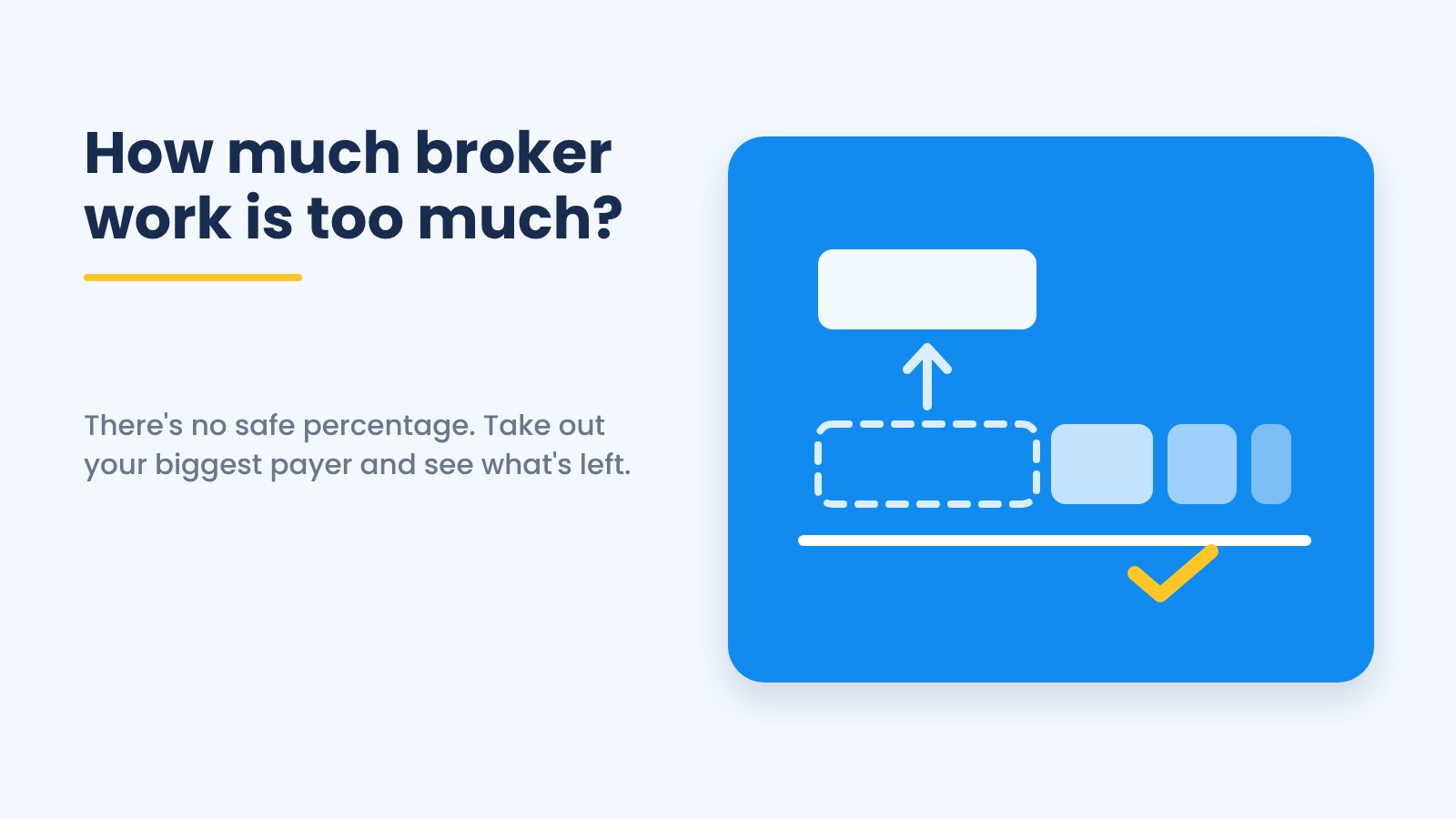
Broker work is too much once losing your biggest broker would sink the company. Where that line falls depends on your payers and your bills, so no percentage can tell you. An even split with private pay doesn’t fix it, because the two kinds of trips want different schedules. Pick the business you’re building, fill its gaps with the other kind of trip, and keep every payer small enough to lose.
In March, an owner near Washington, DC, told me on a demo that one broker had been “maybe 60% of our trips, and now I don’t get anything.” “I don’t know what happened to them in our area,” the owner said. “They just stopped.” Private pay was about 30 to 40% of sales, and the plan now was to “kind of reverse it,” so private pay would be the bigger share.
In July, a founder about to launch in Michigan, with one broker contract and no private-pay riders yet, asked me why I’d warned against a 50-50 split. I hear both conversations on demos. Our guide to how brokers assign and pay for Medicaid rides covers the brokers; this one covers how much of your schedule to give them. It follows the order the question comes up: what broker trips promise, why an even split fights itself, the two ways to build, how the three kinds of trips compare, a test for last month’s trips, and what changes as you add vans.
Are broker trips worth taking?
Broker trips are worth taking to fill empty hours, but Modivcare’s Mississippi manual and MTM’s agreement form promise no minimum number of trips, and MTM’s form can end on 30 days’ notice. Tony Jackson, an Orlando operator with 35 years in the business, put the upside plainly on our October 2025 episode about facility contracts: “the broker stuff will keep you from being completely dead. So if you’re slow on the hospital side and slow on the facility side, you fill in those gaps with the broker work.”
With no private-pay riders yet, I told the Michigan founder, “Something is way better than nothing.” Early trips get a new company “seen in the community and getting Google reviews.”
The paper promises less. Modivcare’s Mississippi provider manual (February 2024) says its provider agreements “do not contain any guarantees of a minimum number and/or type of trip assignments.” MTM’s provider agreement form (dated 01.01.2023) “does not guarantee or ensure” any minimum number of trips. Either side may end it “for convenience” with 30 days’ written notice. MTM may also end it immediately if “MTM’s contract with its Client is terminated for any reason.” WellTrans’s Indiana provider agreement (October 2025) ends “without cause upon 60 days written notice.”
That notice protects the agreement, not the trips, which can stop while the agreement runs. My cofounder Jing Zhu said on our 2025 episode about private pay that when brokers merge or a new one doesn’t like your rate, “they can take away your trip overnight or in a few days. So that’s really devastating.”
So count every broker trip as volume you could lose. The next question is how much, and an even split sounds like the safe middle.
Why not split broker and private-pay trips 50-50?
An even split between broker and private-pay trips is risky, because broker work pays off on a packed schedule and private pay needs room between pickups. As I told the Michigan founder, “it’s kind of dangerous to do like 50-50 split because the economics are totally different.”
At Medicaid’s prices, “the volume is the only thing that’s going to keep your business afloat,” as I put it on that call, so you pack the day. On our podcast in September, I said a tight schedule “can work well for more broker trips where there’s not a lot of same day.”
Private-pay riders pay more: posted prices for a 10-mile wheelchair trip ran about double Medicaid’s rate at the median, across the same-state pairs our rates guide compared in October 2026. If you “show up 45 minutes late to a pickup, they’re not going to call you back,” I told the founder, so “with a private pay schedule, you want a little bit larger gaps.”
On one van, the two fight over the same hours. In March 2026, when The Doctor Ride ran one van and no broker trips, one of its founders said in a video on the founders’ own channel that people with a procedure coming up “might call you a month in advance, two weeks in advance.” With one vehicle, “if you try to stick your hand in both pots, you’re going to spread yourself thin.”
You can still run both. “I’m not saying it can never be done,” I told the founder, and “you can mix them, but you have to be very aware” of which trips are which. What I’ve seen owners do is simpler: they “pick one to focus on, and then they will fill in gaps” with the other. A founder I talked with in September got the same answer: “at some point you should probably try to lean one way or the other.”
When should you build on private pay and facility trips?
In most areas in 2026, I’d build on private-pay and facility trips where the riders are there and you have the time or money to win them, and fill the gaps with broker trips. On that October episode, I asked Tony whether you build your schedule with facility trips and then, when gaps open, “pull in some broker trips to fill.” Tony’s answer: “Correct.”
Asked on the private-pay episode about an owner with five vans and only broker trips, Jing said the question is how much time, energy and money to put into private pay.
Private pay needs riders who can afford it, so first check whether your area has enough private-pay riders. They pay before the ride: most owners take a card at booking and charge it at least 24 hours before pickup, or send a payment link due by then. No payment, no car. Facility trips need selling, one building at a time, starting with getting on a facility’s call list, and cash to carry the invoices. University Hospital in Newark’s 2026 request for transport proposals says “UH’s payment terms are Net 45 days,” and Los Angeles County’s health department pays the overflow transport companies on its December 2024 master agreements within 30 days of “a complete and correct itemized billing.”
Duet’s growth work started with owners who’d lost a broker contract or otherwise had vans sitting empty. We kept running into owners saying some version of “four of them are empty because I lost my broker contract,” so we started running their Google Ads and calling facilities to book them meetings. Today the websites, Google Ads and facility calls Duet runs for providers build the trips an owner prices. How much broker work to take, what to charge, the meetings and the rides stay yours.
When does a broker-first company make sense?
A broker-first NEMT company works where rates beat your costs and you run enough vans for thin margins to add up, and it’s safest where more than one broker sends the trips. It “really depends on the broker in your area and how much they pay,” I told the Michigan founder, so start with whether a broker’s offer beats your cost. If it clears with room to spare, “maybe you could grow to 15 vehicles” on broker trips alone. My guess, though: “for most people, the brokers don’t pay very well, so it’s tough to do that.”
Where it works, it can scale fast. A Dallas operator with 11 vans told an industry podcast in September 2025 that on the first day of portal access there were “200 trips instantly sitting on my portal.” By the time of that interview, the operator said, about 900 to 1,000 accepted trips a month sat on that portal. “I kept adding vehicles to meet demand because the demand was there.”
Spread that work across brokers where you can. On a demo in July, I called working with several brokers “much safer and more lucrative” than running on one, and some operators run about five broker contracts to split the risk, where the state has more than one broker. By our broker guide’s count, 15 states hire a single statewide broker as of October 1, 2026, and there the main hedge is facility and private-pay trips. In some small or rural markets, broker-first is where the trips are.
Good brokers exist, too. Christopher Buell, who’s spent decades selling NEMT to facilities, said on our March 2026 episode on calling facilities that the really good ones are “essentially just another client, they pay well, they don’t overwhelm you with runs.” Buell’s advice: “you should take a look at all brokers. I mean, maybe your area is great.”
How do broker, private-pay and facility trips compare?
Broker trips trade price and control for volume you don’t have to sell, private pay is the reverse, and facility trips pay on invoice terms and arrive slowly, then steadily.
| Broker trips | Private pay | Facility trips | |
|---|---|---|---|
| Who books the trip | The broker assigns it | The rider or family | Facility staff |
| Who sets the price | The broker, in your contract | You | You and the facility |
| Volume promised in writing | Usually none | One booking at a time | Usually none |
| How fast trips start | Fast once credentialed, if the network has room | Slow to build; ads speed it up | Slowly, then steadily |
| What wins them | Credentials and taking the trips you’re sent | A website, reviews, ads and a fast answer | Calls, visits and meetings |
| The schedule it needs | Packed | Gaps between pickups | Room for same-day requests |
| When you’re paid | After a complete trip record, on each broker’s schedule | Before the ride | On invoice terms, often net 30 to net 60 |
| What can take it away | Fewer trips with no notice, 30 to 60 days’ notice, or the broker’s own contract ending | Riders leaving, one at a time | A new owner or new staff |
| Who it fits | Fleets on several contracts, or a new company’s first trips | Markets with riders who can pay | Owners who’ll sell building by building |
Broker networks can also be full: in September 2026, MTM’s Rhode Island provider page said MTM was taking new providers only as needed and estimated a wait of 8 to 12 months just for the chance to contract. And the Newark hospital’s request for proposals says its contract “does not guarantee a specific amount of services to be purchased.” So for every payer, facilities included, ask how much of it you could lose.
How much of your business can one payer be?
One payer can be as big a share of your business as you could lose next month and still cover your van payments and insurance, broker or not. Those two bills don’t stop when the trips do. On the one-van example in our guide to what one van costs to run each month, insurance is $1,450 a month and the van payment $614, so that van needs $2,064 a month before gas, maintenance or a driver.
Losing a payer by next month doesn’t take a cancellation. Indiana started PathWays for Aging, a managed-care program for members 60 and older, on July 1, 2024. That shrank the fee-for-service membership whose rides Verida arranges, and the state’s NEMT commission minutes recorded that PathWays “led to a 50% reduction in Verida’s daily trip volume.” Buell has seen the slow version: “you get a check for $10,000 and then the next month maybe the check is seven grand,” and you think, “well, they’re still giving me all this work.”
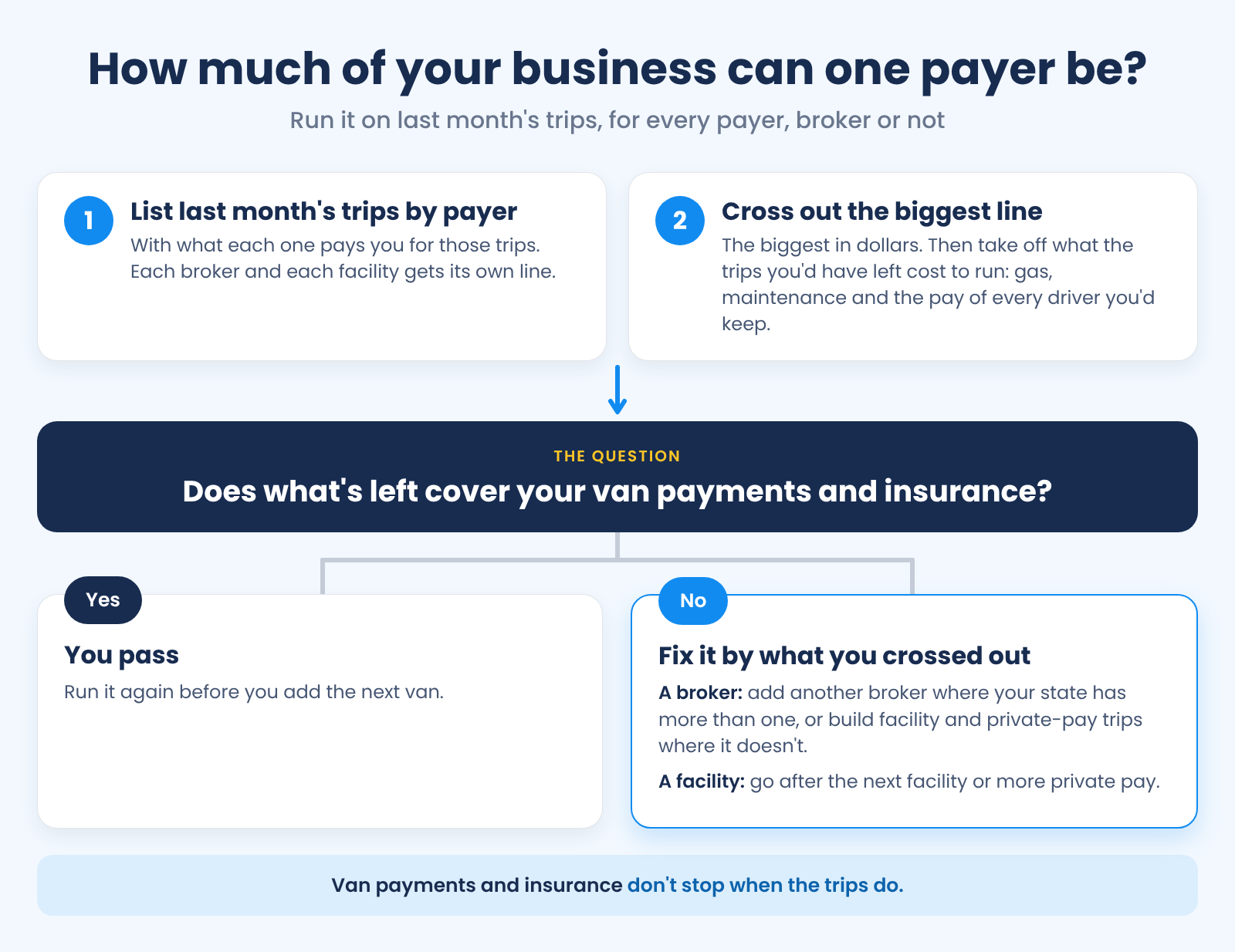
When we look at where a company’s trips come from on demos, the question I want the owner asking is “am I getting too concentrated with one payer?” To answer it, list last month’s trips by payer, with what each one pays you for those trips, and give each broker and each facility its own line. Each private-pay family is its own payer. Cross out the biggest line in dollars, then take off what the trips you’d have left cost to run: gas, maintenance and the pay of every driver you’d keep. If what’s left covers your van payments and insurance, you pass: you’d keep the vans while you replace the trips. Run it again before you add the next van.
If it doesn’t, the fix depends on what you crossed out. A broker: add another broker where your state has more than one, or build facility and private-pay trips where it doesn’t. A facility: go after the next facility or more private pay.
Once you have other trips for those hours, shrink a broker’s line by changing the vehicles and hours you’ve given it. MTM’s Virginia handbook (August 2026) assigns trips by “provider configurations including capacity, hours of operation,” and Modivcare’s Mississippi manual tells a provider getting too many trips to “confirm Modivcare has the correct information about its vehicle capacity and service area.” Turning trips down costs you instead. WellTrans’s Indiana agreement caps reroutes at “no more than 15% of their trips on a monthly basis,” and Modivcare’s manual warns of “fewer trip assignments if reservations are re-routed without valid reasoning.”
Run it this week:
- Sort last month’s trips by payer, with what each pays you for them, each broker and facility on its own line, and circle the biggest in dollars.
- Cross out the biggest line, take off what the rest costs to run, counting every driver you’d keep, and check that what’s left covers your van payments and insurance.
- Find your broker agreement’s ending clause and note its notice: 30 days for convenience on MTM’s form, 60 without cause on WellTrans’s.
- Check the vehicles and hours each broker has on file, and once other trips can fill them, change those, not your acceptance rate, to move its share.
- Write down which business you’re building before your next vehicle: private pay and facilities with broker fill, or broker volume across several contracts.
What changes as you add vans?
As a NEMT company grows, each van adds bills a lost payer would leave unpaid, and private pay alone rarely fills a big fleet. Jing made the second point in a talk on dispatching: private pay is easy to start with, but more vehicles need more trip volume than it brings. An operator in rural Northern California with 30 to 35 vehicles told an industry podcast in March 2026 that about “90% are probably broker related trips.” When broker growth “leveled out or plateaued,” the company “started hammering facilities and local contracts.”
The mix comes up again when you borrow or sell. Michael Shank, who sells wheelchair vans and arranges financing, said on our April 2025 episode on picking NEMT vehicles that banks ask a startup “what percent of your business or your trips are tied to this brokerage?” The reason, in Shank’s words: “these brokers ebb and flow in these contracts in these states.” Buyers price it in too, as our guide to selling a business that runs mostly on broker trips explains.
When we talked in March, the owner near Washington still didn’t know why a broker that had sent about 60 percent of their trips had stopped. You may never get a reason either, so build a schedule that doesn’t need one: cross out the biggest line on last month’s trips, and what’s left is the business you own.
FAQ
Is a broker that sends trips for several health plans one payer or several?
For this test, one. A rate dispute or an ended agreement with that broker takes every plan’s trips at once, so the broker gets a single line on your list. Plans also move their riders to a new broker one plan at a time. Blue Cross and Blue Shield of Texas moved its Medicaid rides from Modivcare to MTM Health on October 1, 2026, and our tracker of this year’s plan-by-plan broker switches lists the rest. So note which plan each broker trip is for, and run the test a second time with the biggest plan crossed out.
Should you keep your Medicaid enrollment if you build on private pay?
Yes, where your state issues a Medicaid number. In my experience, a state-vetted company gets a little more trust from facilities. In California, as I told an owner there in July, “not every Medi-Cal trip has to go through a broker,” so the number can also let a facility use you for its Medi-Cal riders as well as its private-pay ones. Our guide covers how to become a Medicaid transportation provider.
About the author
James O'Donnell cofounded Duet and leads its sales, partnerships, and growth services. He talks with NEMT operators every week, hosts the NEMT Growth podcast, and answers Duet's sales line himself. More about Duet's founders →
Want more trips and less busywork?
See how Duet runs and grows NEMT businesses in a 30-minute demo.