Article
How to Bill Medicaid for NEMT: Brokers, Claims, Codes
For most Medicaid rides you won't send Medicaid a claim. Here's what brokers check, when a real claim starts, and what gets one denied.
By James O'Donnell, Cofounder and COO, Duet ·
Two operators I talked with on calls this summer sit at opposite ends of Medicaid billing. A Dallas-area limousine operator had added two wheelchair-accessible vans and run one ride in two months. “I have our provider number,” the operator told me, “but I wouldn’t know how to bill on any of that stuff.”
A California owner with about 15 vehicles bills health plans directly, with no broker. On those claims, each ride has “a minimum of four line items,” each tagged with where the leg starts and ends. Tag a clinic inside a hospital as the hospital, the owner said, and the line isn’t payable, so someone has to “go back and resubmit.”
Most owners will never need those four lines. You’ll read that billing Medicaid means claim forms and codes. In most states, for most trips, it means closing out a broker’s trip: its trip ID, a signed log and its deadline. Codes take over when you bill a state or a health plan directly. This guide goes in the order a trip gets paid: who you bill, the broker lane, the direct-claim lane, then who should do the work.
Who do you actually bill for a Medicaid ride?
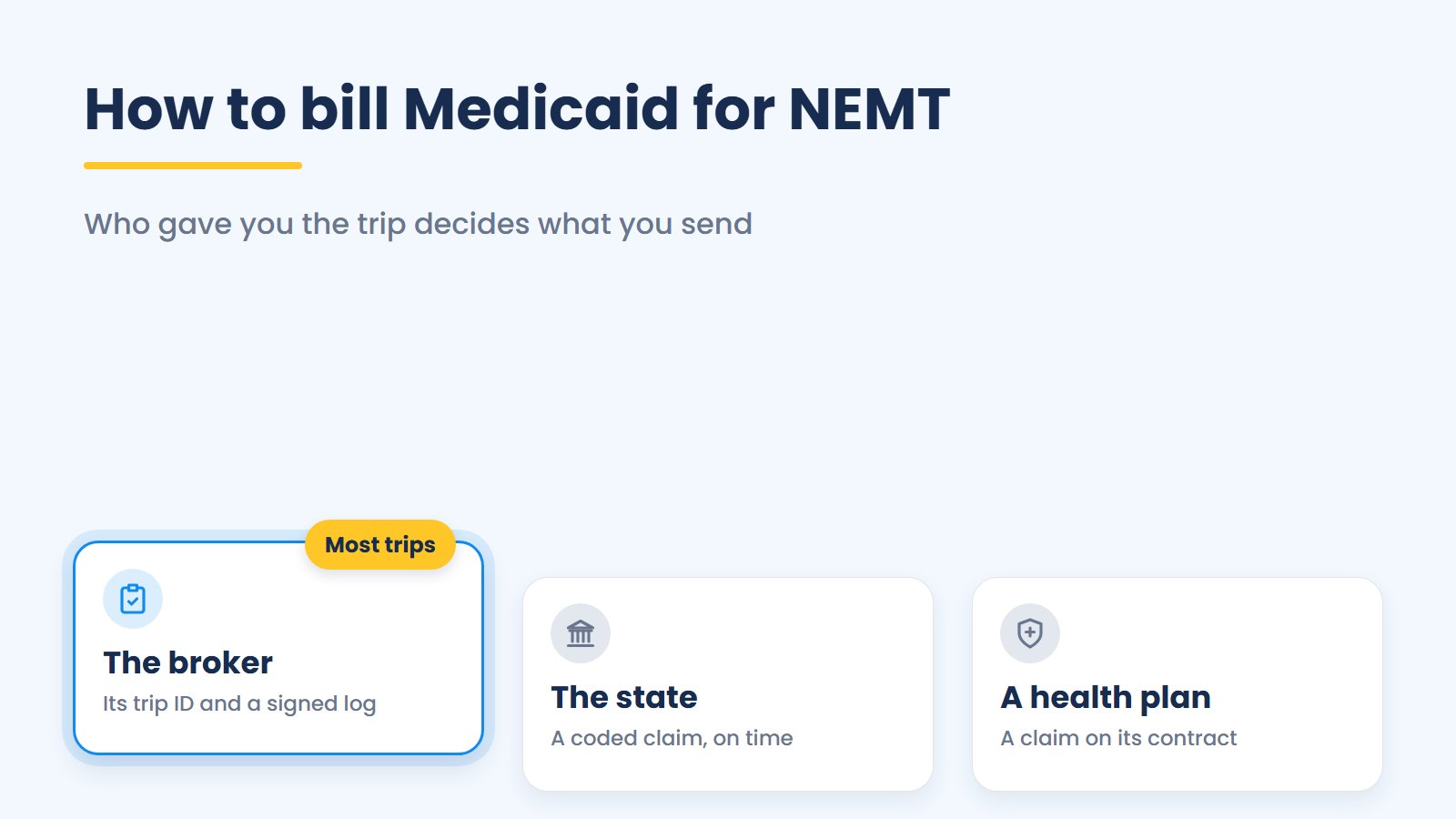
You bill whoever gave you the trip: in most states that’s a broker or a health plan’s ride vendor, and only in a few lanes is it the state itself or a health plan that pays you directly.
A broker is the company a state or health plan hires to hand out Medicaid rides. Colorado’s NEMT billing manual, revised July 17, 2026, says it plainly: “The broker pays enrolled providers directly for NEMT services.” Trips in the broker’s area “cannot be submitted directly to the Department,” and HCPF, the state’s Medicaid agency, says that from Jan. 1, 2027, it won’t pay for trips that MediDrive, its broker, didn’t schedule and approve. Our state-by-state table shows which kind of state you’re in.
The limo operator drives in Texas, where most Medicaid members are in health plans and each plan’s ride vendor pays you. Billing Texas Medicaid directly is a narrow fee-for-service lane, and fee-for-service riders are the ones Medicaid covers without a health plan.
The direct lanes are real but narrow:
- Ohio: licensed wheelchair van companies bill the state Medicaid department for fee-for-service riders, as provider type 83, the state’s wheelchair van category.
- Minnesota: the state’s NEMT billing page, revised Oct. 6, 2026, has companies bill MHCP, the state’s Medicaid program, directly for state-administered wheelchair and stretcher trips, among others.
- California: trips for fee-for-service riders, about 5 percent of Medi-Cal members in the state Medicaid department’s April 2026 count, are billed to Medi-Cal.
- Illinois and Arizona: both run fee-for-service lanes too.
- Michigan: outside Wayne, Oakland and Macomb counties, local offices of the state health department reimburse fee-for-service trips on a statement form, the MSA-4674, not a coded claim.
- Two Minnesota county health plans: South Country Health Alliance and IMCare take NEMT claims directly.
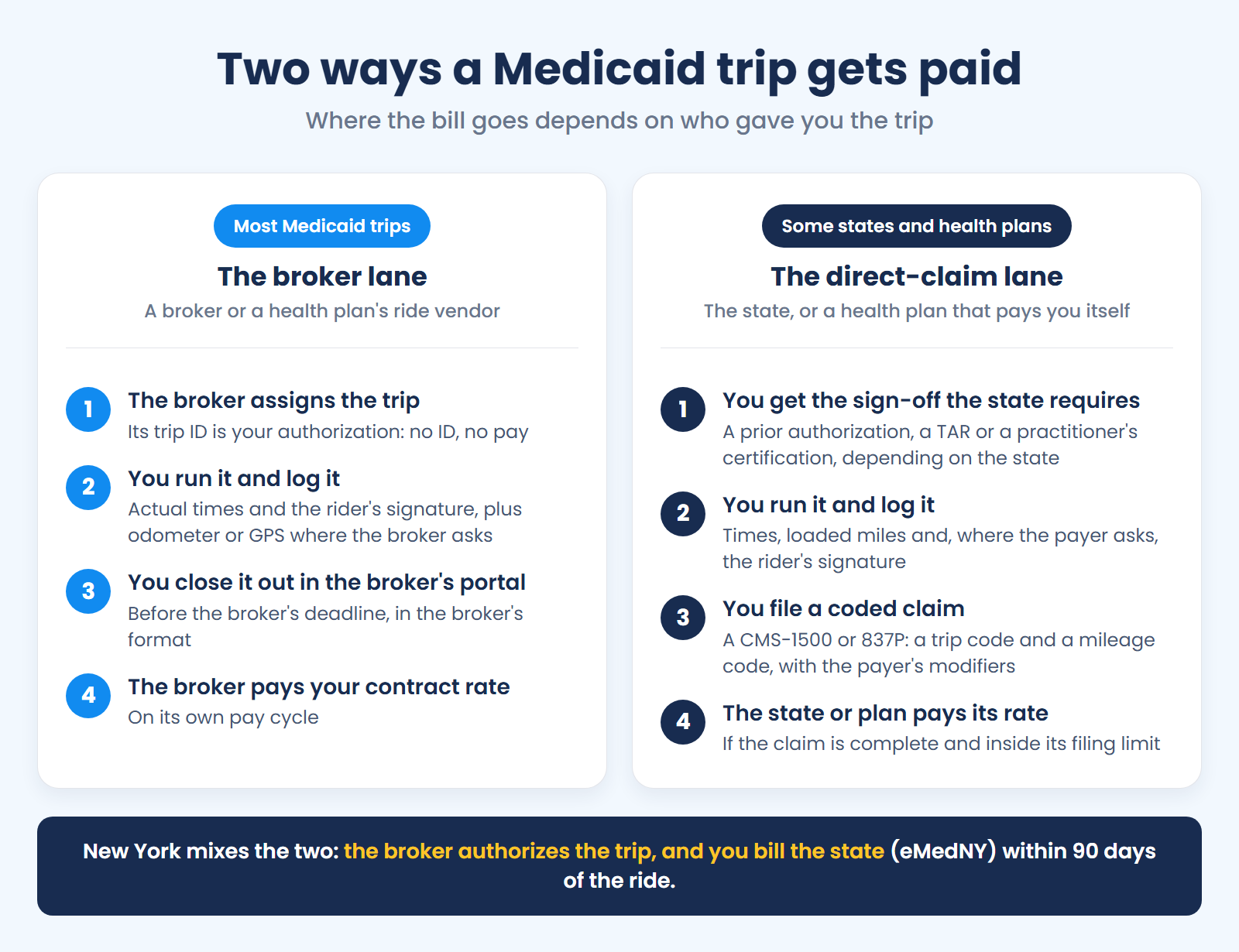
New York mixes the two: MAS, the statewide broker, assigns and authorizes the trip, and you bill eMedNY, the state’s Medicaid claims system, within 90 days of the ride. Indiana mixes them the other way: under its Medicaid transportation module, most fee-for-service trips go through the broker, Verida, which takes them as claims.
| Who pays you | What you send | Where it goes | What it’s checked against |
|---|---|---|---|
| A broker or a plan’s ride vendor | Its trip ID and a signed trip log with actual times | The broker’s portal or app | The broker’s trip record, mileage and deadline |
| The state, for fee-for-service riders | A coded claim, or a statement form in Michigan’s county lane | The state’s claims system or portal, or Michigan’s local office | Its authorization or certification, codes and filing limit |
| A health plan that pays you itself | A coded claim, often electronic | The plan’s claims system | Your contract, its codes and its authorization |
| New York Medicaid | A claim with the 11-digit prior-authorization number | eMedNY | The trip you confirmed in MAS’s system, with GPS |
| A facility | An invoice | The facility’s billing contact | Your agreement’s rates and terms |
| A family (private pay) | A card charge or payment link, before the ride | Your own card processing | The booking |
| Original Medicare | Nothing: it covers no van ride | Nowhere | Nothing |
Facilities pay your invoice on the terms in your agreement, and families pay before the ride: most providers I talk to charge the card at least 24 hours before pickup. Original Medicare pays for no van ride at all. CMS’s claims processing manual says Medicare “simply does not provide any coverage at all” for an “ambulette, wheelchair van, or litter van.”
Start with a list: every place your Medicaid trips came from in the last 30 days (each broker, plan vendor or state program), and next to each, what you send it and where.
How does billing a broker work?
You close out the broker’s trip: its trip ID, a trip log with the actual pickup and drop-off times and the rider’s signature, sent through its portal or app before its deadline.
Everything hangs on the broker’s number. Verida’s Tennessee manual, in BlueCare Tennessee’s provider manual effective Oct. 1, 2026, says “No payments shall be issued for transportation without valid transportation confirmation numbers issued by Verida.” Modivcare’s Mississippi manual, dated February 2024, says the same about its job numbers.
The trip log is the bill. Verida’s manual wants odometer readings at pickup and drop-off, checks GPS and time stamps against its manifest, and says trips it can’t verify “will be subject to denial of payment.” Each leg needs a signature, and “The driver/attendant cannot sign for the Member.” A forgotten tap costs money too. When a driver forgets to mark a drop-off, I told a founder on a demo this summer, there’s no timestamp, and a broker can refuse to pay because, as far as it knows, maybe you didn’t do that trip.
Brokers differ on riders who can’t sign. WellTrans’s Indiana agreement, revised Oct. 16, 2025, won’t take the rider’s initials or a note that the rider was unable to sign: those trips “will not be accepted for payment.” Someone in the rider’s household, a caretaker or a facility staffer can sign in their own name instead. Modivcare’s Mississippi manual asks first for a facility representative’s own signature, and failing that, has the driver write “unable to sign” with the reason. MTM’s required fields are in our guide to when the money comes in.
The broker also sets the format and the miles. Modivcare’s Mississippi manual “does not accept paper claims” and pays the shortest distance from pickup to drop-off, by its mapping software. MTM’s Rhode Island handbook takes trips from its driver app or approved software, and when those fail, a bulk-upload spreadsheet with the trip logs attached. WellTrans’s agreement says its determination of mileage “shall be final.” Your rate is whatever your contract says.
Notice what’s missing: codes. MTM’s Rhode Island handbook and its Virginia handbook don’t ask a van company for a single billing code, and neither do the Modivcare, Verida and WellTrans documents above. The exceptions: New York, where you bill the state; Indiana fee-for-service, where Verida takes claims; and New Jersey, whose contract has its broker accept claims “via CMS 1500 forms or by electronic billing format.”
Why do broker trips come back unpaid or short?
Broker money comes back short for checklist reasons: a late submission, a missing field, miles or times that don’t match the broker’s records, or a driver or van the broker hasn’t approved.
Start with the clock, which each broker’s document sets for itself:
| Broker and state (document date) | Submit within | After the deadline | Pay clock |
|---|---|---|---|
| Modivcare, Mississippi (manual, Feb. 2024) | 60 days from the date of service | 10% less; nothing after 120 days | Twice a month, within 30 days of receipt |
| WellTrans, Indiana (agreement, Oct. 2025) | 60 days | Nothing after 90 days | Twice a month, within 30 days of submission |
| MTM, Rhode Island (handbook, July 2026) | 90 days | Permanently denied as timed out | Per your contract |
| Verida, Tennessee (manual, Oct. 2026) | 120 calendar days | Can be denied as untimely, except in cases like retroactive eligibility | Within 30 days of a clean invoice |
| MTM, Virginia fee-for-service (handbook, Aug. 2026) | 6 months | Not stated in the handbook | Not stated in the handbook |
Every number in that table is one broker’s document, in one state, on its date. Yours is in your agreement. MTM’s Rhode Island handbook pays approved claims “based on your company’s contract,” and MTM’s 2023 agreement form says it pays within 30 days of online submission.
The usual line is that brokers pay in 30 days. Most of the table promises that for clean claims, meaning complete ones, and Indiana’s Medicaid module, published Aug. 19, 2025, says clean claims sent to Verida by Wednesday “will be paid within 14 days.” But Indiana’s own report for July 2026 shows Verida averaged 19 days to decide a claim and 19 more to pay it: about 38 days on those averages, not 14. The same report counts none of the 23,824 paid claims as late, by its own measure.
That month, Verida took in 25,730 Indiana claims and denied 1,906. The top five reasons were “Space Distance Variance” (773), “Incorrect Mobility Type” (204), “Service not provided to member” (181), “Unauthorized Vehicle” (124) and “Missing or Invalid Odometer Reading” (106). The report doesn’t define the first one, so if a broker denies a trip on distance, ask which miles it measured: its mapping, not your odometer, usually sets the miles it pays.
Two more things hold back broker money. MTM’s 2023 agreement form pays nothing for “uncredentialed” drivers or vehicles, and Modivcare’s manual says “No payments will be made for services performed by non-compliant drivers or vehicles.” A late give-back costs you too: hand a trip back with less than 24 hours’ notice, and Modivcare in Mississippi and Verida in Tennessee can deduct the extra cost of covering it from your pay.
Claims a broker sends back for fixes can run on a shorter clock. Modivcare’s Mississippi manual takes 10% off a returned claim that isn’t back within 30 days and denies it if it isn’t back within 60. WellTrans’s 2023 billing guide wants a written dispute within 60 days of its decision.
Then check what arrives against what you ran. Te’ya Miles of That NEMT Girl described an audit on our podcast: one contract’s payout “did not equal” the company’s own records, so the job was going through the trips one at a time, “okay, where’s this trip number?” That only works if your records carry the broker’s trip numbers.
Four habits I’d build first:
- Check every trip before it goes in: the trip ID, the actual times, the rider’s signature, the mobility type the broker booked, odometer readings where the broker asks, and a driver and van it has approved.
- Submit broker trips at least every week, well inside the shortest deadline in your agreements.
- Keep one page of deadlines: each broker’s submission window and pay clock, from your own agreement.
- Match every payment to your trip log by trip number, each pay cycle.
What goes on a claim when you bill Medicaid directly?
A direct claim is a CMS-1500, or the electronic 837P that carries the same information: your billing NPI, the rider’s Medicaid ID, the authorization or certification your state requires, and lines that pair a trip code with a mileage code.
The CMS-1500 is the standard paper claim form, and the NPI is your National Provider Identifier. The claim is built from your trip log, which holds the times, the loaded miles and, where the payer asks, the rider’s signature.
Before you file, each state wants its own sign-off, and the claim has to match it:
- Medi-Cal: a TAR, Medi-Cal’s Treatment Authorization Request, with the practitioner’s prescription, and its ground transportation manual says “modifiers on the TAR and the claim must match.” Our California guide covers Medi-Cal’s direct lane.
- Ohio: the ODM 03452, a practitioner’s certification of necessity for a wheelchair van, signed before you submit the claim.
- Minnesota: a level-of-service assessment where one’s required, and the driver’s own provider ID, the UMPI, on the claim as the provider who gave the service.
- New York: the 11-digit prior-authorization number eMedNY issues once you confirm the trip in MAS’s system (New York calls it attesting), plus your eight-digit Medicaid ID, on an 837P or the paper Form A, not a CMS-1500, per eMedNY’s billing guideline. Attest within 30 days of the ride: the state’s transportation policy manual makes later attestations “subject to payment disallowance.” Our New York guide covers each step from MAS’s trip to payment.
The California owner’s lines go “Pickup, appointment, miles,” then “pickup return, and the return miles”: a base line and a mileage line for each leg. Medi-Cal’s fee-for-service manual allows that shape but doesn’t require it. Medi-Cal’s own sample claim, a wheelchair van ride from home to a dialysis clinic and back, bills two lines: A0130 with 2 units and modifier 76, a tag Medi-Cal allows for a repeat trip the same day, and A0380 for 12 miles. The TAR number goes in box 23.
Here’s a model built from the Medi-Cal manual, not a real claim. Say the clinic is 8 miles away and both legs run in daytime. A0130 at $20.30 times 2 is $40.60, and A0380 at $1.50 a mile times 16 is $24.00, for $64.60. Those are Medi-Cal’s fee-for-service maximums, on its rate page updated September 2023, and it pays your usual charge up to them. Billed as four lines, a base and a mileage line for each leg, the trip still totals $64.60.
On the paper form, four boxes carry most of it, per the 1500 instruction manual from the NUCC, the national committee behind the form, dated July 2025:
- Box 24D: the procedure code, with room for “up to four 2-character modifiers.”
- Box 24G: the units, trips on a base line and miles on a mileage line.
- Box 23: the prior authorization number your payer assigned.
- Box 33a: your billing NPI.
Codes come from CMS’s national code list, HCPCS, and each state picks its own. The descriptions below are plain-English versions of CMS’s October 2026 code file; the states are examples:
| Code | What it is | Where it’s used (examples) |
|---|---|---|
| A0130 | Wheelchair van trip, the base charge | Medi-Cal, New York, Ohio, Minnesota, Illinois, Indiana |
| S0209 | Wheelchair van mileage, per mile | New York, Ohio, Minnesota |
| A0380 | Basic life support mileage, per mile | Medi-Cal, for wheelchair and litter (stretcher) van miles |
| A0425 | Ground mileage, per statute mile | Illinois and Indiana, for wheelchair van miles |
| T2003 | Non-emergency trip, per encounter or trip | Texas fee-for-service; Indiana, for ambulatory trips |
| T2005 | Stretcher van | Medi-Cal, Minnesota, Illinois |
| S0215 | Non-emergency mileage, per mile | Texas, for family or friends who drive a rider |
| T2001 | Attendant or escort | Medi-Cal, Ohio, Minnesota, Illinois |
| T2007 | Waiting time, per half hour | Medi-Cal, after the first 15 minutes |
Other modifiers say where each leg starts and ends. The California owner’s “RJ for the appointment and JR for the return” are CMS’s origin and destination letters, origin first. R is a residence, J a freestanding dialysis facility and H a hospital, per Medicare’s ambulance billing chapter. Ohio, Indiana and Minnesota require them on NEMT claims. Medi-Cal’s fee-for-service manual doesn’t use them on routine wheelchair van lines: its sample uses 76, and UJ marks a leg between 7 p.m. and 7 a.m.
In the owner’s example, map data can read a clinic inside a hospital as the hospital and put an H on the line. Per the owner, those payers won’t pay the H, but that’s their rule, not a general one: Ohio lists hospital pairs such as RH and HR among the wheelchair van pairs that need no manual review. The fix holds anywhere the letters matter: set each address’s place type yourself instead of letting the map guess. “It’s best if you designate them,” the owner said.
Before you sign a direct contract, write one trip from last week as your state’s claim lines: codes, units, modifiers and the authorization number.
How long do you have to file a claim, and what gets it denied?
Filing limits run from 90 days in New York to a year in Ohio, and the denials the state manuals name are mostly paperwork: a missing or mismatched authorization, a missing NPI, a late claim.
Federal rules set the ceiling: under 42 CFR 447.45, a state “must require providers to submit all claims no later than 12 months from the date of service.” Each state’s own limit sits inside that. These five come from New York’s claims rule, Medi-Cal’s claims manual, Ohio’s claims rule, Minnesota’s claims rule and Illinois’s handbook:
| State program (document date) | Filing limit | If you’re late | Fixing a denial |
|---|---|---|---|
| New York, eMedNY (rule; guideline Aug. 2026) | 90 days from the date of service | Only for a delay outside your control, filed with a written reason within 30 days of it ending | Resubmit within 60 days of the notice |
| Medi-Cal fee-for-service (manual, 2025) | Six months after the month of service | 75% of the payable amount in months 7-9, 50% in months 10-12, denied after that | A claims inquiry within six months of the remittance; an appeal within 90 days |
| Ohio Medicaid (rule, effective Feb. 2023) | 365 days from the date of service | Not timely unless an exception applies, such as an eligibility delay (180 days from the notice) | Resubmit within the same 365 days |
| Minnesota MHCP (rule, as published Aug. 2008) | 12 months from the date of service | The state has no obligation to pay, outside listed exceptions | Resubmit within the 12 months; adjust a paid claim within six months of the payment date |
| Illinois HFS (handbook, March 2024) | 180 days from the date of service | Not eligible for payment unless a timely filing exception applies | Corrected claims must also arrive within the 180 days |
For the limo operator, Texas fee-for-service would mean code T2003 on a claim to TMHP, the state’s Medicaid claims administrator, within 95 days of the ride, per Texas’s July 2026 transportation handbook.
Federal rules don’t make Medicaid pay a van company in 30 days, either. The rule behind that number, 90 percent of clean claims in 30 days and 99 percent in 90, covers “clean claims from practitioners, who are in individual or group practice or who practice in shared health facilities.” For “all other claims,” the state has 12 months from receipt. In practice, Medi-Cal pays fee-for-service claims on a weekly checkwrite schedule.
The denials and rejections the manuals name are mostly paperwork:
- Medi-Cal: a claim whose modifiers don’t match its TAR, or a second same-day trip billed without its times and destinations, which “may be denied as duplicate services.”
- New York: “Claims without an ordering provider’s NPI will be rejected,” and the policy manual says “The information on the claim must match the information on the prior authorization.”
- Ohio: its claims rule says claims for certified services “will be denied” without the certifying practitioner’s NPI and legal name and an active Medicaid provider agreement.
- Minnesota: since Jan. 1, 2023, a claim without an enrolled driver’s UMPI as the rendering provider is denied.
Whichever state you bill, add its filing limit to your page of deadlines, and resubmit any denial inside its window: 60 days of the notice in New York.
Should you do your own billing or hand it off?
Learn the lane you run most yourself, then hand off what’s hard, usually direct claims, to a biller who typically takes a cut of what it collects.
If your trips are mostly private pay and facility work, little of this applies. Direct billing isn’t automatically better, either. Outside New York, it reaches a narrow slice of riders and adds the coding, while a broker’s checklist is easier to get right. The California owner can bill direct because the company already holds direct contracts with its payers.
When an owner asked me on a call this summer what billing usually costs, my answer was that billers usually take a cut of what they bring in: “Somewhere between 5% to 10% of the trip.” Take that as a gut check, not a quote, and ask each biller whether chasing unpaid claims is in the cut.
Learn the job first anyway. Rachel Scholler put it plainly on our 2025 episode about running a 30 percent margin: learn how a task works before you hire it out, because “if the person you’re hiring walks out, are you able to still function without them?” That goes for billing companies too. MAS’s 2023 provider network manual says billing companies must enroll in New York Medicaid as a Service Bureau, and that transportation companies are “always responsible for the timeliness and accuracy” of what their billing services send.
Much of the work is assembly: re-keying each trip into claim lines, or into the report a broker wants. That’s the part Duet’s billing takes on. It generates the CMS-1500 from the trips you ran, priced at that contract’s rates, and builds the report or invoice your brokers expect, with every line traced back to the trip record. You still submit through each payer’s own process, and resubmissions and appeals stay with you or your biller.
Before you hand billing off, bill one lane yourself for a full month, so you can check the biller’s work.
The limo operator’s first Medicaid bill, if one comes, will most likely be a plan vendor’s trip ID, a signed log and a deadline, not a claim form. For any owner, the test is one trip from last week: who paid it, what number it carried, what you sent and by when, and whether what arrived matches what you billed. If you can’t answer all of it for one trip, start there.
FAQ
Can I bill a Medicare Advantage plan for rides?
Only if the plan offers rides, and then on its terms, through its ride vendor or your own contract with the plan. Medica’s Minnesota manual, revised February 2023, says its Medicare Advantage plans’ transportation benefits are “subject to the provisions of the provider contract.”
Can I bill Medicaid for a no-show or waiting time?
A no-show, almost never. MTM’s Rhode Island page, updated July 2026, says MTM “does not pay for no shows,” and MAS, New York’s broker, answers the question with a flat “No.” Georgia’s July 2022 NEMT manual was an exception: its broker had to pay the provider for the trip’s “A” leg when a rider failed to board, as long as the van arrived on time. Medi-Cal fee-for-service has one too: its manual lets you bill a “dry run,” when you respond to a call but don’t transport the rider. Waiting time is paid only where a payer lists it, like T2007 in Medi-Cal’s fee-for-service manual, after the first 15 minutes and three half-hour units at most. Our no-show guide covers whether you can bill a no-show anyway.
Do I need an NPI to bill?
Usually, for a coded claim: an NPI is the 10-digit National Provider Identifier, and it identifies your company as the billing provider. New York’s non-emergency transportation claims carry your eight-digit Medicaid ID instead, though they still need the ordering practitioner’s NPI. Broker trips run on the broker’s trip ID, though some brokers’ applications ask for an NPI. Our enrollment guide covers how to get an NPI and what it doesn’t do.
About the author
James O'Donnell cofounded Duet and leads its sales, partnerships, and growth services. He talks with NEMT operators every week, hosts the NEMT Growth podcast, and answers Duet's sales line himself. More about Duet's founders →
Want more trips and less busywork?
See how Duet runs and grows NEMT businesses in a 30-minute demo.