Article
Medi-Cal Fee-for-Service in 2027: What NEMT Providers Need
About 2 million Medi-Cal members leave their health plans on January 1 and keep their rides. Getting paid takes paperwork that covers each ride's date.
By James O'Donnell, Cofounder and COO, Duet ·
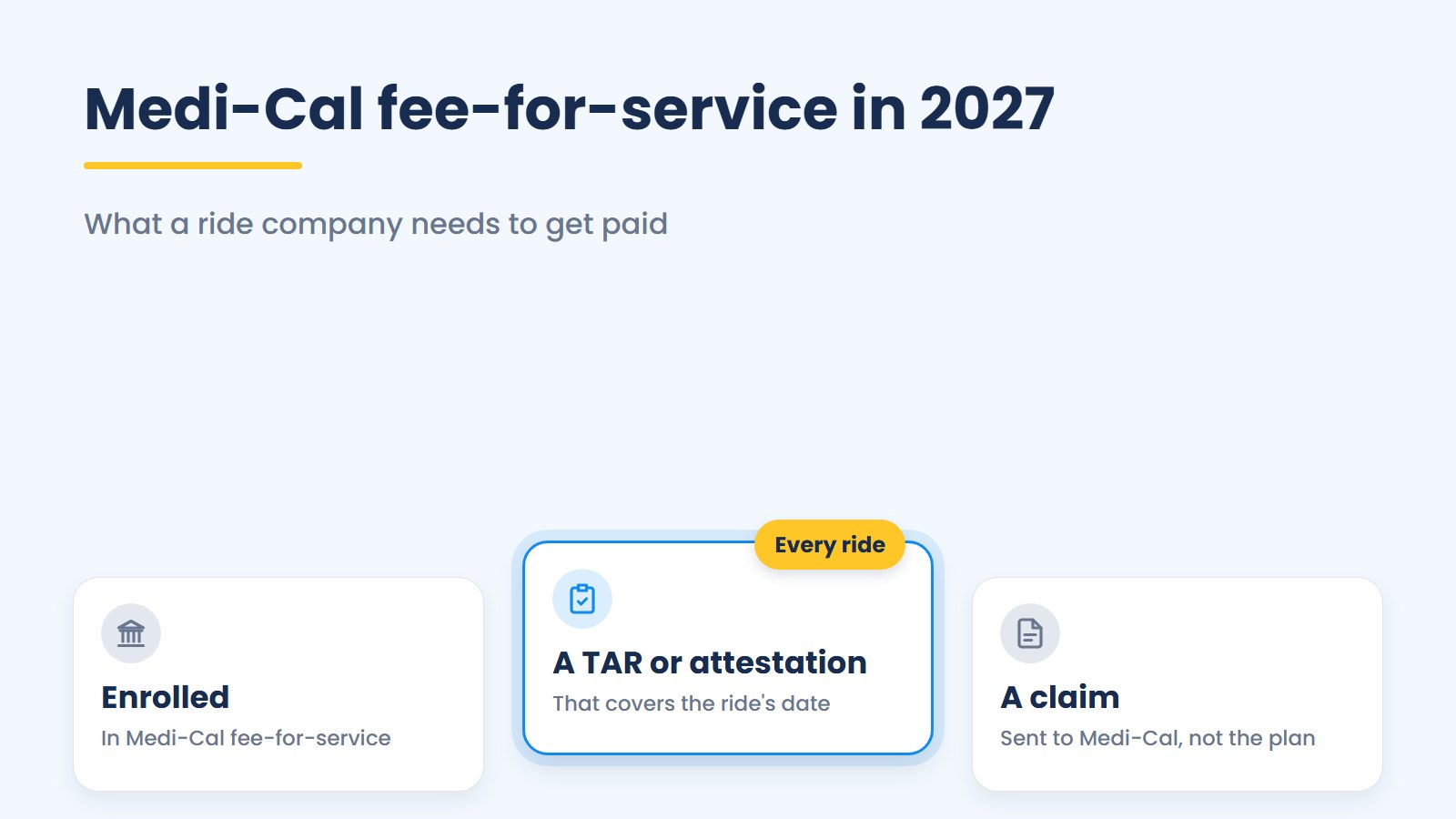
On January 1, 2027, about 2 million Medi-Cal members with unsatisfactory immigration status (UIS) move from their health plans to fee-for-service (FFS), where Medi-Cal pays providers directly for each service. They keep their rides. Only a ride company enrolled in Medi-Cal fee-for-service gets paid for those rides. Each ride needs an eligibility check on its date, plus a TAR, Medi-Cal’s Treatment Authorization Request, for nearly every wheelchair or stretcher van ride, or the rider’s own attestation for an ambulatory ride.
An owner in Kern County who runs under ten vans, mostly plan work, told me on a call in November what his plan had said about these riders. As he put it: “either bill it straight to Medi-Cal or you can just don’t service them.” He’d also heard the riders lose Medi-Cal. They don’t.
On January 1 the broker drops out for these riders, and each ride pays only if your enrollment, your eligibility check and the ride’s paperwork cover its date. A ride they don’t cover is a ride you may never be able to bill. This guide follows the order you set things up in, which is also the order a January ride gets paid: what changes, enrollment, setup, each ride’s paperwork, the claim, and whether these trips pay.
What changes for ride companies on January 1, 2027?
For a ride company, the plan and its broker drop out: from January 1, only a company enrolled in Medi-Cal fee-for-service gets paid for these riders’ trips. The riders keep full-scope Medi-Cal, rides included, if they renew on time.
DHCS, the Department of Health Care Services, which runs Medi-Cal, says so in its fee-for-service provider toolkit, version 1.0 from October 14, 2026: the move “affects how care is delivered, not whether members remain eligible for Medi-Cal.” On rides, DHCS’s September 2026 member FAQ says, “You may still get rides,” and adds, “You might need a form from your new Medi-Cal Fee-for-Service doctor.”
“Approximately 2 million Medi-Cal members will be affected,” says DHCS’s September 22, 2026 presentation to two of its advisory committees.
Transportation gets its own line in the toolkit: “transportation providers must be enrolled in Medi-Cal FFS to continue serving impacted members after January 1, 2027.”
Until then, these riders’ trips reach you through a broker, the company a health plan hires to hand out and usually pay for its trips, or through the plan’s own ride desk. Our guide to how Medicaid ride brokers work covers that lane. Here’s what switches for one of these riders’ Medi-Cal trips:
| For a rider moving to fee-for-service | Through December 31, 2026 | From January 1, 2027 |
|---|---|---|
| Who can be paid | A company in the plan’s network | Only a company enrolled in Medi-Cal fee-for-service |
| Who pays you | The plan or its broker | Medi-Cal, on a claim you send |
| Who approves a wheelchair or stretcher trip | The plan or its broker | DHCS, on an approved TAR with a written prescription |
| What an ambulatory trip needs | What the plan or its broker requires | The rider’s attestation, for that trip or up to a month of rides |
| The card the rider shows | The plan’s member card | Medi-Cal’s Benefits Identification Card (BIC) |
Only the Medicaid lane moves. If one of these riders also books private-pay trips with you, paid by card at booking and charged at least 24 hours before pickup, or through a payment link, those don’t change. Neither do trips a facility pays for on its own terms. Medi-Cal members outside this group stay in their plans, so if none of your riders are moving, little changes for you on January 1.
The toolkit doesn’t say who books these riders’ trips after January 1, or how a ride company learns which of its riders are moving. DHCS sends the riders themselves a notice by December 1. Before December 31, ask your plan’s provider services line and DHCS’s Provider Helpline, (800) 541-5555, which of your riders are moving and how their January trips will reach you.
Are you enrolled in Medi-Cal fee-for-service?
If your company is already enrolled in Medi-Cal fee-for-service as a billing provider, DHCS’s toolkit says you “don’t need to do anything new for this transition.” If it isn’t, the toolkit says “you must submit your application by January 1, 2027 to bill for these members,” through PAVE, DHCS’s Provider Application and Validation for Enrollment portal.
A spot in a plan’s network doesn’t settle it. DHCS’s September 2026 provider FAQ says providers “who only bill through managed care and are not enrolled in Medi-Cal FFS will not be able to care for UIS members after December 31, 2026.” The quickest check is DHCS’s public list of enrolled fee-for-service providers, which the toolkit links as the way to verify your enrollment. The latest cut as I write this is dated November 16, 2026, and ground medical transportation shows as provider type 030. A company approved in the last few days may not show up yet.
DHCS asks you to submit by January 1. Inland Empire Health Plan’s October notice and Partnership HealthPlan’s August notice to their providers go further: apply and be approved by January 1 to get paid at fee-for-service rates. The law adds a clock. Welfare and Institutions Code section 14043.26 gives DHCS 30 days to acknowledge an application and 180 days to decide it. From July 1, 2026 through June 30, 2027, a missed deadline doesn’t approve anything by default: the application “shall remain pending.” So for an application DHCS receives on December 1, the 180 days run out around the end of May 2027, and if DHCS misses that, the application just waits.
The toolkit doesn’t say whether an approval reaches back to the day DHCS received your application, so whether January rides you drive while you wait can be billed later is an open question. Ask the PAVE Help Desk at (866) 252-1949 before you drive one.
To add ambulatory riders to a wheelchair or stretcher van enrollment, Medi-Cal’s transportation manual has you file the DHCS 6209 supplemental changes form, plus a letter if you’ll use the vans and drivers DHCS already approved. Our California startup guide covers the basics of billing Medi-Cal directly, PAVE and the claim form included.
You’re making two decisions here, on different clocks. Whether you can bill these riders at all turns on your enrollment, which DHCS wants you to apply for by January 1. Whether a given rider is worth taking, you can decide one rider at a time: “Enrolling in FFS doesn’t obligate you to take every member who asks for services,” the toolkit says. So file now, and weigh the price later.
This week, look your company up on DHCS’s enrolled-provider list, and if it isn’t there, file in PAVE now rather than in late December.
What do you set up before the first January ride?
You need five things working by January 1: a Provider Portal account, eligibility checks for each ride’s date, a way to file TARs, an attestation file, and a way to send claims and get paid. The portal comes with enrollment: its registration token goes to the pay-to address Medi-Cal has on file. If your PAVE application is still pending, ask the PAVE Help Desk which of these you can set up before approval.
Someone who advises California providers told us on a call in October that operators who’ve been in business for years “don’t even know how to run eligibility.”
- The Provider Portal. Medi-Cal’s Provider Portal is where you check eligibility, send claims electronically and file eTARs, the online version of a TAR. Your company names an administrator, who registers it with that token within 30 days of the date it’s issued, or the token expires. From then on, the administrator has to complete each quarterly directory survey within its 45-day window. DHCS’s August 26, 2026 notice says missing one costs “all users within the organization” access to the portal’s Transaction Center.
- Eligibility on each ride’s date. Medi-Cal’s eligibility manual says to verify eligibility “on the date of service even if eligibility was previously verified for the month,” and never for a future month, so you can’t check a January ride in December. Check by phone through AEVS, Medi-Cal’s Automated Eligibility Verification System, at (800) 456-2387, with the rider’s BIC or Social Security number. You can also use a point-of-sale (POS) device that reads BICs, if you have one, or the Provider Portal, up to 99 riders at a time. AEVS returns a 10-digit confirmation number, the EVC (Eligibility Verification Confirmation), and the other methods give you a confirmation too: keep it in the rider’s record. “Receipt of an EVC number does not guarantee claim payment,” the manual warns.
- A way to file TARs. You can file a TAR online as an eTAR in the Provider Portal, or on paper to DHCS’s TAR Processing Center. Medi-Cal’s TAR manual says providers “generally should request authorization before rendering a service” and gives no turnaround time. The transportation manual adds that incomplete information “will delay approval and may result in claim denials.” File early.
- An attestation file. For each ambulatory rider, keep every attestation, past and current, in the rider’s file. DHCS can ask for them, including “in the event of a state or federal audit.”
- Claims and payment. Claims go to Medi-Cal on paper, on the CMS-1500, the standard claim form for medical services, or electronically through the Provider Portal, sent by you or by a billing service you affiliate with there. Either way, Medi-Cal’s claims manual makes providers “responsible for all claims submitted with their provider number regardless of who completed the claim.” Direct deposit through EFT, electronic funds transfer, is optional: elect it in PAVE, and the EFT section of the manual puts the first deposit within 6 to 8 weeks after your EFT authorization is approved.
This week, name your Provider Portal administrator and put each quarter’s 45-day survey window on the calendar. Then decide who’ll check eligibility on the date of every ride, and where they’ll keep the EVC.
What does each January ride need to get paid?
Medi-Cal pays a ride in full only when it passes four checks: you’re enrolled, the rider is eligible that day, a TAR or attestation covers the date, and the claim matches the paperwork and arrives on time.
The rules behind the third check changed on November 1, 2026. Medi-Cal announced the change in an October 26 notice, and the rewritten ground transportation manual, every page marked “Page updated: November 2026,” spells it out. The four checks, in the order you’ll meet them:
- Enrolled. Your company is enrolled in Medi-Cal fee-for-service. If it isn’t, DHCS says to submit your PAVE application by January 1, 2027, and some plans tell providers to be approved by then. Through June 30, 2027, nothing is approved by default.
- Eligible that day. The rider is eligible on the date of the ride. Check on that date, by phone through AEVS, on a card reader or in the Provider Portal, and never for a future month.
- Covered. The paperwork covers the date of the ride: an approved TAR for a wheelchair or stretcher van, or, for an ambulatory ride, the rider’s attestation for that trip or for a period of up to a month that includes it.
- Billable. The claim’s units and modifiers match the TAR, and Medi-Cal receives the claim within six months after the month of the ride.
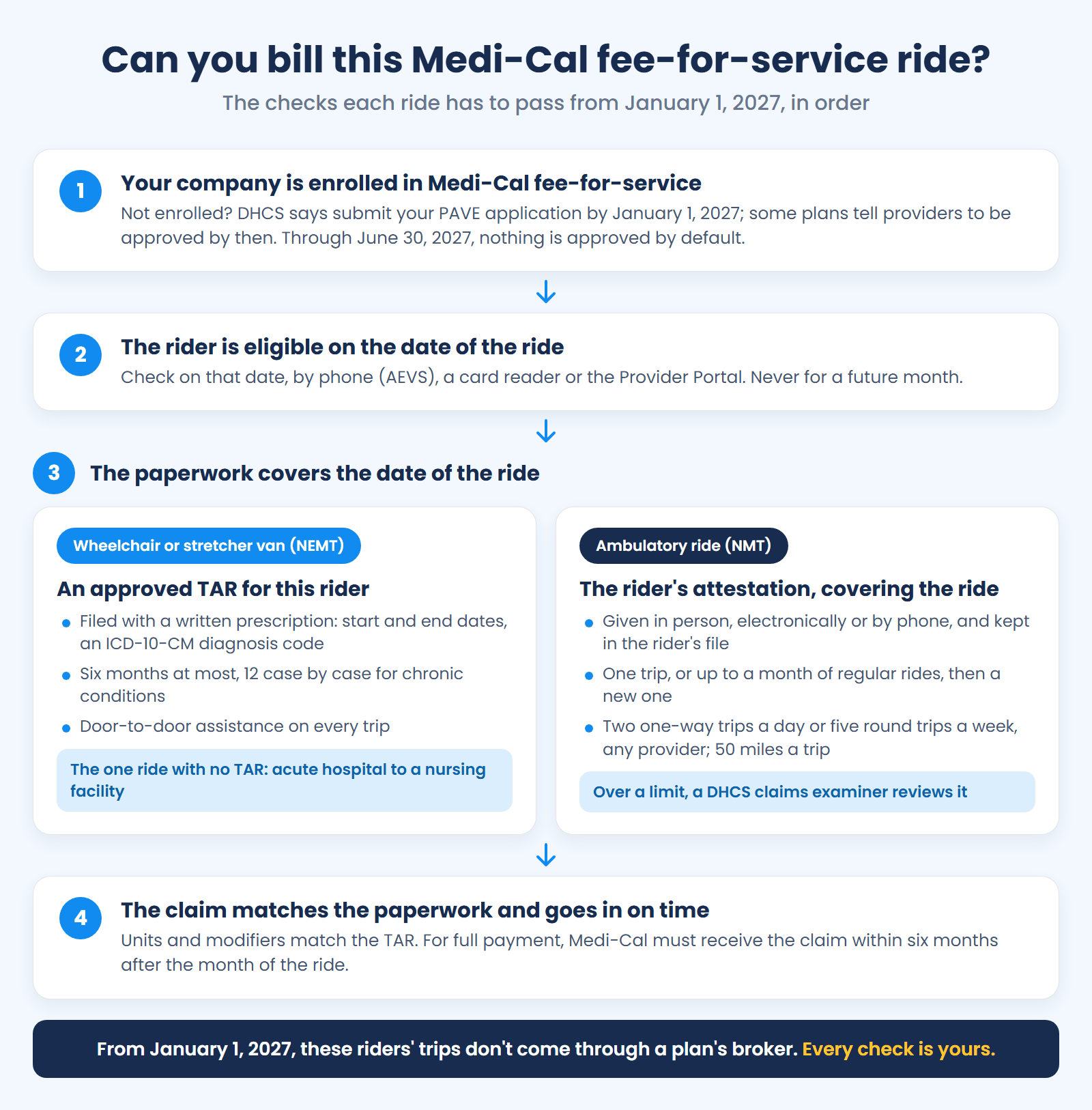
From January 1, these riders’ trips don’t come through a plan’s broker, so every one of those checks is yours.
Wheelchair and stretcher van rides: an approved TAR
A wheelchair or stretcher van ride needs an approved TAR whose dates include the ride, filed with a written prescription that has start and end dates and at least one ICD-10-CM code, the diagnosis code the prescriber assigns. Medi-Cal calls these rides NEMT, for non-emergency medical transportation, and its manual calls a stretcher van a litter van.
The prescription can be DHCS’s NEMT Required Justification form, the DHCS 6182, or the prescriber’s own written prescription, which the manual says “is also commonly known as a Physician Certification Statement” (PCS). Either way, it has to state the trip’s purpose, and it should say how often the rider goes or give the trip dates. It also needs the rider’s limitations in words as well as the code, the modes of transportation, and a statement that the type of transportation is medically necessary. You get it from the rider’s doctor or another licensed prescriber, and it goes in with the TAR.
Prescriptions and TARs both run six months at most; for chronic conditions, both can run up to 12 months, case by case. Continued need after that takes “a new TAR with a new written prescription,” per the October notice. You can file now. The toolkit says, “Starting November 1, 2026, DHCS will accept TARs for impacted members for dates of service on or after January 1, 2027.” That’s the same day the new rules took effect.
For a rider on a standing schedule, like dialysis three days a week, one prescription with the frequency and dates can back a TAR for six months, or up to 12 case by case for a chronic condition. Dialysis riders are among the manual’s own examples of riders who qualify for a wheelchair van. Ongoing rides need more on the prescription, though: the chronic nature of the condition and a treatment plan, because “A diagnosis alone, such as ‘multiple sclerosis’ or ‘stroke,’ will not satisfy this requirement.”
Medi-Cal’s fee-for-service manual now requires door-to-door assistance on every NEMT trip: it “must be provided for all members receiving NEMT.” On the claim, “modifiers on the TAR and the claim must match,” and you can’t bill more units than the TAR approved.
One edge case: the only NEMT ride that needs no TAR, prescription or clinician signature is a transfer from an acute care hospital to a nursing facility, Level A or B, for a rider who was an inpatient there. It’s billed with the modifiers HN and QN.
Some things the toolkit and the manual leave open. DHCS says it will offer “special handling” when it already has the plan’s authorization on record for the same service: you’d still file an eTAR, but without the medical-justification attachments. The toolkit doesn’t say whether that covers transportation. Whether a PCS the plan already has carries over, and how many trips and miles to ask for on a six-month TAR, are open questions too. Ask DHCS’s Provider Helpline, (800) 541-5555, before you count on any of it.
This month, for each wheelchair or stretcher rider you’ll drive in January, get a prescription with start and end dates and an ICD-10-CM code, and file the TAR.
Ambulatory rides: the rider’s attestation
An ambulatory ride needs the rider’s attestation, given to you in person, electronically or over the phone, “that they have an unmet transportation need and that currently available resources have been reasonably exhausted.” Medi-Cal calls these rides NMT, for non-medical transportation.
At a minimum, the attestation carries the rider’s name and Medi-Cal ID, plus verification of the appointment, or a receipt for an unscheduled stop like a pharmacy pickup. The unmet need is shown by any one of five reasons the manual lists:
- no valid driver’s license
- can’t afford fuel for a private vehicle
- no working vehicle in the household
- can’t travel or wait for care alone
- a medical condition that affects the rider’s ability to travel
Someone who advises California providers put the phone version plainly on that October call: “It could be verbally, but they have to have it somewhere registered.” The manual agrees on both counts. One attestation covers a single trip or up to a month of regular rides, and after that, the rider gives a new one every month.
Since November 1, ambulatory rides are limited to “Two (2) one-way trips per day or five (5) round trips per week, per Medi-Cal member, any provider,” and 50 miles a trip. A rider with appointments three days a week makes three round trips, inside the weekly five. Rides over a limit can still be given, but their claims need review and approval by a DHCS claims examiner, with documentation that the rider needed the ride to reach covered care.
Set a monthly renewal date for every ambulatory rider’s attestation, and keep each one in the rider’s file.
How do you bill Medi-Cal for the ride?
Bill each ride on a paper CMS-1500 or electronically through the Provider Portal, so that Medi-Cal receives it within six months after the month of the ride. For a ride with a TAR, the claim carries the TAR’s control number and modifiers that match it.
Medi-Cal’s claims manual gives its own example of the six-month limit: a service on April 15 has to reach Medi-Cal “prior to October 31.” Late claims still pay, just less: 75 percent of the payable amount in the seventh through ninth month after the month of service, 50 percent in the tenth through twelfth, and after that they’re denied. Medi-Cal pays on a weekly checkwrite schedule.
The ground manual also wants a round trip’s times and destinations, and the full pickup and drop-off addresses behind the miles, in Box 19. The CMS-1500 boxes and a model Medi-Cal claim are in our Medicaid billing guide.
The advisor on that October call said most of the providers they work with have never seen a CMS-1500. Filling one in is mostly assembly, and that’s the part Duet’s NEMT billing software takes on. It generates the CMS-1500 from the trips you ran, priced at the rates you set for Medi-Cal, with every line traced back to the trip record. You still check eligibility, file the TARs, keep the attestations and submit each claim through Medi-Cal’s own process.
Send claims every week, well inside the six-month limit.
Are these trips worth taking at fee-for-service rates?
These trips are worth taking where your cost per trip fits under Medi-Cal’s maximums. Medi-Cal pays your usual charge to the general public, up to $35.30 for a 10-mile one-way daytime trip by wheelchair van, $41.29 by stretcher van and $30.65 for an ambulatory trip.
Those come from Medi-Cal’s rate pages: a wheelchair van base of $20.30 plus $1.50 a mile, a stretcher van base of $26.29 plus the same $1.50, and an ambulatory base of $17.65 plus $1.30 a mile. The wheelchair and stretcher page is dated September 2023, the ambulatory page August 2020. A wheelchair round trip of 10 miles each way tops out at $70.60. Set those numbers against what each trip actually costs you to run.
On a demo in November, I told a startup owner in Northern California that at today’s rates, you lose money on these trips most of the time. I also said the rates will probably go up, and depending on where they end up, getting into this work could become worth it.
By the manual’s own rules, a few kinds of trips fit the math better:
- Standing orders. A regular rider’s TAR, good for up to six months (sometimes 12), spreads one round of paperwork across dozens of trips.
- Shared rides. Riders going from the same pickup to the same destination each need a TAR, and the wheelchair base drops to $16.22 a rider for two, with the miles billed once, on the first rider’s claim. Two riders on one 10-mile trip top out at $47.44 for the van, against $35.30 for one.
- Hospital-to-nursing-facility transfers. They need no TAR at all, at the same daytime maximums as other wheelchair or stretcher trips.
Before you take these riders, price one 10-mile wheelchair trip against $35.30.
The Kern owner told me he’d have a better idea by December or January. You can know sooner. Take one rider who moves, say a wheelchair rider on dialysis three days a week, and walk their Monday, January 4 ride through the four checks. Is your company enrolled? Will the rider show as eligible when someone checks that morning? Does an approved TAR cover January 4? Can the claim reach Medi-Cal before July 31, with modifiers that match? Four yeses, at a price you’ve checked against $35.30, and his plan’s first option, billing it straight to Medi-Cal, is a real one for that ride. A no on any of the first three, and you could be driving it for free.
FAQ
What happens to January trips my plan’s broker already booked?
Ask the plan, in writing, because each plan gets a choice. DHCS’s toolkit doesn’t mention booked trips. For authorizations a plan received before January 1 for services on or after that date, the toolkit says plans “have the option to continue processing provider authorizations or refer the provider to submit a TAR through the DHCS’ Medi-Cal FFS TAR process.” DHCS also says plans have to keep member services running through December 31, 2026. If yours sends you to DHCS, call the Provider Helpline at (800) 541-5555.
What changes for a night ride?
Medi-Cal treats a wheelchair or stretcher van ride between 7 p.m. and 7 a.m. as a night call, billed with modifier UJ. Put the start and stop times on the TAR, in its medical justification field, and on the claim, in Box 19. The wheelchair van base maximum rises to $26.43, so a 10-mile night trip tops out at $41.43, and a stretcher van’s at $47.42. If only one leg of a round trip runs at night, bill it on two lines and put UJ on the night leg only.
What if a rider has no Medi-Cal card?
Check eligibility with the rider’s Social Security number instead: AEVS takes either the BIC number or a Social Security number. With neither, DHCS’s toolkit says to contact the county Medi-Cal office where the rider lives, and you’ll have to identify yourself as a Medi-Cal provider. The rider can get a replacement BIC through that office or through BenefitsCal.
About the author
James O'Donnell cofounded Duet and leads its sales, partnerships, and growth services. He talks with NEMT operators every week, hosts the NEMT Growth podcast, and answers Duet's sales line himself. More about Duet's founders →
Want more trips and less busywork?
See how Duet runs and grows NEMT businesses in a 30-minute demo.