Article
NEMT Cost Per Trip: What Each Trip Costs You to Run
On our example, a trip's own gas and wear cost about $3, but the month comes to $29 a trip. Here's how to find yours.
By James O'Donnell, Cofounder and COO, Duet ·
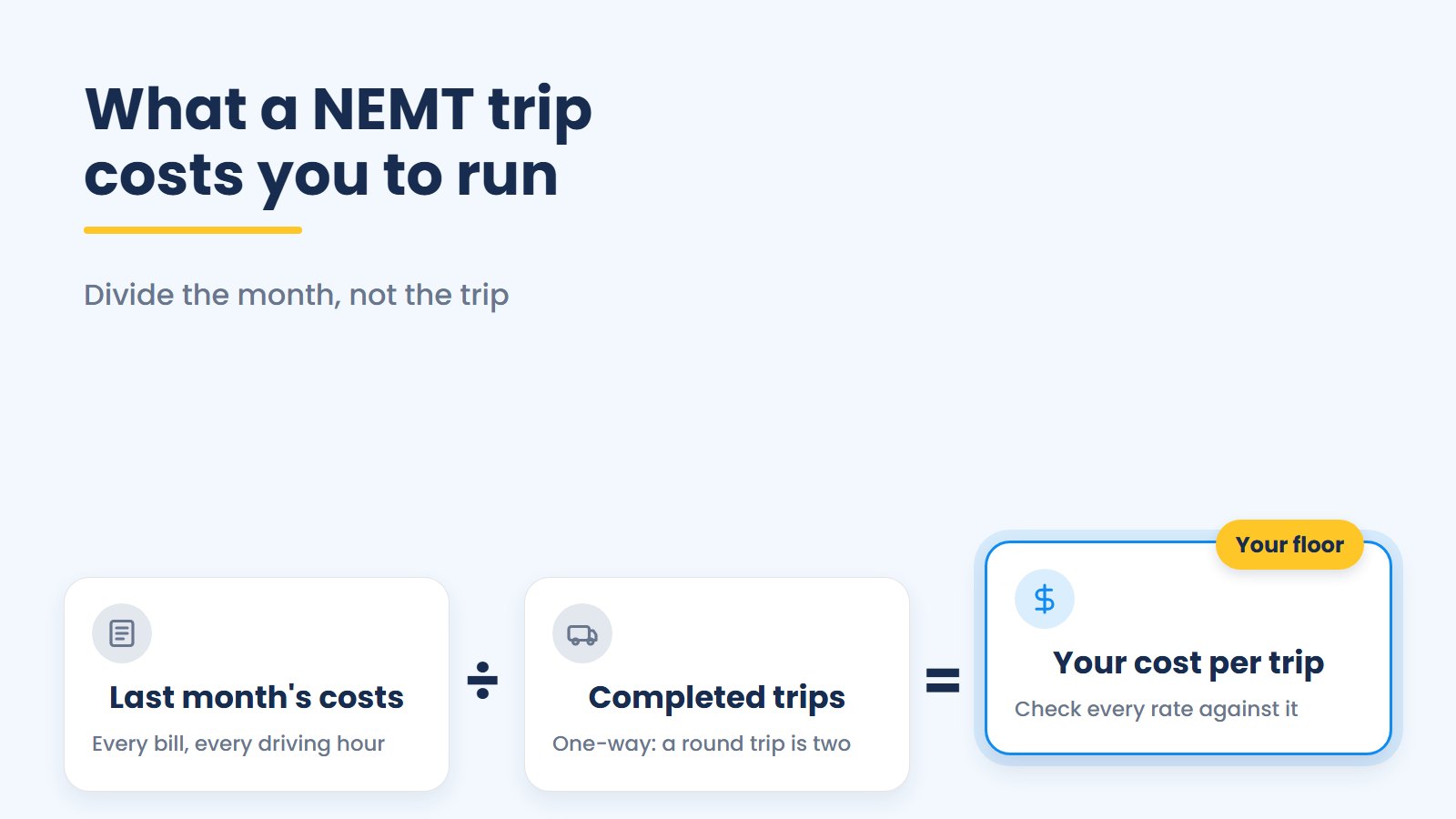
To find your NEMT cost per trip, add up everything last month cost you to run (insurance, the van payment, gas, repairs, phone and software, and every hour someone spent driving, yours included) and divide by the one-way trips you completed. On our example of one financed wheelchair van running 100 trips a month, that’s about $29 a trip before anyone is paid. Count your own driving hours at a driver’s wage and it’s about $60; with a hired driver, about $64.
Very little of that is the trip itself: a trip’s own 10 miles burn about $3.14 of gas and wear, against $28.64 a trip for the month. The rest goes on while no rider is aboard. Rachel Scholler, who ran a NEMT company in rural Wisconsin for 17 years, put the empty part plainly on our pricing episode: if a far-off trip pays “$150 or $200” and you come back unloaded, “that’s almost three-quarters of your day for the one trip.”
Your version of that decision is usually a rate: a broker’s rate sheet, a facility’s offer, or Minnesota Medicaid’s fee-for-service rate of $39.00 for a 10-mile wheelchair trip outside its rural areas (as of October 2026). Next to $3.14 of gas and wear, $39.00 looks generous. Next to the month, it covers the van but not your hours or a driver’s. A trip’s cost isn’t the gas it burns. It’s mostly the van, the insurance and the driver’s hours, so judge every rate against last month’s total costs divided by last month’s completed trips. I’ll take it in the order you’d argue it with yourself before saying yes, starting with what one trip burns and ending with your own books.
What does one trip burn in gas and wear?
On our example van, a 10-mile wheelchair trip burns about $3.14 of gas and wear, and about $7.85 once you add the 15 empty miles each trip averages.
Say you run one financed wheelchair van, bought used for $33,000, that drives 2,500 miles a month and completes 100 one-way trips of 10 miles each, with the bills from our guide to NEMT startup costs. That leaves 1,500 empty miles, or deadhead: the drive to each pickup, the gaps between riders, the trip home. That’s 60% of the driving, an assumption rather than a measured average.
Gas was $4.478 a gallon, the U.S. average for regular the week of Sept. 21, 2026 (the Energy Information Administration’s weekly prices). At 22 miles a gallon, the EPA rating for a 2026 Chrysler Voyager, those 2,500 miles burn $509 of gas. Maintenance at AAA’s 2025 average for newer vehicles, 11.04 cents a mile, adds $276, and an older, high-mileage van will cost more. That’s about 31.4 cents a mile: $3.14 for a trip’s own 10 miles, and $7.85 for the 25 miles the average trip takes once its share of empty miles is in.
Against a $39.00 rate, $7.85 leaves $31.15, as if every trip cleared $31. The month says otherwise.
How do you calculate your NEMT cost per trip?
Divide last month’s total costs by the one-way trips you completed: on our example van, that’s $28.64 a trip before anyone is paid, $59.72 with your own driving hours counted and $64.24 with a hired driver. It’s the formula in our guide to running a NEMT business, where Paul Muench, who runs Gentle Turns Transportation in Phoenix, explains why a round trip counts as two.
Four records give you most of the total: the insurance bill or declarations page, the loan statement, your fuel and repair receipts, and the payroll report. Then four rules:
- Count one-way trips. A round trip is two.
- Count completed trips only. A no-show isn’t a trip, but its driver time and miles stay in the total.
- Spread yearly bills evenly. A $17,400 insurance year paid as $4,350 down and 10 payments of $1,305 still costs $1,450 a month, a twelfth of the year.
- Start with last month, then average three. One slow month or one big repair can swing it.
With more than one van, total every van’s bills, miles and trips, and count a dispatcher’s or office helper’s pay along with the drivers’.
Count your own driving hours too, at a driver’s wage. The Bureau of Labor Statistics counts NEMT drivers with shuttle drivers and chauffeurs, whose median pay was $17.93 an hour in May 2025, about $3,108 a month full time. A hired driver costs you more, about $3,560 a month, once you add payroll taxes and workers’ comp. Here’s the example’s month three ways (a loaded mile is one with a rider aboard):
| Our example, one month at 100 trips | You drive, unpaid | Your hours at $17.93 | Hired driver |
|---|---|---|---|
| Insurance, a twelfth of $17,400 | $1,450 | $1,450 | $1,450 |
| Van payment | $614 | $614 | $614 |
| Gas, 2,500 miles at 22 mpg | $509 | $509 | $509 |
| Maintenance, 11.04 cents a mile | $276 | $276 | $276 |
| Phone | $15 | $15 | $15 |
| Driving hours | $0 | $3,108 | $3,560 |
| Total for the month | $2,864 | $5,972 | $6,424 |
| Cost per completed trip | $28.64 | $59.72 | $64.24 |
| Per mile driven (2,500) | $1.15 | $2.39 | $2.57 |
| Per loaded mile (1,000) | $2.86 | $5.97 | $6.42 |
Add the costs our example leaves out, if you pay them:
- General liability. Brokers and facilities commonly ask for this second policy on top of the auto policy.
- A reserve for the next van, if yours is paid off: about 12 cents a mile, or $300 a month at 2,500 miles, a rough figure from one wheelchair-van dealer’s 2026 lease prices for extra miles.
- Software, accounting, permits and yearly driver checks, with yearly bills divided by 12.
- Card fees, on private-pay trips only.
Leave out what you spent to launch and your own living costs. At Minnesota’s $39.00, only the first column clears.
Why does a trip cost so much more than its gas?
Most of a trip’s cost keeps running when no rider is aboard: the van payment, the insurance and the driver’s hours between riders. With a hired driver, gas is $509 of the $6,424 month, 7.9%. The van payment, the insurance and the driver are $5,624 of it, 87.5%.
New York’s health department found the same shape in a 2022 review of ambulette companies, which run the state’s wheelchair and stretcher vans: personnel was 55% of their 2021 operating costs, fuel 6%. Only 66 of 244 companies completed its survey, and the department called its own study “inherently flawed,” so trust the shape more than the numbers.
The hours are the biggest piece. A full-time driver is paid for about 173 hours a month, or 1.73 hours a trip at 100 trips. The trip itself is shorter: a three-mile wheelchair trip takes 30 to 45 minutes of service, door to door, as my cofounder Jing Zhu explained in her talk on NEMT dispatching. The rest goes to driving between riders, waiting and gaps in the schedule. The owner of a Denver wheelchair service said on a dispatch-software company’s podcast in 2023 that a transport takes his crews an hour and a half on average, and “That doesn’t count driving there and driving to your next pickup.” So, he said, “payroll is two to three hours for a transport.”
Jing made the same point on our pricing episode: drop a rider two hours away and “you have to pay that driver” for the two hours back. “So it’s a solid cost for you.” A no-show is that cost with no trip to divide it by, “strictly out of your own margin,” as Jing put it, and who pays for a no-show depends on the payer.
To find your own empty miles, write down the odometer on the first and last day of the month and subtract the loaded miles in your trip log. On the example, cutting the empty share from 60% to 40% saves only $2.61 a trip in gas and wear, from $28.64 to $26.03. Empty miles get expensive through the driver’s hours, not the gas.
Then there’s your own time. Rachel told me on an earlier episode, in 2025, that as an owner-operator, “I didn’t need to pay myself.” Looking back, she said, “my rates were probably a little bit lower than they should have been.”
Does each payer’s rate cover your cost?
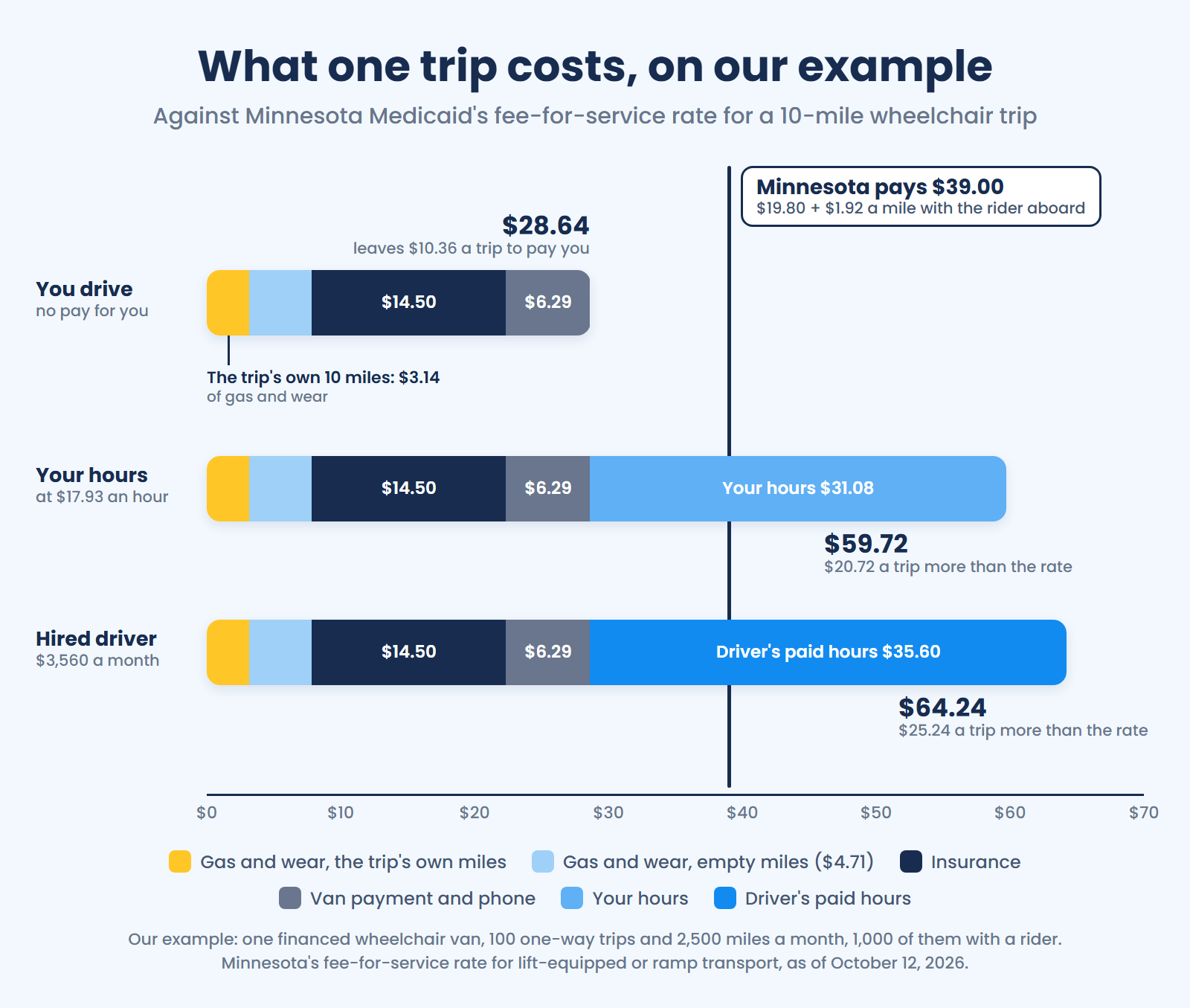
On our example, Minnesota Medicaid’s fee-for-service rate of $39.00 for a 10-mile wheelchair trip covers the van’s $28.64 a trip but not your hours or a driver’s, which take it to $59.72 or $64.24. Private pay covers whatever you build into your price, and a facility pays whatever your agreement says.
Minnesota makes a good yardstick because its fee schedule is public and current: for riders outside the state’s rural areas, it’s $19.80 a trip plus $1.92 a loaded mile in the fee schedule as of October 12, 2026. That’s the state’s rate for trips outside its health plans, which carry about 80% of Minnesota’s NEMT spending, as our guide to who pays for rides in Minnesota explains.
Stack one trip against that rate. The trip’s own 10 miles cost $3.14 in gas and wear and its share of empty miles $4.71, insurance adds $14.50, and the van payment and phone $6.29. That’s $28.64, which leaves $10.36 of the $39.00 to pay you. Count your own hours at $17.93, $31.08 a trip, and it’s $59.72; a hired driver’s paid hours, $35.60, make it $64.24, $25.24 more than the rate.
The per-mile part flatters, too: Minnesota’s $1.92 a loaded mile works out to 77 cents a mile driven when 10 of every 25 miles carry a rider.
Medicaid and brokers generally don’t pay separately for the empty miles, the wait or a no-show. Minnesota’s human services department told a state House committee in March 2026 that “NEMT providers cannot bill for ‘no load’ miles,” such as the drive to a pickup (its slides to the committee). CMS, the federal Medicaid agency, says no-load miles generally can’t be paid as their own service, though states “may build the cost of no load miles and beneficiary no-shows into their transportation payment methodology” (its 2023 coverage guide). Nebraska’s Medicaid fee schedule, revised January 1, 2026, says its base rate includes “unloaded mileage, and usual waiting/standby time.” So the base rate is where those costs are supposed to be paid, and your cost per trip tells you whether it covers them.
On private pay you set the price, so you can charge for what Medicaid doesn’t pay separately. A Reno company’s tariff filed with Nevada’s Transportation Authority, accepted May 22, 2026, charges $50 per 30 minutes of wheelchair waiting and the full fare for a cancellation inside two hours. Card fees come out of what you collect: about $2 to $3 on a $75 trip at published card-processing rates (October 2026), depending on how the card is taken.
Your cost per trip is only the floor. When I think about pricing, I start from what the market pays and check costs against it, and what to charge for a private-pay ride has its own section in our private-pay guide.
Facility trips pay whatever the agreement says. Christopher Buell, who’s been in NEMT for decades, writes the extras in: “I have wait time, cancel time… I’m putting all that in my service agreement,” he said on our episode on calling facilities. The other end looks like University Hospital in Newark’s 2026 request for transportation proposals, which caps rates at New Jersey’s Medicaid rate, pays 45 days after the invoice and has no line for waiting or cancellations.
Before you sign or renew with any payer, set your cost per trip beside what it pays for your most common trip.
What moves your cost per trip the most?
How many trips you fit into the hours and the month you’re already paying for moves your cost per trip more than anything else. Before anyone is paid, 73% of the month is fixed: the insurance, the van payment and the phone cost the same at 60 trips or 140. Here’s the example van’s cost per trip as trips rise, at 25 miles a trip:
| Completed trips a month | Cost per trip, you drive unpaid | Cost per trip, hired driver |
|---|---|---|
| 60 | $42.50 | $101.84 |
| 80 | $33.84 | $78.34 |
| 100 | $28.64 | $64.24 |
| 120 | $25.18 | $54.84 |
| 140 | $22.70 | $48.13 |
With a hired driver on the same 173 paid hours, the cost per trip falls to Minnesota’s $39.00 at about 181 trips a month, about eight every weekday. That’s under an hour of paid time per trip, against 1.73 hours at 100 trips. If your trips take longer, you’ll hit overtime or need a second driver first, and both move that line.
With hired drivers, the other lever is shifts that follow the trips, so you aren’t paying for hours with nobody to carry. A lot of Rachel’s drivers were retirees who “didn’t mind split shifts, half days.”
Insurance moves it a lot too: at $1,200 a month instead of $1,450, the van costs $26.14 a trip before anyone is paid, and at $1,800, $32.14. An established fleet can pay far less (Rachel was paying about $500 a month a van when she sold), and what NEMT insurance costs a new company explains the gap.
Gas moves it by cents. At $4.331, the U.S. average for the week of Oct. 12, each trip costs 17 cents less. An older Grand Caravan, rated 20 mpg in its 2016-2019 models, adds about 51 cents a trip. Heavy lift vans like the Ford Transit T-350 have no EPA rating at all, so go by your fuel receipts.
Sharing rides pulls it down, where riders can ride together. Rachel took nursing-home residents on outings eight or 10 at a time at a discounted rate per person, and still made more “than if I did one transport.”
Should you take a trip that pays less than your cost?
A trip that pays less than your cost per trip is worth taking when it fills time you’re already paying for and pays more than its own gas, wear and extra driver pay.
At the example’s 31.4 cents a mile, a trip’s own extra cost is $3.14 of gas and wear if the van’s already headed that way, and up to $7.85 with a full 25 miles. An hourly driver who’s on the clock and would otherwise sit idle costs nothing extra for it. A driver paid by the mile or by the trip adds that pay; one customer Jing described pays drivers “two parts. Hourly rate and also based on mileage.” And a trip that runs a driver into overtime adds the overtime.
The insurance and the van payment get paid either way, so turning the trip down doesn’t make them smaller, and whatever it pays above its own cost goes toward them. A fill-in trip belongs in idle time, though, not in the catch-up room you keep in each van’s day for late pickups. And it only works at the edges: if your trips pay less than your cost per trip on average, the month loses money.
Take and turn down trips strategically. A rough trip from an ER discharge desk that sends you good ones is a different call from a random broker trip where you’ll break even or lose money. Rachel’s version was shorter: “there’s no shame in turning trips down.”
How do you run the numbers on your own books?
Pull last month’s records, plus the two odometer readings and the trip log, and let the free NEMT cost-per-trip workbook (.xlsx) do the division. The blue cells start with our example, so overwrite them:
- Tab 1, steps 1 and 2. Enter last month’s fixed bills, then the miles from your odometer and trip log and your gas and repair spending.
- Tab 1, steps 3 and 4. Enter any drivers’ wages, the hours you drive in a typical week, the wage you’d pay a driver (it starts at $17.93) and last month’s completed one-way trips, with no-shows left out.
- Tab 2. Enter what up to three payers pay for your most common trip: the base rate, the per-mile rate and the miles with a rider aboard.
Tab 1 returns your cost per trip with and without your hours, per mile driven and per loaded mile, and your share of empty miles. Tab 2 sets each payer’s rate against it and checks a fill-in trip; tab 3 lists the example’s sources.
Duet’s reports let you export the trips each vehicle ran and the dollars they brought in, so you can put your own costs beside them and see what each van is doing for the business. Drivers clock in and out in Duet’s driver app, payroll hours flow from those clock-ins, and the hours export too. Providers also use its map of pickups and dropoffs to decide where to hire drivers and park vans overnight, cutting deadhead miles and fitting more trips into each van’s day. The insurance bill, the loan statement and the odometer readings still come from you. Duet is free while you run fewer than 100 trips a month; past that, most providers pay less than $50 per active vehicle a month.
This week, run last month’s numbers once, then again with your own hours at $17.93, and compare both with your biggest payer’s rate. Paul put it this way on our 2025 conference panel: “start with getting a handle on what your expense is and be able to break that down to the expense per ride.” Then run the next far-off trip through it before you say yes. Rachel’s $150 or $200 trip would still cost you most of a day.
FAQ
Is there an industry average cost per trip?
Not a national one with a real population and method behind it. The cost-per-trip figures that come up in search come from software vendors and an insurance agency, and the ones that show their math assume about eight trips a van a day, nearly twice our example’s 100 a month.
Can you use the IRS mileage rate as your cost per mile?
Not for a wheelchair van. The IRS’s 2026 business rate, 72.5 cents a mile through June 30 and 76 cents from July 1, is an optional deduction rate for cars and vans in general, and it has no driver’s hours in it. Our example van costs $1.15 a mile driven before anyone is paid, and $2.57 with a hired driver.
Does a stretcher trip cost more to run?
Usually, because it takes two people. Jeanine, who runs SailorGirl Transport, sends two on every stretcher trip, “whether it’s 5 minutes down the street or 15 hours down the road,” as she told me on our long-distance episode. On our stretcher episode I put it simply: “you’re paying for that second attendant.” Count the second person’s hours when you run a stretcher van’s numbers.
About the author
James O'Donnell cofounded Duet and leads its sales, partnerships, and growth services. He talks with NEMT operators every week, hosts the NEMT Growth podcast, and answers Duet's sales line himself. More about Duet's founders →
Want more trips and less busywork?
See how Duet runs and grows NEMT businesses in a 30-minute demo.