Article
AI in NEMT: What It Can and Can't Do for Operators (2026)
Put AI on the work nobody would do, like the 10 p.m. call. Leave who rides with whom to the person who knows your riders.
By James O'Donnell, Cofounder and COO, Duet ·
As of October 2026, AI earns its keep in a small non-emergency medical transportation (NEMT) company on the work nobody else would get to. That means the call that rings out at 10 p.m., the reminder calls nobody has time for, a week of dash-cam footage and a trip list too long to read. Where a person who knows your riders already does the job, like deciding who drives whom tomorrow, AI should hand that person a draft and stop there.
This summer, a solo owner-operator in the Charlotte area told me on a call that he’d been asking around about AI. He drives his own van and runs mostly private-pay trips, and most of his riders are “50, 60-plus.” His finding: “if it’s more of an older person, they’re not really too fond of AI assistants.” Riders he’d picked up told him they went with him because “they like talking to a person,” though, he’s found, a grown child booking for a parent doesn’t mind an AI. He’d thought about adding one, then didn’t: “I just got five, six clients because I don’t do AI.” When he can’t pick up, his calls roll to a family member.
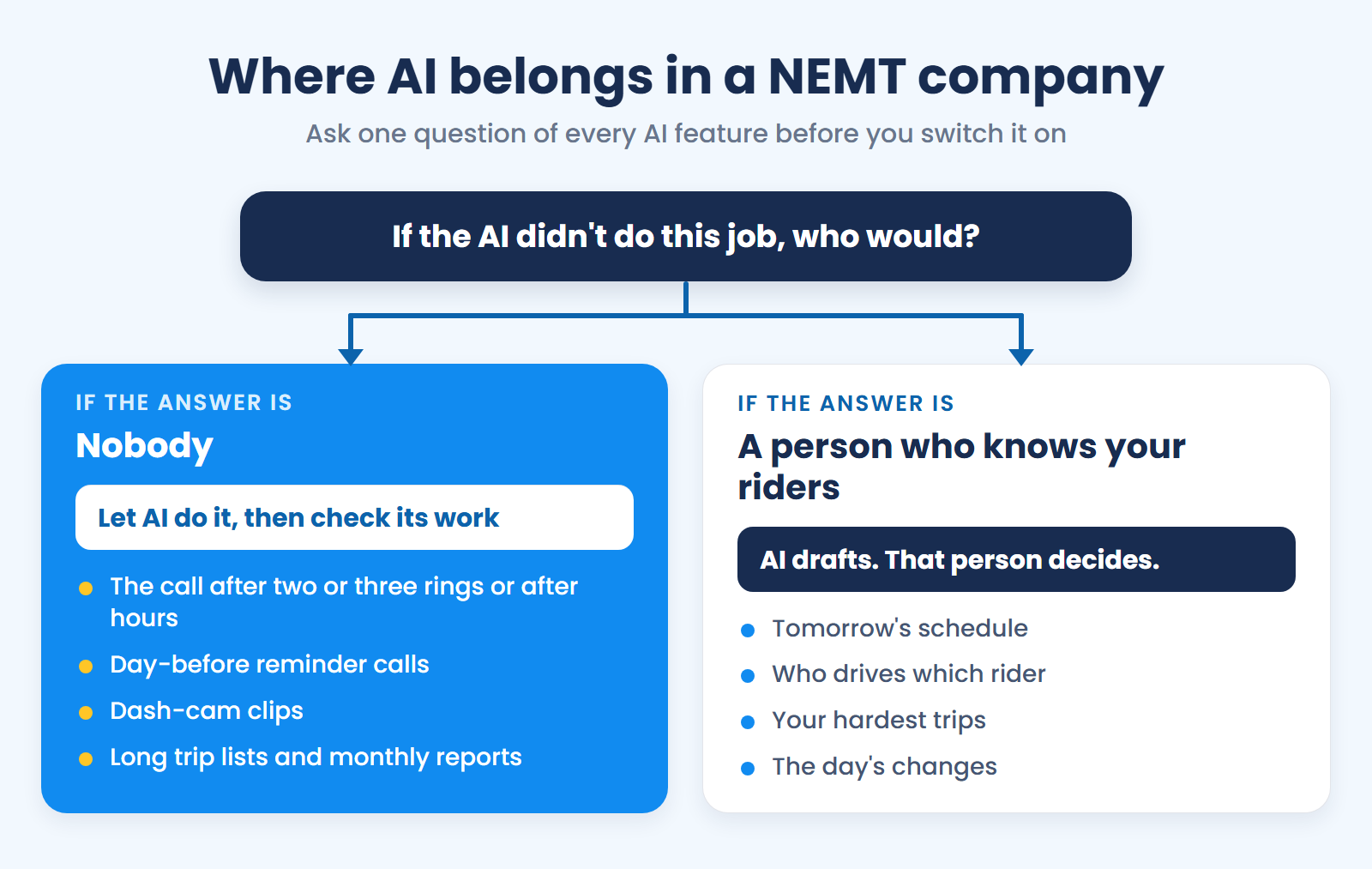
I told him what I tell most owners: “a human is the best way to answer the phone, always,” and AI belongs “between humans and the answering machine.” For him, the family member is the better backup, and AI comes in only if that person gets too busy. That’s the test for any AI feature: if the AI didn’t do this job, who would? If the answer is nobody, and the work is worth doing, hand it to AI and check its work. Below, those four jobs come first: the phone, reminder calls, dash-cam footage, and trip lists and reports. Then comes tomorrow’s schedule, the one job where AI only drafts and the dispatcher who knows your riders decides who rides with whom, then how who pays changes the answer and how to test a tool.
Should AI answer your phone?
A person who knows your riders should answer first, and AI should take only the call that would otherwise ring out to voicemail, because nobody else will.
The real alternative to AI on that call is voicemail, not your dispatcher, and a caller who reaches voicemail often calls the next company on Google. As I said on our episode with Josh Hagen of Careway Mobility, “everyone would rather talk to a human, but it’s a lot better than an answering machine.”
Daytime facility calls are where a person matters most. An owner in Orange County, California runs a small wheelchair-and-stretcher fleet for facilities and private-pay riders. He told me he’d paid for the generic AI receptionist add-on from his phone provider, then decided not to renew it: “I don’t have time to train it that much.” He could see a tool like that covering after hours, but “for daytime facilities, they expect somebody to answer.”
If you drive half the day yourself, those driving hours are what a backup is for: a family member, a live answering service or a voice AI that takes the booking. A tech-forward Ohio owner, two years into a small facility-focused fleet, said on a 2026 industry podcast that he uses a 24/7 live answering service because “I have found that seniors really love a live answering service.” Any of them beats voicemail.
That’s the gap Duet’s voice AI is built for. Your team answers first. When nobody picks up after two or three rings, day or night, it answers, takes the trip details and books the trip onto your Duet dispatch board, with a transcript and summary of the call saved for your dispatcher. A caller who asks for a person gets transferred back to your business line, so riders always have a path to a human. It’s built for NEMT calls, so it knows a wheelchair trip from a stretcher trip, and we tune its script with you. It’s included with Duet’s dispatch software at no extra cost, and you still decide who drives each trip.
So set your business line to roll to a backup after two or three rings, and make the backup something that takes a booking, not a voicemail box.
Should AI make your reminder calls?
AI can make the day-before reminder calls nobody on your team has time for, as long as each reminder reaches the phone the rider actually answers.
A one-van owner-operator told me on a call that “some people do request that phone call,” but “I might be too busy to give them a call.” Nobody else is going to make those calls, so hand them over, except for riders who’ve told you they’d rather hear a person, like the Charlotte owner’s. Whoever makes the call, a cancel or a “make it 10:30” has to reach your dispatcher the same day.
The catch is the phone. About one in ten adults 65 and older (10.0%) still answered their calls mostly or only on a landline in the federal health survey for July to December 2025, and a landline can’t show a text. And 16% of people 65 and older had a cellphone that isn’t a smartphone in the Pew Research Center’s 2025 survey, so a link in a text may not open. Those are national figures, so check your own rider list, and don’t let automated reminders default to texts.
Some brokers already remind riders, too. In a June 2024 presentation to Wisconsin’s health department, MTM, one of the national NEMT brokers, said it sends its own “Ride Reminder” 48 and 24 hours before each trip. It goes by phone call unless the rider picks an app notification or a text, and the same slides still require providers to contact riders the day before. Our no-shows guide covers which riders need a call instead of a text and who gets a second try the morning of.
Before you switch on automated reminders, mark the riders who answer only a landline or a phone that can’t open links, and ask each broker what it already sends and what it still requires from you.
What do AI dash cams actually save?
An AI dash cam saves review time: it picks the clips worth watching, and a person still watches them and talks to the driver.
A Tennessee fleet owner said on an industry podcast that his transportation director used to spend “5 to 10 hours a week” looking at video. Now, with an AI camera system flagging the clips, the review “takes maybe 10 minutes a week,” with reports for each driver. That’s one operator’s report, not a typical result, and he added a caveat: a camera is “only as good as the monitoring.”
A federal study points the same way. NIOSH, the federal workplace-safety research institute, tested in-vehicle cameras and warning lights on 315 trucking and oil-field vehicles over about two years (Journal of Safety Research, 2017). Risky driving fell more when supervisors coached drivers from the video than with the in-cab lights alone, and the lights alone did no better than no feedback.
If your cameras flag clips, go through the flags every week, and talk to each driver they name within the week.
Can ChatGPT or Claude help with the office work?
ChatGPT or Claude can sort the trip lists and reports nobody would read line by line, once the riders’ names, addresses and ID numbers are out and you check what comes back.
A Georgia owner running two vehicles on VA trips (for the Department of Veterans Affairs) told me on a call how she works through her VA trip list. She has ChatGPT and Perplexity pull out the trips “within 20 or 15 miles of pickup for me, no matter where they’re going,” and the AI points out which ones look good for her. Broker trip lists come out as spreadsheets too: MTM’s July 2026 Rhode Island provider handbook lets providers export trips as “Excel or CSV,” CSV being a plain spreadsheet file.
Before you upload a list like that, delete the riders’ names, street addresses, phone numbers and Medicaid or member ID numbers, and keep a trip number so you can match the answer back. If it’s a broker’s list, check what your agreement says about sharing it. Towns or ZIP codes and pickup times are enough to sort by distance. Then ask something like “which of these trips pick up within 15 miles of my ZIP code? Give me the trip number, town, time and destination,” and check a few on a map before you accept anything.
Reports work the same way. On a call in June, my advice was simple: export a month of trips, “plug that into ChatGPT or Claude or your favorite AI,” and ask which drivers run noticeably better or worse on time. The export needs the actual pickup times as well as the scheduled ones. A private-pay operator on an operators’ community call I was on set up Claude to pull his Google Ads numbers, match them against his own booking records and report back: “This is what we lost. This is why we lost it.” He was just as clear about the next step: “you obviously want to look over that.”
One caution. A Florida consultant who works with NEMT owners told me on a call in August that many of them think they can build their own tools with Claude. Making something reliable takes patience and time they don’t have, though, and the project they start on a Monday morning sits untouched for three weeks. Sorting a list is a different job from building software.
Export last month’s trips, delete the riders’ names, addresses, phone numbers and ID numbers, ask ChatGPT or Claude which pickups ran late and what they had in common, and check three of its answers against your own records.
Can AI build tomorrow’s schedule?
Scheduling software can draft tomorrow, but a person already does this job well: the dispatcher who knows which rider won’t share a van should finish the draft and pick each driver.
Most of what I see sold as AI scheduling is optimization math, the kind public paratransit agencies have bought for decades, and the public record on it is mostly old and modest. A 2004 report from the federally funded Transit Cooperative Research Program, TCRP Synthesis 57, found agencies could build the next day’s schedule with fewer people. But in a 2001 national survey of operators it summarized, before-and-after comparisons, on the whole, “did not show the kind of dramatic efficiency changes that operators have hoped for.” Let the software do the first pass, then finish the draft yourself.
The draft slips in predictable places. The managing partner of a large Florida operator told me on a call that their auto-scheduler can pack the local trips onto every driver, then ask for an extra driver to cover the long-distance ones. So his team places the long trips by hand first.
My cofounder Jing, who wrote our piece on the difference between scheduling and dispatching, summed it up on our dispatching episode: “medical transport is so much more than just routing optimization.”
The person’s edge is knowing the riders. As I’ve said on demos, “no algorithm is going to know the riders or the facilities the way you do.” Maybe two of your riders are happy to share a van, but “Dolores would never want to ride with anyone else.”
A dispatch-software CEO on a panel at the 2026 conference of NEMTAC (the NEMT industry’s accreditation commission), who sells scheduling software, put the rule plainly: “AI should suggest and human should decide.” I agree, with one addition: the person needs rules for when to change the draft. Honolulu’s city auditor found in 2016 that schedulers’ manual overrides of its paratransit system “created problems, including late pick-ups, longer user time spent on vans, and poor customer service.” The same audit found the system couldn’t place 4,134 trips in December 2014, because rider demand ran past what it had room for (Honolulu audit 16-02). Software can’t add vans, and ad-hoc changes make their own late pickups.
Three rules cover most of it. Place the long-distance trips by hand before the software fills the day. Check every hard trip yourself before you assign it: stretcher, oxygen and bariatric runs if you have them, multi-loads and riders who need extra loading time. And change anything else only for a reason you can name, like Dolores.
Where AI fits depends on who pays for the trip
Who pays changes where AI earns its keep: the phone matters most for private-pay trips, the trip list for broker trips, and a person on the line for facilities during the day.
| Job | Broker (Medicaid) trips | Facility trips | Private-pay trips |
|---|---|---|---|
| Answering calls | Most trips come through the broker’s portal or software; some brokers still phone in urgent trips or will-call returns | Staff expect a person during the day; after hours, a backup that takes bookings | Families often book whoever answers first, so an AI backup earns the most here |
| Reminder calls | Some brokers remind riders themselves; keep any day-before call your broker requires | One call to the front desk often confirms the day’s riders, and some facilities need none | Send the reminder to whoever booked, often a family member, as well as the rider |
| Tomorrow’s schedule | Brokers assign or offer their trips; MTM’s system looks for routing and shared-ride opportunities before it assigns them, and you choose which offered trips fill your gaps | Recurring appointment runs anchor the draft; same-day discharges are a person’s call | On-demand bookings land after the draft; a person fits them in |
| Trip lists and reports | The offered trips, sorted by distance from your base | Trips and on-time by facility, so you know where each account stands | Booked and lost calls, and why |
As private pay grows, the phone backup matters more. As broker volume grows, the trip list does.
How to check an AI tool before you trust it
Before you trust any AI tool, ask who finds out when it’s wrong and how fast, then try it on last week’s hardest trips. Start with the test from the top of this guide: if the AI didn’t do this job, who would?
Then put the tool through the checks that fit it:
- Who finds out when it’s wrong, and by when. Ask what happens when the AI books or assigns something wrong, who sees it and how fast. As a NEMTAC 2026 panelist put it, “you don’t get to outsource the tech and outsource the accountability.”
- For a scheduling tool, your hardest trips. Ask for a trial on your own trips before you sign, and run it on last week’s five hardest ones. Check whether each got assigned, on time, with enough loading time and the right vehicle. As one panelist warned, don’t settle for “Ooh, look, I’m on time for all of these easy trips.”
- For a phone or booking tool, the fields your dispatcher needs. Pickup time and appointment time belong in separate fields, because the appointment is the time you can’t miss, and office notes stay apart from what the driver sees.
- For anything that talks to riders, a person on the first ask. A caller who asks for a human should get one the first time. No rider should have to “scream representative representative representative three times,” as one of the panelists said.
- Who measured the number. Ask any vendor who measured its number, on which fleet and over what period, then talk to owners who use the tool. Even a software vendor speaking at a 2025 conference told owners to “talk to actual users of this AI,” and not “people like me who try to sell you a product.”
Before your next AI demo, write down who does each job the feature would do today. The Charlotte owner’s answer, for his phone, is a family member. The day that person can’t pick up either, the answer is nobody, and that’s the call to hand over.
FAQ
Will AI replace my dispatcher?
Not the part of the job that decides the day. Scheduling is the plan for tomorrow, and dispatching is everything that changes once the vans roll. As my cofounder Jing put it on our dispatching episode, dispatching is the adjustment on the day: a driver stuck in traffic, a flat tire, a no-show, a rider who comes out 15 minutes late. That’s still a person’s job.
Is route-planning software really AI?
Under a federal definition, yes: AI means “a machine-based system that can, for a given set of human-defined objectives, make predictions, recommendations or decisions influencing real or virtual environments.” Route and scheduling math fits that, and so does a voice agent. They’re different kinds of AI, though, so ask any vendor which kind its “AI” is.
Does any state use automation to check on NEMT providers?
Ohio’s law now requires it. A state law in force since October 6, 2026 requires Ohio’s Medicaid department to develop and implement automated fraud-detection tools. They must be able to flag “anomalous or irregular patterns by nonemergency medical transportation service providers” and “discrepancies between location data and submitted claims,” and the department also has to run periodic audits and investigations (Ohio Revised Code 5164.404). The same law has the department require the Medicaid NEMT providers it covers to use an electronic system that verifies trips with GPS within 18 months (Ohio Revised Code 5164.401), so by about April 2028. As written, the law leaves out ambulette and ambulance companies the state’s EMS board licenses. If you run trips in Ohio, make sure your drivers’ trip times and locations match what you bill.
About the author
James O'Donnell cofounded Duet and leads its sales, partnerships, and growth services. He talks with NEMT operators every week, hosts the NEMT Growth podcast, and answers Duet's sales line himself. More about Duet's founders →
Want more trips and less busywork?
See how Duet runs and grows NEMT businesses in a 30-minute demo.