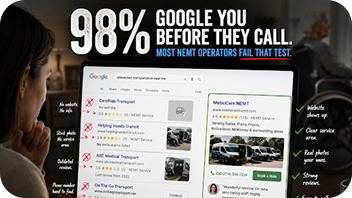
Article
The 5 Must-Haves for an NEMT Website
Harry Chambers is a digital marketing expert and a two-time guest on our podcast. Here's what he checks in the first 20 seconds on a website, the five things every NEMT site needs, and the 30-minute quote clock behind all of it.
Guest: Harry Chambers, digital marketing expert. Episode 23 of the Duet NEMT Growth Podcast.
By James O'Donnell, Cofounder and COO, Duet · · Updated
Before every demo I do, I look the company up. I want the same three things a daughter wants when she’s booking her mother a ride to dialysis: what you do, where you do it, and whether anyone else was happy with you. On a lot of NEMT websites I can’t answer the first two. By my rough count, a quarter or more never say where the company is located, and most of the rest don’t say it until you’ve scrolled past everything else. Google can’t figure it out either, which is why those companies don’t show up when someone searches “wheelchair transportation near me.”
So I brought Harry Chambers, a digital marketing expert, back on the podcast. He was one of the first guests we ever had, on episode 2 [2], and for episode 23 I asked him for the five things an NEMT website has to have to bring in private-pay riders [1]. His list is below, along with his rule on posting prices, how fast you have to answer a quote request, and what I see looking up NEMT companies every week.
A private-pay rider is a consumer with options, and that decides everything else on this list. Nobody handed them your name the way a broker hands you a trip. They found you on Google, or a neighbor mentioned you, and now they’re checking, at 9 p.m., when they can’t talk to you. All they can do is read.
What does a private-pay rider look for on an NEMT website?
A private-pay rider, or the family member booking for them, wants three answers in the first few seconds on an NEMT website: what you do, where you do it, and what other people say about you. Harry checks the same three things in the first 20 seconds of any site he reviews, and most of what follows is about answering them without making anyone scroll.
Start with the top of the page, the part web people call the hero section. It should say the service and the place. The biggest text on the page, your headline, should name the service you most want to sell and the city and state you sell it in. “Wheelchair transportation in Houston, Texas” does the job. Google matches that headline to what someone typed, and a family reading it knows in a second that you do what they need where they live. The adjective in front of it matters less than people think:
“You can use whatever adjective you want to describe your business, like reliable, affordable. That stuff is in the noise. Don’t get caught up in ‘every company has reliable.’ Nobody cares. Make sure you have the service you want people to know you do the most, and where you do it.”
Right under the headline, put your rating or your reviews. Harry’s advice is a Google five-star badge or the reviews themselves directly beneath the hero, so a visitor confirms three things in one glance: right kind of company, right area, real reputation. Then make the service area impossible to miss. A map, or a plain list of the counties you cover, on the homepage. Harry’s read on the family that has to dig for it: they’ve probably already lost interest and gone to the next company.
Now build all of that for a phone. Harry’s number for NEMT sites is about 80 percent mobile. An operator I know who watches his own analytics sees 60 to 70 percent. Google itself indexes and ranks the mobile version of your site, not the desktop one [5]. So three or four long paragraphs about your mission, which look fine on a laptop, become a scroll that never ends on a phone. Keep the homepage copy in short blocks, and let the About page be the one place you go long. My own rule: design the site on your phone, and review every draft on your phone.
And make the phone number a button. A 65-year-old booking a ride for his wife doesn’t want to copy your number and paste it into his dialer. He wants to press something. Harry calls click-to-call the easiest way to do business with you, and it belongs at the top of every page, never only in the footer.
Now the five.
Must-have 1: Which levels of service should an NEMT website explain?
An NEMT website should spell out the levels of service you offer: curb to curb, door to door, door through door, or a full medical concierge, plus a wait-and-return option if you have one. Consumers who’ve never bought a medical ride compare you to Uber, and the level of service is the difference they can see.
Harry put this first because of how often riders confuse NEMT with a rideshare. If your site just says “medical transportation,” a family doesn’t know whether you’ll walk Dad from his apartment door to the exam room or drop him at the curb. Spell it out on the homepage, and make it a choice on the booking page, so someone can pick door through door and you can quote it. People will pay more for premium service, but only for a premium they can see.
The wait-and-return line is the one I’d underline. If you’ll wait at the appointment and be there when they come out, say so, even on ambulatory trips. That one sentence separates you from every curb-to-curb rideshare in town.
Must-have 2: Does an NEMT website need a separate services page?
Yes. Put about four services on the homepage with a “view all services” button, and give the full list its own page: each service with a short description and a get-a-quote button. The homepage is the hook. The services page is where a rider confirms you do the thing they need, and where Google finds the words people actually search.
If people search “wheelchair transportation,” your site needs to say wheelchair transportation, on the homepage and on a services page that describes it. Whether you break it out further, with a separate page for stretcher, bariatric, or dialysis trips, is a market-by-market call. Harry’s view is that more content only helps you rank, and either structure works. Mine is that separate pages earn their keep the day you run Google Ads: the stretcher ad lands on the stretcher page and the wheelchair ad on the wheelchair page, and at that point you’re writing as much for Google as for the reader, which is fine as long as each page has real substance.
One pattern Harry sees in website analytics is worth knowing before you build deep service pages. People land on the stretcher page, jump back to the homepage to figure out who you are, then return to the stretcher page to book. A great stretcher page never excuses a weak homepage.
Must-have 3: How should an NEMT website show reviews?
Show real reviews on your NEMT website, pulled live from Google, Facebook, or Yelp, with each one clickable through to the original, and filter the widget to three or four stars and up. A typed-in testimonial with a first name under it makes people wonder if it’s real. A review they can click and verify doesn’t.
I asked Harry for the single website change he’s seen make the biggest impact. He didn’t hesitate:
“Reviews, by far. You can have a great-looking website, but if people come to it and they’re not sure if anybody’s used this service before, they don’t want to be your guinea pig. People hate being the first customer.”
His example:
“They’ve been in business for 10 years, had great reviews, probably 60 or 70 five-star reviews, and none of them were on the website. You’ve got all these people saying great things about you, and you don’t make sure people know that when they land on the website.”
Harry’s tool for this is a widget that pulls reviews from Google, Facebook, and Yelp automatically, so the site updates itself as new ones come in. Plenty of standalone widgets do the same thing, and most let you filter out one- and two-star reviews. Do that. The full profile is one click away for anyone who wants it; your website puts your best foot forward. If you have no budget at all, you still have no excuse. Screenshot your five best reviews, put them on the page, and link to the rest. Harry’s words: “Screenshot it. I don’t care.”
The reviews also have to exist. Harry’s rule of thumb: with zero reviews, your profile is findable by name and rarely shown to anyone else. Three or four turn it on. Above ten, if they’re positive, you start showing up again and again. Google says as much in its own guidance: more reviews and positive ratings can help your local ranking [4].
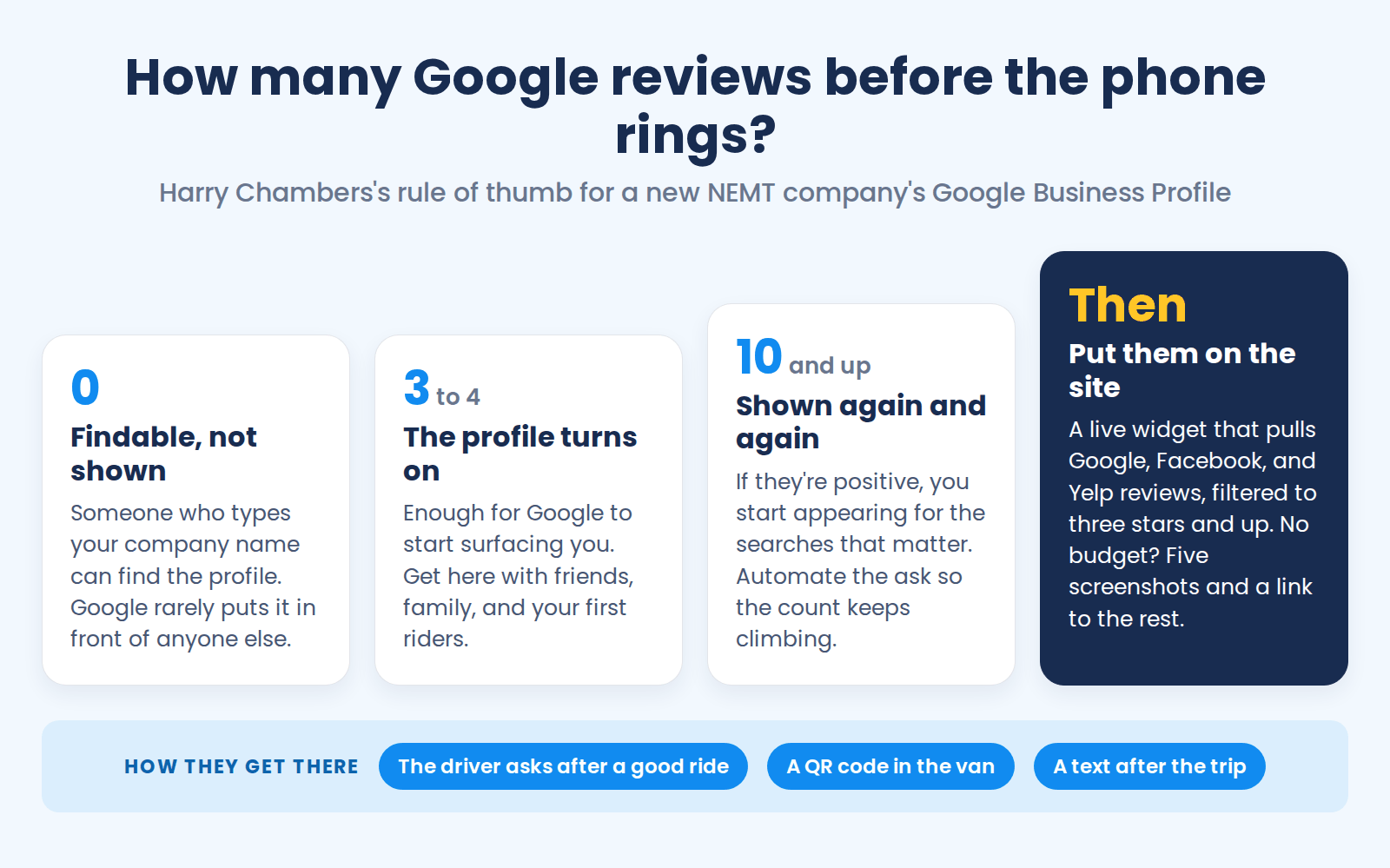
The failure mode is never asking. I’ve seen very good services, 15 years in business, sitting at seven reviews and three stars, because the only riders who bother to write one unprompted are the one in a thousand who had a bad trip. So ask, after every good ride. Have the driver ask in person, send a text afterward, and put a QR code in the van that opens your review page, so the rider can do it while the good trip is still fresh. One trick I’ve seen work well: $25 to the driver every time a review mentions them by name. If you’re brand new, our guide to starting an NEMT business covers getting the first ten from friends and family before you sell to strangers.
One more from Harry, on whether a small company can compete on reviews at all. MedTransit Pro in Houston, he said, started in June with one vehicle. By the time we recorded in mid-August they had about 50 positive reviews. Their competitors run six or ten vehicles, and they’re competing with them anyway, because a family reads the reviews and never asks how many vans you have.
Must-have 4: What photos should be on an NEMT website?
Put real photos of your real vehicle and your real people on your NEMT website: the van in front of a hospital at drop-off, the driver at the ramp, you and your team in front of the wrap. Stock and AI images are fine to launch with. Replace them as you go, because a site that’s all AI makes a family wonder whether the company is real.
Harry’s honest about the sequencing. A brand-new company doesn’t have a photo shoot, so it’s fine to launch on a mix of stock and AI images and swap in real photos as you take them. His assignment: when you’re dropping someone off at the hospital, step back and take a picture of your vehicle with the hospital behind it. He’ll also tell you that AI images have gotten good enough that most people can’t tell anymore, and that a month from now nobody will. He still wants the mix, because the site has to send one message: this is a real company, we do this, and we do it well.
Two things I’d add. First, there’s one particular stock photo, a wheelchair being loaded into a van at sunset, that by my rough count sits on a quarter of NEMT websites, and Google can tell it’s on all of them. If you don’t have your own pictures yet, at least take a bad photo of your own van, hand it to ChatGPT or Gemini, and ask it to clean up the lighting or put your logo on the side. It won’t look like a photo shoot. It also won’t be on 50 other websites. Second, once you’ve got a few vans and some revenue, a real shoot is worth the money.
Someone watching the episode live raised a point I’d never considered: insurance underwriters look at your website too. An AI picture of six vans on a policy that insures one is a question you don’t want to answer. Harry’s take on fleet size in general:
“I have yet to see a consumer say, ‘This company only has one vehicle, I’m not going to reach out to them.’ That has not been the case at all. I think you can get in trouble when you start to put up the face of, hey, we’re bigger than what we are, especially from an insurance perspective.”
Owners with one van tell me all the time that they’re intimidated by the competitor with twenty. Don’t be. You, the owner-operator, are giving a better ride than the twentieth driver that fleet hired, the one who’s been there three months and doesn’t much care. Lean into that. Put your own face on the site, and put your story on the About page. You’ve told me how you spent five years driving a relative who used a wheelchair, and how long you’ve lived in this town. That’s the story a family wants, and it’s the reason they’ll ride with you instead of the corporate vans.
Video does the same job even better. Harry loves a video in the hero section, with one catch: background hero videos usually only play on desktop, so add a second video somewhere it shows on a phone. A real clip of you helping someone into the vehicle can’t be argued with. Te’ya Miles, who runs That NEMT Girl and was on episode 17, uses her own infomercial as her homepage header, and it’s her getting a client into the van [3]. You can also embed your Instagram on the site so people see the videos without leaving the page. One video a month is plenty to show you’re real people with real vehicles.
Must-have 5: What should an NEMT quote form ask for?
An NEMT quote form should ask only for what you need to call back with a price: name, phone, email, trip date and pickup time, pickup address and destination, one-way or round trip, and the type of ride, with bariatric offered as a choice. Everything else, from stairs to exact weight, waits for the confirmation call.
The form is the hook. If they’re not calling you, it’s the only way a lead gets into your hands, and Harry has seen it turned into a wall. Thirty questions to get a quote. Forms that say “page 1 of 4.” The family fills in two fields, looks at what’s ahead, and opens your competitor’s site to see if it’s easier there. Harry’s fair about the flip side, too: a long form pushes some people to call instead, and a phone call is a good outcome. It’s the ones who leave that you never hear about.
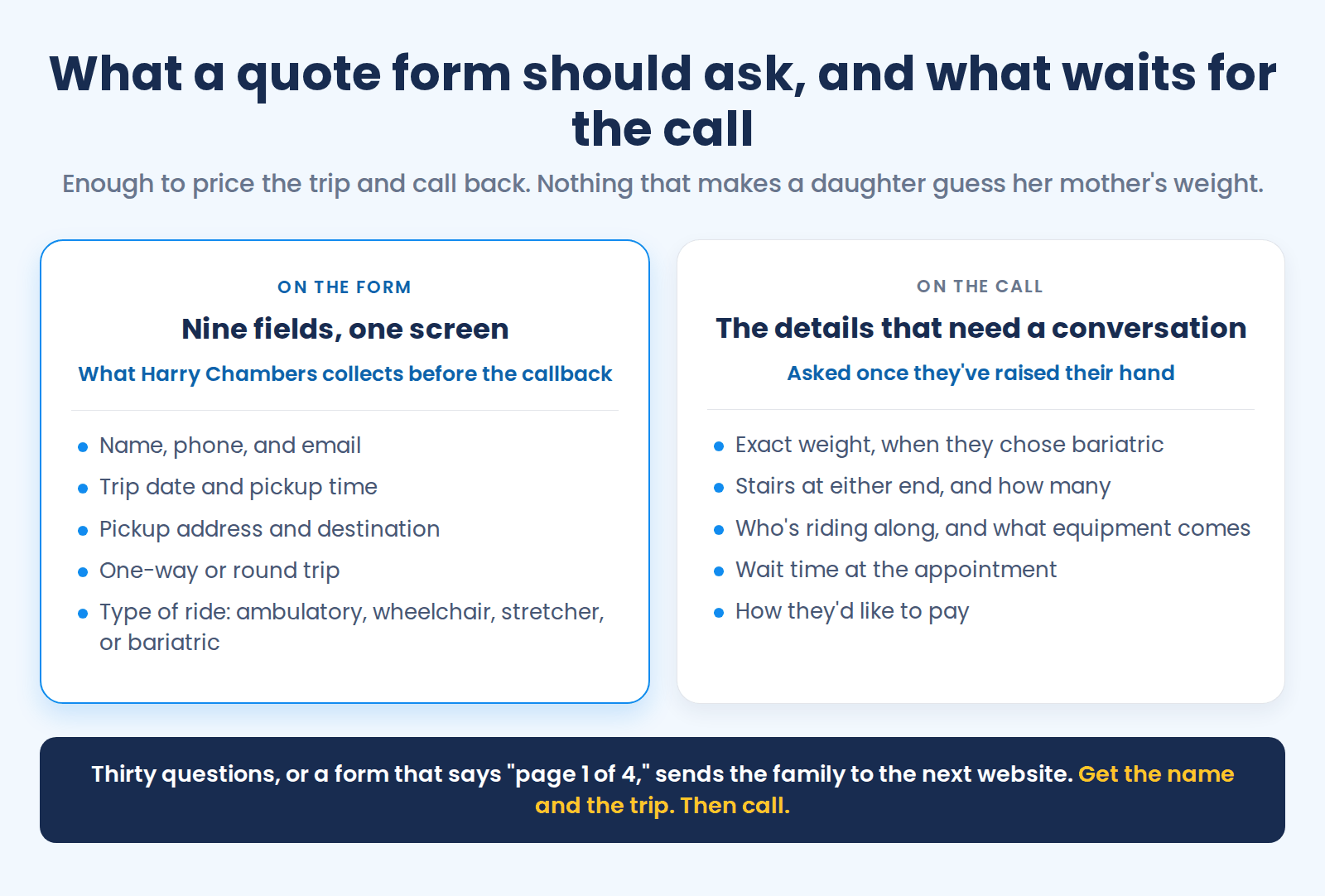
Weight is the field Harry sees get operators in the most trouble:
“If I’m coordinating for my mom, I don’t really know her weight. And if you have it as a required field, I can’t submit. So we’re going to put something bogus in there anyway just to get it through the gate.”
His fix is to offer bariatric as a type of ride, so the person can tell you what they need without typing a number, and to collect the real weight on the confirmation call, where you’d be asking about stairs and equipment anyway. One operator watching live suggested a gentler middle ground for the form: a yes-or-no question, above or below 200 pounds. Either way, the number gets collected. It just doesn’t get collected by a required field at 9 p.m.
Above the form, put three short steps so a family knows what happens next: submit a request, we confirm your details and price, then you ride. It sets the expectation that a call is coming, which matters for the next section.
One more thing that saves you time and typos: use a form that feeds your dispatch software or CRM. Duet gives every provider a booking link; point your “book now” button at it and the request lands in your Duet account to accept or decline, with nobody retyping addresses. Nowhere in that process is someone copying a phone number off an email and getting a digit wrong.
Bonus: Should you put your prices on your NEMT website?
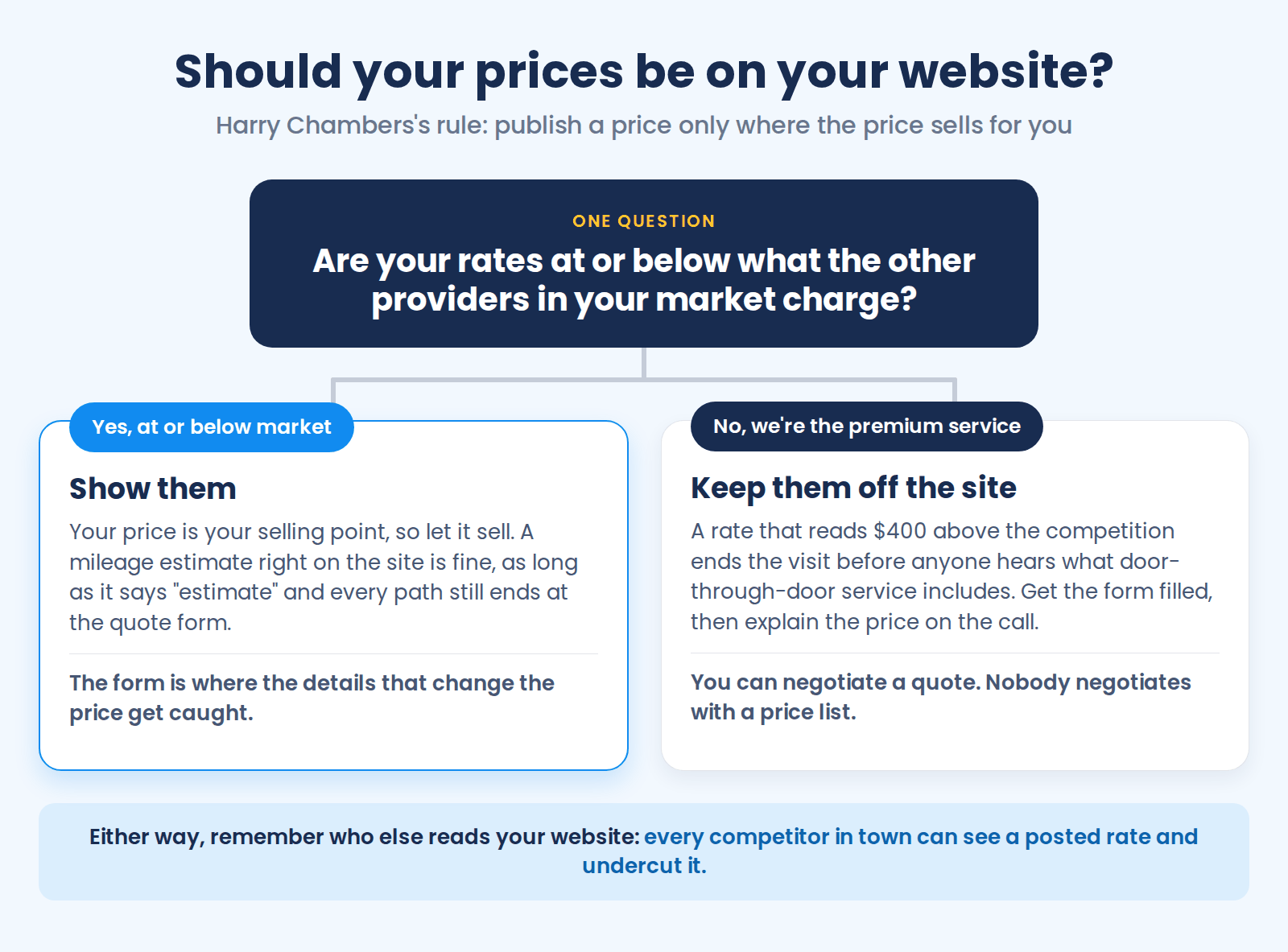
Post your prices on your NEMT website only if they’re at or below what other providers in your market charge, because then the price sells for you. If you’re the premium option, keep rates off the site and get people to the quote form, where you can explain what the price includes. Any estimate you do show should say “estimate.”
Harry gets this question constantly, and he answers it with one question back: is your pricing lower than, or at, what the market expects? If it’s lower, it’s a selling point. Put it up. You can even install a widget where someone enters the mileage and gets a ballpark, as long as it’s labeled an estimate that depends on the details of the trip, and as long as every path still ends at the quote form, because there are always details a form doesn’t catch. Say you’re 25 percent above market because you’re running a real concierge service. Don’t post it:
“They’ll have the pricing posted and nobody will ever fill out the form, because they’re like, ‘Man, this is $400 more than the competition,’ and you never have the opportunity to explain your level of service or even negotiate from that point.”
Harry’s careful to call this his opinion rather than a law, and he adds the part people forget: your competitors can read your website too, and a posted rate is an invitation to undercut it.
Te’ya Miles told me the same thing from the other direction on episode 17: if your price depends on the details of the trip, a price sheet on the site just confuses the caller, who sees one number online and hears another on the phone [3]. Let a dropdown collect the details, and quote once you have them.
How fast should you respond to an NEMT quote request?
Respond to an NEMT quote request within 30 minutes if you can, and never more than two hours. Harry put it plainly:
“If you do not call a customer back with a quote, or email them back with a quote, within two hours, they’ve already called your competition.”
Thirty minutes is his target. And for the owner who’s also the dispatcher and the driver, he ranks it bluntly: “If you’re a one-man operation, the most important part of your business, outside of giving good service, is telling people what the price of the service is going to be so they can pay for it.”
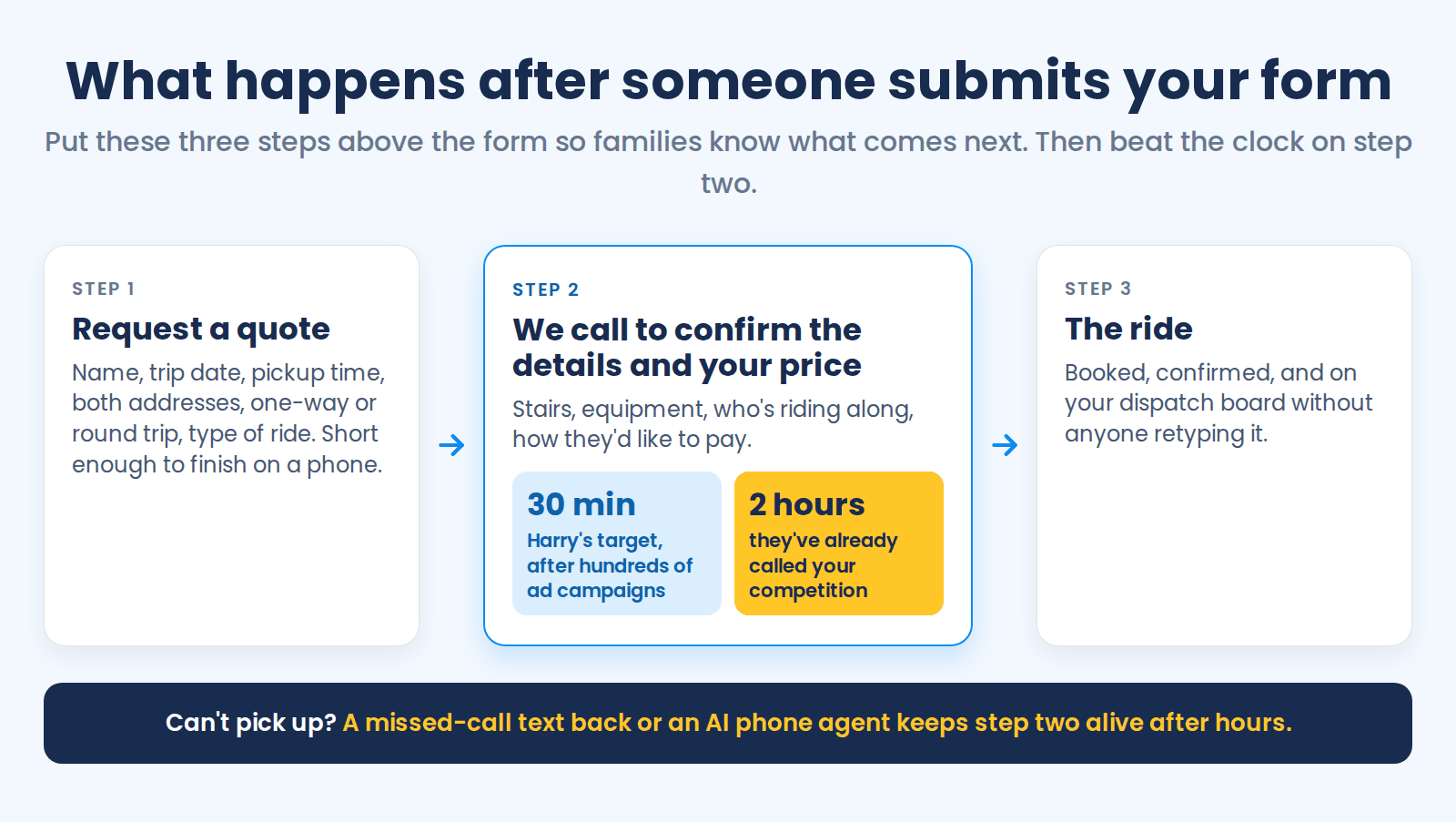
The form is half of it. The other half is the phone, and how it gets answered at 10 p.m. on a Sunday, or while you’re loading a rider and can’t pick up. Harry recommends a missed-call text back: when nobody answers, the caller immediately gets a text, “Hey, we’re serving other customers. Can we give you a call back in 10 minutes?” or whatever you want it to say. The other option is an AI phone agent that picks up when you can’t, which after hours is what a lot of callers expect anyway. We built one into Duet for exactly that hour of the day, and there are other good ones. Whichever you pick, make sure it knows NEMT, so a caller can ask about a wheelchair van and a wait-and-return without confusing it. The choice between a text back and an agent mostly comes down to how many calls you get after hours. The wrong answer is neither, because a family that doesn’t hear from you calls the next name on Google.
Behind all of this is a shift Harry says Medicaid providers struggle with when they add private pay. Broker work trains you to take what’s assigned. Private pay is a service business with a customer who can leave:
“You have to roll out the red carpet. I’ve got to answer the phone immediately. I’ve got to call you back. I’ve got to give you quotes quickly. They have options. They don’t have to use you.”
The most common mistake he sees in that transition, by the way, isn’t on the website at all. It’s pricing private-pay trips like broker trips. Private pay pays more, because nobody handed you the trip for taking the lowest bid, so learn what your market actually charges before you set a rate. Our private-pay guide covers how to secret-shop it.
Should you build your NEMT website yourself or hire someone?
Either works, as long as the site has the five things above. You can build an NEMT website yourself with an AI tool for the price of a subscription, hire a specialist who knows NEMT, or spend thousands on something fully custom. The prompt matters more than the builder: an AI-built site is only as good as what you told it to include.
I asked Harry when he’d recommend each route. His answer: if all you need is a storefront, so someone who sees your van can look you up and understand what you do, build it yourself. The AI builders now produce genuinely good-looking sites. Harry’s warning:
“AI is only as good as the prompt that you give it. If you don’t give it enough information to put on the website, it won’t do it.”
So when you sit down to build one, hand the tool this list. It’s also what an agency will check first. Before anyone turns on Google Ads, the first question is “where’s your website?” If it’s missing the basics, it has to be rebuilt before the ads go on. A site that already has the five things gets your ads live faster.
On platforms, Harry’s answer as of our August recording is that WordPress and the newer AI-native builders are close on search rankings and getting closer; the technical gap that existed a year ago has mostly closed. If you have a WordPress site that’s performing, don’t replatform it, refresh the look. I lean toward the newer stacks because they load instantly on a phone with two bars of signal, but I agree with him on the rest, including the part nobody wants to hear: ranking takes time on any platform, and a site that’s a month old won’t rank on day one.
Two smaller questions come up every time. Should you buy the domain before the website? Harry says there’s no right order; most owners buy it first because they want a professional email address, and the site connects to it later. And how do you know the site is working? Install Google Analytics, ignore it for the first month, then watch where people leave. Harry’s words: “You want people to go homepage, figure out the services, book a ride. You want that order to flow.” If the services page is where visitors bail, the services page is what needs fixing. Once you’re running ads, the same install shows you which ads turn into rides.
We build NEMT websites, and I’ll tell you what Harry told the audience: whoever builds yours, make sure they understand this industry, and if they don’t, hand them the five must-haves and don’t let them talk you out of any of them.
Harry’s closing line was the one I’d put on the wall:
“The website, in terms of private pay, is literally the face of your business. If somebody looks up your business, you can’t talk to them right then and there. The only thing they can do is go to your website. So your website has to be an extension of you telling that person about your business.”
Having a website at all puts you in the upper half of NEMT companies, by my count. Having these five things on it puts you in a much smaller group, and that group is the one families call.
FAQ
How many pages does an NEMT website need?
Four or five: a homepage, a services page, an About page, a booking or quote page, and a contact page. Most NEMT websites follow that same formula, and you don’t need to spend thousands to get it. Separate pages for individual services, like stretcher or dialysis trips, are optional and most useful once you run Google Ads that can land on them.
What should the headline on an NEMT website say?
The service you most want to sell and the place you sell it, for example “Wheelchair transportation in Houston, Texas.” Google matches that headline to what people search, and a visitor knows in a second that you do what they need where they live. The adjective in front of it, reliable or affordable, matters far less than the service and the city.
Is it okay to show only one vehicle on an NEMT website?
Yes. Harry Chambers, a digital marketing expert, has never seen a consumer pass on a company because it had one van. What gets you in trouble is pretending to be bigger, especially with AI images of a fleet you don’t insure, since insurance underwriters look at websites too. Show your one van in front of a hospital and put your own face on the site.
How do I get my first Google reviews for an NEMT company?
Ask after every good ride, in person, by text, and with a QR code in the vehicle that opens your review page. Three or four reviews make a Google Business Profile start showing up, and above ten it appears again and again. Many new operators get the first handful from friends and family on free or discounted rides before selling to strangers, then embed the reviews on the website with a widget that pulls them in automatically.
Do I need a quote form if riders can just call?
Yes. A website works at 9 p.m. when you’re not answering, and a lot of private-pay bookings come from adult children who’d rather type than call. Keep the form short, name, phone, email, trip date and time, both addresses, one-way or round trip, and type of ride, and call back with a price within 30 minutes if you can. Put a tappable phone number next to it for everyone who’d rather talk.
Sources
[1] Duet NEMT Growth Podcast, Ep. 23: “The 5 Must-Haves for an NEMT Website” (Harry Chambers), August 28, 2026. https://www.youtube.com/watch?v=U0D7Yvs0_pg
[2] Duet NEMT Growth Podcast, Ep. 2: “How to Succeed in NEMT Private Pay” (Harry Chambers and Jing Zhu), April 18, 2025. duetinc.com/duetblog5_privatepaywebinar
[3] Duet NEMT Growth Podcast, Ep. 17: “The Most Common NEMT Mistakes Nobody Warns You About” (Te’ya Miles, That NEMT Girl), May 22, 2026. duetinc.com/duetblog21_nemtgirlinterview
[4] Google Business Profile Help, “Tips to improve your local ranking on Google,” accessed September 2026. https://support.google.com/business/answer/7091
[5] Google Search Central, “Mobile site and mobile-first indexing best practices,” accessed September 2026. https://developers.google.com/search/docs/crawling-indexing/mobile/mobile-sites-mobile-first-indexing
About the author
James O'Donnell cofounded Duet and leads its sales, partnerships, and growth services. He talks with NEMT operators every week, hosts the NEMT Growth podcast, and answers Duet's sales line himself. More about Duet's founders →
Want more trips and less busywork?
See how Duet runs and grows NEMT businesses in a 30-minute demo.