Article
NEMT Cold Calling Script for Facilities: What to Say
The first call to a facility should sell nothing. Ask who sets up transfers, get a name, call back. Christopher Buell's script, call by call.
Guest: Christopher Buell, NEMT Alliance. Episode 14 of the Duet NEMT Growth Podcast.
By James O'Donnell, Cofounder and COO, Duet · · Updated
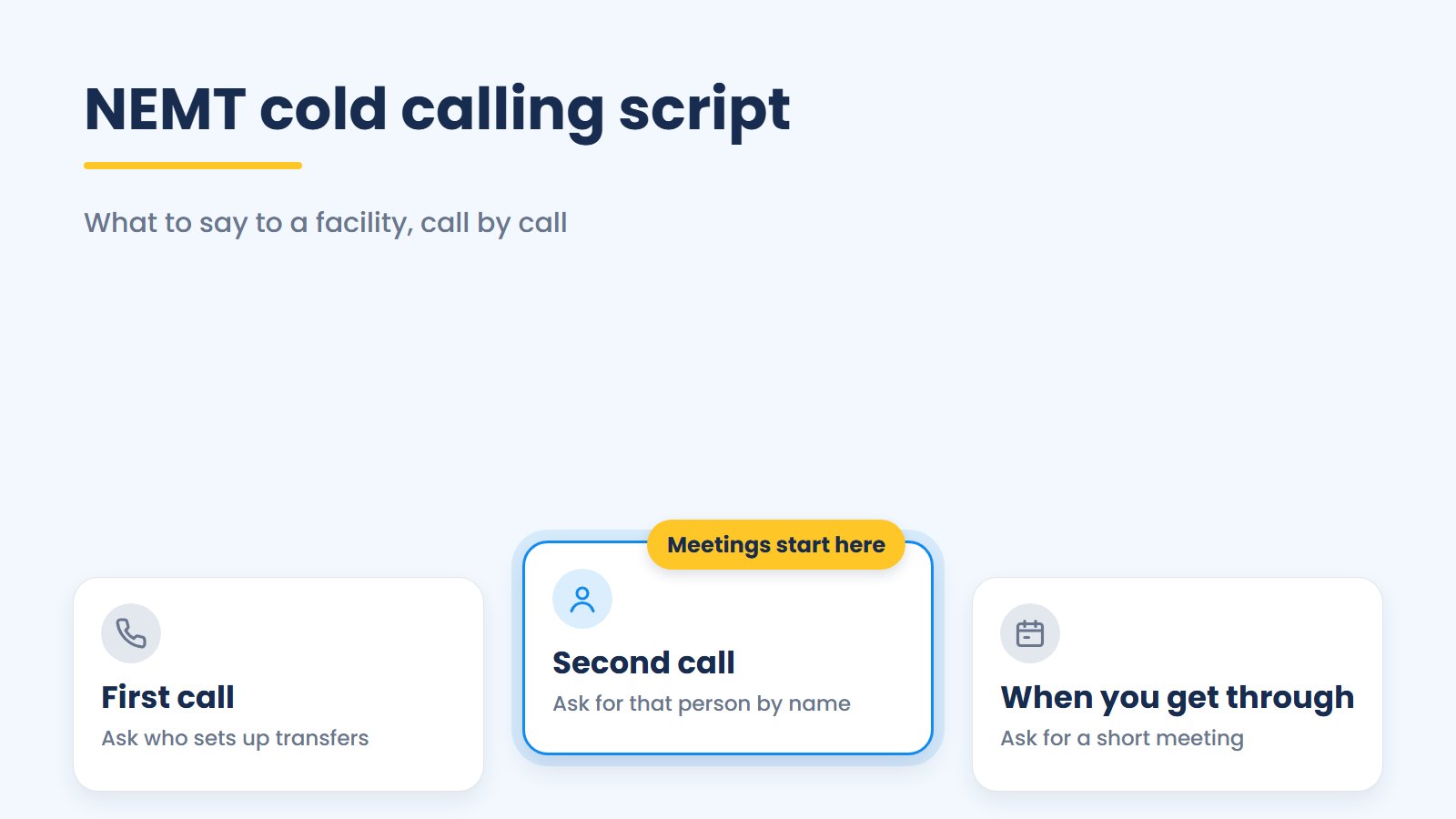
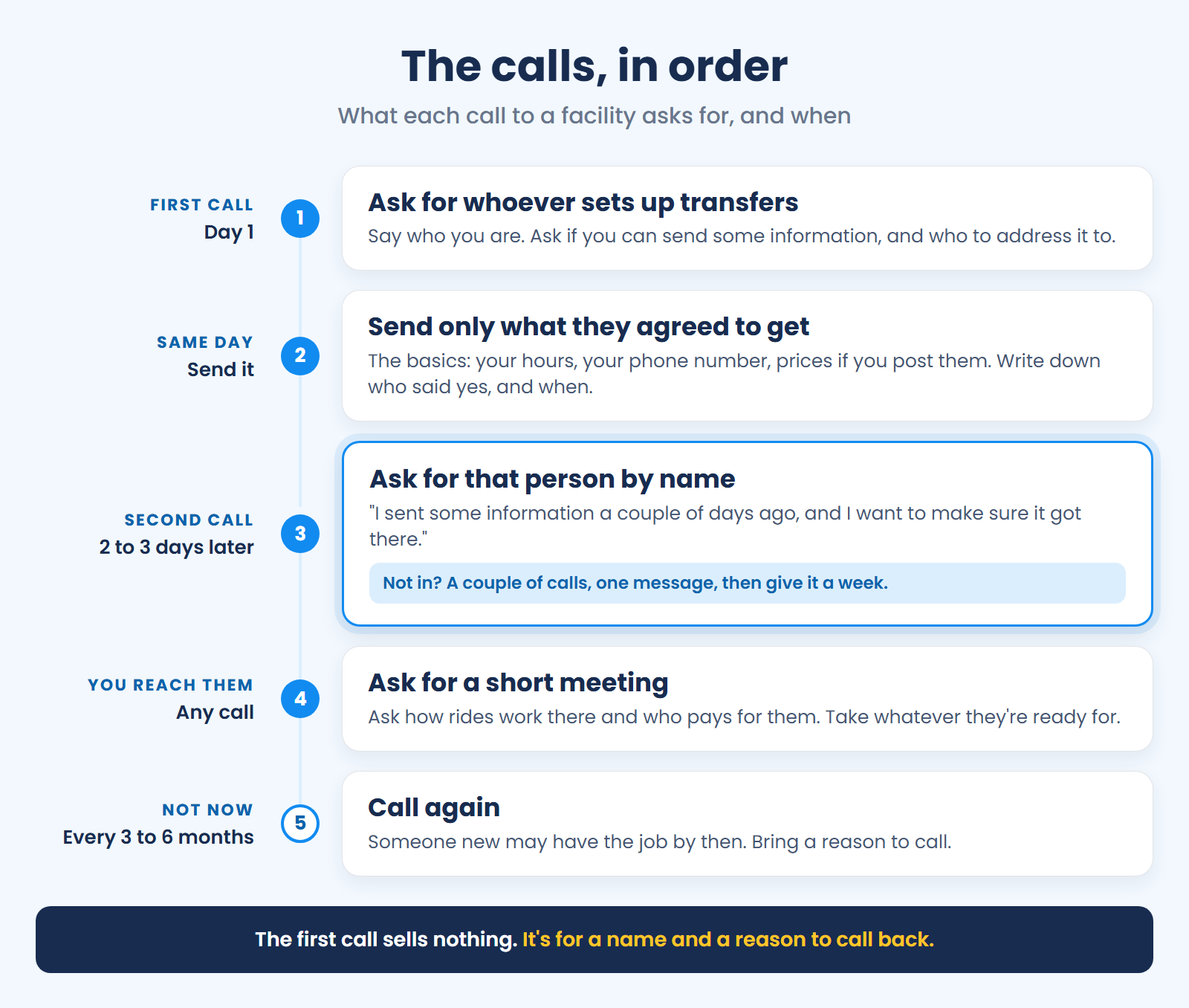
When you cold call a nursing home, rehab or hospital for NEMT trips, don’t try to sell anything on the first call. Say who you are, ask the front desk for the person who sets up transfers, and ask if you can send that person some information. Get a name if they’ll give you one. Then call back two or three days later and ask for that person by name.
That second call is where meetings start. Christopher Buell, who grew his first NEMT company to about 11 vans with no broker work, told me on our podcast that you get through on the second and third calls: “The magic doesn’t happen on the first call.” Most people fail at sales, he said, because they want to say “Well, I called them” and move on. So the first call has two jobs: a name and a reason to call back.
Christopher calls the person you’re trying to reach Becky, so I will too. On the episode, he said he makes these calls for other NEMT companies and teaches owners to make their own through his NEMT Alliance. Below is his script, plus what I’ve told owners and our own callers. It follows the calls in the order you’ll make them, from the first ring to the meeting and the months after.
Which facilities should you call?
Every facility in your service area that could send you a ride goes on one spreadsheet, with an empty column for the name of whoever sets up transfers. Don’t screen anyone out before you’ve called. Christopher doesn’t: there have been “so many times,” he told me, when he wondered why he was even calling someone and it turned into a great contact.
You only cover so much area, so there’s no reason you can’t reach every facility in it over time. Our facility contracts guide covers which buildings pay for rides and which to call first.
Dialysis clinics are the exception. In my experience, most dialysis riders are on Medicaid, so their rides come through the broker, and most clinics leave the booking to the rider and the broker. Many will let you leave flyers for riders stranded after treatment who’d pay for their own ride home, but don’t count on the clinic to call you.
Who do you ask for when the front desk picks up?
Ask for the job, not a title: “Is there somebody there that sets up transfers?” That’s Christopher’s line, and at a nursing home it works because someone always has that job. Federal rules make a nursing home help residents arrange rides to outside appointments like lab work and X-rays, and other sections of the same rules cover dental, vision and hearing visits.
If the front desk wants a title, use the one that fits the building. At a nursing home or senior living community, ask for social services or the activities director (some homes call that job the Community Life Coordinator). At a hospital, ask for case management or whoever handles discharges. At a rehab, Tony Jackson, an Orlando operator with 35 years in the business, starts with admissions: “you don’t want to deal with the administrator not just yet,” he said on our episode about winning facility contracts. Titles vary, so see what people in your market call the job.
Asked plainly, the front desk often just routes you. As I told Josh Hagen of Careway Mobility on our episode answering a new manager’s questions, “half the time they’ll just be like, ‘Yeah, oh, it’s Joe. Joe’s in charge of transportation. Let me transfer you.’” (At some buildings, Becky is Joe.) If the answer is “we don’t use that kind of service,” thank them and call the next one.
What do you say in the first 30 seconds?
Say who you are, then ask for something small that’s easy to say yes to: permission to send some information, or a chance to do something nice for the residents. Don’t sell. When someone cold calls me, they have five to 10 seconds to say something that makes me care, and “Can I have five minutes of your time?” isn’t it.
Christopher’s route is the information ask, and he told me he uses it every single day. Mine, for nursing homes and senior living, starts with the residents. When Josh asked me what to say in the first 30 seconds, I described how our callers do it. They ask for the activities director, open with “we want to give back to the community,” and offer to come in and bring some candy for bingo night. That way “you don’t fire the gatekeeper reflex,” and they’ll ask what you do soon enough. In my experience the activities director is a much easier meeting to get than a case manager, and from there you can get to whoever books rides.
Here’s the script, with both routes in it:
- To whoever answers: “Hi, this is [your name]. Is there somebody there that sets up transfers, like rides to appointments?” At a hospital, ask who handles transportation for discharges. At a nursing home or senior living community, you can ask for the activities director instead.
- If they ask what it’s about: “I’m with [your company]. We do [wheelchair] rides here in [town], and I’d like to send some information to whoever sets them up.”
- If they put you through: “Hi, I’m [your name] with [your company]. We do [wheelchair] rides in [town]. How do rides work for your [residents or patients], and who pays for them?” Then ask for the meeting: “Could I stop by one day this week and learn what you need?”
- If you reach the activities director: “We’d like to do something nice for your residents, like bring in some candy for bingo night.” When she asks what you do, tell her, and ask who sets up rides.
- If you can’t be put through: “We’re [your company], and we do [wheelchair] rides here in [town]. Is it okay if I send some information about us? Is email or fax better, and who should I address it to?”
- Before you hang up: “And who am I speaking with? When’s the best time to catch them?”
Write down the receptionist’s name too, so your next call can open with it.
If you bring something, keep it small and for the residents, like that bingo candy, and never tie it to a referral, past or future. Federal anti-kickback law sets no minimum dollar amount for a gift meant to win Medicaid business, so skip gift cards and personal gifts for the staff who choose a ride company.
What if the front desk won’t put you through?
Get a place to send your information and, if you can, a name to put on it, then hang up. That’s a good first call. A lot of times, front desk staff are “trained to get rid of you,” Christopher said, so don’t argue with them, and don’t pitch them either.
Christopher would rather have a fax number. “People do not want to give emails. Emails are very personal. Fax numbers, in my opinion, are almost better,” he said, because a fax can reach a whole team. Ask for both and use whichever they give you. What you send matters less than the excuse it gives you to call back: to Christopher, it’s “a tool the salesperson uses when he calls back.” Send the basics Christopher brings to a meeting: your hours and your phone number, plus prices if you post them. He likes having his out there: “there’s something to me that strikes it as more honest and easier.”
Unless you already do business with a facility, the Federal Communications Commission’s junk-fax rule bars faxing it an ad it didn’t agree to receive, and a fax number on its website isn’t agreement by itself. A spoken yes counts if you get it, along with the number, before you send anything, and it’s on you to prove it, so write down who said yes, the date and the number. That’s why the script names your company before it asks to send anything. Anyone who gets a junk fax can sue for $500 a fax, or up to three times that if it was willful or knowing.
What do you say on the second call?
Call back two or three days later and say you’re checking that what you sent got there. If you got a name on the first call, ask for that person by name. If you didn’t, this is the call that gets it. Christopher’s version: “I sent them a fax a couple days ago. I just want to make sure they got it.” Only say it if you sent something.
Suddenly, he said, the call is different: “You’re not a salesperson. You’re something else.” A receptionist who knows how to screen a sales call doesn’t know what to do with a follow-up, so she asks who you sent it to. You say the transportation department. “Well, that’s Becky.” Christopher writes the name down: “either I get Becky or I don’t. I don’t really care because I got a name now.” The call after that starts with “Is Becky there?”
If she isn’t in, Christopher might call a couple of times in a row to reach her, then leave a message and give it a week. “You don’t want to be overly annoying,” he said. Better still, ask the front desk when she’s usually in, and call then. If you get her voicemail: “Hi, this is [your name] with [your company]. I sent some information on [day], and I want to make sure it got there. My number is [number].”
What do you say when you get through?
Ask how rides work in her building and who pays for them, then ask for a short meeting, and take whatever she’s ready for. Christopher opens with interest in them: “My company would love to have a relationship with you guys. What do you do? What are your experiences now?”
When I asked him whether he’s trying to close Becky right there, he said the goal is a relationship. The call is just the way in: “the phone call is the tool to get you the in-person meeting because the in-person meeting is where the relationship happens.” Best case, she agrees to sit down and talk through what she needs. If she isn’t ready for that, Christopher takes what he can get, even a quick hello when he’s in the area.
Listen for who pays, because it decides what you’re asking for. A building that pays for some rides itself can sign a service agreement with you: a hospital paying to free up a bed, or, in some states such as Louisiana, a nursing home paying for its Medicaid residents’ non-ambulance rides.
Elsewhere, a Medicaid resident’s ride usually goes through the state’s broker or a health plan’s ride vendor, so the building usually can’t just hand it to you. In my experience, some brokers will send a rider to you if the rider keeps asking for your company by name, but the ask usually has to come from the rider. And Christopher says a lot of buildings will take your brochure and hand it to patients: the facility doesn’t pay, but “the patient could pay.” Ask them to pass your information to residents and families who book their own rides.
At a hospital, the person who signs the agreement cares about price, Christopher said, but “the guy that’s putting the order in cares that you say yes,” and discharges happen every hour of every day. If you can’t get there within about two hours, don’t sell the hospital on discharges yet. If you can take a 2 a.m. discharge, say so: few companies will.
Our guide to the first trip covers what to bring to that meeting and who in the building books rides.
What do you say when they already have a provider?
When a facility already has a provider, agree, and ask to stay in their back pocket for the day that provider can’t come. “We’re already using somebody else” is the objection Christopher hears a lot, and he doesn’t argue: “yeah, that’s okay. I just want to share the information, have you stick it in your back pocket, and if you ever need us, give us a holler.” The day their regular company says it can’t be there until tomorrow, they’ll remember who’s been calling. “They don’t need you today, but they’ll probably need you tomorrow,” he said.
“We have our own vans” is fine to hear, too. In my experience, those vans break down, and finding a driver for them is a constant struggle.
Getting on a facility’s provider list is the easy part. Owners who push hard “get put in as the fifth provider and they never get any trips because they don’t get called,” as I told Josh. The back pocket is different: it asks only for the trips nobody else takes, like nights, weekends and the day the regular company can’t come. Who pays for those trips follows the same lanes as any other: a facility-paid trip, a family paying privately, or a Medicaid ride that usually goes through the broker.
Here’s what to say to the answers you’ll hear on these calls:
| When they say | Try this |
|---|---|
| “We already use someone.” | “That’s fine. Can I send our information so you have us in your back pocket for nights, weekends or a day they can’t make it?” |
| “We have our own vans.” | “Who takes residents when the van breaks down, or at 8 p.m. on a Sunday?” |
| “Our facility doesn’t pay for rides.” | “Could you pass our information to residents and families who book their own rides?” |
| “We can’t accept gifts from vendors.” | “No problem. Can I just send you how our rides work?” |
| “Just send me something.” | “Happy to. Who should I address it to?” Then call back in two or three days. |
| “We don’t use that kind of service.” | “Thanks for your time.” Then call the next facility. |
How long do you keep calling?
Keep calling until you get a meeting or a firm no, and call every “not now” again in three to six months, because the person in that job may change. Christopher’s reason for those calls is “to wait for somebody, a new person in that job.”
Nursing homes lose staff fast. In the Care Compare averages CMS published in October 2026, nursing-staff turnover was 45.8% a year nationally, and the average home lost an administrator about every two years. The person who told you “not now” may not be there in six months.
When a contact moves, follow her. “If you have a good relationship built up with Becky at some local hospital and then Becky takes a new job at a different hospital, that can be one of the easiest ways to get a new customer,” Christopher said.
“The hardest part of sales is coming back,” he said, so give every call a reason: a new review, an opening in your schedule, a driver on a new day. When an owner told me they’d started running a driver on Saturdays, I told them that was their excuse to call a facility contact back.
Christopher writes everything down, including the date he talked to Becky. Give your sheet these columns:
- The facility and its main number
- The front desk’s name, and the name and title of whoever sets up transfers
- How to reach that person (direct line, email or fax) and who agreed to receive what
- Each call’s date and what happened
- The next call’s date and the reason for it
- Where it stands: no, not now, back pocket, meeting or trips
If you’d rather not make the calls yourself, Duet’s facility outreach callers make them in your company’s name and book meetings with activities directors, discharge planners and administrators. The meetings are still yours to run.
Look at your list tonight. Every facility marked “called” with no name next to it isn’t a no. It’s a first call, and somewhere in that building is a Becky who hasn’t heard your name yet.
Cold calling FAQ
Is it legal to cold call nursing homes and hospitals?
Yes, when you dial a facility’s business line by hand. The federal do-not-call rules are written for residential subscribers, and the FTC’s telemarketing rule exempts business-to-business calls except its ban on misleading statements. Faxes are different: send an ad only to someone who agreed to receive it. Those are the federal rules; check your state’s too.
Should I walk in instead of calling?
Call first, and walk in when the phone stalls. Te’ya Miles, the Atlanta operator behind That NEMT Girl, told me on our podcast that most of the time you can’t just pop up on facility staff, because they’re busy. Her advice: call first to set up a meeting. If you can’t reach the person or get an email, stop by, tell the front desk who you’ve been trying to reach, and leave your brochure and card.
Should I tell a facility my company is new?
You don’t have to lead with it, and never pretend to be bigger than you are. What I’d say instead is that you’re a smaller operation that really cares about the seniors and wants to do a good job. Then offer the trip nobody else wants, like a Sunday night. If they ask how long you’ve been running, tell the truth.
About the author
James O'Donnell cofounded Duet and leads its sales, partnerships, and growth services. He talks with NEMT operators every week, hosts the NEMT Growth podcast, and answers Duet's sales line himself. More about Duet's founders →
Want more trips and less busywork?
See how Duet runs and grows NEMT businesses in a 30-minute demo.