Article
Which Facilities Use NEMT Services? Build a List That Pays
Many facilities use NEMT, but fewer book and pay for rides. Rank your list by who pays, who books and what your vans carry.
By James O'Donnell, Cofounder and COO, Duet ·
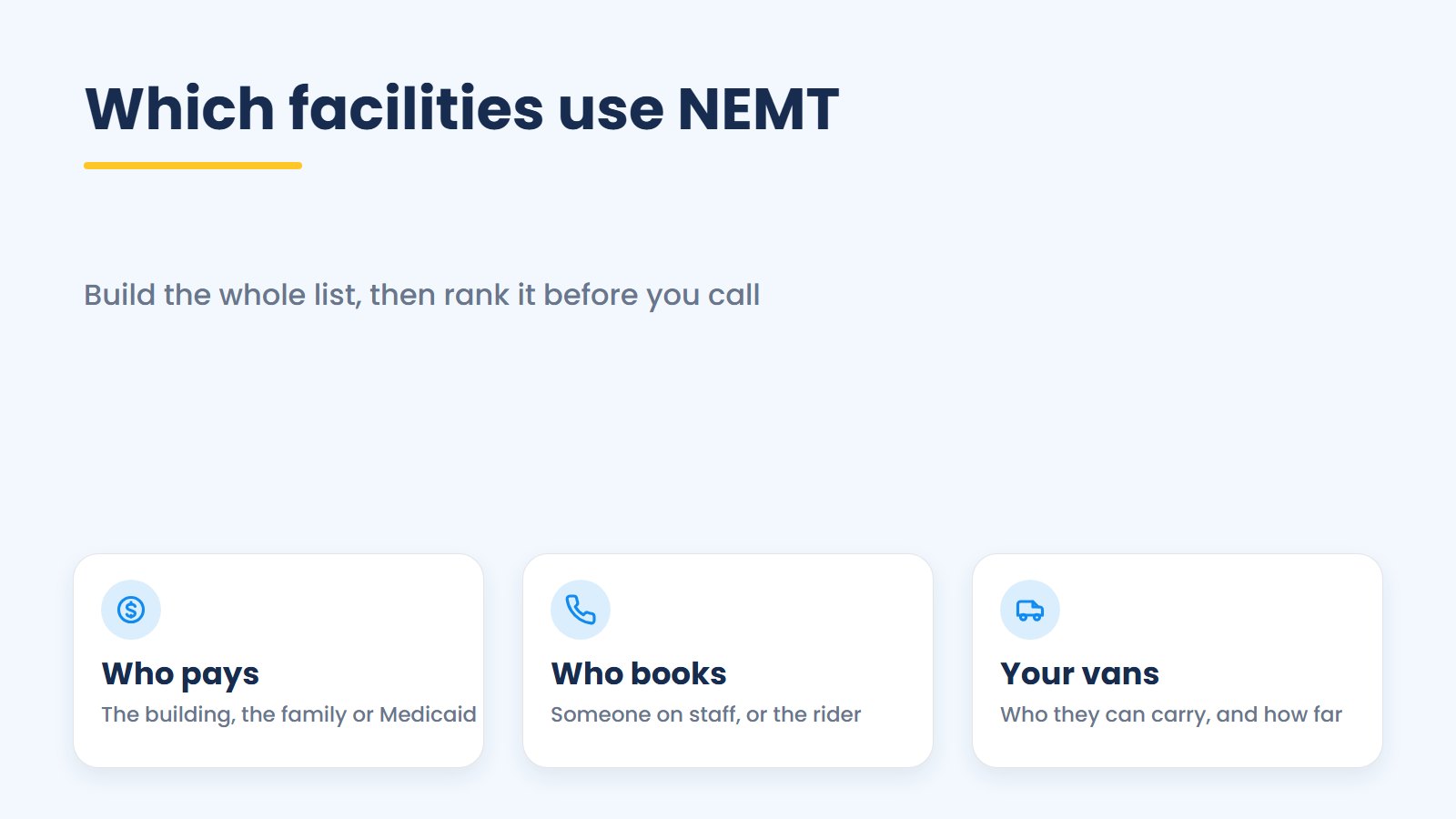
Nursing homes and rehabs, hospitals, assisted living and memory care, hospices, PACE programs, adult day programs, Veterans Affairs (VA) medical centers, group homes, home health agencies, surgery centers, doctors’ offices and dialysis clinics all use non-emergency medical transportation (NEMT). They use it in three ways. Some book rides and pay for them, some book rides that the family or Medicaid pays for, and some only send riders your way. So put every one in your service area on your list, and call first the ones that book rides your vehicles can carry and that someone will pay you for.
One owner asked me on a call this year, “How do you identify in this territory who to contact?” My answer was a longer list than you’d think: in my experience, a typical service area holds 500 to 1,000 facilities, across about 50 types. Search the question and you’ll find lists of places riders go, with dialysis centers “heavily utilized” and clinics that “partner” with ride companies. But where riders go and who hires you are different lists. In Medicaid claims from six states in fiscal 2018, doctors’ offices were the most common destination, on 20.3% of ride-days, per a 2021 report from MACPAC, the commission that advises Congress on Medicaid. A doctor’s office rarely pays for a ride.
Keep the long list, and put it in order. In my experience, the order you call in, not the length of the list, decides how fast the paying trips come, so rank every facility by who pays, who books and what your vans can carry. The sections follow the order you’ll build it in: who pays at each kind of facility, the free lists, how far out to go, the call order and first call, then the facilities that mostly send riders.
Which facilities use NEMT, and who pays at each?
Nursing homes, hospitals, PACE programs and VA medical centers book rides and can pay for them; assisted living books or refers rides that residents and families mostly pay for; and clinics, surgery centers and home health agencies mostly send riders.
| Facility | Who books rides | Who usually pays | Trips you’ll get | Fits which vans |
|---|---|---|---|---|
| Nursing home or rehab | Admissions or social services | The home, the family or Medicaid, by resident and state | Admissions from the hospital, follow-ups, discharges | Wheelchair, ambulatory; stretcher for some |
| Hospital | Case managers, discharge coordinators | The patient’s coverage or family first; the hospital when it needs the bed | Discharges, often same-day | Stretcher-heavy at the emergency room (ER) |
| PACE program (Program of All-Inclusive Care for the Elderly) | The program’s care team or transportation staff | The PACE organization, under your written contract | Runs to the PACE center, overflow | All, as participants need |
| VA medical center | The VA’s beneficiary travel office, after a VA clinician asks | The VA, for eligible veterans on approved trips | Trip by trip | Wheelchair, stretcher |
| Hospice | Hospice staff | Generally the hospice, for rides tied to the terminal illness (depends on the state); otherwise the patient’s coverage | Transfers, often urgent | Stretcher, wheelchair |
| Adult day program | The program, or families | Depends on the state: New York’s adult day health centers that contract out pay the ride company directly; Georgia’s Medicaid broker carries those trips | Daily runs, several riders at once | Ambulatory, wheelchair, bigger vans |
| Group home (developmental disabilities) | The home | Depends on the state: New York’s certified homes must provide or pay for residents’ medical rides | Appointments, day-program runs | Ambulatory, wheelchair |
| Assisted living or memory care | The front desk, the activities director or the family | Mostly the resident or family; Medicaid in some states; sometimes the community, added to the monthly fee | Doctor visits, outings | Ambulatory, wheelchair |
| Independent living | Residents, for themselves | The resident | Occasional; many residents still drive | Ambulatory |
| Home health agency | Refers: nurses and aides see who needs rides | Not the agency (Medicare home health excludes rides); the patient’s Medicaid, plan or family | Repeat trips to dialysis, chemo, therapy | Wheelchair |
| Surgery center | The patient or family | The patient’s Medicaid, plan or family | One-off; a fit for wait-and-return | Ambulatory, wheelchair |
| Doctor’s office or clinic | Staff refer | The patient’s Medicaid, plan or family | Repeat visits for therapy or chemo | Ambulatory, wheelchair |
| Dialysis clinic | Usually the rider, through the broker | Usually Medicaid, through the broker | Standing trips several days a week | Ambulatory, wheelchair |
The first seven rows are the accounts: facilities that book rides and can pay you, within the limits the table gives for hospices, adult day programs and group homes. Our guide to NEMT contracts covers their agreements and rate sheets, and its FAQ explains how veterans’ rides from a nursing home get paid. For hospitals, read our guide to hospital discharge work.
Assisted living, the eighth row, sits in between: the building books or refers the ride, and the resident or family usually pays. On one call I put it this way: “Barbara asks the front desk, hey, can you get a car for me?” The front desk arranges the ride, but “Barbara or her family is going to pay for the transport themselves,” with a card. The last five rows mostly send riders, who pay through Medicaid, a health plan or their own pocket.
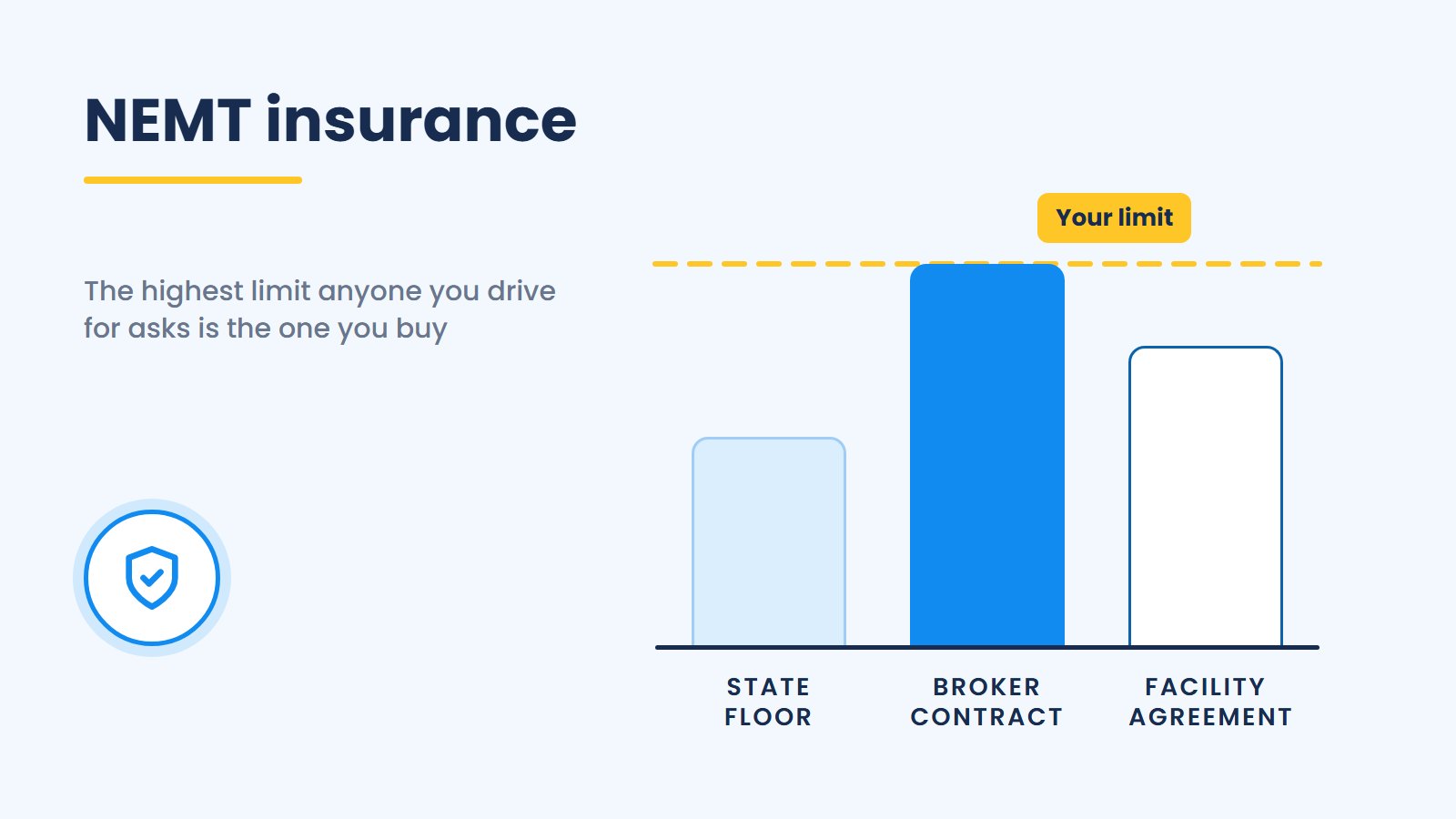
Original Medicare isn’t in the table because it doesn’t pay for wheelchair or stretcher van rides at all: its claims manual says Medicare “simply does not provide any coverage at all” for non-ambulance rides. A Medicare Advantage plan may offer rides through its own vendor, but it doesn’t have to. In 2026, 22% of people in individual plans and 73% in special needs plans were in plans that offered transportation, per KFF’s review of 2026 Medicare Advantage plans. Several rows change by state, so treat the payer column as your guess until the building confirms it.
Where can you get free lists of the facilities near you?
CMS, the federal agency that runs Medicare and works with states on Medicaid, publishes free lists of nursing homes, hospitals, hospices, home health agencies, surgery centers and dialysis clinics, and some states publish their licensed assisted living homes too. These are the ones to download:
- Care Compare files from CMS. The nursing home list gives each home’s beds, average residents a day and chain, and it’s the only one of these CMS lists with latitude and longitude. The hospital list gives each hospital’s type and whether it has emergency services. The dialysis list marks clinics with a late shift, one starting at 5:00 p.m. or later. As of October 28, 2026, Care Compare also lists 6,669 hospices, 12,409 home health agencies (with no county column), 1,222 inpatient rehab facilities and 311 long-term care hospitals.
- CMS’s Provider of Services file. The quarterly Provider of Services file has street addresses, and phones on most rows, for 6,665 active surgery centers and 5,196 active intermediate care facilities for people with intellectual disabilities in its Q3 2026 edition. That edition also added community health centers, rural health clinics and community mental health centers. Keep the rows with termination code 00, the active ones.
- PACE programs. The National PACE Association’s monthly PACE in the States report counted 205 programs in 33 states and DC in September 2026, with one city for each. Seventeen states have none.
- State license lists. CMS doesn’t certify assisted living, memory care or adult day centers, so those lists come from your state. California’s Community Care Licensing file had 7,939 licensed assisted living homes, in data as of May 25, 2025. Texas Health and Human Services lists 2,011 assisted living facilities with an active license as of October 27, 2026, 740 with Alzheimer’s capacity, plus 389 adult day centers, all with map coordinates. New York’s Health Facility General Information file lists adult homes and enriched housing. A map search fills in doctors’ offices and clinics.
Clean the list before you rank it, because a listing doesn’t prove a place is open. California’s file marks closed homes in its status column, and 30.5% of its rows are closed. Care Compare’s hospice list has no such column, yet 487 of its 6,669 hospices (7.3%) show as terminated in CMS’s Provider of Services file, so look each hospice up there by its CMS number and keep code 00. Filter by county or city as well as ZIP code, since some facilities list a PO box ZIP. Keep the small homes, though: 78.9% of California’s licensed assisted living homes are licensed for six or fewer residents. This week, download the nursing home, hospital and hospice lists and your state’s assisted living list for your county, and delete the closed rows.
Building that list and making the calls is the part Duet’s facility outreach service takes on. We build your facility list, make the cold calls in your company’s name, and book decision-maker meetings onto your calendar with activities directors, discharge planners and administrators. You get 8 meetings in your first month, guaranteed, or we keep working free until you have them. It’s $2,000 a month as of October 2026, or $1,600 with Duet software. You still run the meeting, sign the agreement and drive the first trip. I told one owner this year to budget “minimum five hours a week, probably more” for the facility work you keep: calling people back right away and visiting the facilities that want to meet you in person.
How far out should your list go, and which facilities fit your vans?
Set one radius you’d drive for a short trip, put every facility inside it on the list, and mark the ones that send riders your vehicles can carry.
The radius is your call. Frank Ciccarella, a NEMT consultant, told owners on our October episode about startup paperwork to think about everything inside a circle around their base, with a 20-mile radius as his example. One outreach firm lists everything within 30 to 40 miles of its client, and owners I’ve talked with work anywhere from about 10 to 50 miles. As I told one owner, “we could sort of start closest to you and spiral outward.” You don’t want to drive 30 miles for a five-minute trip and then drive back, and a couple of facilities in one area can make a day of driving worth it.
Inside the radius, everything goes on the list. Christopher Buell, who teaches facility sales to NEMT owners, says “a prospect list shouldn’t have less than a thousand contacts,” and “there’s more prospects out there than you realize.” You’ll work a list that long from the top, over time.
Then mark what your vans can carry. On calls, I match facility types to the fleet. Stretcher, gurney or bariatric vehicles fit ER discharges, hospices and some rehabs. Wheelchair and ambulatory vans fit assisted living and skilled nursing. Ambulatory fleets with big vans fit adult day programs and assisted living. For one owner without a stretcher, my whole note on hospices was “Hospice, sketchy, a lot of stretcher work.” A facility your vans can’t serve stays on the list, set aside for the day you add the vehicle.
In what order should you call the facilities on your list?
Set aside the facilities your vans can’t carry or that sit past your radius, then call first the ones with a payer you can bill, staff who book rides and trips that repeat, and the closer one first on a tie.
Score the rest. Who pays and whether someone on staff books rides count most. Trips that repeat add a point, and so does a building where your vans fit every rider, not just some. On who pays, a facility or family that pays beats a mixed building, which beats one you’re not sure about. The highest score gets the first call.
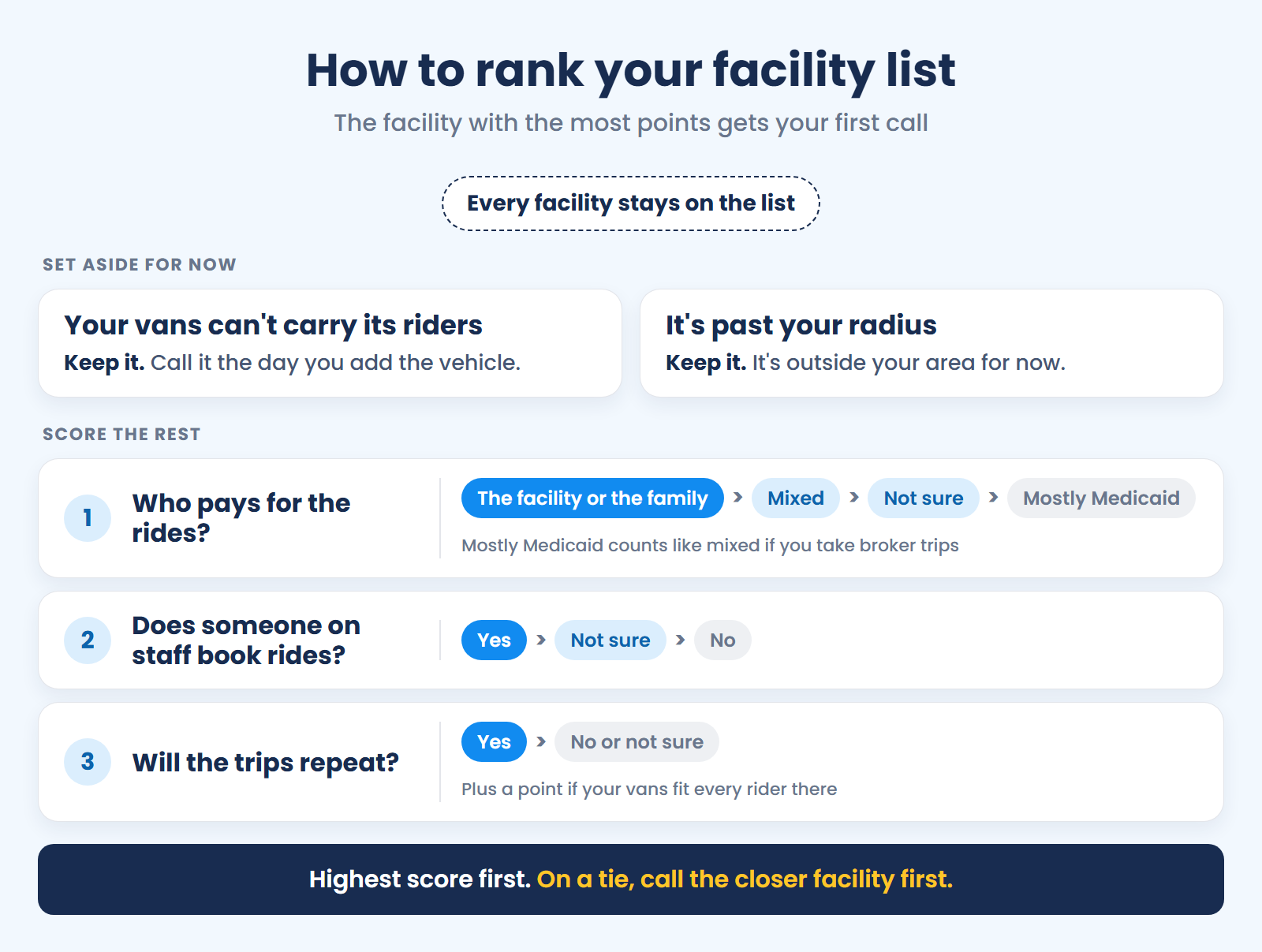
Which payers count depends on which ones you can bill. If you can’t bill Medicaid yet, move the Medicaid-only buildings to the bottom and keep them for the day you can. An owner in New York put his rule simply: “If they say at least 5% private, well, we’ll be there.” If you’re in the broker’s network, a building full of Medicaid riders counts like a mixed one, since some brokers will send a rider who asks for you by name. And facilities pay on invoice terms, often a month or more after the trip, so some owners chase that work and others avoid it; weigh it against the cash you can float.
Who books matters as much. Where staff decide which company to call, one relationship can send you trip after trip. Mac, one of the founders of The Doctor Ride in Charlotte and a guest on our podcast, covers these setups in his April 2026 video on facility types, an idea he credits to a post in his online community. Where the resident or family orders and the building pays, he says it takes “relationship building on two fronts”: the staff who pay you and the families who call.
Some types are slower to win. In Mac’s experience, the relationships “that take the longest to build” are the ones where the facility orders and pays, and he likens “the big hospitals and the big VA places” to “that big giant yacht.” A smaller memory care community you catch when it wants more transportation “really shouldn’t take that long.” Speed doesn’t change the order, though. The score ranks who can pay and who books, not how fast a building says yes, so start the slow ones early and keep up the monthly check-ins Mac recommends.
When an owner asked me which kind of facility is most often looking for a new provider, I said, “if you held a gun to my head, I would say assisted living.” That’s a hunch. Our facility outreach caller finds senior living, assisted living and skilled nursing “the easier ones.” None of it is a reason to skip anyone. As our cold-calling script for facilities puts it, “Don’t screen anyone out before you’ve called.”
Rank your list with the free spreadsheet
The free NEMT facility target list (.xlsx) does this ranking for you, with no email needed. It holds up to 1,000 facilities, with columns for who sets up transfers and each call, plus the free lists and first-call questions on their own tab. To use it:
- On the Settings tab, set your radius and whether you take Medicaid broker trips.
- Paste or type each facility with its type and miles from your base (a map app gives you the drive), then fill in whether your vans fit, who pays (your guess), whether staff book rides and whether trips repeat.
- Sort by Call order and call from the top.
- When a building tells you who pays, write it in “Who pays (after the call),” which replaces your guess.
It returns a call order. Facilities your vans can’t carry, or that sit past your radius, stay on the list, unranked. At the default settings, the example tab puts an assisted living community four miles out first, with 8 points: 3 because the family pays, 3 because the front desk books, 1 because the trips repeat and 1 because your vans fit. A PACE center also scores 8, but it’s 15 miles out, so it comes second. The points are a starting point, so change them to fit the work you want, and fill the sheet in for your county this week.
What to confirm on the first call
Ask who orders the rides and who pays for them, because the answer changes what you sell, to whom, and how long it takes. Before you pitch anything, Mac says to “determine who orders the rides, who pays for the rides,” and who controls the relationship between transportation and the residents. “That diagnosis is going to determine your messaging,” he says.
Ask whether the building runs its own van, and on which days. Facilities in Mac’s market tell him things like “we give our residents rides on Tuesdays and Thursdays.” Sell the other days, nights and weekends.
Have your own answer ready, because buildings ask back. In my experience, buildings with residents on both Medicaid and private pay often want to know, “can you [serve] all of them or just the private ones?” Write the confirmed payer in the sheet’s “Who pays (after the call)” column the same day. Our first-trip guide covers what to bring and ask at the first meeting.
Where do doctors’ offices, surgery centers and dialysis clinics fit?
Keep doctors’ offices, surgery centers, home health agencies and dialysis clinics on the list for the riders they send, and win those riders with flyers and referrals, since the buildings rarely pay.
Federal surgery center rules require every patient to be discharged “in the company of a responsible adult,” unless the attending physician exempts them. The rule doesn’t say whether a hired driver can be that adult, so ask each center what it accepts. When Josh Hagen of Careway Mobility asked me on our September episode how to get surgery centers sending discharge rides, I said these centers often “will not let people take an Uber afterward.” I called it “a good fit for a wait and return service.” While your driver waits, they can chat with other people in the lobby, like a daughter who brought her parent in and may call you next time. When the rider or family pays, price it like any private-pay ride.
Doctors’ offices are similar. As I told one owner, doctors usually don’t pay for the transport “unless it’s hospital discharge,” but “they can, like, recommend you.” Leave a stack of brochures at the front desk.
Home health agencies don’t pay either. Under Medicare’s home health rules, “The transportation of beneficiaries, whether to receive covered care or for other purposes, is excluded from home health coverage.” Their patients still ride, since Medicare lets homebound patients leave home for dialysis, chemo and adult day care. Home care agencies can refer riders too: when I asked Jeanine of SailorGirl Transport on our podcast whether an owner should learn home care or partner with a home care company, she said, “You absolutely need to partner.”
Dialysis riders mostly come through the broker, because most of them are on Medicaid. The exception is “a super high-end” private-pay clinic, which I told Josh to treat more like a nursing home or assisted living account.
Back to the owner who asked how to identify who to contact in a territory: the answer is the whole territory, worked from the top. If you’re not sure a type is worth your time, call ten of them; as I put it on one call, that’s “a good way to decide.” Take the top ten rows on your list and write down who books a ride at each and who pays for it. Every blank is a call for this week.
Facility list FAQ
Do PACE programs hire outside ride companies?
Some do, for overflow. A North Carolina owner said in a 2026 podcast interview that his local PACE program runs its own vehicles and keeps “a couple backups.” He stopped by one day and left his card, got a call about two months later and ran his first trip about a week and a half after that. Federal PACE rules require a written contract that states the payment rate. You accept the program’s payment as payment in full and bill no one else for the ride, and the program has to train its transportation staff, contractors included.
How often should I re-pull the lists?
Whenever each source updates. CMS planned its next nursing home file for December 2, 2026, and its next dialysis file for January 20, 2027, and the Provider of Services file comes out every quarter. Each time you re-pull, delete the newly closed rows and add the new facilities to your sheet.
About the author
James O'Donnell cofounded Duet and leads its sales, partnerships, and growth services. He talks with NEMT operators every week, hosts the NEMT Growth podcast, and answers Duet's sales line himself. More about Duet's founders →
Want more trips and less busywork?
See how Duet runs and grows NEMT businesses in a 30-minute demo.