Article
Should You Hire a Salesperson for Your NEMT Business?
Who should make your facility calls: you, a paid calling service or a salesperson, what each one costs, and the test to run first.
By James O'Donnell, Cofounder and COO, Duet ·
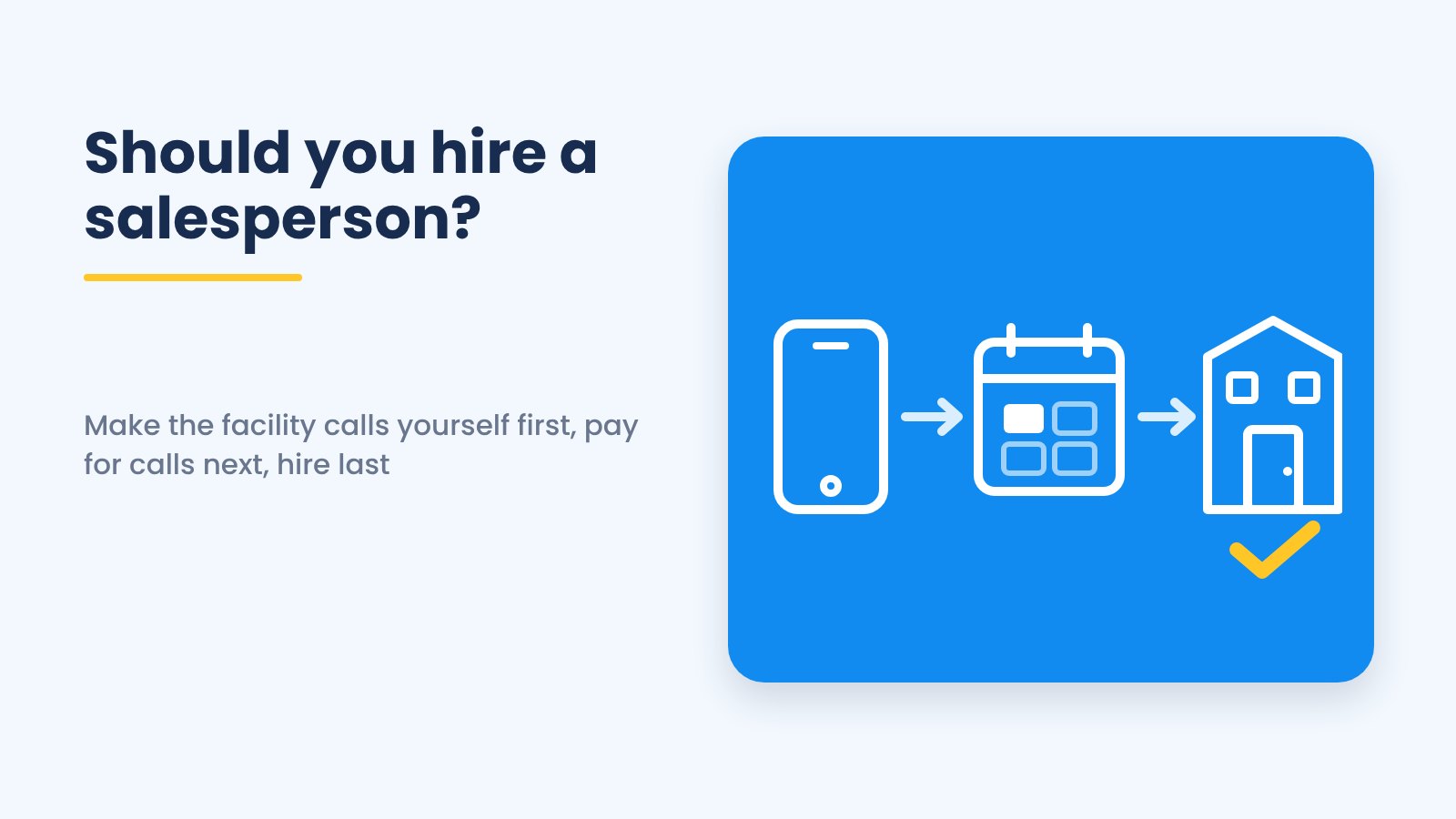
Hire a salesperson last. Make the facility calls yourself first, pay someone to make them once getting past the front desk is what stops you, and hire only for steady facility accounts that need someone every week. Before you pay anyone, make sure you could take five more facility trips next week and get to a facility on a day’s notice. Whoever makes the calls, judge them by booked meetings with the people who choose which company a facility calls, not by dials or leads.
Here’s what it looks like when an owner doesn’t show up. In one owner’s first couple of weeks with our outreach service, our caller lined up about a dozen facility contacts who wanted to hear from him. He called three of them and didn’t walk into a single one. So I stopped the work and offered his money back: “you’re just lighting money on fire,” I told him. Another owner on the same service checked the list every morning and afternoon, called right away, and went in himself or sent a driver to drop off his cards. He got trips.
The first owner had paid for the calls. Nobody can sell you the part where you show up.
I take the sales calls for that service, so I hear owners make this decision out loud. Our guide to how a small company wins its first facility agreement covers the contract; this one covers who makes the calls. Below are the three options in the order they cost money, which is also the order I’d tell an owner to grow through them, then what to ask any outreach firm and a test for next week.
When should you make the facility calls yourself?
Make the calls yourself while you have more hours than money, and for as long as your own calls and visits keep turning into meetings. With one van, I don’t necessarily recommend buying our service. As I told a one-van owner in Charlotte this summer, “it’s something you kind of can and should do yourself.” And when someone in Montana told me only 20 facilities were in range of him, I said I didn’t know that we could help.
Doing it yourself is slow. A new one-van owner in the Inland Empire left his card and a pen at front desks. “No one called me back,” he told me. An owner in Orange County who mostly runs broker trips figures 100 calls might turn up “two, three, four” interested facilities, and his company doesn’t have the time to make them.
Price those hours at what a hired driver in your seat would cost. At the national median in the Bureau of Labor Statistics’ May 2025 wage data for shuttle drivers and chauffeurs, the job category that includes NEMT drivers, a full-time driver runs about $3,560 a month with payroll taxes and workers’ comp. That’s $20.54 an hour. Five hours a week of your own calling is worth about $445 a month, the cheapest selling there is while it keeps producing meetings. For the calls themselves, use a call-by-call script for the front desk.
If you don’t have those hours, buy them before you buy selling. Te’ya Miles has run a NEMT company in Atlanta since 2019 and coaches other owners. On our episode about the most common NEMT mistakes, she said owners stay stuck doing “tasks that you should have an admin assistant doing by now” instead of “the networking that your business needs to grow.” A part-time driver or an office hand buys back your mornings; a salesperson doesn’t, because facilities would “rather talk to the owner than to some hired guy,” as I told a new owner this summer.
When is it worth paying someone to make the calls?
Pay someone to make the calls once the front desk, not the meeting, is what stops you, and you have room for more trips and free mornings for meetings. An operator in rural North Texas had knocked on doors for two months with one ride to show for it. He told me the $2,000 was “a drop in the bucket to the time that I’ve spent.”
On demos I describe the split with a rule of thumb, not a count of hours. Our caller does “the first maybe 75%”: the calls, the front desk and finding the right person. The owner does “the 25% of going in.”
That first 75% is what the outreach service we run at Duet does. We build your facility list, our callers make the calls in your company’s name, and we book the meetings onto your calendar. As of October 2026 it’s $2,000 a month, or $1,600 with Duet software, month to month with no cancellation fee. It guarantees 8 meetings with facility decision-makers in your first month, or we keep working free until you have them. A meeting counts when someone at the facility with “real influence over transportation” (an activities director, discharge planner, social worker or administrator) has agreed to meet about working with your company. At exactly 8, that’s $250 a meeting in month one.
What stays yours is following up the same day and showing up. Someone running a seven-van company asked me whether they’d “only have to show up.” Yes, and on time: booked for 10 a.m. tomorrow means there at 10, while some owners take “three days to even call.” I tell owners to plan on at least 20 minutes a day for callbacks and five to ten hours a week in person.
Those meetings can become rides the facility pays for, private-pay rides its residents’ families book, or Medicaid trips that still come through the broker. Our guide covers what to do between the meeting and the first trip.
When should you hire a salesperson?
Hire a salesperson only once you have steady facility accounts that need visits every week, because at the national median one costs about three times what a $2,000-a-month calling service does and can leave with your facility accounts. In the same May 2025 BLS data, sales representatives of services (other than advertising, insurance, finance and travel) had a national median of $69,990 a year across all industries. The middle half earned $47,670 to $100,480. With the employer’s payroll taxes, the median is about $6,300 a month, before benefits, workers’ comp, a phone and mileage.
I tell owners that a salesperson who knows the local facility directors can bring in contracts quickly, but six months later they may leave and take the facilities along, “because the relationship was with them, not with your company.”
Marqus Johnson, a Tampa operator who trains drivers to sell, sees it differently. On episode 20 of our podcast, he described worrying about a driver walking off with a facility as “a scarcity mentality,” because “That facility still knows what company actually provides the transportation service.” Both can be true, so keep the facility list, the call notes and two names at every building in your company’s records. It’s the same reason buyers discount relationships that live with the owner.
The other way to get a salesperson is to grow one. A Los Angeles owner said in a 2025 interview on another industry show that one of his first hires started part-time and is now his “business development manager and marketing manager.” Others grow theirs from the driver’s seat, by paying drivers a share of the facility trips they bring in.
How do the three options compare?
Your own calls cost the least cash and the most hours, a salesperson costs the most and risks the relationships, and a calling service sits between, as long as you make the callbacks and visits. The calling-service column uses our published price; the salesperson column uses the BLS median plus payroll taxes.
| Your own calls | A calling service | A salesperson | |
|---|---|---|---|
| Monthly cost | No cash; 5 hours a week is worth about $445 | Ours: $2,000 for 8 guaranteed meetings in month one, $250 each at most; others vary | About $6,300 at the national median with payroll taxes, before benefits |
| What you’re paying for | Your own time | Booked meetings, or only dials and lists | A person’s whole week |
| Whose relationship it is | Yours | Yours, if you take the meetings | Can become the salesperson’s |
| Your hours a week | Every call, callback and visit | 20 minutes a day, plus five to ten hours a week in person | Fewer, but facilities still want to meet the owner |
| Who it fits | One van, a thin market, or doors already opening | More than one van, mostly broker or private-pay trips, stuck at the front desk | Facility trips already a steady share of the week |
| Biggest risk | The calls stop when the schedule fills | Meetings go cold because nobody follows up | The relationships leave with the person |
| Move to the next column when | The front desk stops you and five more trips would fit | Your accounts need someone every week | One person can’t cover them; grow the next one inside |
Cost per meeting compares firms; it doesn’t say what a meeting is worth.
What should you ask an outreach firm before you pay?
Ask first what counts as a meeting, and get the answer in writing, because that one definition decides what you’re paying for. Firms sell different things: a list, dials, booked meetings, or a cadence like the one an outreach firm described in 2025 on another industry show, “two to three phone calls within two weeks and then also three emails.”
Here are the questions owners ask me, plus one they should, and what a good answer sounds like:
- What counts as a meeting? A good answer names the job titles, a time the person agreed to and which buildings. As I told one owner, a small residential home and a hospital network’s corporate director are “two very different meetings to set up.”
- How do you charge? A one-van owner in Baltimore told me about a seller she thought charged per call, whose cost “would run up pretty quickly.” Per meeting, you can end up arguing over whether a five-minute call counted. A good answer tells you the most you’ll pay in a month and how many meetings that buys.
- What share of your calls become booked meetings? An owner near Dallas-Fort Worth asked for the “closing ratio” outright. A good answer is meetings a month in a market like yours, not dials a day.
- Do you call the same facilities for my competitors? An incoming operations chief in Northern California called this the fiduciary question: whether a firm is “going to the same people on behalf of every single company.” A good answer is a straight yes or no, written into the contract.
- Do you already have relationships with facilities? Be careful with a yes. A firm that would hand you a relationship it won for another client would hand yours to the next one.
- Who keeps the list and the notes if I cancel? Few owners ask, and every owner should. A good answer: the facility list, the names, the call notes and any recordings stay with you.
- What do you guarantee? Meetings, at most. When an owner in South Florida asked me to guarantee enough revenue to cover the fee, I told her, “I cannot guarantee you revenue because I can guarantee you meetings.”
Ask us every one of these, too.
Our own guarantee counts those four titles, never a receptionist brush-off.
Those four aren’t the same desk. Discharge planners and social workers often arrange the rides. An administrator approves which companies get called but almost never books a ride. In my experience, an activities director is an easier meeting than a case manager, and from there you can get to whoever books. So ask any firm which desk each meeting is with and how you’ll reach the person who books.
Could you get to a facility tomorrow and take five more trips next week?
Before you pay anyone to sell, open next week’s schedule. As a gut check, if five more facility trips wouldn’t fit, nobody could get to a facility tomorrow morning, or you couldn’t carry a few months before facility trips pay, fix that first.
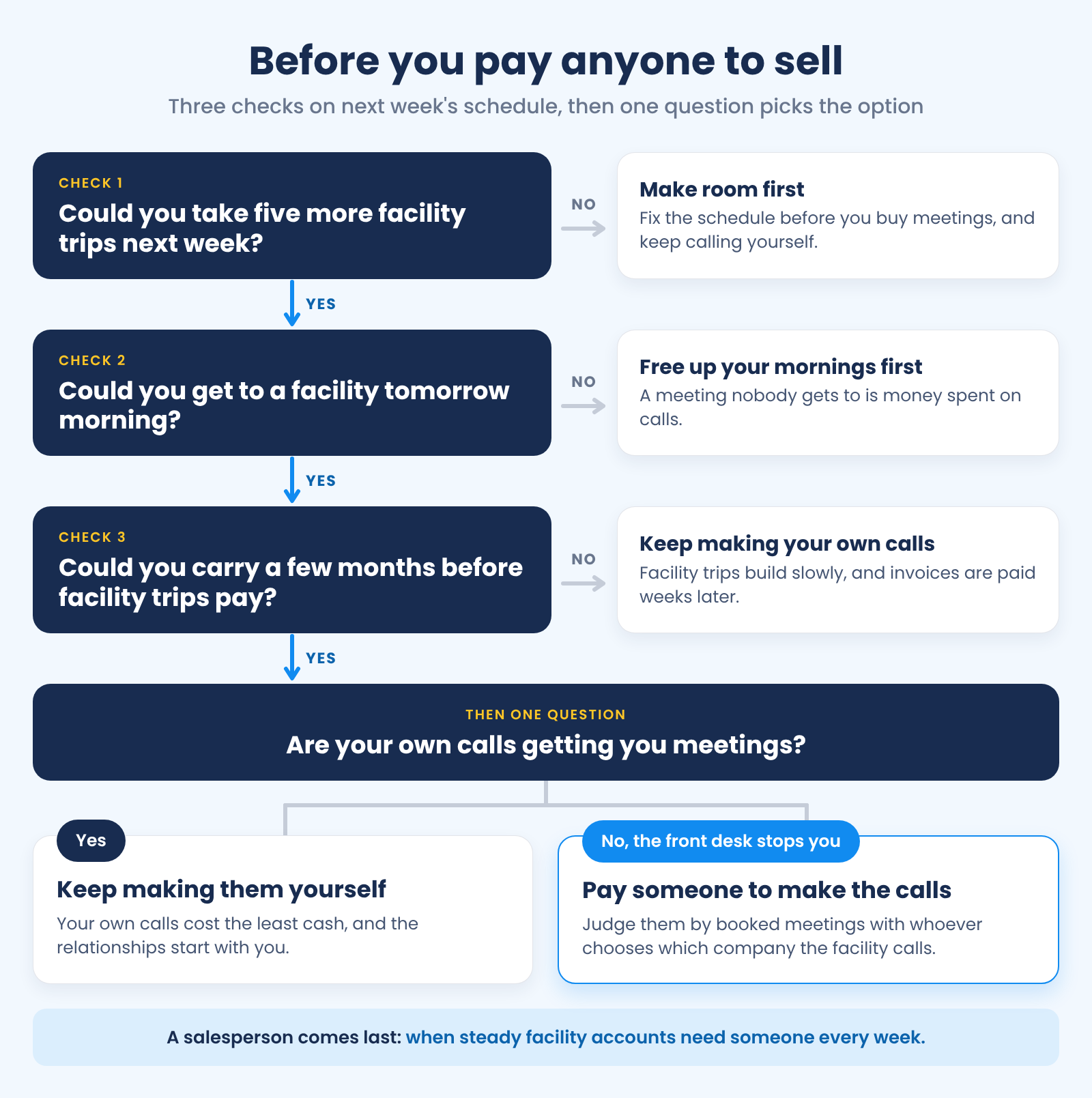
On demos I check the first two, though I don’t put a number on the trips. I won’t sell this service to an owner who doesn’t have the time to show up on one day’s notice, or at least call, and I ask what their capacity to take on more trips looks like.
An owner-operator in Jacksonville who drives his own trips paused our service because “I don’t have the time to do the necessary follow-up,” and a meeting could cost him a trip. A startup owner in Maryland told me, “I can’t afford to pay for this service, yet I’m looking for work.” I told him that was “a good reason not to buy this service right now.” As I explained to him, trips from a new facility build over “a month or two or more.” And facilities pay by invoice, often 45 days or more after the trip.
None of this means stop calling. But a van sitting empty this week needs trips sooner than a facility will send them. For an empty vehicle, I told a five-vehicle manager on our podcast to start with Google Ads, and our guide shows what each interested caller costs on Google Ads.
This week:
- Count next week’s open seats, and don’t pay anyone to sell until five more facility trips would fit.
- Block 20 minutes a day for callbacks and five to ten hours a week for visits, and keep them for a month.
- Price your selling hour at what it costs to put a driver in your seat, about $20.50, so five hours a week costs about $445 a month.
- Divide any firm’s fee by the meetings it guarantees, and get its meeting definition in writing: $2,000 for 8 in month one is $250 a meeting.
- Save two names at every building you call, plus the call notes, in your company’s records.
The owner whose service I stopped had about a dozen facility contacts waiting to hear from him, and he walked into none of them. So before you pay anyone to sell, pick the morning next week you’d spend at a facility if one said yes tonight, and put it on your calendar. If you can’t find that morning, keep making the calls yourself until you can.
About the author
James O'Donnell cofounded Duet and leads its sales, partnerships, and growth services. He talks with NEMT operators every week, hosts the NEMT Growth podcast, and answers Duet's sales line himself. More about Duet's founders →
Want more trips and less busywork?
See how Duet runs and grows NEMT businesses in a 30-minute demo.