Article
How to Start a NEMT Business in Pennsylvania (2026)
Pennsylvania has no NEMT license, but paid rides need PUC authority that local carriers can contest. Here's the order that wastes the least money.
By James O'Donnell, Cofounder and COO, Duet · · Updated
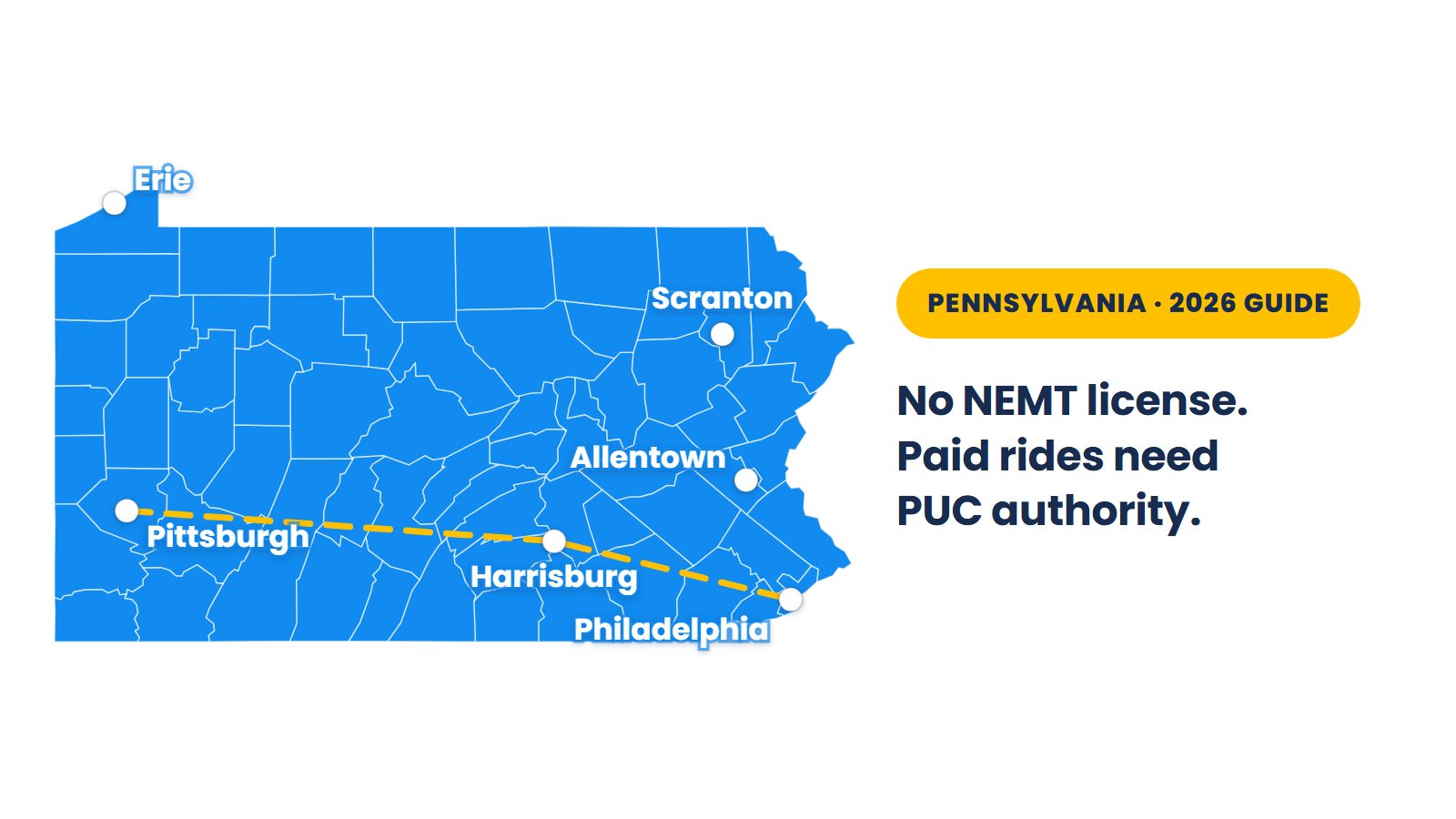
To start a NEMT business in Pennsylvania, form an LLC ($125) and apply to the Pennsylvania Public Utility Commission (PUC) for paratransit authority: $350, three months or longer, more if another carrier protests. You can’t run or advertise rides until the certificate issues. There’s no NEMT license. Medicaid rides run through the Medical Assistance Transportation Program (MATP), county by county, usually through a transit agency; only Philadelphia uses a broker, Modivcare. Budget about $23,000 to $50,000 for one used wheelchair van, counting six months of fixed bills.
Pennsylvania at a glance:
- PUC authority: a certificate of public convenience in paratransit service for a NEMT company paid to carry riders within Pennsylvania, wheelchair and stretcher vans included, with narrow exceptions [1][2].
- Protests: every application is published in the Pennsylvania Bulletin, and objectors, usually rival carriers, get at least 15 days to protest your fitness [3].
- PUC clock: “3 months or longer,” by the PUC’s estimate [4]. Dockets show 87 days to a certificate for an unprotested 2025 application and 157 for a protested one [5][6].
- Who runs Medicaid rides: county programs and transit agencies in 66 counties; in Philadelphia, Modivcare, a broker the Department of Human Services (DHS) hires to assign Medicaid rides and pay for them [7].
- Direct billing: no fee-for-service billing for van trips to medical care; waiver transportation for people with intellectual disabilities or autism is a direct Medicaid door [8][9].
- Insurance: the PUC’s floor is $35,000 of split liability; plan on at least a $500,000 combined single limit, the auto minimum in ride broker MTM’s standard provider agreement [10][11].
- Drivers: 21 or older, with State Police and driving-history checks [12].
In May 2025, a Philadelphia NEMT company asked the PUC to add paratransit rights from five counties: Berks, Bucks, Lehigh, Montgomery and Northampton. Five carriers already licensed there filed a protest, Bucks County’s own Medicaid ride provider among them [6][13]. Every ground was fitness: too little on where the vans would be kept or on safety, no credit or cash shown. Both sides asked to postpone the September hearing to negotiate, but it convened as scheduled. Nobody appeared for the company, and the judge ordered it to get a lawyer. In October it narrowed its application. Berks, Lehigh and Northampton stayed; Bucks and Montgomery shrank to a handful of towns. The docket lists the certificate 157 days after filing.
In Pennsylvania, carriers already in your counties can contest your PUC application, and county programs hold the Medicaid rides. So file narrow and start with private pay and facilities. Filing narrow means asking the PUC only for the counties your vans, drivers and money can serve on day one. The checklist below runs in the order the gates open, which is also the order that wastes the least money. The rest of the guide takes those gates in turn: the PUC’s rules, then who pays and how the Medicaid doors open, then the money and the calendar.
I run Duet, which builds dispatch software and runs growth services for non-emergency medical transportation (NEMT) companies, and I talk to NEMT owners on demos every week, Pennsylvania operators included. This is the Pennsylvania edition of our national guide on how to start a NEMT business. Requirements change, so confirm against the linked sources before you spend money.
The one-page checklist: how to start a medical transportation business in Pennsylvania
Pick your counties first: the PUC judges fitness against the territory requested. Each phase below ends with the money it puts at risk.
Phase 0: pick your counties, riders and first trips
- Counties: name only the counties you can serve from day one. The PUC weighs your capital, equipment and experience against “the territory requested” [14].
- Medicaid: call the MATP office in each county you’re weighing, and ask who drives its trips and whether that provider subcontracts. The answer helps you pick counties.
- Riders: walking, wheelchair and stretcher riders all ride under the same certificate. A rider who needs medical monitoring on the way is an ambulance trip, not yours [2][15].
- First trips: line up a facility or a private-pay referral source now, for service that starts once you’re certified. Operating without a certificate draws a $1,000 fine per violation [4].
- Money at risk: none yet.
Phase 1: form the company
- File an LLC’s certificate of organization with the Department of State: $125, plus $70 for a fictitious name if you’ll use a trade name. A $7 annual report follows each year [16].
- Get a free employer identification number (EIN) from the IRS.
- Put the down payment and working cash in a company bank account. PUC staff told a Philadelphia applicant that filed in December 2024 that property and accounts not in the company’s name “would be excluded from consideration” [17].
- Money at risk: $125, plus $70 for a trade name.
Phase 2: build the fitness file and file with the PUC
- File the PUC’s paratransit application (rev 12/6/21) with $350, paid through eFiling or by certified check, money order or attorney’s check. Staff refuse personal and company checks [2][17].
- Answer every item in the verified statement: your experience, where the vans will be kept, how you’ll dispatch, your vehicle safety program and how you’ve priced insurance [2].
- Write your driver policies to 52 Pa. Code §§ 29.501-29.509. That same applicant was denied 36 days after filing for leaving them out [12][17].
- Attach a balance sheet less than six months old. If you’ll buy the van after approval, show the cash or financing for it in the company’s name [2][14][17].
- Money at risk: $350, one time.
Phase 3: ride out publication and any protest
- The PUC publishes your application in the Pennsylvania Bulletin. The protest deadline falls at least 15 days later, protests may challenge only your fitness, and a protested application then waits 20 days for a settlement [3].
- At a hearing, a limited liability company needs a Pennsylvania-licensed lawyer, or one admitted for the case [6].
- Money at risk: $0 without a protest; a lawyer’s fees with one.
Phase 4: approval, then 60 days to insure and file a tariff
- Approval gives you 60 days to file your tariff, your public price list, and to have your insurer file a Form E for your coverage, or the PUC can dismiss the application [3][17].
- Buy or finance the van in that window. Register it with “BA” bus plates, $119 a year for seven seats, and book its twice-a-year state inspection [18].
- Letter both sides with your name and “Pa.P.U.C. No. A-” number, at least 2 inches high [19].
- Money at risk: about $6,600 down on a $33,000 van, $2,207 in Pennsylvania tax, title, lien and plates, and about $4,350 of insurance due at signing; the van price, down payment and insurance come from our national cost model.
Phase 5: book the trips you control, then open the Medicaid doors
- Start facility and private-pay trips the day the certificate issues; neither needs Medicaid enrollment.
- Then sign on with your county’s MATP provider, Modivcare in Philadelphia, or the Office of Developmental Programs (ODP) for waiver trips.
- Put up a NEMT website and a Google Business Profile once you’re certified, and keep the facility visits going.
- Money at risk: about $1,934 a month in fixed bills for a financed van while the Medicaid doors open.
What licenses and requirements does a NEMT business need in Pennsylvania?
Pennsylvania has no NEMT license; the gate is a PUC certificate that rival carriers can protest. Under 66 Pa.C.S. § 102, a company that offers to carry passengers between Pennsylvania points “for compensation” is a common carrier by motor vehicle. Section 1101 makes service lawful only with a certificate “first had and obtained” [1]. The PUC’s paratransit application covers “Transportation of people in wheelchair and stretcher vans” [2].
What circulates online gets much of this wrong:
| The claim you’ll read elsewhere | What Pennsylvania actually requires |
|---|---|
| ”A Pennsylvania NEMT Provider License from the Pennsylvania Department of Health / Transportation” | No such license exists. Paid rides need the PUC’s certificate; the Department of Health licenses ambulance services [1][4][15] |
| “average processing time … about two (2) weeks” | That’s the PUC’s pace for property and large group carriers. Paratransit authority has an estimated processing time of “3 months or longer” [4] |
| “enroll as a provider via the PA DHS PROMISe Portal” | Not for MATP van work, which county programs and Philadelphia’s broker buy by contract rather than through Medicaid enrollment [7][8] |
| “regional NEMT brokers (such as Modivcare or MTM)“ | For MATP, one broker in one county: Modivcare, in Philadelphia. Community HealthChoices plans use their own ride brokers, MTM among them, for non-medical waiver trips [7][32][35] |
| A “$688” or “approximately $709” application fee | $688 was the federal provider enrollment fee in 2023; it’s $750 in 2026. In transportation, Pennsylvania charges it only to ambulances [20] |
| “minimum liability coverage often starts at $1,000,000 to $1,500,000” | The PUC’s legal floor under 16 passengers is $35,000 split, plus first-party medical and wage-loss benefits. Higher limits come from contracts, like MTM’s $500,000 minimum [10][11] |
| “filing an LLC application costs $70” | An LLC’s certificate of organization is $125; $70 is the fictitious-name fee [16] |
| “Drivers must be at least 18 years old” | 21 under PUC rules; 18 to 20 only as a Department of Health-certified emergency medical services vehicle operator [12] |
| “Stretcher unit … Special license needed.” | No stretcher-van license exists; the PUC certificate covers stretcher vans for riders who need no monitoring [2][15] |
The exits from the certificate are narrow. The statute excludes anyone who “furnishes transportation for any injured, ill or dead person” [1]. The PUC’s exemption list reads that as an “ambulance-like vehicle which is medically equipped,” on trips to or from health care providers, not “Dr.’s Offices” [21]. By that list, a wheelchair van with only a driver doesn’t qualify. An older PUC policy statement speaks more loosely of paratransit “utilizing specialized equipment,” so get the PUC’s answer in writing before you rely on the exclusion [21]. The list also exempts transportation “Incidental to primary non-transportation business,” like a home-care agency driving its own clients, and “Free Transportation - no compensation of any type” [21].
Government contract work is the edge worth a call. The PUC’s policy at 52 Pa. Code § 41.22 puts contractors and subcontractors of a county or state agency outside its jurisdiction under certain conditions. Among them, the agency sets or approves the rates, routes, schedules and terms of service, including who rides, and polices the contractor’s compliance [21]. A carrier working only under a county MATP contract should ask the PUC (717-787-3834) whether it needs a certificate at all. Private-pay and facility trips never qualify, so a company that wants those lanes needs the certificate anyway.
Philadelphia gets no exception. The Parking Authority regulates taxis and limousines there, but the law’s limousine definition excludes “Other paratransit service,” so a Philadelphia NEMT van files with the PUC [4][22]. Cities add registrations on top. Philadelphia wants a Commercial Activity License and a Business Income and Receipts Tax (BIRT) account, and Pittsburgh has its own business registration form [23].
Which counties should you ask the PUC for?
Ask only for the counties you can prove you’ll serve, because the PUC weighs your fitness against “the territory requested.” Its policy statement, 52 Pa. Code § 41.14, asks whether you have “sufficient capital, equipment, facilities and other resources necessary to serve the territory requested” [14]. The protest at the top of this guide quoted that line and argued that nothing showed the company’s resources “in any way changing” to serve an expanded territory [6].
The company kept Berks, Lehigh and Northampton whole. It gave up most of Bucks and Montgomery, the two counties where all five protesting carriers’ paratransit authority is based [6]. More counties can come later, through a $350 amendment application backed by trips you’re already running [3].
How do you get a PUC number in Pennsylvania?
File the PUC’s paratransit application with a one-time $350 fee and a fitness file, and expect three months or longer even if nobody protests. Staff read the file and send data requests for whatever’s thin. The December 2024 Philadelphia applicant shows how. A data request asked for its driver policies and a company-only balance sheet. Staff found the answers didn’t cover the driver-hiring policies, and a denial letter followed 36 days after filing. The applicant petitioned for reconsideration within the 20 days allowed, got the case reopened in April 2025 and won approval that June, six months after filing [17].
Publication adds time: “A Bulletin posting will pause the application process for up to 5 weeks,” the PUC’s FAQ says [4]. The unprotested Beaver and Allegheny application shows the pace. Its docket lists a data request 15 days after filing, approval on day 70 and the certificate on day 87 [5].
What happens if carriers protest your application?
Since June 3, 2017, a protest can challenge only your fitness, not whether your area needs another carrier, and it can still cost you counties. The PUC’s 2017 rule stopped making applicants prove “a public demand or need,” leaving it to “be determined in the marketplace” [14]. The PUC’s Bulletin notices now say “Protests based on endangering or impairing operations of an existing carrier will not be honored” [14]. New York, by contrast, still gives incumbents 30 days to argue your area doesn’t need you.
A protest still turns a paperwork review into a case before an administrative law judge. The rule builds in a settlement window: a protested application waits 20 days “to permit the applicant to make restrictive amendments leading to the withdrawal of protests” [3]. A restrictive amendment narrows your territory or service, and the protesters withdraw in exchange. At a hearing, a limited liability company “must be represented by an attorney licensed to practice law in Pennsylvania, or admitted pro hac vice,” meaning admitted for that one case [6].
Protests aren’t automatic: the Beaver and Allegheny application was published and drew none, by its docket [5]. Fitness is the part you control.
What happens after the PUC approves you?
Approval starts a 60-day clock: your insurer files a Form E and you file a tariff, or the PUC can dismiss the application and you pay to start over. It can extend the deadline on a written request showing good cause [3]. The approval letter says you “cannot operate” until both are filed and approved [17]. The December 2024 Philadelphia applicant was approved on June 18, 2025 and dismissed on August 27, with neither on file [17]. “Applicants can never provide their own insurance proof,” the PUC’s FAQ says, so line up an insurer who’ll file the Form E before approval arrives [4].
The tariff is your public price list: paratransit rates “shall be based on provisions contained in tariffs filed, posted and published,” and your minimum reservation lead time goes in it too [19]. The van itself needs working air conditioning and heat, snow or all-weather tires from October 1 to April 1, no dent bigger than 4 inches and, yes, “four matching wheel covers” [19].
What are the NEMT insurance requirements in Pennsylvania?
Plan on at least $500,000 of combined auto liability, the bar in MTM’s standard provider agreement, well above the PUC’s floor. MTM books non-medical rides for PA Health & Wellness’s waiver participants [35], and its form, posted on DHS’s HealthChoices site, sets minimums of $500,000 combined single limit for auto and $500,000 per occurrence for general liability. The limits are “as may be determined by MTM” [11]. It’s MTM’s contract, not a Pennsylvania rule, so ask each county program and Modivcare for their numbers before you bind a policy.
For the record, here are the floors:
| Who sets it | Minimum | Rule |
|---|---|---|
| PUC, vehicle that can carry fewer than 16 passengers | $35,000 split: $15,000 per person, $30,000 per accident, $5,000 property damage; plus $25,000 first-party medical and $10,000 wage loss | 52 Pa. Code § 32.11(b) [10] |
| PUC, 16 to 28 passengers | $1 million | § 32.11(c) [10] |
| PUC, 29 or more passengers | $5 million | § 32.11(d) [10] |
| Any registered Pennsylvania vehicle | $15,000/$30,000/$5,000, plus $5,000 medical | 75 Pa.C.S. §§ 1702, 1711 [10] |
| MTM’s provider agreement | $500,000 auto combined single limit; $500,000 general liability per occurrence | MTM’s 2023 form on DHS’s site [11] |
The premium is the bigger number. Our national model budgets $1,200 to $1,800 a month for a new company’s wheelchair van at broker-grade limits (about $1 million of auto liability), from quotes reported in 2024 to 2026. A quarter of the year, about $4,350, comes due at signing. Our guide to lowering NEMT insurance premiums covers how to shop at those limits.
Workers’ comp starts with your first employee. Skipping it is a crime under section 305 of the Workers’ Compensation Act, and “Every day’s violation shall constitute a separate offense” [24]. Pennsylvania rates it through the Pennsylvania Compensation Rating Bureau (PCRB), whose class 828, Paratransit Service, carries a loss cost of $2.593 per $100 of payroll from April 1, 2026 [24]. One full-time driver at the state’s $16.46 median wage for shuttle drivers and chauffeurs carries about $890 of that a year, before the insurer’s own multiplier [25]. A new employer also pays 3.822% unemployment tax on the first $10,000 of each employee’s 2026 wages [25].
What do NEMT drivers need in Pennsylvania?
Pennsylvania NEMT drivers need no commercial driver’s license (CDL) for a typical wheelchair van, but PUC rules require them to be 21. A CDL starts at a vehicle designed for 16 or more passengers including the driver, or rated at 26,001 pounds [26].
What does the PUC require of a paratransit driver?
The PUC’s driver rules, 52 Pa. Code §§ 29.501-29.509, set the file for anyone driving a vehicle that seats 15 or fewer [12]:
- License: a current, valid driver’s license.
- Age: 21 or older. An 18-to-20-year-old may drive paratransit only as a Department of Health-certified emergency medical services vehicle operator, and the carrier reports any accident or moving violation to the PUC within 3 calendar days.
- Criminal history: a Pennsylvania State Police record, plus records from every other state the driver lived in during the last 12 months, before the first trip. Then a State Police check every 2 years. Convictions that bear on whether the driver can serve “safely and legally” disqualify.
- Driving history: records from every state the driver held a license in during the past 3 years, then at least every 12 months.
- Alcohol and drugs: no “detected presence” of either while in service.
- Vans seating 9 to 15, driver included: a federal medical qualification and federal hours-of-service rules, PennDOT’s in-state adoption of most federal motor carrier safety rules, and on a trip across a state line, the federal rules themselves [12][26].
County and broker contracts add clearances the PUC doesn’t require. Philadelphia’s 2016 broker terms and Dauphin County’s MATP policy both required an FBI fingerprint check and a Pennsylvania child abuse clearance on top of the State Police check [27][28]. The three cost $62.95 a driver at DHS’s employee rates as of October 2026: $22.00 for the State Police check, $13.00 for the child abuse clearance and $27.95 for FBI fingerprints [28].
On pay, Pennsylvania’s median for shuttle drivers and chauffeurs, the federal job category that includes NEMT drivers, was $16.46 an hour in May 2025 [25].
Can a NEMT company run stretcher van trips in Pennsylvania?
Yes, for riders who need no medical monitoring on the way: Pennsylvania’s emergency medical services (EMS) law names the stretcher vehicle, and the PUC’s paratransit certificate covers it [2]. Under 35 Pa.C.S. § 8139, a stretcher vehicle is a non-ambulance for people who “do not receive and cannot reasonably be anticipated to require medical assessment, monitoring, treatment or observation during transportation” [15]. There’s no separate stretcher-van license.
Cross that line and it’s an ambulance trip. Carrying someone your company knows, or should know, needs monitoring “shall constitute unlawful operation of an ambulance,” even on trips to “a physician’s office” [15]. Running an unlicensed EMS agency is a third-degree misdemeanor, and the Department of Health can add up to $5,000 a day in civil penalties [15].
The payer changes too. DHS’s December 2023 MATP Basics deck lists riders “requiring a stretcher” among the trips MATP doesn’t cover [29]. Keystone First’s 2026 handbook, for one, says the plan covers NEMT when members “need to use a stretcher,” and lists a stretcher trip to the doctor under the ambulance transportation it’s responsible for [30]. Ask each health plan whether it pays anyone but an ambulance for stretcher trips. Then put the screening question in your dispatch protocol in writing: does this rider need any medical assessment, monitoring, treatment or observation on the way? If yes, send an ambulance.
Who pays for NEMT rides in Pennsylvania?
Medicaid is the volume, but county programs buy it; facilities and families pay directly. Every lane needs the PUC certificate, with the one possible exception of MATP-only work under a county or state agency contract [21].
Medicaid is the volume, and county programs buy it
MATP spent about $133.5 million on 4.1 million trips in state fiscal year 2025, July 2024 to June 2025, an average of $32.65 a trip, DHS’s June 2026 study estimates [7]. That’s transportation costs only, and the average blends bus passes and mileage reimbursement with van rides, so it isn’t a van rate. CMS, the federal Medicaid agency, counted 2,952,912 Pennsylvanians in Medicaid and the Children’s Health Insurance Program (CHIP) in June 2026, a preliminary count in its monthly Performance Indicator data [31]. The health plans send most of them to MATP. Keystone First’s handbook says the plan “does not cover non-emergency medical transportation (NEMT) for most HealthChoices members” [30].
Facilities are the stability
Nursing facilities “will continue to be responsible for providing non-emergency transportation for their residents,” says DHS’s Community HealthChoices transportation sheet, revised January 2019 [32]. Health plans cover some residents’ trips, but the nursing home arranges them; Keystone First’s 2026 handbook, for example, tells members in a nursing home, “Your nursing facility will arrange for this transportation” [30]. That makes the nursing home the account to win. Dialysis is different. Dialysis rides are great, but in my experience most dialysis riders are on Medicaid, so in Pennsylvania they ride MATP, and a dialysis clinic isn’t a facility account. CMS lists 301 dialysis facilities in Pennsylvania as of June 16, 2026, and DHS counts dialysis among MATP’s covered trips [29][31].
Sign the first facility before the van, and keep visiting after you sign. An owner who started a NEMT company in the Philadelphia area in 2026 had two facility contracts before he owned a van, and a third came through a relationship. About eight weeks after launch, he told an operators’ call I sat in on that his first van still “isn’t fully booked out.” His lesson: no number of contracts guarantees trips every day, so you have to stay in good graces with the facilities.
Private pay is the margin
Private-pay families book directly, and Pennsylvania has 2,665,974 residents 65 and older, 20.4% of the state, in the Census Bureau’s 2024 one-year American Community Survey [31]. Most private-pay operators I talk to take a card at booking and charge it at least 24 hours before pickup, or send a payment link due by then. No payment, no car. Some also take a small nonrefundable deposit to hold the spot. In Pennsylvania the price goes on the tariff the PUC approves. The certificate covers advance-reservation rides, and your tariff sets how far ahead riders must book. The one gap: “Paratransit carriers may not render service to or from airports” [2][19].
Who is the NEMT broker in Pennsylvania?
Only Philadelphia has a broker for MATP, Pennsylvania’s Medicaid ride program: Modivcare. In the other 66 counties, MATP runs through the county itself or a provider the county or DHS contracts, usually a transit agency [7].
A broker is the company a state or health plan hires to assign Medicaid rides and pay for them. DHS introduced “a broker model” in Philadelphia in 2005, and its June 2026 study names Modivcare as the current broker there [7], the same company Michigan hires for fee-for-service rides in Wayne, Oakland and Macomb counties. DHS keeps trying to re-bid that contract: two attempts were cancelled after bid protests, and a third “is in a stay” while litigation is pending, as of the study. No statewide or regional broker procurement has been issued since 2018 [7].
That makes Pennsylvania one of the 7 states our broker guide counts as state or county programs. Ohio splits its rides between county offices and the health plans’ ride vendors. Pennsylvania’s Community HealthChoices plans hire ride brokers too, MTM among them, for non-medical waiver trips [32][35].
Lawmakers asked whether to change that. Act 46 of 2025, signed November 12, 2025, ordered DHS to study a brokerage model [33]. The June 25, 2026 study, which also looked at New Jersey’s single statewide broker, concluded that “the evidence strongly supports continuing MATP under the improved in-house county delivery model” [7]. So outside Philadelphia, the Medicaid door is a contract with whoever runs your county’s program.
Which counties run MATP which way?
Here’s DHS’s June 2026 map, updated for Dauphin County’s July 1 move. Programs change hands, so confirm before you build on any row [7][34].
| How the county runs MATP | Counties | Who to ask about trips |
|---|---|---|
| County vendor (38) | Armstrong, Beaver, Bedford, Blair, Bradford, Bucks, Butler, Cambria, Cameron, Carbon, Clarion, Clearfield, Clinton, Elk, Erie, Fulton, Huntingdon, Jefferson, Juniata, Lackawanna, Lawrence, Lehigh, Luzerne, Lycoming, McKean, Mercer, Mifflin, Monroe, Montgomery, Northampton, Somerset, Sullivan, Susquehanna, Tioga, Warren, Washington, Westmoreland, Wyoming | The vendor, usually the county’s transit agency, which runs the whole program |
| DHS direct agreement (14) | Adams, Berks, Columbia, Cumberland, Dauphin (since July 1, 2026), Franklin, Indiana, Lancaster, Montour, Northumberland, Perry, Snyder, Union, York | rabbittransit, or South Central Transit Authority in Berks and Lancaster |
| County plus a transit provider, or hybrid (6) | Allegheny, Crawford, Delaware, Lebanon, Schuylkill, Venango | The county’s MATP office, which shares the work with a transit provider |
| The county itself (8) | Centre, Chester, Fayette, Forest, Greene, Pike, Potter, Wayne | The county’s MATP office, which is the provider |
| Broker (1) | Philadelphia | Modivcare |
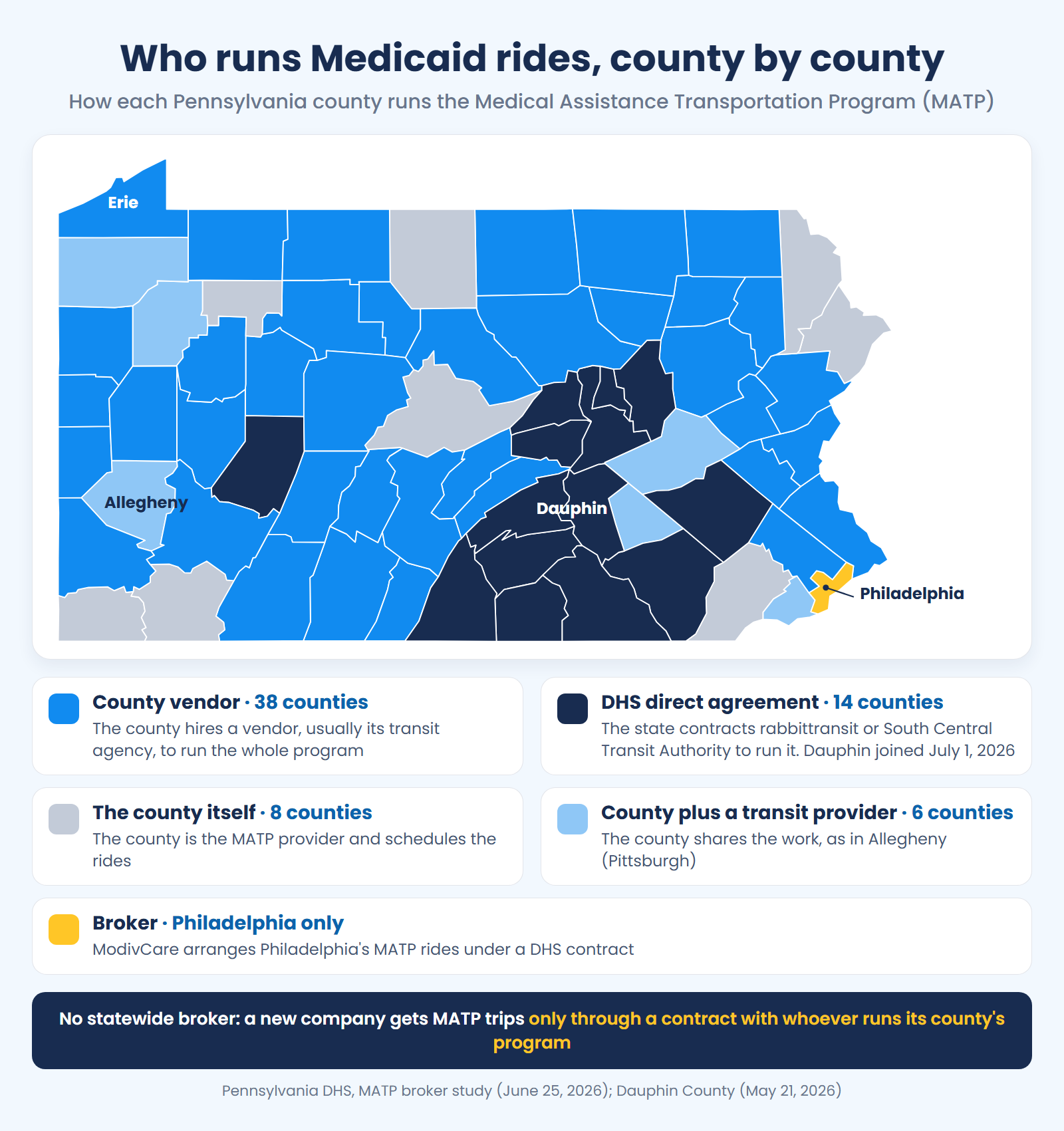
Dauphin County announced on May 21, 2026 that rabbittransit would take over its MATP on July 1, and riders had to reapply [34]. DHS’s study had already described that as a move “from a Hybrid model to a DHS Direct Agreement” [7]. Our tracker of broker contract changes in 2026 follows the bigger switches across the states.
How do you become a Medicaid transportation provider in Pennsylvania?
Subcontract with your county’s MATP provider, or credential with Modivcare in Philadelphia; there’s no state application for MATP van work. Waiver trips are a Medicaid door where you enroll with the state yourself.
Can I bill Pennsylvania Medicaid directly for NEMT rides?
Not for van trips to medical care: Pennsylvania’s Medicaid transportation provider type, Provider Type 26, has no specialty named for wheelchair van or sedan service. Its specialties cover ambulances and mileage reimbursement, and route transit and paratransit to OMHSAS, the state’s behavioral health office, and non-emergency trips to ODP [8]. MATP pays carriers through county and DHS contracts instead, and the application fee applies only to the ambulance specialties [7][20]. ODP’s waiver transportation is a direct door, and it doesn’t cover medical trips.
Step one: your county’s MATP provider
Your county’s MATP provider decides whether a private carrier gets its trips. Find your county’s row in the table above, call that office this week, and ask who drives its trips and whether that provider subcontracts.
In its 2023 paratransit guide, rabbittransit, now running MATP in 12 counties, says it uses subcontractors, so riders may ride with different providers in different vehicles [7][13]. Allegheny County’s MATP packet lists four ACCESS carriers, each serving “specific areas of Allegheny County” [13]. In Bucks County, the MATP provider is Bucks County Transport, one of the five protesting carriers at the top of this guide [6][13].
Get the contract’s driver, vehicle, training and insurance terms in writing before you buy anything, because administrators “can add additional contract requirements to their transportation providers,” DHS’s study notes [7].
Eugene Gindin, who runs Capital Area Transport Service in the DC area, said on our podcast about sustainable NEMT growth that on government contracts, starting as a subcontractor is the best first step. He’s watched prime contractors “fail as much as they succeed.”
Step two: Modivcare in Philadelphia
In Philadelphia, apply to Modivcare’s paratransit network. DHS’s 2016 request for proposals for that broker contract, which no re-bid has replaced, made the broker credential its carriers and inspect each vehicle before signing, then every 12 months [27]. The broker also trains drivers before their first MATP trip, and DHS approves every subcontract in advance [27]. Ask Modivcare whether its Philadelphia network is taking new carriers, and on what insurance and rates.
Step three: waiver trips
ODP’s Transportation-Trip service is a Medicaid door you open yourself. It pays by zone: $36.54 for a one-way trip up to 10 miles, $65.78 for 10 to 30 miles and $74.73 beyond 30, effective July 1, 2024 [9]. You enroll as Provider Type 26, specialty 267, with an ODP waiver provider agreement and a Medical Assistance provider agreement. Or you subcontract under an Organized Health Care Delivery System, a waiver provider allowed to hire transportation subcontractors [9].
ODP’s Adult Autism Waiver rules ask for PUC certification “when required by state law,” liability and auto insurance and ODP’s orientation, and cap transportation at $10,000 per participant per plan year [9].
Step four: Community HealthChoices plans’ ride brokers
Community HealthChoices (CHC), Pennsylvania’s Medicaid managed care program for long-term services, buys non-medical rides for waiver participants through brokers. DHS’s 2019 transportation sheet says the CHC plans “will use transportation brokers,” and PA Health & Wellness, for one, sends those participants to MTM’s booking app [32][35]. Credential with the plan’s broker for that work. DHS’s study found the brokers ran most CHC rides “on parallel transportation networks” outside the public shared-ride system, so the transit agency isn’t the door there [7].
How long does credentialing take?
Each door sets its own pace: your county’s MATP provider, Modivcare and ODP each run their own process, so ask each how long its last new carrier took. County programs also weigh a track record: Delaware County’s March 2026 request for proposals for its MATP transportation provider asked for three references and three years of financial statements [13].
That’s the catch-22: programs want a record, and a record needs trips. Facilities and private-pay families need no enrollment, so they’re where a new company’s record starts. Our guides on winning facility contracts, getting your first trip from a facility meeting and private pay cover that stretch.
Don’t build the whole schedule on one payer
Pennsylvania’s Medicaid doors move, so build on facility and private-pay trips. Counties change providers, as Dauphin did on July 1, 2026, and Delaware County put its MATP transportation out for proposals that spring [13][34]. Philadelphia’s broker re-bid was stuck in litigation as of DHS’s June 2026 study [7]. From January 1, 2027, some adults 19 to 64 must renew every six months, and those without a child under 14 also face work requirements, which can shrink the rider base [36]. And the state’s own General Fund line for Medical Assistance transportation sits flat at $68.346 million in both 2025-26 and 2026-27 [37].
Book one facility and one private-pay source before the van payments start.
Whatever the mix, keep it on one schedule. Dispatch software like Duet brings Modivcare’s trips and county trip lists onto the board beside your facility and private-pay work. Modivcare, Philadelphia’s broker, is one of Duet’s direct integrations. Any other trip list, a county program’s or its transit agency’s, comes in by trip file import or bulk upload, and each trip bills at the rate its contract sets. The PUC certificate and any protest, each county subcontract, Modivcare’s credentialing and rates, and invoicing each payer through its own process stay with you.
How much does it cost to start a NEMT business in Pennsylvania?
Budget about $23,000 to $50,000 for one used wheelchair van, counting six months of fixed bills, plus a lawyer if your application is protested. The low end, about $22,700, is an older $20,000 van financed with 20% down. The high end, about $50,200, is a 2016-2019 van at the $33,000 dealer median, bought outright; finance that van and it’s about $27,500. Pennsylvania’s own inputs are the LLC and PUC fees, the 6% sales tax and the Department of Transportation’s (PennDOT) title, lien and plate fees. The rest comes from our national cost model.
| Line item | Pennsylvania amount | Note |
|---|---|---|
| LLC | $125 | Plus $70 for a fictitious name and a $7 annual report [16] |
| EIN and national provider identifier (NPI) | $0 | Free from the federal agencies that issue them |
| Pennsylvania NEMT license | $0 | None exists |
| PUC paratransit application | $350, one time | No annual fee [4] |
| Temporary authority (optional) | $100 | Emergency-only, and protestable [1][3] |
| Lawyer, if protested | Get a quote | An LLC needs a Pennsylvania-licensed lawyer, or one admitted for the case, at a hearing [6] |
| Medicaid application fee | $0 | Not owed for MATP van work [20] |
| Used wheelchair van, 2016-2019 | About $33,000, or $6,600 down if financed | September 2026 dealer median; the national model finances 80% at 14% over 60 months, $614 a month |
| Tax, title, lien and plates | About $2,207 financed, $2,171 bought outright | 6% sales tax ($1,980), $72 title, $36 lien, $119 bus plates for seven seats. Tax runs 7% for buyers in Allegheny County and 8% in Philadelphia [18][38] |
| PUC assessment | A share of your intrastate revenue | Billed yearly after your sworn revenue statement [1][4] |
| Insurance due at signing | About $4,350 | A quarter of the national model’s $17,400 year |
| Workers’ comp | About $890 of loss cost a year per full-time driver | Class 828, before the insurer’s multiplier [24][25] |
| Equipment and lettering | About $1,000 | Including the 2-inch PUC lettering on both sides [19] |
| Screening and training | About $1,000 | Includes $62.95 for the three clearances MATP contracts ask for [27][28] |
| Phone and basic marketing | About $300 | National model |
| Six months of fixed bills | About $11,600 financed, $7,920 bought outright | $1,934 a month financed: a $1,305 insurance installment, a $614 van payment and $15 for a phone; $1,320 with no van payment |
| Total, owner driving | About $27,500 financed, $50,200 bought outright | Before a lawyer or workers’ comp; an older $20,000 van, financed, comes to about $22,700 |
One line may come back. Pennsylvania’s sales-tax rules exempt “vehicles used directly by a public utility engaged in business as a common carrier” (61 Pa. Code § 32.34(a)) [38]. Asked whether a PUC number allows tax exemptions, the PUC’s FAQ answers “Yes, possibly” [4]. On a $33,000 van, that’s about $1,980. The transfer rule wants the buyer registered with the PUC as a common carrier, so ask the Department of Revenue (717-787-1064) how it applies before you buy [38].
On the revenue side, ODP’s waiver rate is a published Medicaid per-trip price a new company can bill: $36.54 for a trip up to 10 miles [9]. At that rate, the financed van’s $1,934 of monthly fixed bills takes 53 short waiver trips to cover, before fuel or a driver’s pay. County and broker rates are set by contract.
How do you fund a NEMT startup in Pennsylvania?
Pennsylvania adds community lenders and free consulting to the Small Business Administration’s (SBA) loans, and one state program won’t fund a van:
- SBA 7(a) loans and microloans, covered in our national cost model.
- Community development financial institutions (CDFIs): the state’s economic development department, DCED, lists them by county. Entrepreneur Works Fund serves Philadelphia, Bridgeway Capital the west and Reinvestment Fund the whole state [39]. Ask each lender whether a van counts.
- Pennsylvania Small Business Development Centers: “no-cost, confidential consulting services” at 15 centers [39].
- DCED’s Small Business First doesn’t fit: its 2015 guidelines fund mobile equipment “if, and only if, such equipment is not titled or registered for highway use” [39].
None of them speeds up the PUC, so size your loan payments to the slow timeline.
How long does it take to start a NEMT business in Pennsylvania?
About three months to a certificate if nobody protests, five or more if someone does. Those clocks include the insurance and tariff filings: the unprotested Beaver and Allegheny application took 87 days from filing to certificate, and the protested Philadelphia one took 157 [5][6].
Here’s the sequence, with the clocks that apply:
- Before you file: pick your counties and riders, form the LLC, put the cash in the company’s account and write the fitness file.
- Review and publication: data requests, then a Bulletin posting that can pause the process “for up to 5 weeks” [4].
- The protest window: at least 15 days. A protest adds a 20-day settlement window and possibly a hearing [3].
- Approval: 60 days to buy and insure the van and get the Form E and tariff on file [3].
- Certificate: start running and advertising, and follow up with your county’s MATP provider, Modivcare or ODP the same week.
Run the parallel track the whole time: line up facilities and families for service that starts once you’re certified, and hold ads until the certificate issues. Budget the fixed bills in the cost table for every month the Medicaid doors stay closed.
The Philadelphia company at the top of this guide got its certificate for less of the map than it asked for. Nobody argued that Bucks and Montgomery already had enough vans, because since 2017 nobody can. Every ground in the protest was something the company’s own file didn’t show. If I were filing tomorrow, I’d ask only for the counties my file could defend, and I’d spend the wait lining up the facilities and families who’ll ride the week the certificate arrives.
Pennsylvania NEMT FAQ
Does MTM broker Medicaid rides in Pennsylvania?
Not MATP rides. Philadelphia’s MATP broker is Modivcare, and the other 66 counties run MATP through county programs and transit agencies [7]. MTM shows up on the Community HealthChoices side: PA Health & Wellness points waiver participants with transportation in their service plans to MTM’s booking app [35]. MTM’s standard provider agreement is also posted on DHS’s HealthChoices site [11]. Ask each plan which broker books its rides.
How do NEMT companies get paid in Pennsylvania?
It depends on the payer. County programs and their vendors pay MATP carriers under their own contracts, and Philadelphia’s 2016 broker terms required the broker to decide on 90% of accurate invoices within 30 days [27]. ODP pays enrolled waiver carriers its zone rates, $36.54 to $74.73 a trip [9]. Facilities pay under their own contracts, and private-pay riders usually pay by card before pickup, at the price on your PUC tariff [19].
Can I get temporary PUC authority while my application is pending?
Possibly, but it’s built for emergencies [1]. The PUC’s rule describes emergency temporary authority as limited-duration authority “to meet an emergency situation,” granted for up to 60 days at first, and each temporary application costs $100 [3]. A temporary-authority application is published with your permanent one, and a carrier that “can and will provide all or part of the proposed service” may protest it, an availability test permanent applications no longer face [3]. Call the PUC at 717-787-3834 before you count on it.
Can I start a Pennsylvania NEMT business with my own car or minivan?
For walking riders, yes, once it’s titled to your company and runs under your PUC certificate. PUC staff count only property in the company’s name, and a for-hire vehicle seating 15 or fewer gets bus plates and PUC lettering like any van; a passenger van used for hire is inspected twice a year, a car once [17][18][19]. County programs and Modivcare set their own vehicle rules, so ask before you count on Medicaid trips in a car.
Can a Pennsylvania NEMT van take riders into New Jersey or Delaware?
Yes, under federal rules rather than the PUC’s, whose authority covers trips that start and end in Pennsylvania [4]. A van designed for 9 to 15 passengers, driver included, that carries riders for pay across a state line is a federal commercial motor vehicle and needs a U.S. Department of Transportation (USDOT) number. Pennsylvania drops that filing only for carriers that stay in the state [26]. Check the Federal Motor Carrier Safety Administration’s operating-authority rules before the first cross-border trip.
Do you renew PUC authority every year?
No. The $350 application fee is one time, with no annual fee [4]. What recurs is upkeep. Insurance proof at the PUC “cannot lapse.” A sworn statement of your Pennsylvania revenue for the PUC’s assessment is due by March 31 each year, the bus registration renews every year or two, and the van is inspected twice a year [1][4][18]. Your LLC’s $7 annual report comes due too [16].
Do Pennsylvania NEMT drivers need PASS or another certification?
Not under PUC rules, which cover license, age, criminal and driving history, alcohol and drugs, and don’t mention Passenger Assistance Safety and Sensitivity (PASS) training or CPR [12], though the PUC application asks you to describe your driver training program [2]. Course requirements come from the contract. Philadelphia’s broker must train drivers before their first MATP trip, ODP requires its own orientation, and county programs set their own terms, so ask what each one accepts before you pay for a course [9][27].
Is MATP the same as Pennsylvania’s senior shared-ride program?
No. MATP is DHS’s Medicaid ride program, free to the rider. The Senior Shared-Ride Program is PennDOT’s: riders 65 and older pay 15% of the fare and lottery funds pay 85%, about $72.8 million for 2.6 million trips in state fiscal year 2025 [7]. The two often share the same county vans, and DHS’s MATP deck says riders 65 and older are referred to shared ride, with MATP paying the 15% [29].
Is the Pennsylvania market worth entering in 2026?
Yes, if you enter with trip sources you control. The demand is there, but county programs and one broker hold the Medicaid rides [7], the state’s own Medical Assistance transportation line is flat [37], and work requirements start January 1, 2027 [36].
Key official sources
[1] 66 Pa.C.S. §§ 102, 1101, 1103 and 510: the common carrier definition and its exclusions, certificates of public convenience and temporary certificates in emergencies, and the PUC’s annual assessment. https://www.palegis.us/statutes/consolidated/view-statute?txtType=PDF&ttl=66&div=0&chpt=1, https://www.palegis.us/statutes/consolidated/view-statute?txtType=PDF&ttl=66&div=0&chpt=11 and https://www.palegis.us/statutes/consolidated/view-statute?txtType=PDF&ttl=66&div=0&chpt=5
[2] Pennsylvania Public Utility Commission (PUC), Application for Motor Common Carrier of Persons in Paratransit Service (rev 12/6/21): the fee, the verified statement, the balance sheet, airports and the wheelchair and stretcher van wording. https://www.puc.pa.gov/documents/utility-files/432/App_MC_Persons_Paratransit_Service120621.pdf
[3] 52 Pa. Code §§ 1.43, 3.381 and 3.383: PUC fees, publication, protests, the 20-day amendment window, the 60-day compliance rule and temporary authority. https://www.pacodeandbulletin.gov/secure/pacode/data/052/chapter1/s1.43.html, https://www.pacodeandbulletin.gov/secure/pacode/data/052/chapter3/s3.381.html and https://www.pacodeandbulletin.gov/secure/pacode/data/052/chapter3/s3.383.html
[4] PUC, Frequently Asked Questions About Intrastate Authority (rev 6/25/24): when you need a PUC number, the fine, the one-time fee, processing time, the Bulletin pause, Form E, upkeep and tax exemptions. https://www.puc.pa.gov/media/3066/motor_carrier_faq062524.pdf
[5] PUC docket A-2025-3058187, an unprotested 2025 paratransit application for Beaver and Allegheny counties: filing, data request, approval letter (December 29, 2025) and certificate (January 15, 2026). https://www.puc.pa.gov/docket/A-2025-3058187, https://www.puc.pa.gov/pcdocs/1908135.pdf and https://www.puc.pa.gov/pcdocs/1910199.pdf
[6] PUC docket A-2025-3055256, a 2025 paratransit application for added territory: the docket listing, joint protest (July 14, 2025), hearing notice (July 18, 2025), order on the restrictive amendment (October 10, 2025) and certificate (October 23, 2025). https://www.puc.pa.gov/docket/A-2025-3055256, https://www.puc.pa.gov/pcdocs/1886806.pdf, https://www.puc.pa.gov/pcdocs/1887408.pdf, https://www.puc.pa.gov/pcdocs/1898369.pdf and https://www.puc.pa.gov/pcdocs/1899593.pdf
[7] Pennsylvania Department of Human Services (DHS), MATP broker study under Act 46 of 2025 (June 25, 2026): county models, Philadelphia’s broker and re-bids, MATP and shared-ride spending, CHC brokers, contract requirements and the study’s conclusion. https://www.pa.gov/content/dam/copapwp-pagov/en/dhs/documents/docs/publications/documents/highlighted-reports/matp-broker-study-act-46-of-2025-june-25-2026.pdf
[8] DHS, Requirements for Provider Type 26 (Transportation) (January 31, 2019) and Provider Type Specialty Codes (updated March 28, 2024). https://www.pa.gov/content/dam/copapwp-pagov/en/dhs/documents/providers/billing-info/documents/provider-enrollment-docs/Transportation%20Requirements.pdf and https://www.pa.gov/content/dam/copapwp-pagov/en/dhs/documents/providers/documents/medical-assistance/Provider%20Type%20Specialty%20Codes.pdf
[9] Office of Developmental Programs (ODP), Adult Autism Waiver provider information table (July 1, 2026) and fee schedule notice 24-1583 (November 2, 2024): Transportation-Trip rates, enrollment, qualifications, training and limits. https://www.pa.gov/content/dam/copapwp-pagov/en/dhs/documents/providers/providers/documents/odp/2026-08-04-aaw-provider-information-table.pdf and https://www.pacodeandbulletin.gov/Display/pabull?file=%2Fsecure%2Fpabulletin%2Fdata%2Fvol54%2F54-44%2F1583.html
[10] 52 Pa. Code § 32.11 and 75 Pa.C.S. §§ 1702 and 1711: PUC passenger carrier insurance and Pennsylvania’s private-car minimums. https://www.pacodeandbulletin.gov/secure/pacode/data/052/chapter32/s32.11.html and https://www.palegis.us/statutes/consolidated/view-statute?txtType=PDF&ttl=75&div=0&chpt=17
[11] MTM, Transportation Provider Services Agreement (January 1, 2023), posted on DHS’s HealthChoices site: insurance minimums. https://www.pa.gov/content/dam/copapwp-pagov/en/dhs/documents/healthchoices/documents/transportation-provider-services-agreement-01-01-2023.pdf
[12] 52 Pa. Code §§ 29.501-29.509: paratransit driver rules. https://www.pacodeandbulletin.gov/Display/pacode?file=/secure/pacode/data/052/chapter29/subchapFtoc.html&d=reduce
[13] County MATP providers’ own documents: Bucks County Transport’s MATP page, rabbittransit’s Summer 2023 paratransit guide, Allegheny County’s MATP packet (current as of June 2026) and Delaware County’s RFP HS-000022 (March 2026). https://www.bctransport.org/medical-assistance-transportation/, https://www.rabbittransit.org/wp-content/uploads/2023/05/Paratransit-2023_English-SPREADS-for-web.pdf, https://www.alleghenycounty.us/files/assets/county/v/4/services/dhs/documents/resources/transportation/matp-application-packet-for-adults.pdf and https://www.delcopa.gov/sites/default/files/2026-04/RFP_MATP_March_2026_AFS_REV_TIMELINE_AOD.pdf
[14] 52 Pa. Code § 41.14, the PUC’s 2017 rulemaking (47 Pa.B. 3099) and its May 30, 2026 notice of motor carrier applications: the fitness test and fitness-only protests. https://www.pacodeandbulletin.gov/secure/pacode/data/052/chapter41/s41.14.html, https://www.pacodeandbulletin.gov/Display/pabull?file=%2Fsecure%2Fpabulletin%2Fdata%2Fvol47%2F47-22%2F929.html and https://www.pacodeandbulletin.gov/secure/pabulletin/data/vol56/56-22/791.html
[15] 35 Pa.C.S. Chapter 81, the Emergency Medical Services System Act: EMS agency licensing, stretcher and wheelchair vehicles, and penalties. https://www.palegis.us/statutes/consolidated/view-statute?txtType=PDF&ttl=35&div=0&chpt=81
[16] 15 Pa.C.S. §§ 146 and 153 and the Department of State’s annual report page: LLC, fictitious name and annual report fees. https://www.palegis.us/statutes/consolidated/view-statute?txtType=PDF&ttl=15&div=0&chpt=1 and https://www.pa.gov/agencies/dos/programs/business/types-of-filings-and-registrations/annual-reports
[17] PUC docket A-2024-3052726, a 2024 Philadelphia paratransit application: the data request and denial (recited in the April 24, 2025 order), the June 18, 2025 approval letter and the August 27, 2025 dismissal. https://www.puc.pa.gov/docket/A-2024-3052726, https://www.puc.pa.gov/pcdocs/1875882.pdf, https://www.puc.pa.gov/pcdocs/1883605.pdf and https://www.puc.pa.gov/pcdocs/1892759.pdf
[18] PennDOT’s MV-70S fee schedule (April 2026) and bus registration fact sheet (February 2025), 75 Pa.C.S. § 102’s bus definition, 75 Pa.C.S. § 4702 and 67 Pa. Code § 175.5: title, lien and bus plate fees and periodic inspection. https://www.pa.gov/content/dam/copapwp-pagov/en/penndot/documents/public/dvspubsforms/bmv/bmv-forms/mv-70s.pdf, https://www.pa.gov/content/dam/copapwp-pagov/en/penndot/documents/public/dvspubsforms/bmv/bmv-fact-sheets/fs-busreg.pdf, https://www.palegis.us/statutes/consolidated/view-statute?txtType=PDF&ttl=75&div=0&chpt=1, https://www.palegis.us/statutes/consolidated/view-statute?txtType=PDF&ttl=75&div=0&chpt=47 and https://www.pacodeandbulletin.gov/secure/pacode/data/067/chapter175/067_0175.pdf
[19] 52 Pa. Code Chapter 29, paratransit and vehicle sections: method of operation (§ 29.353), tariffs (§ 29.355), lettering (§ 29.71) and vehicle condition (§ 29.403). https://www.pacodeandbulletin.gov/secure/pacode/data/052/chapter29/s29.353.html, https://www.pacodeandbulletin.gov/secure/pacode/data/052/chapter29/s29.355.html, https://www.pacodeandbulletin.gov/secure/pacode/data/052/chapter29/s29.71.html and https://www.pacodeandbulletin.gov/Display/pacode?file=/secure/pacode/data/052/chapter29/subchapEtoc.html&d=reduce
[20] DHS MA Bulletins 01-16-14 and 99-22-11, and CMS’s 2023 and 2026 provider enrollment application fees in the Federal Register: who pays the fee in Pennsylvania, and how much. https://www.pa.gov/content/dam/copapwp-pagov/en/dhs/documents/docs/publications/documents/forms-and-pubs-omap/c_228992.pdf, https://www.pa.gov/content/dam/copapwp-pagov/en/dhs/documents/docs/publications/documents/forms-and-pubs-omap/MAB2022122901.pdf, https://www.govinfo.gov/content/pkg/FR-2022-12-05/html/2022-26340.htm and https://www.govinfo.gov/content/pkg/FR-2025-12-03/html/2025-21877.htm
[21] PUC motor carrier exemption list (rev 10/5/21), 52 Pa. Code §§ 41.11 and 41.22, and a January 2025 PUC order reciting staff’s ruling that a home-care agency’s transport of its own clients was incidental to its home-care business: the ill-or-injured, incidental, free-transportation and government-contract exemptions. https://www.puc.pa.gov/media/1686/exemptions100521.pdf, https://www.puc.pa.gov/pcdocs/1861700.pdf, https://www.pacodeandbulletin.gov/secure/pacode/data/052/chapter41/s41.11.html and https://www.pacodeandbulletin.gov/secure/pacode/data/052/chapter41/s41.22.html
[22] 53 Pa.C.S. Chapter 57: the Philadelphia Parking Authority’s taxi and limousine definitions. https://www.palegis.us/statutes/consolidated/view-statute?txtType=PDF&ttl=53&div=0&chpt=57
[23] City of Philadelphia, License FAQs, and City of Pittsburgh, Business Registration Form (rev. 07/26). https://www.phila.gov/media/20190301143527/License-FAQs.pdf and https://pittsburghpa.gov/files/assets/city/v/1/finance/documents/18373_business_registration_form.pdf
[24] Workers’ Compensation Act § 305, the Pennsylvania Compensation Rating Bureau’s April 1, 2026 loss costs and the Insurance Department’s workers’ comp guide. https://www.palegis.us/statutes/unconsolidated/law-information/view-statute?txtType=PDF&yr=1915&sessInd=0&smthLwInd=0&act=338&chpt=3, https://pcrb.com/wp-content/uploads/2026/02/p040126.xlsx and https://www.pa.gov/content/dam/copapwp-pagov/en/dli/documents/businesses/compensation/wc/insurance/documents/worker_comp.pdf
[25] Bureau of Labor Statistics, Occupational Employment and Wage Statistics, shuttle drivers and chauffeurs (May 2025), Pennsylvania series; and the Department of Labor & Industry’s 2026 unemployment tax highlights. https://api.bls.gov/publicAPI/v1/timeseries/data/OEUS420000000000053305308 and https://www.pa.gov/agencies/dli/resources/for-employers-and-educators/how-to-file/uc-tax/yearly-tax-highlights
[26] 75 Pa.C.S. § 1603, 49 CFR 390.5 and 67 Pa. Code Chapter 231: the CDL threshold, the federal commercial motor vehicle definition and Pennsylvania’s intrastate adoption of federal safety rules. https://www.palegis.us/statutes/consolidated/view-statute?txtType=PDF&ttl=75&div=0&chpt=16, https://www.govinfo.gov/content/pkg/CFR-2024-title49-vol5/pdf/CFR-2024-title49-vol5-sec390-5.pdf and https://www.pacodeandbulletin.gov/secure/pacode/data/067/chapter231/067_0231.pdf
[27] DHS, RFP 01-15 for MATP services in Philadelphia County (July 29, 2016): the broker’s carrier credentialing, clearances, inspections, training, subcontract approval and invoice terms. http://contracts.patreasury.gov/Admin/Upload/419909_4100077277%20Attachment%20A.pdf
[28] Dauphin County MATP Policy 07-03 (revised October 27, 2020) and DHS’s clearance pages: driver clearances and their fees. https://www.dauphincounty.gov/docs/default-source/mental-health/07-03-matp-provider-driver-clearances-and-training-revision.pdf?Status=Master&sfvrsn=dad4100f_2, https://www.pa.gov/agencies/dhs/resources/keep-kids-safe/child-abuse-clearances/criminal-background-check, https://www.pa.gov/agencies/dhs/resources/keep-kids-safe/child-abuse-clearances/pa-child-abuse-history-clearance and https://www.pa.gov/agencies/dhs/resources/keep-kids-safe/child-abuse-clearances/fbi-fingerprinting
[29] DHS, MATP Basics (December 2023): covered and non-covered services and the shared-ride referral for riders 65 and older. https://www.pa.gov/content/dam/copapwp-pagov/en/dhs/documents/healthchoices/documents/matp-101-dhs-transportation-meeting-12-11-2023.pdf
[30] Keystone First 2026 Member Handbook: MATP, stretcher and nursing-home transportation. https://www.keystonefirstpa.com/content/dam/keystone-first/keystone-first-pa/pdf/member/handbook/english.pdf.coredownload.inline.pdf
[31] CMS Medicaid and CHIP enrollment data (Performance Indicator dataset, September 2026 release), CMS Dialysis Facility Listing by Facility (modified June 16, 2026) and the Census Bureau’s American Community Survey 2024 1-year, table B01001, via Census Reporter. https://data.medicaid.gov/api/1/metastore/schemas/dataset/items/6165f45b-ca93-5bb5-9d06-db29c692a360, https://data.cms.gov/provider-data/api/1/metastore/schemas/dataset/items/23ew-n7w9 and https://api.censusreporter.org/1.0/data/show/latest?table_ids=B01001&geo_ids=04000US42
[32] DHS, HealthChoices Transportation (revised January 2019): nursing facility and Community HealthChoices transportation. https://www.pa.gov/content/dam/copapwp-pagov/en/dhs/documents/healthchoices/hc-services/documents/Transportation.pdf
[33] Act 46 of 2025 (HB 749), signed November 12, 2025: the NEMT brokerage study. https://www.palegis.us/statutes/unconsolidated/law-information?sessYr=2025&sessInd=0&actNum=46
[34] Dauphin County, MATP transition to rabbittransit (May 21, 2026). https://www.dauphincounty.gov/home/dc-news/2026/05/21/matp-transition-to-rabbittransit
[35] PA Health & Wellness, LTSS member transportation page: MTM Link for waiver participants. https://www.pahealthwellness.com/members/ltss/member-resources/Transportation.html
[36] DHS, Changes Coming to Medicaid in Pennsylvania: work requirements and six-month renewals from January 1, 2027. https://www.pa.gov/agencies/dhs/resources/medicaid/medicaid-changes
[37] Office of the Budget, 2026-27 enacted General Fund appropriations: the Medical Assistance-Transportation line. https://www.pa.gov/content/dam/copapwp-pagov/en/budget/documents/publications-and-reports/commonwealthbudget/2026-27-budget-documents/2026-27%20enacted%20budget%20-%20general%20fund%20appropriations%20web.pdf
[38] 61 Pa. Code §§ 32.34 and 31.46 and the Department of Revenue’s local sales tax page: the common-carrier vehicle exemption and the Philadelphia and Allegheny County rates. https://www.pacodeandbulletin.gov/Display/pacode?file=%2Fsecure%2Fpacode%2Fdata%2F061%2Fchapter32%2Fs32.34.html&d=reduce, https://www.pacodeandbulletin.gov/Display/pacode?file=%2Fsecure%2Fpacode%2Fdata%2F061%2Fchapter31%2Fs31.46.html&d=reduce and https://www.pa.gov/agencies/revenue/resources/tax-types-and-information/sales-use-and-hotel-occupancy-tax/local-sales-tax
[39] DCED’s Pennsylvania CDFI Network page, the Pennsylvania Small Business Development Centers and DCED’s Small Business First guidelines (2015). https://dced.pa.gov/pa-community-development-financial-institutions-cdfi-network/, https://www.pasbdc.org/ and https://dced.pa.gov/download/small-business-first-program-guidelines-09-pdf/?ind=0&filename=Small+Business+First+Program_guidelines-09.pdf&wpdmdl=58147&refresh=67b5468c65ba91739933324
Last verified against the sources above in October 2026. Pennsylvania requirements, county MATP providers and broker contracts change; check the primary sources before acting, and treat this guide as education, not legal advice.
About the author
James O'Donnell cofounded Duet and leads its sales, partnerships, and growth services. He talks with NEMT operators every week, hosts the NEMT Growth podcast, and answers Duet's sales line himself. More about Duet's founders →
Starting in a nearby state?
Want more trips and less busywork?
See how Duet runs and grows NEMT businesses in a 30-minute demo.