Article
Wheelchair Securement in NEMT: Tie-Downs, Belts, Training
Drivers usually get the four straps on. The rider's belt is what gets skipped, and an ordinary stop or turn does the rest.
By James O'Donnell, Cofounder and COO, Duet ·
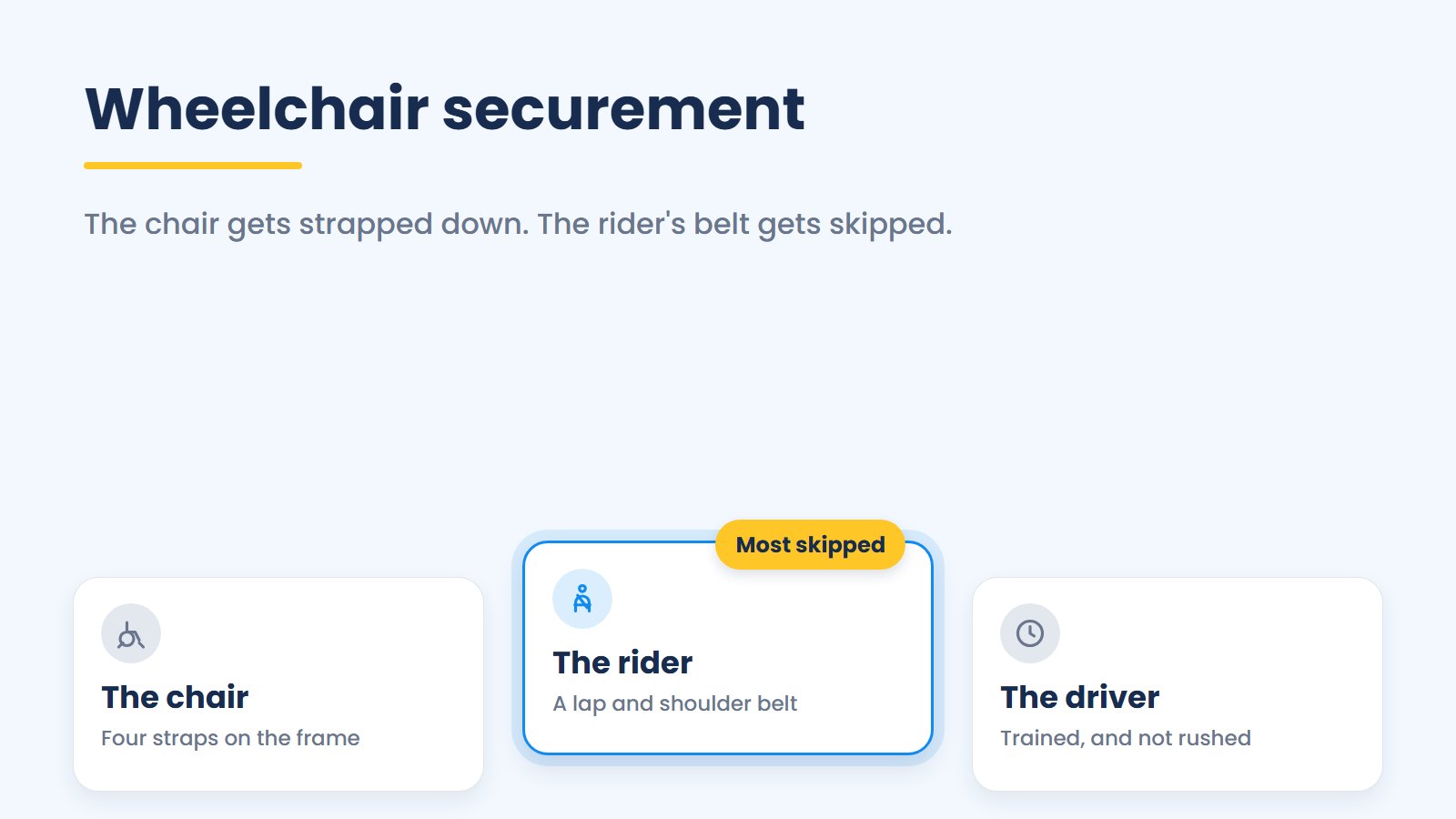
Securing a wheelchair in a NEMT van is two jobs on every ride. Four straps hold the chair to the van by its frame, two in front and two behind, and a crash-tested lap and shoulder belt holds the rider. Skip or rush either one and an ordinary stop or turn can hurt the rider, and the step that gets skipped most is the rider’s shoulder belt.
New Jersey’s Department of Human Services built a 2026 van safety training deck around five real-world cases. In the first, a rider’s wheelchair fell over during a turn and the rider’s head struck the van’s wall. The camera footage later showed the straps “appeared attached but were not properly tightened.”
Securement usually fails like that, on an ordinary ride with one step done halfway. In a 2018 study, University of Louisville researchers reviewed video of 475 wheelchair and scooter trips on two paratransit vans at one transit agency. Drivers used all four tie-downs on 75% of trips, but the rider’s belts were missing or misused on 88%, most often because the driver never put on the shoulder belt. And in an estimate by NHTSA, the federal highway safety agency, for 1991 to 1995, most wheelchair riders hurt in incidents involving vans weren’t in a crash, and improper or no securement was the most common cause. The fix starts with training and time, not new straps.
This guide follows the trip in order: before the van leaves, the chair, the rider and the drive, then chairs that aren’t built for vans and riders who won’t be belted, the training, and the proof.
What should you know before the van leaves?
Before the van leaves, know the rider’s chair and weight, plan the minutes securement takes, and check every strap and belt in the van.
Start with the chair. A WC19 wheelchair is built and crash-tested to ride as a seat in a vehicle, with four marked hook points and a WC19 label. Most aren’t. UMTRI, the University of Michigan institute that leads the standards work, says in its FAQ on riders without WC19 chairs that “only a small fraction” of today’s wheelchairs comply. Some power chairs have no usable hook points at all, which is worth knowing before the van arrives.
Then the weight. My cofounder Jing said on our private-pay episode that wheelchair and stretcher riders can weigh 300, 400, even 500 pounds, and not every provider can carry them. The Americans with Disabilities Act (ADA) rule on lift and securement use, 49 CFR 37.165, lets a covered company decline a rider who outweighs the lift’s rating, chair included. These rules reach a company that sells rides to the public. For one that runs only broker trips it’s less settled, so check your contract and follow them either way.
Where you get the answers depends on who’s paying:
- Broker trips: ask on the day-before confirmation call: the chair type, whether it has four marked hook points, the rider’s weight and the stairs at both ends.
- Hospital discharges: ask whether the rider has a chair at all. On our dispatching episode, Jing said riders who came in through the ER often left theirs at home.
- Private pay: the family booking the ride knows the chair and the stairs, so ask before you quote.
Then the minutes. Q’Straint’s director of training, in a 2024 industry podcast interview, estimated about five minutes from picking a rider up at the door to secured, for a crash-tested chair. For a complicated chair, especially a first-time rider’s, the estimate was seven to ten. Scheduling every rider at a flat five minutes is “what leads to so many people rushing through the process,” the director said, and what gets rushed is the last step, the rider’s belt. Put those minutes on the schedule, and leave room for them when you decide how full to run your schedule.
Last, the van, before every shift. The daily checklist in AMF-Bruns’s tie-down user manual, on its downloads page, starts with the retractors: pull each strap out quickly to check that it locks. UMTRI’s brochure adds: check the tie-downs and belts regularly and replace worn parts. A 2026 recall notice for some Q’Straint QRT-360 retractors warned that one “may stay unlocked.” It tells owners to check the label for part number Q011002 and a manufacturing month of August or September 2025, and Q’Straint replaces the affected retractors. While they waited for replacements, owners were told to confirm before each trip that every one locks.
Frank Ciccarella, a safety and training consultant who teaches securement, warned about used vans on our episode about startup paperwork. If a used van comes with a Q’Straint system, he said, “you got to make sure that all the straps are there so you can do the four-point securement plus the lap and shoulder belt.” Our vehicle guide covers what else a used van should pass. If a position is short a strap, I’d pull it from wheelchair trips until it’s fixed; the ADA rules make covered companies repair securement devices promptly.
How do you secure a wheelchair in a van?
Face the chair forward with its brakes on and use a four-point tie-down: four straps hooked to its frame, two in front and two behind, tightened until the chair barely moves.
The steps:
- Face it forward. UMTRI’s Ride Safe brochure and AMF-Bruns’s and Sure-Lok’s instructions all say so.
- Lock the brakes, or power the chair off. It’s step one on Sure-Lok’s Titan 800 instruction placard.
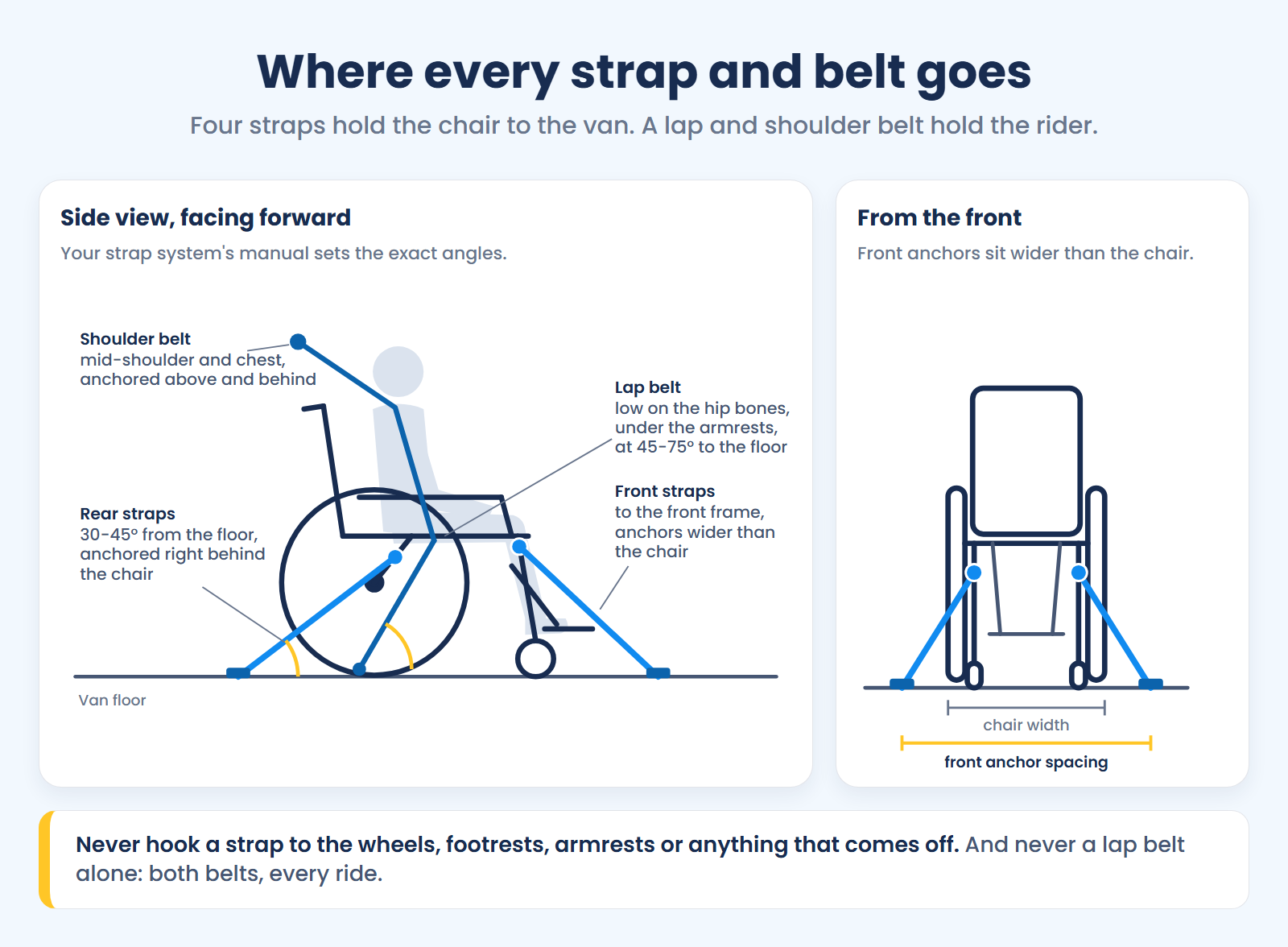
- Hook the frame and nothing else. UMTRI’s brochure says to use the four marked points on a WC19 chair, or welded frame joints on others, and never the wheels, footrests, armrests or anything that comes off.
- Angle the rear straps. Anchor them right behind the chair’s rear hook points, 30 to 45 degrees from the floor, per UMTRI.
- Spread the front straps. UMTRI says to anchor them wider than the chair for stability. Seen from the side, AMF-Bruns puts them at 40 to 60 degrees from the floor. Your system’s manual has its own numbers and its own order for hooking the straps, and both win.
- Take out the slack. Sure-Lok’s placard has you rock the chair forward and back, or tension the webbing with the retractor knobs.
- Check the movement. AMF-Bruns has you release the brakes, check for movement, then set them again. New Jersey’s deck adds a pull on each strap, because “looking at straps isn’t enough.”
Paul Muench, who built Gentle Turns in Phoenix to five vans in a year, explained step 6 on our episode about his first year. Each of his Q’Straint straps sits a little loose in its retractor housing until he turns the dial “one or two clicks.” Skip that and the chair moves, which alarmed him as a driver.
On the chair side, the classic mistake is where the hooks go. Tony Jackson spent about ten years as a national securement trainer for the Community Transportation Association of America (CTAA). He told me on our facility contracts episode that he got into training after seeing crews “tying the wheelchairs through the wheels.” The Louisville researchers found tie-downs on casters, armrests and footrests.
How tight is tight enough depends on whose number you use. For vans built to the ADA’s vehicle spec, 49 CFR 38.23 limits an occupied chair to “no more than 2 inches in any direction” in normal driving. AMF-Bruns uses the same 2 inches. UMTRI’s safety tips for providers say half an inch, and New Jersey’s rule for mobility assistance vehicles says one inch. Treat 2 inches as the most you’ll accept, and one inch in a New Jersey mobility assistance vehicle.
How do you belt a wheelchair rider?
Every rider needs a lap belt low on the hip bones and a shoulder belt across the chest, every ride, and the shoulder belt is the step drivers skip most.
What UMTRI and the makers say:
- Lap belt low and under the armrests. UMTRI wants it “low across the front of the pelvis on the upper thighs, not on the abdomen.” Seen from the side, it angles 45 to 75 degrees from the floor. Thread it between the armrest and the seatback to keep it off the armrests.
- Shoulder belt across the middle of the shoulder and chest. It joins the lap belt near the hip, with its upper anchor above and behind the rider’s shoulder. Never run it across the face or neck.
- Both belts, every ride. AMF-Bruns says its system “is not designed for use with only a pelvic securement.” The ADA’s vehicle spec requires a seat belt and shoulder harness at every wheelchair position, and MTM’s 2026 Virginia Medicaid handbook has drivers “verify that all wheelchairs and wheelchair passengers are correctly secured” before starting the vehicle.
- The chair’s own belt doesn’t count. UMTRI says postural belts attached to the wheelchair “are not strong enough to withstand crash forces.” A Florida owner who trains drivers in securement said it this way on an operator call I joined in March: it’s “a wheelchair belt, but it’s not a transportation-approved seatbelt.” The exception is a crash-tested lap belt labeled WC19, and the shoulder belt still connects to it.
In the Louisville study, drivers left off one or both belts on 65% of trips, and the missing one was the shoulder belt 98% of the time. Most misrouted lap belts sat on top of the armrests. No one was hurt on those recorded trips. A 2010 UMTRI case series of 42 wheelchair riders in crashes and other incidents found the same split. Of the 34 chairs that were properly secured, all but one held, but 30 of the 42 riders weren’t properly belted.
New York’s Justice Center for the Protection of People with Special Needs built a 2020 securement toolkit around cases “loosely based on real Justice Center cases.” In one, staff tied the chair down with all four floor straps but draped the shoulder belt behind the rider. A dog ran into the street, the driver slammed on the brakes, and the chair held while the rider fell out of it.
How should you drive with a wheelchair rider aboard?
Brake early and corner slowly, and leave enough time that nobody rushes, because riders in vans get hurt far more often without a crash than in one.
NHTSA’s 1997 research note estimated that 7,121 wheelchair users were hurt or killed in incidents involving a motor vehicle from 1991 to 1995. Vans were in almost half of those injuries, and more than nine in ten of the van injuries weren’t a collision. Improper or no securement was the largest category, at 35% of all the injuries, and 65% of those cases involved vans. Lifts, transfers and ramps made up most of the rest. Collisions between a wheelchair and a motor vehicle were 26%, mostly with passenger cars, and vans were in only 7% of them. Data that old shows the direction of the risk, not its size today.
Rushing is how a careful driver misses a step. Rachel Scholler, who built and sold a NEMT company in rural Wisconsin, said on our episode about growing at a 30% margin that overworked drivers start speeding. They may skip steps, too, “because they’re rushing because they feel so overwhelmed.” One of New York’s cases had both: a chair with only one front strap tipped over when the driver “was going fast and made a sharp turn.”
New Jersey’s deck tells drivers to “anticipate turns to reduce risk,” and Frank’s driver training adds a closed course with cones to practice stops and turns with a passenger in back.
If a rider slides anyway, pull over as soon as it’s safe and get help rather than lifting a heavy rider alone. MTM’s Virginia handbook has drivers pull over “in a safe location outside of traffic” and call dispatch for help when a rider’s behavior or anything else makes driving unsafe. Experienced providers told one driver who struggled alone to call the fire department next time, Jing said on our private-pay episode.
Time is the part you can plan. Duet’s auto-scheduling builds the day with the time it takes to load and unload each rider, and a few settings let you tune it to how your operation runs. The minutes at the curb and in the van go on the schedule instead of getting squeezed out of it. The training, the strap check and the belt on every ride are still yours.
What if the chair isn’t WC19, or the rider won’t be belted?
A chair that isn’t WC19 still rides, strapped by its strongest frame parts, and a rider who won’t be belted gets one written rule that applies to everyone.
For the chair, UMTRI says to hook welded frame junctions or spots joined with hardened steel bolts, “often indicated by six raised lines or bumps on the bolt head.” On a tilt chair, keep all four straps on the seat frame or all four on the base, or they can go slack if the seat angle shifts in a crash. For a shrouded power chair with no usable points, one fix UMTRI describes is add-on strap loops, which most tie-down makers sell. None of it makes the chair crash-tested.
The rest of 37.165 sets what a covered company can require. It may require that the chair be secured, but it “may not deny transportation” because the chair “cannot be secured or restrained satisfactorily.” For vans not built to the ADA spec, the Department of Transportation’s commentary calls the duty “best efforts”: the company “does the best it can, given its securement technology and the nature of the wheelchair.” It may recommend a vehicle seat but “may not require” one.
Scooters count, too: the same rules define a wheelchair as any mobility aid with three or more wheels, manual or powered, that’s usable indoors. AMF-Bruns recommends that scooter riders move to a vehicle seat, which you can suggest but not require.
Any transfer has its own catch. Paul’s insurance doesn’t cover his drivers moving riders from a bed or their own chair into the company’s chair, so ask your agent what your NEMT insurance covers.
A rider who won’t wear the belt is a policy question, and the policy has to cover everyone. The Federal Transit Administration’s seat belt guidance, posted by North Carolina’s transportation department, says a transit agency can’t require belts of wheelchair riders unless it requires them of every rider. National Interstate Insurance’s sample policy for NEMT and paratransit operators does that, with exceptions that “must be documented.” If a rider unbuckles, the policy has the driver pull over when it’s safe and help them get secured again.
On broker trips, ask the broker how it handles a refusal. Modivcare’s Mississippi manual, dated February 2024, includes a “Securement Waiver” a rider can sign to decline securement and release the provider and Modivcare. On facility and private-pay trips the policy is yours, so put each refusal in writing.
Some riders unbuckle mid-trip anyway. A Fort Worth-area owner told me on a call this summer that riders on a behavioral-health contract kept doing it. Every ride needed two people, and the cost “didn’t make financial sense.” The company stays away from that work now.
What wheelchair securement training do drivers need?
Every driver needs hands-on securement training in the kind of van they’ll drive before their first wheelchair trip, then refreshers on your state’s or payers’ schedule.
For companies the ADA rules cover, 49 CFR 37.173 requires staff “trained to proficiency.” The Department of Transportation’s commentary adds, “A bus driver must know how to operate lifts and securement devices properly.” It sets no course, hours or refresher interval, but a driver who has forgotten the training no longer meets the standard.
States and payers set the refresher clock, and they don’t agree:
| State (who it covers) | What drivers need | How often |
|---|---|---|
| Minnesota (special transportation service providers) | A securement demonstration before the first ride; 8 hours of passenger assistance within 45 days for wheelchair work | 2 hours of securement training every 3 years |
| Ohio (licensed ambulettes, its wheelchair van license) | A passenger assistance course with hands-on securing of the chair and the rider | At least every 3 years |
| Louisiana (Medicaid rides) | Wheelchair securement and PASS (Passenger Assistance, Safety and Sensitivity) before the first ride, in person at companies with wheelchair vans | At least every 2 years |
| Texas (Medicaid’s Medical Transportation Program) | Training on assistive devices, including wheelchair lifts and tie-down equipment | At least once a year |
| Tennessee (TennCare health plans’ rides) | 32 hours of training before the first ride, with wheelchair securement among the topics | 15 hours every year |
| Rhode Island (Medicaid rides through MTM) | Wheelchair safe-transport training and PASS | Every year, plus 12 hours of in-service training a year |
The rows come from Minnesota’s training rule for special transportation drivers, Ohio’s ambulette driver rule, Louisiana’s Medicaid transportation manual, the Texas rule for Medical Transportation Program drivers, TennCare’s July 2026 health plan contract and Rhode Island’s 2023 contract with MTM, its broker.
Many brokers and states name PASS, CTAA’s course. CTAA’s own instructors teach two-day classes for drivers and for trainers, and its PASS classroom page lists $600 a student for members and $750 for non-members. The driver certificate lasts two years. PASS On-Line “does not include a hands-on wheelchair securement component,” CTAA says, so a wheelchair driver who goes that route still needs an in-person half-day securement class with a certified PASS trainer within three months. With a certified trainer on staff, CTAA’s course materials cost members $35 a driver for the two-day course, or $46 for the online course plus the half-day class.
Q’Straint’s site lists online training courses and webinars, and its 2018 announcement of its training academy describes Securement 101 as a self-paced online course in four lessons. Payers decide what counts. Modivcare’s Mississippi manual wants a PASS Wheelchair certificate from every driver at a company offering wheelchair service, with any alternative course approved in advance. LCP Transportation, the ride vendor for some Indiana Medicaid health plans, accepts “2-day PASS training or Q’Straint training” on its credentialing checklist. An online course alone won’t meet Louisiana’s in-person rule.
Train in the van they’ll drive. In one New York case, a chair tipped on a sharp curve with staff last trained more than three years earlier, “in a different vehicle” on “a different type of securement system.”
The hard part is finding a hands-on trainer. I meet a lot of owners looking for securement training, and it can be hard to find; some experienced operators run a class every month at their own location. Ask CTAA for its list of certified trainers near you, and expect some to say no: the host of that March operator call warned that many train only their own company’s drivers. John at Fenton Mobility, a van upfitter, suggested on our vehicles episode asking your local Q’Straint rep. Securement is one of several certificates brokers ask for, and our guide to NEMT certification covers the rest.
How do you prove your drivers secure riders correctly?
Keep what a broker, a facility or an insurer asks to see: a certificate in each driver file, a signed hands-on check, a procedure in each van and dated strap checks.
After an accident, the paper is what’s left. When Frank reviews a case, he first asks for the company’s training program and policies, written if possible, then “what did the driver get trained on or what did they sign off for?”
Brokers act on the record, the driver’s and the company’s. Georgia’s NEMT policy manual, revised July 2022, removes a driver after “one confirmed incident” of failing to secure a wheelchair, until the provider documents securement training. Modivcare’s Kansas manual, updated May 2022, suspends a driver after a first failure and bars them after a second. MTM’s Virginia handbook adds 2 points to the provider’s record for each substantiated securement complaint and can require driver retraining; at 5 points, the provider gets a five-day business suspension.
Facilities ask before they book. At a meeting I sat in on in October, a rehab hospital asked a local provider about liability insurance, then training and “how do you secure the wheelchairs in your vehicles?” University Hospital in Newark’s 2026 request for transportation proposals wants proof of staff training “within 24 hours” of asking.
The record protects you on every ride, private pay included. A Tennessee operator described a claim on a 2026 industry podcast: a rider slid down in the chair, but camera footage showed the rider had been belted and had loosened the belt. The claim “never even made it to court.”
The four records:
- A certificate in each driver file, PASS or whatever each payer accepts, dated before the driver’s first wheelchair trip.
- A signed hands-on check: the driver secures a chair and belts a rider in your van while a trainer signs off, like the insurer VFIS’s sample proficiency checklist for paratransit operators.
- A written procedure in each van. AmTrust’s loss-control sheet on wheelchair securement says, “Keep a copy of the proper procedures in the vehicle at all times.”
- Dated strap checks: every strap, retractor and belt, each shift, with the date, the van and who checked.
To start, download our one-page wheelchair securement check and driver sign-off sheet (Word). Edit the steps to match your strap system’s manual, keep one in each van, and sign off each driver on it.
Then test it on yourself. Sit in a wheelchair in your own van, let your newest driver secure the chair and belt you, and ride one slow lap of the lot with no hard braking. By the first turn you’ll know whether the chair shifts and whether the belts sit where they should. People who train providers on this equipment do it: Ed Bandas of Broda, the seating maker, once let a customer secure him in their van and rode to dinner that way, he told me on our episode on Broda’s Traversa chair. The straps in that New Jersey van looked attached too.
FAQ
Do you have to tie down an empty wheelchair?
Yes. AmTrust’s loss-control sheet on loading a wheelchair says “Securement is needed even if no one sits in the wheelchair,” and UMTRI’s Ride Safe brochure says a chair whose rider moves to a vehicle seat should be “stored and secured in the vehicle.” UMTRI’s reason applies to any loose chair: in a crash it’s an injury hazard to the other people in the van, and a power chair can weigh more than 300 pounds.
Do tie-downs need replacing after a crash?
Usually, and the maker’s manual decides when. Q’Straint’s installation manual says to replace any system or component, floor and wall anchorages included, “that were used during a vehicle collision.” Sure-Lok’s Titan 800 placard says its system must be replaced after a vehicle collision. AMF-Bruns’s manual says to replace the straps, belts and anchorages after a crash that got the van towed, “even if there is no visual damage.” The rider’s chair is a separate question: UMTRI’s rule of thumb is that a tow-away crash may mean replacing parts of the chair, so check with its maker.
Is there free securement training?
Sometimes, through a broker. MTM’s Virginia Medicaid handbook lists a module on “Passenger sensitivity, wheelchair securement, and mobility device handling” among the trainings its providers’ drivers complete “at no cost to the provider.” It doesn’t replace the PASS course the same handbook requires before a driver’s first trip, so ask each broker you work with what it offers and what it still requires.
About the author
James O'Donnell cofounded Duet and leads its sales, partnerships, and growth services. He talks with NEMT operators every week, hosts the NEMT Growth podcast, and answers Duet's sales line himself. More about Duet's founders →
Want more trips and less busywork?
See how Duet runs and grows NEMT businesses in a 30-minute demo.