Article
How to Start a NEMT Business in Arkansas (2026)
Arkansas has no NEMT license but does require ArDOT authority, and your county's broker decides whether Medicaid trips are open to you.
By James O'Donnell, Cofounder and COO, Duet ·
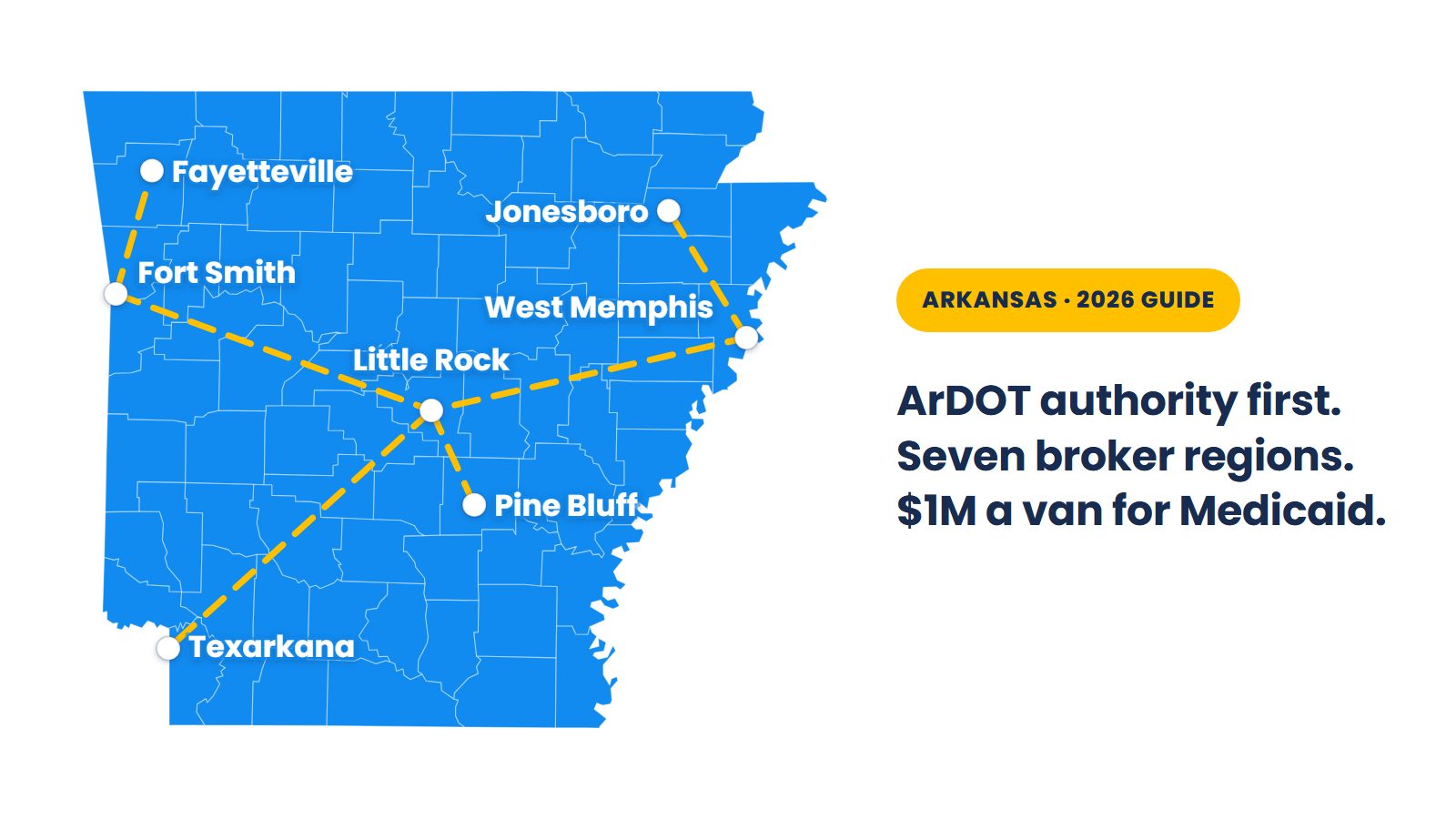
To start a NEMT business in Arkansas, form an LLC ($45 online), insure a van and get passenger-carrier authority from the Arkansas Department of Transportation (ArDOT) at a hearing in Little Rock. There’s no NEMT license. Medicaid van trips come only through your county’s regional broker, whose state contract wants $1 million of insurance and a camera in every van. Budget about $28,600 for one financed used van. ArDOT’s hearing and the broker’s review set your clock, so line up private-pay and facility trips while you wait.
Arkansas at a glance:
- No NEMT license: a for-hire van company needs ArDOT’s intrastate passenger authority instead, at $50 plus $5 a van, after a Little Rock hearing you must attend [1][2].
- Four brokers, seven regions: a broker is the company the state pays to book Medicaid rides. As of November 2026, Verida holds Regions A to D, Central Arkansas Development Council E, the Area Agency on Aging of Southeast Arkansas F and Modivcare G [3].
- Two brokers drive: the local brokers for Regions E and F, which cover 32 of the state’s 75 counties, also run their own vans [3][4].
- The state’s bar: the Department of Human Services (DHS) broker contract wants $1,000,000 of insurance and an interior GPS camera on each vehicle [5].
- Broker pay: your broker negotiates your rate and must pay within 30 days of your invoice, and DHS stays out of disputes [5].
In July 2025, DHS settled a three-way tie for the lowest bid in Pulaski, Faulkner and Lonoke counties, Arkansas Medicaid’s Region G, with a coin flip, and Modivcare won. In September, DHS awarded the region to Verida instead. In October, the State Procurement Director sustained Modivcare’s protest and ordered the July award reinstated [7][8]. Modivcare took over Region G’s rides on January 2, 2026, on the same ride phone number [9]. Then, on June 19, 2026, DHS put Region G out to bid again [6].
Region G is the loud case, but the rule holds statewide. In Arkansas your county’s broker is your only Medicaid door, and in two of seven regions that broker drives its own vans, so check your region before you buy one.
There’s real volume behind those doors, though most of the trips sit behind the two where the broker drives. DHS counted 830,774 Arkansas Medicaid enrollees on October 1, 2026, and the brokers reported 465,871 trips in 2023, 58 percent of them in Regions E and F [10][11].
I run Duet, which builds dispatch software and runs growth services for non-emergency medical transportation (NEMT) businesses, and this is the Arkansas edition of our national guide on how to start a NEMT business. Requirements change, so confirm against the linked sources before you spend money.
The checklist runs in the order that wastes the least money: free checks, then van one and ArDOT’s hearing, then the broker, with private-pay and facility calls from week one. Then come who pays, the broker doors, the rules, getting in, and cost and time.
The one-page checklist: steps to start a NEMT business in Arkansas
Check your county’s broker region before you spend a dollar, and file with ArDOT the week van one’s policy binds. Each phase ends with the money at risk, from our national one-van budget with Arkansas’s fees swapped in, for a used wheelchair minivan based outside Little Rock.
Phase 0: make the free checks
- Your region: find your county on the map of non-emergency transportation (NET) regions that AFMC, a DHS contractor, publishes. The city of Conway sits in Faulkner County, Region G, but Conway County is Region D [3].
- Your broker: call it and ask whether it’s signing new transportation companies in your county. In Regions E and F, where the broker drives, ask that first.
- Your first accounts: ask three nursing homes who drives their residents to appointments, since Arkansas Medicaid’s ride program doesn’t cover nursing facility residents [5].
- Your city: ask the clerk about a business license and any vehicle-for-hire permit. Little Rock has a permit just for medical transport [39].
- Your insurance: get quotes at $1,000,000 a van, with DHS named as an additional insured, before you shop for the van.
- ArDOT: call its Legal Division at (501) 569-2355 and ask how long hearings are taking [2].
- Money at risk: nothing yet.
Phase 1: form the company
- File a Certificate of Organization with the Secretary of State: $45 online, $50 on paper [12].
- Get a free employer identification number (EIN) and a free national provider identifier (NPI) under the NEMT taxonomy code, 343900000X. Modivcare’s provider application has a field for each [13].
- Money at risk: about $345, counting $300 for a phone and basic marketing.
Phase 2: buy van one, bind its policy, then file with ArDOT
- The van: our model uses a used 2018 wheelchair minivan posted at $36,991 in Bryant in November 2026, with 20 percent down [14].
- The policy: bind it before you file, since ArDOT’s application wants “current proof” of insurance at the liability amounts its Rule 13.1 sets, on a certificate or ACORD form [2]. Our model prices about $1 million from day one, the broker contract’s bar.
- The registration: register the van with the Department of Finance and Administration (DFA) within 60 days of buying it. DFA won’t register a vehicle used for hire until its liability insurance is on file [15][16].
- The filing: send ArDOT the $50 filing fee, plus $5 for each vehicle on a separate cashier’s check or money order [2].
- Money at risk: about $14,250 more ($7,398 down, $4,350 of insurance at signing, $2,447 of sales tax, registration and title, and $55 to ArDOT), so about $14,600 in.
Phase 3: get through the hearing
- The notice: ArDOT publishes a Notice of Filing, and protests are due within 10 days of the official filing date [2]. ArDOT’s notices say a protest may challenge whether the applicant is “fit, willing and able” [17].
- The hearing: it comes at least 20 days after ArDOT sends notice of its date and place [18], at ArDOT’s office at 10324 Interstate 30 in Little Rock, and “Personal appearance at the hearing is mandatory” [2].
- Your first local trips: while you wait, trips inside your city’s commercial zone don’t need ArDOT authority. ArDOT’s FAQ says that if you don’t go “so many miles outside your Commercial Zone” you don’t need to apply, so ask ArDOT where yours ends and ask your city clerk about its permit first [21].
- The lettering: once the permit issues, put your company name and permit number on both sides of the van [18].
- Money at risk: about $1,000 more for equipment and lettering, so about $15,600 in.
Phase 4: build to the broker’s bar and apply
- The camera: install an interior camera with GPS, HD 720p video and 45-day playback. A van whose camera is down can’t carry Medicaid riders until it’s fixed [5].
- The driver file: CPR from a hands-on class, training in child passenger safety, defensive driving, lift operation and wheelchair securement, state and federal background checks, and drug tests [5].
- The applications: apply to your region’s broker, and the same week to SafeRide and MTM Health, the ride vendors some Medicare plans name in their 2026 plan documents [19][20].
- Money at risk: about $1,000 more for driver screening and training, so about $16,600 in, plus the camera system, which our model leaves for you to quote.
Phase 5: run your own trips while the broker reviews you
- Your website: put up a website families can book on and claim your Google Business Profile.
- Your accounts: visit the nursing homes you called in Phase 0, and your nearest hospitals’ discharge planners.
- Money at risk: six months of fixed bills at $2,009 a month, for a total of about $28,600.
Who pays for NEMT rides in Arkansas?
Four main payers buy NEMT rides in Arkansas: Medicaid through the brokers that hold its seven regions, Medicare Advantage plans through their ride vendors, hospitals and nursing homes, and families paying out of pocket. Medicaid is the volume. The other three are trips you can go find yourself.
Medicaid: the volume, paid to brokers per member
DHS’s Division of Medical Services (DMS) pays each broker a set amount per member per month (PMPM), whether or not anyone rides. The state’s actuary certified a statewide average of $7.54 PMPM for 2026, from $3.44 in Region A to $16.59 in Region F, or about $67.4 million for the year [22]. Those are payments for each eligible member, never a van company’s rate per trip.
About three in four of the brokers’ 2023 trips were ambulatory and one in ten was by wheelchair; the rest were mileage reimbursement, taxi and bus rides [11]. The ride costs the rider nothing, and for most riders there’s “no limit on the number of trips or miles,” DHS’s ride page says [9]. Since January 1, 2026, rides to adult developmental and early intervention day-treatment centers also run through the brokers, on separate trips from other riders, unless a center drives its own clients [11][5][6].
Health plans don’t arrange these rides. The provider manual for Arkansas’s Provider-led Arkansas Shared Savings Entity (PASSE) plans lists NET first among the services they don’t cover, so PASSE members ride through the brokers too [23]. Dialysis rides land here as well. In my experience most dialysis riders are on Medicaid, so their trips go through the broker, not the dialysis center.
Medicare Advantage plans: rides through named vendors
Some Medicare Advantage plans add routine rides, and Arkansas’s two biggest dual-eligible plans name the vendor that runs them. UnitedHealthcare’s two largest Arkansas dual-eligible special needs plans (D-SNPs), for people on both Medicare and Medicaid, had 17,141 and 17,106 members in November 2026, per the Centers for Medicare & Medicaid Services (CMS) [24]. They cover 24 and 36 one-way trips a year and list SafeRide for routine transportation [19].
Aetna’s Dual Extra Care plan in Faulkner, Garland, Pulaski and Saline counties covers up to 12 one-way trips and says, “We have teamed up with MTM Health to provide this benefit” [20]. Humana’s largest Arkansas D-SNP covers 60 one-way trips a year but names no vendor, sending members to Customer Care [25]. These are 2026 plan documents, so check each plan’s 2027 papers before you count on a vendor.
In the Delta, these plans can carry a big share of the riders. An owner in eastern Arkansas told me on a 2025 demo that most riders there are on UnitedHealthcare or Humana plans, and “The biggest thing down here is wheelchair, wheelchair, wheelchair.”
Hospitals and nursing homes: accounts you can call this week
Facilities that book you pay your invoice for rides the broker doesn’t cover. Nursing homes go first on the call list, for the reason in Phase 0, and our guide to who pays for nursing home transportation covers the pitch.
Hospitals take longer. Christopher Buell, who ran two NEMT companies and now sells facility calling to NEMT owners, ran his second one in Arkansas and walked the halls handing out business cards, as he said on our episode about calling facilities. Many Little Rock hospitals had ambulance companies under contract, and when those wouldn’t run in winter weather, the hospitals called him. “I kind of got the bottom of the barrel,” he said, and at first, “I barely got any business out of the hospitals.” By the time he closed the company, he told an industry podcast in April 2024, every Little Rock hospital in one system was using him.
Signed agreements don’t guarantee trips, either. The owner of a small private-pay company in northwest Arkansas told me on an August 2026 demo that 10 companies had been “lined up” as customers before launch. After it, “I had two contracts actually signed,” with very few rides, because hospitals, nursing homes and assisted living there call one big incumbent first.
Families: private pay, and where it’s thin
Families pay your price, by card, before the ride. Take the card at booking and charge it at least 24 hours before pickup, or send a payment link that’s due by then. No payment, no van. Some owners also take a small nonrefundable deposit to hold the spot.
Posted Arkansas prices are scarce. One Hot Springs Village chauffeur service posts $110 for a medical ride from Hot Springs to Little Rock, plus $20 an hour to wait and a $50 no-show fee, with nothing posted for wheelchair riders. That’s one data point, not a market rate, so shop your own area before you set prices.
Private pay also varies by region. That northwest Arkansas owner runs on private pay plus two workers’ comp ride networks, which “actually pay you. And they pay you on time.” The Delta is thinner. “We’re in a rural poverty area. So you calling for your grandma is very rare,” the eastern Arkansas owner told me, and people there “pay their neighbor, but they’re not willing to pay that much.” Our guide to finding private-pay riders has the playbook.
Who is the NEMT broker in Arkansas?
As of November 2026, four organizations hold Arkansas Medicaid’s seven NET regions: Verida has A to D, Central Arkansas Development Council (CADC) has E, the Area Agency on Aging of Southeast Arkansas has F, and Modivcare has G [3]. Arkansas Medicaid has no statewide broker, and in Regions E and F the broker also drives its own vans. A broker is the company the state pays to book Medicaid rides and get them run, by its own drivers or by companies it subcontracts. DMS has bought rides this way, one broker per region, under a federal waiver CMS first approved in 1998 [26].
Here are the seven regions, as AFMC’s map revised in December 2025 shows them [3]:
| Region | Counties | Cities include | Broker | Ride line |
|---|---|---|---|---|
| A | Baxter, Benton, Boone, Carroll, Madison, Marion, Newton, Searcy, Washington | Fayetteville, Springdale, Rogers, Bentonville | Verida | 1-888-833-4136 |
| B | Cleburne, Fulton, Independence, Izard, Jackson, Sharp, Stone, Van Buren, White, Woodruff | Searcy, Batesville | Verida | 1-888-833-4128 |
| C | Clay, Craighead, Crittenden, Cross, Greene, Lawrence, Mississippi, Poinsett, Randolph, St. Francis | Jonesboro, West Memphis, Blytheville | Verida | 1-888-833-4130 |
| D | Conway, Crawford, Franklin, Johnson, Logan, Perry, Polk, Pope, Scott, Sebastian, Yell | Fort Smith, Russellville | Verida | 1-888-822-6155 |
| E | Calhoun, Clark, Columbia, Dallas, Garland, Hempstead, Hot Spring, Howard, Lafayette, Little River, Miller, Montgomery, Nevada, Ouachita, Pike, Saline, Sevier, Union | Hot Springs, Bryant, Texarkana, El Dorado | Central Arkansas Development Council | 1-800-385-9992 |
| F | Arkansas, Ashley, Bradley, Chicot, Cleveland, Desha, Drew, Grant, Jefferson, Lee, Lincoln, Monroe, Phillips, Prairie | Pine Bluff, Helena-West Helena | Area Agency on Aging of Southeast Arkansas | 1-844-683-2300 |
| G | Faulkner, Lonoke, Pulaski | Little Rock, North Little Rock, Conway | Modivcare, since January 2, 2026 | 1-888-833-4135 |
Find your county’s row and call that broker this week. The table’s number is the riders’ line, so ask for whoever signs up transportation companies.
In Regions E and F, the broker is also a van company. The state’s contract allows it: a broker “may operate as a sole provider, or as the prime contractor/broker with subcontractors as transportation providers” [5]. CADC runs its own transit service, South Central Arkansas Transit (SCAT), with a fleet that “ranges from large buses to small mini-vans” [27]. It bid for Region E in 2025 saying, “As the direct service provider, CADC-SCAT maintains full control of all daily operations,” and listed one subcontractor [4].
The Area Agency on Aging of Southeast Arkansas, which does business as Southeast Arkansas Transportation (SEAT), told DHS it oversees subcontracted providers across Region F’s 14 counties and “also acts as a direct transportation provider in 10 of those counties” [4]. Neither local broker posts an application for outside companies [27][28], but SEAT’s bid shows subcontractors still work in its region, so the door isn’t shut. Call before you buy: CADC’s SCAT manager at 501-332-5426, or SEAT at 870-543-6300, the number on its 2025 bid.
In every region, an outside company signs with the broker, not with the state, on an agreement DHS approved first [5].
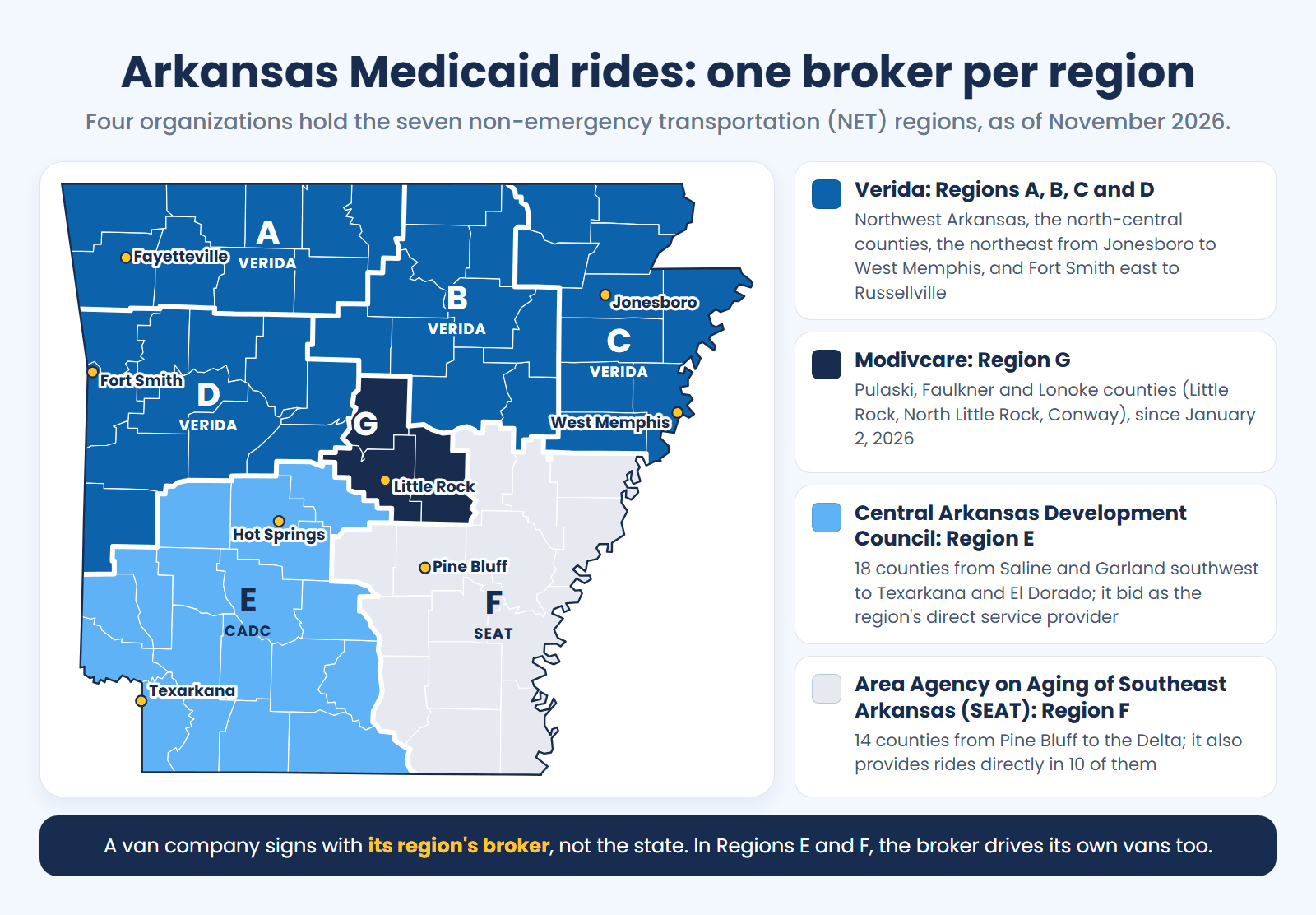
DHS picked these brokers in 2025 with Invitation for Bid 710-25-049: the lowest responsive bid in each region won, from a bidder with at least five years of experience in non-emergency medical transportation [5]. In every region, two or more bidders offered the same lowest price, the bottom of the rate range the state’s actuary set, and DHS’s bid tabulation refers to coin-flip results to break those ties. In Region B, the first winner declined the contract, and a November 5, 2025 coin flip between the two remaining tied bidders went to Verida. The record says simply, “Coin flip landed on heads” [7][11]. Each contract runs a year, renewable for up to six more [5].
Region G went out to bid again. DHS posted Invitation for Bid 710-26-069 on June 19, 2026, for “Region G (consisting of Pulaski, Faulkner, and Lonoke counties),” with bids due July 7 [6]. It says, “The anticipated starting date for the contract is January 1, 2027.” No award, protest or cancellation was posted on DHS’s procurement pages as of November 19, 2026. We log moves like this one in our 2026 tracker of broker changes.
Two neighbors run Medicaid rides differently. Missouri runs its rides through MTM Health, and Texas lets each Medicaid health plan pick its own ride vendor. Our state-by-state map of who arranges Medicaid rides covers the rest.
Is MTM or Southeastrans the NEMT broker in Arkansas?
Not under those names. Southeastrans is Verida’s old name, and DHS’s ride page still says so: “Southeastrans is now Verida” [9]. MTM was one of the brokers DHS named in its 2018 award, but it isn’t on today’s map; in January 2019 the state asked Southeastrans to take over Regions A, B, C and G, according to Verida’s 2025 bid [29][4]. In 2026 plan documents, MTM Health arranges rides for one Aetna Medicare plan in central Arkansas, but that’s Medicare, not Medicaid [20].
Can I bill Arkansas Medicaid directly for NEMT rides?
Not for van trips: Arkansas’s Department of Human Services (DHS) pays the brokers per member, and the broker pays you. DHS’s answers to Region G bidders put it plainly: “DHS pays for trips on a capitation basis, not per trip” [6].
Your money comes from your subcontract. The state’s contract tells each broker to “negotiate service delivery rates with each qualified subcontractor,” with the rate “fully disclosed in the agreement” [5]. The broker must pay “within a reasonable time, not to exceed thirty (30) calendar days, following the Broker’s receipt of an invoice.” And if it doesn’t, “DHS shall not be responsible or intervene on behalf of any subcontractor.” Get the rate for each kind of trip in writing before you sign.
Ambulance companies are the exception. They enroll with Arkansas Medicaid themselves, with an Arkansas Department of Health (ADH) ambulance license and Medicare enrollment, and bill fee-for-service [30]. The May 2026 fee schedule allows up to $141.25 for a basic life support non-emergency transport (code A0428) plus $6.63 a mile (A0425) [31]. Day-treatment centers that drive their own clients bill Medicaid directly too, under provider type 24 with code A0120 [6]. That lane belongs to the centers, not to a van company.
Do I need an Arkansas Medicaid provider number?
Arkansas Medicaid’s Transportation provider type has no specialty for a broker’s van subcontractor, so ask before you pay for anything. Its Required Documents Finder lists eight specialties under provider type 15, Transportation: six for ambulances, one for NET brokers, and a “Non-Public Transportation” specialty that requires a certification from DHS’s Developmental Disabilities Services (DDS) [32].
DHS’s answers to Region G bidders call transportation providers hired by a broker “subcontractors,” and they say DHS “does not coordinate the subcontracting work” [6]. Call DMS at 501-682-8292 and ask whether a subcontractor must enroll before you pay an enrollment fee or file an application [9].
What licenses and requirements does a NEMT business need in Arkansas?
Arkansas has no NEMT license, but a for-hire van company needs intrastate passenger authority from ArDOT under the Arkansas Motor Carrier Act, Ark. Code 23-13-218 for common carriers and 23-13-222 for contract carriers [18]. ArDOT puts it this way: “All for-hire motor carriers transporting property or passengers in intrastate commerce (wholly within) are required to apply for the authority to operate in Arkansas” [1]. None of the statute’s exemptions names medical or wheelchair transportation. Our national guide to NEMT licenses compares how other states handle this step.
NEMT companies file as contract carriers. ArDOT’s notices for NEMT applicants from 2019 to 2025 describe the same authority: “Passengers and their belongings, under continuing contract(s),” between the company’s home counties and all points in Arkansas, over irregular routes [17]. The statute steers them there, since a common-carrier certificate only lets you carry passengers on “regular routes, and between fixed termini,” the way a bus line runs [18]. A contract permit can’t cover “more than six (6) contracts” at once, so when you file, ask ArDOT how it counts a broker agreement, facility contracts and private-pay riders.
Permits renew by December 31 each year, with current proof of liability insurance and $5 a vehicle [1][33]. Temporary authority exists, but it’s narrow: up to 90 days for $25, with no hearing, only for an “urgent and immediate need” where no capable carrier serves [18]. Running without authority risks a civil penalty of $100 to $500, and the statute separately makes it a violation fined $100 to $500 the first time and up to $1,000 each time after, with each day a separate offense [18].
DFA adds its own rules for a vehicle used for hire. It won’t register one until a liability policy or certificate of insurance is on file, and its Rule 2024-2 has the applicant file a notarized disclosure statement every year listing past business names, judgments and bankruptcies [15]. A vehicle used for hire can’t be self-insured.
Which trips don’t need ArDOT authority?
Trips wholly within one city, between adjoining cities or inside a commercial zone don’t need ArDOT authority, and two more exemptions in Ark. Code 23-13-206 can touch a van company. Each has an edge [18]:
- Local trips: transportation “wholly within a municipality or between contiguous municipalities or within a commercial zone.” Arkansas law borrows the old federal commercial zones, which reach 3 miles past the limits of a town under 2,500 people and 4 miles for 2,500 to 24,999. Bigger cities get 6 miles for 25,000 to 99,999, 8 miles for 100,000 to 199,999 and 10 miles for 200,000 to 499,999 [34].
- State programs: passengers carried “under contract or by cooperative agreement with the State of Arkansas” when the trips are “exclusively” for a federally or state-funded program. A broker’s subcontractor has no contract with the State, and DHS’s broker contract asks for each vehicle’s “registration with the Arkansas Department of Transportation” anyway [5].
- Act 389 of 2021: it exempted intrastate commercial motor vehicles of 26,000 pounds or less, except those “Designed to transport more than fifteen (15) passengers, including the driver” [35]. The same section still says passenger transportation “shall continue to be regulated,” and ArDOT kept docketing NEMT applications in 2024 and 2025. Plan to file unless ArDOT’s Legal Division tells you otherwise.
What do other Arkansas guides get wrong?
The claims below skip ArDOT’s authority, miscount the brokers, quote the car-insurance minimum and cite van rates no Arkansas schedule sets, and each sits next to what Arkansas actually requires:
| The claim you’ll read elsewhere | What Arkansas actually requires |
|---|---|
| With no NEMT license, “compliance is enforced through state business/vehicle registration, Medicaid rules, and broker credentialing” | That list skips the state step: a for-hire passenger carrier needs ArDOT’s intrastate authority unless an exemption fits, and NEMT companies file as contract carriers [1][17][18] |
| MTM Health is a primary broker, or Arkansas has three brokers | Four organizations hold seven regions as of November 2026: Verida, Central Arkansas Development Council, the Area Agency on Aging of Southeast Arkansas and Modivcare [3] |
| For Medicaid trips, credential with your regional broker “or managed care plans” | PASSE plans exclude NET, and rides for ARHOME, the coverage for newly eligible adults, come through Arkansas Medicaid directly, so Medicaid rides go through the regional broker [23][36] |
| Insurance means the $25,000-per-person car minimum | DHS’s broker contract requires $1,000,000 on each vehicle, with DHS named as an additional insured [5] |
| A Medicaid fee schedule sets what NEMT companies earn per trip | Each broker negotiates its subcontractors’ rates; the state’s transportation fee schedule covers ambulance and day-treatment codes, not broker van trips [5][31] |
| Expect a “30- to 45-day payment lag” | The broker contract says brokers must pay within 30 calendar days of your invoice, though DHS won’t step into a dispute [5] |
| NET rides can include “wheelchair/stretcher transport” | DHS’s broker contract lists no stretcher service; a stretcher or gurney ride is an ambulance trip under Ark. Code 20-13-202, for an ADH-licensed service [5][37] |
| “obtain a USDOT number if applicable” | Only for interstate trips: the federal list of states that require a U.S. Department of Transportation (USDOT) number of intrastate carriers leaves out Arkansas, and ArDOT’s passenger packet doesn’t ask for one [38][2] |
Do Arkansas cities add their own permits?
Little Rock does, and it names medical transport outright. Its Transportation Code defines a “medical transport service” as for-hire rides “to special client groups, between places of residence and medical providers,” and an operator must run “a minimum of two (2) medical transport vehicles” [39]. Each vehicle must be “designed for seven (7) passengers or more, including the driver,” must be “four (4) model years old or newer when initially inspected,” and leaves service at the end of its eighth model year.
The permit takes a hearing noticed to “each holder of a current operator permit,” a $100 application fee, $400 more on approval and $500 a year after that. Driver permits are $20, and the code lists a $50 vehicle permit in its late-fee table, so confirm that fee with the city [39]. The code leaves out “any entity operating under the authority, license or contract granted or funded by the department of human services,” so ask the city whether your broker trips fall under that line and whether your private-pay rides still need the permit. Little Rock’s business license comes on top: as of November 2026, its catch-all class charges $200 plus $30 an employee, though the city can charge a similar business’s rate instead, and base rates rise 3 percent on January 1, 2027 [40].
Elsewhere the license layer is cheap and uneven [41]. Conway requires no business license, and Bentonville keeps a free registry. Fort Smith charges $100 a year and waives the first year for a new business. Springdale charges $40 plus $2.50 an employee, Rogers $40 plus $10 for each owner and each employee working over 25 hours a week, and Fayetteville $98 for a new business outside the home, rising to $130 in June 2027.
Taxicab rules are the trap. Fayetteville, Springdale and Fort Smith define a taxicab in words that could take in a for-hire minivan: a vehicle for hire seating no more than seven passengers. North Little Rock leaves out “vans for transportation of handicapped persons.” Ask each city clerk which rules your van falls under, and budget a week of calls for the cities you’ll serve.
What are the NEMT insurance requirements in Arkansas?
Plan on $1,000,000 of coverage on each van if you want Medicaid trips, because DHS’s broker contract requires it, not the $25,000-per-person car minimum one online guide quotes. The contract says, “The Broker shall maintain insurance in the amount of $1,000,000 on each vehicle,” and a subcontractor’s $1,000,000 must include “contractual liability coverage to protect the State” [5]. DHS also requires the broker to make sure DHS is named as an additional insured on the policies the contract requires, so ask for quotes written that way. The contract calls it liability insurance on each vehicle, and Modivcare’s application asks for your auto liability combined single limit and your general liability aggregate separately [13].
For the record, the other numbers you’ll see:
- The state car minimum: $25,000 per person, $50,000 per accident and $25,000 of property damage, under Ark. Code 27-22-104 [42].
- ArDOT’s Rule 13.1: the 1992 text in the Arkansas Administrative Code sets $50,000 per person, $80,000 per accident and $30,000 of property damage for passenger vehicles seating 12 or fewer [43]. ArDOT’s 2026 FAQ still points to Rule 13.1 for the amounts, so ask its Legal Division whether they’ve changed [21].
- Little Rock’s permit: $250,000, $500,000 and $250,000, with a deductible of no more than $25,000 [39].
- Trips across a state line: $1.5 million for a vehicle seating 15 or fewer, counting the driver, under federal rules [44].
I don’t have an Arkansas premium figure to give you. Our national model prices a new company’s wheelchair van at about $17,400 a year for about $1 million of auto liability: $4,350 at signing, then ten installments of $1,305. Our guide to what a brand-new company pays for coverage shows the method.
Getting a quote can be the slow step. On an operator community call I sat in on in November 2026, a central Arkansas starter with the LLC done said it had been “like, two months now” and “I cannot even get a quote right now.” Claims move the price, too. Christopher Buell ran his Arkansas company for four years, and after one driver’s accident his insurance rates doubled. Start quoting the week you form the LLC.
Workers’ comp generally starts at three employees, and Arkansas counts the owner. The Workers’ Compensation Commission’s Form A counts “an owner, a sole proprietor, a partner,” part-time employees and volunteers toward the three [45]. So an owner and two part-time drivers can already need a policy. The same form lists one employee as enough for a subcontractor, and DHS’s broker contract calls a broker’s van companies subcontractors [5], so a broker’s van company may need a policy from its first hire. Ask your agent or the Workers’ Compensation Commission (800-622-4472, or 501-682-3930 in Pulaski County) how your LLC’s members count and whether a broker agreement makes you a subcontractor.
What do NEMT drivers need in Arkansas?
NEMT drivers in Arkansas don’t need a commercial driver’s license (CDL) for a typical van, but state law says “No Class D license shall be valid to carry passengers for hire without a ‘P’ endorsement” (Ark. Code 27-23-111) [46]. A CDL starts at a vehicle designed for 16 or more passengers, counting the driver, or at 26,001 pounds. The P endorsement can’t go to anyone under 18, and a 1993 DFA rule charges $5 to add it between renewals.
The catch is who counts as “for hire.” The same rule says the term covers drivers who “receive a fare” and “does not include those drivers paid on a salary basis” [46]. The cheap move is to have every driver, you included, add the P, and to ask DFA’s Office of Driver Services if you want the wage question settled.
What does Arkansas’s broker contract require of drivers?
DHS’s broker contract sets one driver file for every broker’s companies [5]:
- Age: 21 or older, “as required by the insurance carrier.”
- CPR and first aid: current certificates from a hands-on class. Training “provided solely online will not be accepted.”
- Training: documented child passenger safety, defensive driving, lift operation and wheelchair securement.
- Driving record: clean, with removal after any two moving violations or at-fault accidents in 12 months, and no suspended or revoked license in the last five years.
- Drug and alcohol tests: before hire and at random, under U.S. Department of Transportation (USDOT) rules.
- Background checks: federal and Arkansas State Police criminal checks, plus a DHS Central Registry check.
- Residency: five years in Arkansas, or a background check from the state the driver lived in before.
Modivcare’s national requirements add a “PASS Wheelchair Certificate,” which it describes as “Completion of hands-on wheelchair transport training.” Its Arkansas page adds screening by “Adult and Child Maltreatment Registries” and says it offers a certification program through the National Safety Council, the American Heart Association and the Community Transportation Association of America [13]. Ask your broker for its own list before you hire.
Can a NEMT company run stretcher van trips in Arkansas?
No: Arkansas law makes any vehicle used for “transporting any person by stretcher or gurney” an ambulance (Ark. Code 20-13-202), and every ambulance needs an Arkansas Department of Health (ADH) license [37]. Wheelchair vans are left out when they carry someone “in an upright position or Fowler’s position while in a wheelchair” without emergency medical services personnel. Fowler’s position means the head is raised 30 to 90 degrees. ADH’s EMS rules, in the version effective October 28, 2024, also count convertible chairs: a stretcher includes “all devices that can be transformed from wheelchair to stretcher” [47].
An ambulance service’s operational permit costs $500 a year in each county where it has an operational base, plus $100 a year to inspect and permit each ambulance, under the statute’s fee sections [37]. ADH’s base fees, up to $50 a permit and $5 a vehicle, come on top. Running one without a license is a misdemeanor. Arkansas Medicaid draws the same line: “Ground ambulance services must be provided by a licensed ambulance service, even if the trip is a routine or non-emergency transfer” [30].
In Little Rock, stretcher work is franchised too. The city’s code gives its ambulance authority, which does business as Metropolitan Emergency Medical Services (MEMS), an exclusive franchise over “all emergency and nonemergency intracity patient transports” [39]. With narrow exceptions, no one else may run a for-hire ambulance there “regardless of whether it is an emergency or routine non-emergency patient transport.” Put the line in your intake script: a rider who must lie down, or who rides in a chair that converts to a stretcher, goes to a licensed ambulance.
How do you become a Medicaid transportation provider in Arkansas?
You subcontract with your region’s broker. It inspects every van before it signs, and DHS approves the agreement. The state’s contract says the broker “shall conduct an initial inspection of all the subcontractor’s vehicles” before any service agreement, and agreements must be “pre-approved by DHS prior to signing” [5].
Step one: find your region and ask if its broker adds companies
Use the region table or AFMC’s map. In Regions A to D and G, signing with the broker is the normal door. In E and F, where the broker drives, ask whether it adds outside companies in your county, and get the answer before you buy a van. For Verida, ask for its Arkansas intake steps; its 2025 bid says, “All of our vehicles in Arkansas are required to have cameras if we are transporting Medicaid members” [4].
Step two: apply to the broker
Modivcare takes applications for Region G on its national “Join our network” form, which lists Arkansas and requires your business start date, dispatch software, general liability aggregate, auto liability combined single limit and workers’ comp coverage amount [13]. Its Arkansas page says each vehicle gets “an initial 45 point vehicle inspection by a Modivcare Field Monitor” before it carries riders, then a re-inspection at least twice a year.
Step three: build each van to the contract
DHS’s contract sets one vehicle standard for every broker’s network [5]:
- Camera: HD 720p, GPS, an interior view and “Minimum 45-day playback.”
- Climate: air conditioning that reaches 68 degrees and heat that reaches 74, measured at the rear.
- Boarding and safety: a step for a floor over 12 inches, a child safety alarm in any vehicle for more than seven passengers plus the driver, and tires with at least 4/32 inch of tread.
- Markings: your company’s name and contact information, plus the DHS Medicaid NET Helpline’s.
- Paperwork: DFA registration permits and ArDOT registration for each vehicle, with your insurance certificates.
- Inspections: the broker’s monthly check, a certified mechanic’s yearly inspection at the broker’s cost, and at least one inspection a year by the state’s NET Monitoring Contractor, plus random checks.
Step four: apply to the Medicare plans’ ride vendors the same week
Medicare plan rides are a separate door for the same van. Apply to SafeRide, the vendor UnitedHealthcare’s two largest Arkansas D-SNPs list in their 2026 plan documents, and to MTM Health, which runs the rides for Aetna’s Dual Extra Care plan in four central Arkansas counties in 2026 [19][20]. Ask each for its own requirements and timeline.
How long does credentialing take?
I haven’t seen an Arkansas broker publish a credentialing time. The gates are knowable, though: ArDOT authority on file, a $1,000,000 policy, the broker’s inspection, DHS’s approval of your agreement and a working camera. Ask your broker how long its last new company took from application to first trip.
That’s the catch-22: brokers want all of that before your first trip, and you need trips to pay for it. The facility and private-pay rides from the who-pays section are what carry you. Our guides to winning a nursing home or rehab account and getting from a facility meeting to its first ride cover that stretch, and our guide to how Medicaid ride enrollment works state by state shows how other states order these steps.
Don’t build the whole schedule on one payer
Arkansas’s broker map keeps changing, so keep trips you control on the board. Four regions moved to a new broker in early 2019, the 2025 bid ran on coin flips and a protest, and DHS put Region G out to bid again in June 2026 [4][7][8][6]. If one broker is most of your schedule, each of those moves lands on you.
Christopher Buell lived the Arkansas version, as he told it on our podcast. After his first company, he moved to Arkansas and “started with one van a second time.” He found the state cliquish, “like I’m not one of them,” and then “in the end it didn’t matter. What mattered was knocking on doors.” The broker side of his Arkansas story runs from “I was the number one call” to being dropped.
He made the case for the other side, too, on an industry podcast in April 2024. “If I had to do things over today, I would have spent more time going after brokers,” he said, even if only “to get you by until you can bridge the gap.” So take the broker trips when they come, and keep building the trips you control.
However you dispatch, keep every payer on one schedule. Duet integrates directly with Modivcare and MTM and supports trip file import for Verida and SafeRide, so it puts Verida’s and Modivcare’s trips on one board with your facility and private-pay rides. You still apply to the broker, meet the state contract’s bar and run every trip yourself.
How much does it cost to start a NEMT business in Arkansas?
Budget about $28,600 for one financed used wheelchair minivan and six months of bills outside Little Rock. Two newer vans built to the two-van minimum and model-year limits of Little Rock’s medical transport permit come to about $64,500, before payroll for the one driver you’d hire. Arkansas’s inputs are its fees, its 6.5 percent sales tax on a used van of $10,000 or more and van prices posted in Bryant in November 2026 [16][14]. The rest comes from our national startup model, whose inputs are hypothetical but typical: vans 80 percent financed at 14 percent over 60 months, and $17,400 a year of insurance per van. Only one 2023 van was posted, so the model prices van two the same.
| Line item | One used van, Conway | Two 2023 vans, Little Rock |
|---|---|---|
| LLC Certificate of Organization, online [12] | $45 | $45 |
| EIN and NPI | $0 | $0 |
| “NEMT license” | $0 | $0 |
| ArDOT authority, $50 plus $5 a van [2] | $55 | $60 |
| City business license [41][40] | $0 | $230 |
| Little Rock medical transport permit, if it applies [39] | Not needed | $640 |
| Van down payments, 20 percent | $7,398 | $18,396 |
| State sales tax, registration, decal and title [16] | $2,447 | $6,065 |
| Equipment and lettering | $1,000 | $2,000 |
| Driver screening and training | $1,000 | $2,000 |
| Phone and basic marketing | $300 | $300 |
| Insurance due at signing | $4,350 | $8,700 |
| Sales tax on ride fares [48] | $0 | $0 |
| Six months of fixed bills | $12,054 | $26,022 |
| Total | About $28,600 | About $64,500 |
The fixed bills are insurance at $1,305 a month per van, the van payment ($689 for the 2018 minivan, $856 for each 2023 van) and $15 of phone. Insurance is already the biggest cost: about $12,200 of the one-van total. Outside the totals sit your city and county sales tax on the van, which DFA caps at the first $2,500 of the price, the camera system, payroll, workers’ comp and the van’s property tax [16].
Anyone quoting a cheap Arkansas launch for Medicaid work hasn’t priced $1 million of insurance on each van.
How do you fund a NEMT startup in Arkansas?
Four programs serve Arkansas startups at this size [49]:
- SBA microlenders: the Small Business Administration’s microloans run up to $50,000, and its Arkansas list includes Communities Unlimited in Fayetteville, People Trust Community Loan Fund in Little Rock, Forge in Huntsville, Arkansas, and LiftFund.
- ASBTDC: the Arkansas Small Business and Technology Development Center offers free one-to-one consulting and market research.
- ADFA’s Capital Access Program: the Arkansas Development Finance Authority enrolls loans through participating lenders, and its FAQ says start-ups are eligible, “subject to Lender underwriting guidelines.”
- Arkansas Capital Corporation: microloans of $5,000 to $50,000 for startup costs, equipment and working capital, fully amortized over up to five years.
One door is closed. ArDOT’s Section 5310 program, which funds vans for seniors and riders with disabilities, answers the question directly: “My agency is for-profit. Do we qualify? No.” None of these speeds up the ArDOT hearing or a broker’s review, so borrow for the months you’ll actually wait.
How long does it take to start a NEMT business in Arkansas?
Plan on ArDOT’s hearing, at least 20 days after ArDOT sends notice of its date and place, then the broker’s review, and start private-pay and facility calls the week you file. ArDOT’s packet sets the steps but not a processing time [2]:
- Week one: form the LLC, get your EIN and NPI, make the Phase 0 calls and start insurance quotes.
- When van one’s policy binds: file ArDOT’s application, and register the van with DFA within 60 days of buying it [16].
- After ArDOT accepts the filing: it publishes a Notice of Filing. The official filing date is the third calendar day after the notice’s date, protests are due within 10 days of it, and your verified statement is due 15 days after it, served on anyone who protested.
- The hearing: at least 20 days after ArDOT sends notice of its date and place, in person in Little Rock [18]. If someone protests, there’s a pre-hearing conference a week before.
- The permit: letter the van, then apply to your region’s broker and the Medicare plans’ vendors.
- The broker’s review: an inspection of every van, DHS’s approval of the agreement and a working camera, then your first broker trip [5].
Run lean through it. When Christopher Buell started his second company in Little Rock, his first trip came “something like two and a half months” after he opened his doors, he told that 2024 industry podcast. It was a hospital discharge, and the hospital’s second order came “months down the road.” In the meantime, he found “other businesses that gave me other work.” Budget per the cost breakdown, with six months of fixed bills, because the clock is ArDOT’s hearing plus the broker’s review, and neither one is yours to set.
Your county’s broker is your only Medicaid door, and the state decides who holds it, on its schedule, not yours. In Pulaski, Faulkner or Lonoke, the broker you apply to now may not be the one booking your trips in 2027, so ask DHS’s Office of Procurement (501-682-0120) who won the Region G rebid before you sign.
Arkansas NEMT FAQ
How do Arkansas Medicaid riders schedule a ride?
Riders call their region’s broker at least 72 hours (three full days) before the appointment, not counting Saturdays, Sundays or holidays, a rule AFMC dates to January 1, 2026 [9][36]. In Region G that’s Modivcare at 888-833-4135, the number riders there already used. The ride is free, and an urgent appointment a doctor calls in skips the 72 hours. The NET Help Line, 1-888-987-1200, option 1, answers questions [3].
How many rides does ARHOME cover?
ARHOME, Arkansas’s coverage for newly eligible adults, gives members in a commercial insurance plan eight one-way trip legs a calendar year. AFMC calls the rides “a ‘wrap-around’ benefit provided through Arkansas Medicaid directly, not the private insurance carriers” [36]. The limit doesn’t apply to traditional Medicaid riders, to ARHOME members found medically frail or to the gap before a member’s plan starts [5]. AFMC adds, “An extension for more trips can be requested if medically necessary” [36].
Does Arkansas Medicaid pay for nursing home residents’ rides?
Not through the broker program. DHS’s broker contract says the NET program “does not cover transportation services” for nursing facility residents, residents of intermediate care facilities for people with intellectual disabilities, members for whom Medicaid only pays Medicare costs (the QMB, SLMB and QI-1 groups), ARKids First-B children, retroactive eligibility periods or incarcerated people [5]. Ask each nursing home who books and pays for its residents’ appointment rides.
Does Medicare pay for NEMT rides in Arkansas?
Original Medicare doesn’t. CMS’s claims manual says Medicare covers no “non-ambulance forms of transportation, such as ambulette, wheelchair van, or litter van” [50]. Some Medicare Advantage plans add routine rides through a vendor the plan names, so ask each plan who runs its rides before you count on its members.
Can a Memphis, Texarkana or Shreveport company take Arkansas trips?
Yes, with the right paperwork for each trip, and the same rules cover an Arkansas company driving riders to Memphis or Shreveport. A paid trip across the state line is interstate, which usually means federal operating authority, a USDOT number and $1.5 million of liability for a vehicle seating 15 or fewer, counting the driver [44]. Trips that stay inside Arkansas need no USDOT number, since the federal list of states that require one of intrastate carriers leaves out Arkansas [38]. A trip that starts and ends in Arkansas needs ArDOT’s authority, and ArDOT’s FAQ says a carrier with federal authority “will still need to apply for an intrastate authority” [21]. Our guides cover the Memphis side of the line and Louisiana’s rules for a Shreveport company.
What does an Arkansas NEMT company owe each year?
For an LLC, three state items: the $150 franchise tax, due May 1 starting the year after you form; ArDOT’s renewal by December 31, with current proof of liability and $5 a vehicle; and DFA’s notarized disclosure statement for vehicles used for hire [51][1][15]. On top come each van’s registration, city business licenses, which Little Rock makes due each January 1, and workers’ comp, which generally starts at three employees, counting the owner.
Is Arkansas a good state to start a NEMT business?
It can be, if you start with trips you control. Arkansas Medicaid had 830,774 enrollees on October 1, 2026, by DHS’s count, and the state had 562,707 residents 65 or older in 2024 [10][52]. The field is filling in: 257 active NPIs in Arkansas carry the NEMT van code, and 135 of them were first issued in 2023 or later, by our count of the July 2026 federal NPI file [53]. An NPI is a registration, not a working company. The caution is the doors: in Regions E and F the broker drives its own vans, so check your county’s broker before you buy.
Key official sources
[1] ArDOT Legal Division, Arkansas Intrastate Authority page and its Renewals page (main page modified August 25, 2026; read November 19, 2026): who must apply for intrastate authority, renewals due by December 31, and the Legal Division’s contact. https://ardot.gov/divisions/legal/arkansas-intrastate-authority/ and https://ardot.gov/divisions/legal/arkansas-intrastate-authority/renewals/
[2] ArDOT, passenger carrier intrastate authority application packet, Corporation version, instruction sheet rev. 5-04 (read November 19, 2026): the $50 filing fee and $5 a vehicle on a separate check, current proof of insurance in Rule 13.1’s amounts on a certificate or ACORD form, the Notice of Filing, filing, protest and verified-statement dates, the pre-hearing conference, hearings at 10324 Interstate 30 in Little Rock, mandatory personal appearance, no USDOT number asked, and the Legal Division’s phone. https://media.ark.org/ardot/Passenger-Carrier-Corporation.pdf
[3] AFMC for Arkansas DHS, NET broker map (“REVISED DECEMBER 2025”; read November 19, 2026): the seven regions, their counties, each region’s broker and ride line, and the NET Help Line. https://afmc.org/images/Medicaid/AFMC_NETmap_ENGLISHSPANISH_20251229_v1.3.pdf
[4] DHS, 2025 bid responses to IFB 710-25-049 from Central Arkansas Development Council, the Area Agency on Aging of Southeast Arkansas (SEAT) and Verida (read November 19, 2026): CADC as Region E’s direct service provider with one proposed subcontractor, SEAT’s oversight of subcontracted providers and direct service in 10 of Region F’s 14 counties, its phone, and Verida’s January 2019 takeover of Regions A, B, C and G and its camera rule. https://humanservices.arkansas.gov/wp-content/uploads/710-25-049-CADC-Response-Combined.pdf, https://humanservices.arkansas.gov/wp-content/uploads/710-25-049-AAASEA-Response-Combined.pdf and https://humanservices.arkansas.gov/wp-content/uploads/710-25-049-Verida-Redacted-Response-Combined.pdf
[5] DHS Office of Procurement, Invitation for Bid 710-25-049, Non-Emergency Medical Transportation Services, Solicitation Revision 2 (issued June 5, 2025; read November 19, 2026): the one-year term and renewals, award to the lowest responsive bidder per region, five years of broker experience, brokers as sole providers or prime contractors, separate day-treatment trips, ARHOME’s trip limit, the excluded groups, vehicle, camera and inspection standards, the $1,000,000 on each vehicle and DHS as additional insured, driver standards, DHS approval of subcontracts, negotiated rates, payment within 30 days of an invoice, and DHS staying out of pay disputes. https://humanservices.arkansas.gov/wp-content/uploads/710-25-049-Solicitation-Revision-2-Clean-Version.pdf
[6] DHS Office of Procurement, Invitation for Bid 710-26-069, Non-Emergency Medical Transportation Services, Region G, its announcement page and its revised answers to bidders’ questions (posted June 19, 2026, answers revised July 2, 2026; read November 19, 2026): the three counties, bids due July 7, 2026, the anticipated January 1, 2027 start, capitation rather than per-trip payment, transportation providers as subcontractors, DHS not coordinating subcontracting, day-treatment centers billing A0120, and the buyer’s phone. No award was posted on DHS’s procurement pages that day. https://humanservices.arkansas.gov/announcements/non-emergency-medical-transportation-services-region-g/, https://humanservices.arkansas.gov/wp-content/uploads/710-26-069-Solicitation.pdf and https://humanservices.arkansas.gov/wp-content/uploads/710-26-069-Revised-Written-Questions-and-Answers.pdf
[7] DHS Office of Procurement, the anticipation-to-award notices for IFB 710-25-049 (posted July 21, September 10 and November 10, 2025), Bid Tabulation Revised 2 and the Region B tie-bid record (read November 19, 2026): the awards by region, Region G’s September award to Verida, tied low bids in every region, and the November 5, 2025 coin flip for Region B. https://humanservices.arkansas.gov/announcements/non-emergency-medical-transportation-services-2/, https://humanservices.arkansas.gov/announcements/non-emergency-medical-transportation-services-ata-2/, https://humanservices.arkansas.gov/announcements/non-emergency-medical-transportation-services-ata-3/, https://humanservices.arkansas.gov/wp-content/uploads/710-25-049-Bid-Tabulation-Revised-2.pdf and https://humanservices.arkansas.gov/wp-content/uploads/710-25-049-Tie-Bids-Coin-Flip-Region-B-signed.pdf
[8] Arkansas Office of State Procurement, protest determination on IFB 710-25-049, Region G (October 20, 2025; read November 19, 2026): the three-way tie for the lowest bid settled by coin flip, the sustained protest, and the order to reinstate the July 21, 2025 award of Region G to Modivcare. https://sas.arkansas.gov/wp-content/uploads/Protest-Determination-Letter.-10.20.25.Final_.pdf
[9] DHS Division of Medical Services, NET (Non-Emergency Transportation) page (modified April 16, 2026; read November 19, 2026): the Region G change to Modivcare on January 2, 2026, with the same number, no cost and no limit on trips or miles, 72 hours’ notice, urgent trips, “Southeastrans is now Verida,” and DMS’s phone. https://humanservices.arkansas.gov/divisions-shared-services/medical-services/healthcare-programs/net-non-emergency-transportation/
[10] DHS, Monthly Enrollment and Expenditures Report, September 2026 (posted October 19, 2026; read November 19, 2026): 830,774 enrollees on October 1, 2026. https://humanservices.arkansas.gov/wp-content/uploads/Monthly-Enrollment-and-Expenditures-September-2026.pdf
[11] Milliman for DHS, CY 2026 NET bid rate ranges, Exhibit 3 to IFB 710-25-049 (letter dated May 9, 2025; read November 19, 2026): the CY 2026 bid rate ranges by region, the brokers’ CY 2023 trips by region and service type, and day-treatment rides joining the broker contracts in 2026. https://humanservices.arkansas.gov/wp-content/uploads/710-25-049-Exhibit-3-Actuarial-Letter-of-CY-2026-NET-Rate-Ranges.pdf
[12] Arkansas Secretary of State, LLC forms and fees (read November 19, 2026): $45 online and $50 on paper for a domestic LLC’s Certificate of Organization. https://www.sos.arkansas.gov/business-commercial-services-bcs/forms-fees/llc
[13] Modivcare, “Join our network” page and application form (read November 19, 2026), and its Arkansas facility page (modified April 7, 2026; read November 19, 2026): Arkansas on the form’s state list, the required and optional fields, its national driver requirements, the 45-point initial inspection, re-inspection at least twice a year, maltreatment registry screening, and the certification program it offers providers. https://www.modivcare.com/transportation-providers-contact-us/ and https://www.modivcare.com/facilities/ar/
[14] MobilityWorks, Wheelchair Accessible Vans for Sale in Arkansas, Bryant store listings (read November 20, 2026): a used 2018 Grand Caravan at $36,991 and a used 2023 Voyager at $45,990. https://www.mobilityworks.com/wheelchair-vans-for-sale/arkansas/
[15] Ark. Code 27-14-1501 (FindLaw, current as of March 28, 2024) and DFA Rule 2024-2 (LII; effective November 28, 2024), both read November 19, 2026: no registration for a vehicle used for hire until its liability insurance is filed with DFA, the annual notarized disclosure statement and its contents, and no self-insurance. https://codes.findlaw.com/ar/title-27-transportation/ar-code-sect-27-14-1501/ and https://www.law.cornell.edu/regulations/arkansas/006-15-24-Ark-Code-R-001
[16] DFA, motor vehicle FAQs, Recent Changes in the Law (Motor Vehicle), Sales and Use Tax FAQs and the MyDMV registration fee schedule (read November 19 and 20, 2026): 6.5 percent on a used vehicle of $10,000 or more, local tax capped on vehicle sales at $2,500 of the price, 60 days to register, and registration, decal and title fees. https://www.dfa.arkansas.gov/office/motor-vehicle/faqs-for-dsmv/, https://www.dfa.arkansas.gov/office/motor-vehicle/recent-changes-in-the-law/, https://www.dfa.arkansas.gov/office/taxes/excise-tax-administration/sales-use-tax/sales-and-use-tax-faqs/ and https://dfa.arkansas.gov/wp-content/uploads/MyDMV-Fee-Schedule.pdf
[17] ArDOT, Notice of Filing list (modified November 17, 2026) and four notices of filing for NEMT companies’ passenger applications, 2019 to 2025 (read November 19, 2026): contract-carrier authority for “Passengers and their belongings, under continuing contract(s),” over irregular routes, protests challenging whether the applicant is fit, willing and able, and hearings in Little Rock on dates to be set. https://ardot.gov/divisions/legal/arkansas-intrastate-authority/notice-of-filing/
[18] Arkansas Motor Carrier Act, Ark. Code 23-13-201 to 23-13-265, on FindLaw (“Current as of March 28, 2024”; read November 19, 2026): the definitions, including the commercial zone, the exemptions in 23-13-206, certificates and permits under 23-13-218 and 23-13-222, hearings at least 20 days after notice, the regular-route limit for common carriers of passengers, the six-contract cap, temporary authority, penalties, the $5 yearly fee per vehicle, and the name and permit number on both sides of each vehicle. https://codes.findlaw.com/ar/title-23-public-utilities-and-regulated-industries/ar-code-sect-23-13-206/ (and the neighboring sections at the same address pattern)
[19] UnitedHealthcare Dual Complete AR-S001 (H2001-034) and AR-S2 (H2001-065), 2026 enrollment guides (read November 19, 2026): 24 and 36 one-way trips, with SafeRide for routine transportation. https://www.uhc.com/communityplan/assets/plandocuments/2026/enrollmentkit/en/2026-AR-EG-H2001-034-000-EN.pdf and https://www.uhc.com/communityplan/assets/plandocuments/2026/enrollmentkit/en/2026-AR-EG-H2001-065-000-EN.pdf
[20] Aetna Medicare Dual Extra Care (HMO D-SNP) H5325-011, 2026 Summary of Benefits for Faulkner, Garland, Pulaski and Saline counties (read November 19, 2026): up to 12 one-way trips of up to 60 miles, provided with MTM Health. https://content.medicareadvantage.com/2026/Aetna-Y0001-H5325-011-DS94-SB2026-M-SF20250923.pdf
[21] ArDOT, Frequently Asked Questions, Arkansas Intrastate Operating Authority, with its motor carrier fee table (PDF created June 1, 2026; read November 19, 2026): commercial-zone trips, Rule 13.1 for insurance amounts, interstate carriers still applying for intrastate authority, and yearly renewal. https://media.ark.org/ardot/FREQUENTLY-ASKED-QUESTIONS.pdf
[22] Milliman for DHS, CY 2026 NET capitation rate development, Exhibit 6 to IFB 710-26-069 (October 28, 2025; read November 19, 2026): the certified CY 2026 rates per member per month by region and statewide, and estimated CY 2026 spending. https://humanservices.arkansas.gov/wp-content/uploads/710-26-069-Exhibit-6-Report-CY26-NET-Capitation-Rate-Development.pdf
[23] DHS, Provider-led Arkansas Shared Savings Entity (PASSE) Program provider manual, Section II (modified June 30, 2026; read November 19, 2026): NET first on the list of excluded services. https://humanservices.arkansas.gov/wp-content/uploads/PASSE_II.docx
[24] CMS, Medicare Advantage enrollment by state, county and contract, and the Special Needs Plan comprehensive report, November 2026 (parsed November 19, 2026): enrollment in each Arkansas dual-eligible special needs plan. https://www.cms.gov/files/zip/ma-enrollment-state-county-contract-november-2026-abridged-version-exclude-rows-10-or-less-enrollees.zip and https://www.cms.gov/files/zip/snp-comprehensive-report-november-2026.zip
[25] Humana Gold Plus SNP-DE H5619-123, 2026 Evidence of Coverage (read November 19, 2026): 60 one-way trips a year, arranged through Customer Care. https://assets.humana.com/is/content/humana/H5619123000EOC26pdf
[26] CMS, Arkansas 1915(b) NET waiver renewal AR.0003.R03.00 (approved effective April 1, 2023 through March 31, 2028; read November 19, 2026): CMS’s August 26, 1998 approval of regional brokers paid a monthly capitated rate. https://www.medicaid.gov/medicaid/section-1115-demonstrations/downloads/AR.0003.R11.00.pdf
[27] Central Arkansas Development Council, SCAT transportation page and Passenger Handbook (read November 19, 2026): SCAT’s own non-emergency medical transportation, its fleet and the SCAT manager’s phone. https://www.cadc.com/transportation and https://www.cadc.com/_files/ugd/f74d03_76f74f4df3ee44979da73ac3a050f1e9.pdf
[28] Area Agency on Aging of Southeast Arkansas, Transportation page (read November 19, 2026): its own transportation service and accessible vehicles. https://aaasea.org/services/transportation-512019
[29] DHS, anticipation to award for solicitation 710-18-1025, Non-Emergency Medical Transportation Services (posted October 25, 2018; read November 19, 2026): the four anticipated awardees, MTM and Southeastrans among them. https://humanservices.arkansas.gov/announcements/non-emergency-medical-transportation-servicesnet/
[30] Arkansas Medicaid provider manual, Transportation, Section II (latest release July 1, 2026; read November 19, 2026): ground ambulance only by a licensed ambulance service, and ambulance enrollment with an ADH license and Medicare enrollment. https://humanservices.arkansas.gov/wp-content/uploads/TRANSP_II.docx
[31] Arkansas Medicaid Transportation Fee Schedule, provider type 15 (run May 13, 2026; read November 19, 2026): A0428 at $141.25 and A0425 at $6.63. https://humanservices.arkansas.gov/wp-content/uploads/TRANSP-fees.pdf
[32] DHS, Arkansas Medicaid Provider Enrollment Required Documents Finder workbook (read November 19, 2026): the eight specialties under provider type 15, Transportation. https://humanservices.arkansas.gov/wp-content/uploads/ARProvTypeSpecialtyChkList.xlsx
[33] ArDOT, Arkansas Intrastate Annual Renewal instructions (read November 19, 2026): the renewal form, current proof of liability and $5 a vehicle. https://media.ark.org/ardot/Renewal-Instructions.pdf
[34] 49 CFR 372.241, commercial zones determined generally, on LII (read November 19, 2026): zone distances by the base city’s population. https://www.law.cornell.edu/cfr/text/49/372.241
[35] Act 389 of 2021 (HB1115), Arkansas General Assembly (act dated March 17, 2021; read November 19, 2026): the exemption for intrastate commercial motor vehicles of 26,000 pounds or less, except vehicles designed to carry more than 15 passengers including the driver. https://www.arkleg.state.ar.us/Acts/FTPDocument?path=%2FACTS%2F2021R%2FPublic%2F&file=389.pdf&ddBienniumSession=2021%2F2021R
[36] AFMC, Non-Emergency Transportation page (read November 19, 2026): ARHOME’s eight one-way trip legs a year through Arkansas Medicaid directly, the extension a member can request if medically necessary, and the 72-hour rule as of January 1, 2026. https://afmc.org/individuals/non-emergency-transportation
[37] Ark. Code 20-13-202, 20-13-204, 20-13-211, 20-13-212 and 20-13-213, on FindLaw (current as of March 28, 2024; read November 19, 2026): the ambulance definition and wheelchair exclusion, licensing of every ambulance, the license and vehicle fees, and the misdemeanor penalty. https://codes.findlaw.com/ar/title-20-public-health-and-welfare/ar-code-sect-20-13-202/ (and the neighboring sections)
[38] FMCSA, “Do I Need a USDOT Number?” (last updated September 3, 2025; read November 19, 2026): the states that require a USDOT number of intrastate carriers, and the interstate triggers. https://www.fmcsa.dot.gov/registration/do-i-need-usdot-number
[39] City of Little Rock Code of Ordinances, chapter 34 (Little Rock Transportation Code) and chapter 5, article III (ambulance service), on Municode (read November 19 and 20, 2026): medical transport service and vehicles, the two-vehicle minimum and model-year limits, the permit hearing, fees and insurance, the exclusion for entities operating under DHS contracts, and MEMS’s exclusive ambulance franchise. https://library.municode.com/ar/little_rock/codes/code_of_ordinances?nodeId=COOR_CH34TRCO_ARTIINGE, https://library.municode.com/ar/little_rock/codes/code_of_ordinances?nodeId=COOR_CH34TRCO_ARTIIRE, https://library.municode.com/ar/little_rock/codes/code_of_ordinances?nodeId=COOR_CH34TRCO_ARTIIIGRTRSEVE and https://library.municode.com/ar/little_rock/codes/code_of_ordinances?nodeId=COOR_CH5AMEMMECA_ARTIIIAMSE
[40] City of Little Rock, business license schedule, Sec. 17-52, and the ordinance raising base rates 3 percent on January 1, 2027 (passed December 16, 2025; read November 19, 2026): the catch-all class at $200 plus $30 an employee, due January 1. https://www.littlerock.gov/!userfiles/editor/docs/Finance/ARTICLE_II._BUSINESS_TAX_Sec52.pdf and https://www.littlerock.gov/city-administration/board-of-directors/meeting-agenda/AGENDA%20-%20WEB%20-%2012-16-2025/O%20-%20Business%20License%20Fee%20Increase%20for%202027.pdf
[41] City codes on Municode for Fayetteville (chapters 117 and 118), North Little Rock (chapter 114), Springdale (chapters 122 and 26) and Fort Smith (chapters 26 and 13), Conway’s 2026 business FAQ, Bentonville’s business registry FAQ and Rogers’s permit fee schedules (read November 20, 2026): taxicab definitions and business license fees. https://library.municode.com/ar/fayetteville/codes/code_of_ordinances?nodeId=CD_ORD_TITXIBURE_CH117VELABU, https://library.municode.com/ar/fayetteville/codes/code_of_ordinances?nodeId=CD_ORD_TITXIBURE_CH118BURELI, https://library.municode.com/ar/north_little_rock/codes/code_of_ordinances?nodeId=MUCO_CH114VEHI, https://library.municode.com/ar/springdale/codes/code_of_ordinances?nodeId=COOR_CH122VEHI, https://library.municode.com/ar/springdale/codes/code_of_ordinances?nodeId=COOR_CH26BU_ARTIILIGE, https://library.municode.com/ar/fort_smith/codes/code_of_ordinances?nodeId=COOR_CH26VEHI, https://library.municode.com/ar/fort_smith/codes/code_of_ordinances?nodeId=COOR_CH13LITAMIBURE_ARTIIIOCRE, https://conwayarkansas.gov/wp-content/uploads/2026/03/Operating_a_Business_in_Conway_FAQs_2026.pdf, https://www.bentonville.ar.gov/faq.aspx?TID=22 and https://www.rogersar.gov/1503/Permit-Fee-Schedules
[42] Ark. Code 27-22-104, on FindLaw (current as of March 28, 2024; read November 19, 2026): the $25,000/$50,000/$25,000 liability minimum. https://codes.findlaw.com/ar/title-27-transportation/ar-code-sect-27-22-104/
[43] Arkansas State Highway Commission Rule 13.1, 1992 filing, on LII (read November 19, 2026): $50,000/$80,000/$30,000 for passenger vehicles seating 12 or fewer. https://www.law.cornell.edu/regulations/arkansas/001-01-92-Ark-Code-R-001
[44] 49 USC 13501 (GovInfo, 2023 edition; read October 6, 2026) and 49 CFR 387.33T (GovInfo, October 1, 2025 edition, read October 6, 2026; LII’s 387.33 page, read November 12, 2026): federal jurisdiction over passenger trips between states, and $1.5 million for vehicles seating 15 or fewer, counting the driver. https://www.govinfo.gov/content/pkg/USCODE-2023-title49/pdf/USCODE-2023-title49-subtitleIV-partB-chap135-subchapI-sec13501.pdf and https://www.law.cornell.edu/cfr/text/49/387.33
[45] Arkansas Workers’ Compensation Commission, Basic Facts page and Form A (revised January 1, 2024) (read November 19 and 20, 2026): coverage at three or more employees, with owners, part-time employees and volunteers counted. https://labor.arkansas.gov/workers-comp/awcc-about-us/basic-facts/ and https://labor.arkansas.gov/wp-content/uploads/forma_with_aff.pdf
[46] Ark. Code 27-23-108, 27-23-110 and 27-23-111 (FindLaw, current as of March 28, 2024) and DFA Driver Services Regulation 1993-9, its rule on the Class D passenger endorsement (read November 19, 2026): the CDL classes, the P endorsement for passengers for hire, its age floor and $5 mid-term fee, and the salary-basis line. https://codes.findlaw.com/ar/title-27-transportation/ar-code-sect-27-23-111/ and https://www.dfa.arkansas.gov/wp-content/uploads/ds1993_9.pdf
[47] Arkansas Department of Health, Rules for Emergency Medical Services, 007.41.24, on LII (read November 19, 2026): the stretcher definition, including devices that convert from wheelchair to stretcher, and a separate service license in each county with an operational base. https://www.law.cornell.edu/regulations/arkansas/007-41-24-Ark-Code-R-001
[48] DFA, Gross Receipts Tax Rule GR-6, 006.05.08 Ark. Code R. 004 (LII copy; read November 19, 2026): utility and public services taxable “except for transportation services and sewer services.” https://www.law.cornell.edu/regulations/arkansas/006-05-08-Ark-Code-R-004-GR-6
[49] SBA, Microloans page (read November 20, 2026) and List of Microlenders, Arkansas rows; ASBTDC, About page; ADFA, Capital Access Program FAQ; Arkansas Capital Corporation, Microloan Program; and ArDOT, Section 5310 FAQ (July 2026), all read November 20, 2026 unless noted: loan limits, Arkansas microlenders, ASBTDC’s free consulting, start-up eligibility for CAP, ACC’s loan range and terms, and the for-profit answer on Section 5310. https://www.sba.gov/funding-programs/loans/microloans, https://www.sba.gov/loans/microloans/list-of-microlenders/, https://asbtdc.org/about/, https://adfa.arkansas.gov/wp-content/uploads/2024/12/CAP-FAQ.pdf, https://arcapital.com/acc-microlending/ and https://media.ark.org/ardot/5310-FAQs-7.2026.pdf
[50] CMS, Medicare Claims Processing Manual, chapter 6, section 20.3.1 (read October 2, 2026): Medicare covers no non-ambulance transportation, such as an ambulette, wheelchair van or litter van. https://www.cms.gov/Regulations-and-Guidance/Guidance/Manuals/downloads/clm104c06.pdf
[51] Arkansas Secretary of State, 2026 LLC Annual Franchise Tax Report and form LL-01 (rev. 12/24) (read November 19, 2026): $150 a year for every LLC, due by May 1 of the year after formation. https://www.sos.arkansas.gov/uploads/bcs/LLC1_FT_2026.pdf and https://www.sos.arkansas.gov/uploads/bcs/LL-01.pdf
[52] Census Bureau, American Community Survey 2024 1-year, table B01001, Arkansas, via Census Reporter (read November 19, 2026): 562,707 residents 65 or older. https://api.censusreporter.org/1.0/data/show/latest?table_ids=B01001&geo_ids=04000US05
[53] CMS, NPPES Data Dissemination file for July 2026, from the NPI files page, counted November 19, 2026: active NPIs carrying the NEMT taxonomy 343900000X with an Arkansas practice location, and the year each was first issued (our count, organizations and individuals). https://download.cms.gov/nppes/NPI_Files.html
Last verified against the sources above in October and November 2026. Arkansas requirements, brokers and the Region G rebid change; check the primary sources before acting, and treat this guide as education, not legal advice.
About the author
James O'Donnell cofounded Duet and leads its sales, partnerships, and growth services. He talks with NEMT operators every week, hosts the NEMT Growth podcast, and answers Duet's sales line himself. More about Duet's founders →
Starting in a nearby state?
Want more trips and less busywork?
See how Duet runs and grows NEMT businesses in a 30-minute demo.