Article
How to Get Private-Pay NEMT Clients, in the Right Order
Families often book the first NEMT company they can reach. Here's what to set up first, what each step costs, and when calls start.
By James O'Donnell, Cofounder and COO, Duet ·
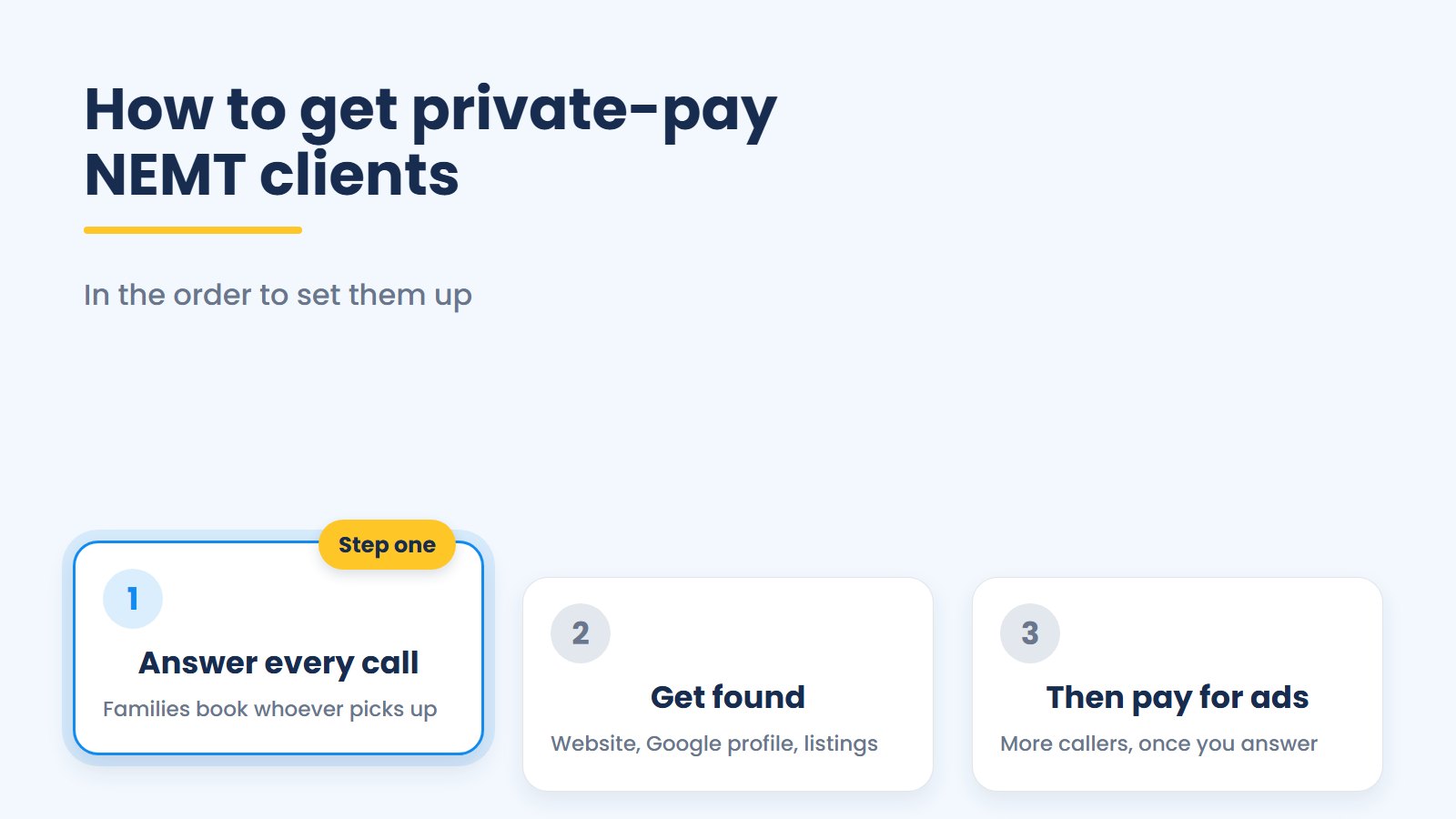
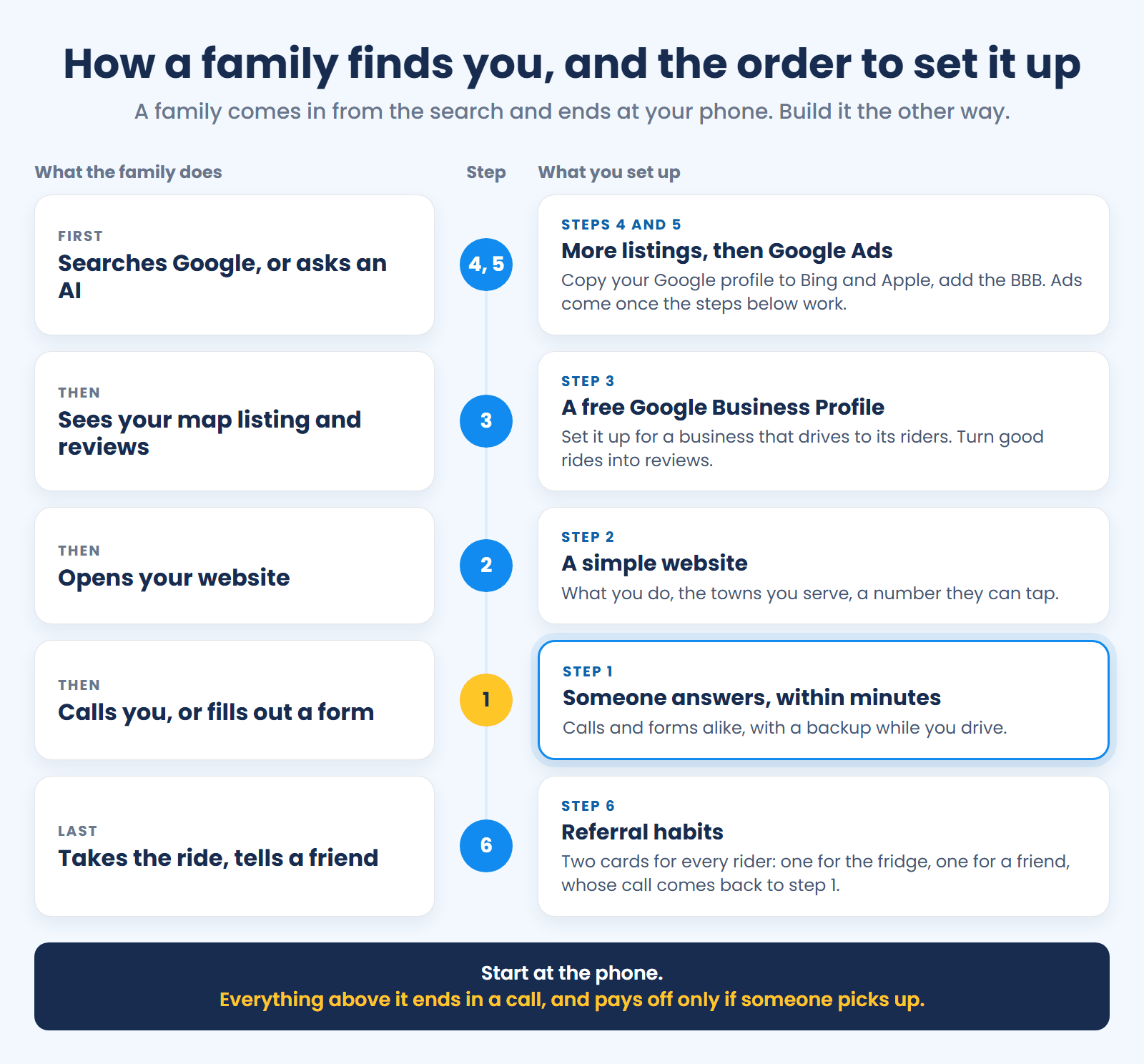
To get private-pay clients, the families who book and pay for their own rides, build in the reverse of how a family finds you. A family searches Google or asks an AI, sees your map listing and reviews, opens your website and then calls. So start at the phone, with someone who answers every call and web form within minutes. Then build a simple website, a free Google Business Profile with a system for getting reviews, and listings on Bing, Apple and the Better Business Bureau (BBB). Turn on Google Ads once the rest works, and start referral habits with your very first ride.
I look up a lot of NEMT companies, and a surprising number don’t have a website at all. Not a bad one. None! Some have been running for months, others for years. Many don’t have a Google Business Profile either, so when a family searches for a ride, they don’t show up on the map. They’re invisible.
For broker trips, none of this matters. Brokers call you. Private pay works the other way around: nobody assigns you the ride. A family finds you or it doesn’t, and it often books the first company that picks up. So get the basics right (answering, a website, a Google profile) before you pay Google to send more callers. Here’s the order I’d set things up in, with what each step costs. At the end, I compare how soon each one rings the phone.
Can a family reach you?
Before anything else, every call and web form gets an answer within minutes, because families call down the list and book whoever picks up. The Doctor Ride, which runs in Charlotte, started partly because of that problem. Mac was booking rides for his grandmother, and a lot of NEMT companies “wouldn’t answer the phone, wouldn’t call them back,” as his cofounder Ray told it on our episode with the two of them. He filled out forms on their websites and didn’t hear back. So they built their company around being “really easy to contact.”
Paul Muench, who owns Gentle Turns Transportation in Phoenix, takes the calls himself with his wife, and they don’t use a call center. He told us on our episode about his first year that “there’s a level of service even on the phone call which is always a first impression.”
Three rules make that work:
- A business line, not your personal phone. One of The Doctor Ride’s owners sees “too many people who are using their personal phone as their business line,” and says to keep the two separate.
- Forms answered as fast as calls. Treat a web form like a missed call and get back to it within minutes. Mac’s forms got no answer at all.
- A backup when you’re driving. Roll the line to a person or an AI phone agent that takes the booking details. As I told Josh Hagen of Careway Mobility on our episode answering a new manager’s questions, a voice AI that picks up and collects the booking info is “a lot better than an answering machine.”
The clocks for calling back and quoting a price are in our private-pay guide’s rules for answering first. This step costs your time, or a backup’s.
What does a family see when they look you up?
A family that looks you up needs a simple website that says what you do, where you do it and how to call you, and you can build one in days. With the phone covered, the website comes next. When Josh asked me what I’d do first if I were starting over with five vehicles, I said I’d “make a really good website.” Then I’d put real effort into showing up at the top of Google in my area.
The Doctor Ride’s first site didn’t take long. Mac said Ray built it “in a few days,” and people were finding it before the company even had a van. Their very first trip, one of the owners said, was “a straight up SEO call.” SEO, short for search engine optimization, is the work of showing up in Google’s unpaid results: someone searched, found the site and called.
A website matters to the people who could send you riders, too. Jeanine Johnson, who runs SailorGirl Transport in Sarasota, played it out on a panel we recorded at a 2025 industry conference: someone you’ve met looks you up, finds no website and thinks, “He’s not really credible. Is this a hobby?”
Building it yourself can take as little as a few days of your own time, as Ray’s did. Lana Becker, a digital marketer, told me on our episode about getting found online that someone “kind of savvy” can build a basic site in about 20 hours. If you hire it out, I’d be skeptical of anyone building you a website for $100, and I’ve heard of people paying $10,000, which seems excessive for this industry. For what goes on the site, see what families check on a NEMT website. The short version is your services, the towns you serve and a phone number people can tap.
How do you get on the map, and get reviews?
Claim your free Google Business Profile, set it up as a business that drives to its riders, and make asking for a review part of every good ride.
If riders don’t come to your office, set the profile up as a service-area business and list the towns you serve.
Fill in every field and verify the profile. Google’s tips on local ranking say businesses with complete and accurate information are more likely to show up in local results, and that verifying makes a profile more likely to show up too. What you can’t do is pay for a better spot in the free results; the same page says, “There’s no way to request or pay for a better local ranking on Google.”
Then ask for reviews, and make the asking a system with two layers: your drivers first, then your dispatcher. Google lets you make a review link and a QR code from your profile. If your service is 100% good, put the QR code in every van and have the driver mention it at some point in the ride: if you’re having a good time, just scan the code. If your rides are closer to 95% good, you don’t have to put the code in the van; you can get negative reviews that way if you’re not careful.
Then give your drivers a reason to ask. Tell them you’ll pay $25 every time a review mentions one of them by name, or whatever you and your drivers decide is reasonable. Te’ya Miles, the Atlanta operator behind That NEMT Girl, puts a QR code on the back of her team’s callback cards, and her drivers get $5 for each review, so they remind riders to scan it and to put the driver’s name in the review. If you don’t let drivers take tips, I’d have them turn the tip into a review: “Instead of a tip, it would make my day if you would leave a review mentioning me.”
A good ask I’ve had came from a handyman I found through one of those gig apps. They hung my TV, asked how the service was, and when I said great, asked if I’d mind leaving a five-star review. They stood there while I did it, and it didn’t feel pushy. It felt like a reasonable favor for good work. That’s the mindset you want your drivers in.
Then your dispatcher. Two or three days after a ride, if the rider hasn’t left a review, have the dispatcher call the rider or whoever booked the trip during a slow stretch: “Hey, just wanted to check in. How was your service the other day?” Most will say great. Then: we’re a small local business, it would really help us if you left a review, and I’ll text you the link. If they reviewed you on Google already, ask for a Yelp review instead. And if they had a bad experience, say the driver was 20 minutes late, make it right on the spot. I’d offer $50 off their next ride, which heads off the two-star review.
Reviews take time. Paul had “over 40 five-star reviews” on his Google page when he came on our podcast in the spring of 2025, about a year in. A northern New Jersey owner who runs mostly private pay told me on a call that reviews are “the main reason people contact us.”
Answer every review, especially the bad ones. An unanswered 1-star is louder than the 1-star itself. Take a complicated complaint to the phone, and never put a rider’s appointment, diagnosis or address in a public reply. This step costs a printed QR code, the driver bonuses and the occasional ride credit.
What if the family asks ChatGPT instead of Google?
Your listings beyond Google start to matter, so copy your Google profile to Bing and Apple Business the same week and add the Better Business Bureau.
When Josh asked me how to stand out in a crowded private-pay market, I said it means showing up at the top of Google. It also means showing up when someone asks ChatGPT, “I need a wheelchair transport in San Francisco. Who should I use?” A beautiful website alone won’t get you there. Google and the AI tools both look for evidence beyond your own site, and there are five or 10 places a NEMT company can build a profile. The Google Business Profile, I said, “is the most important.” Bing’s is “super easy,” because you connect it to Google. Then Apple and the BBB. What they’re all checking, as I put it to Josh, is “is this business sort of real?”
Bing Places for Business is free and puts you in Bing search and Bing Maps, and Microsoft has made it easier to import a Google listing. Apple’s free listing now goes through Apple Business, which replaced Apple Business Connect in 2026, and it’s where you claim your spot on Apple Maps.
I tell owners to set up Bing partly for ChatGPT’s sake. OpenAI’s help page on searching the web with ChatGPT says ChatGPT search “sometimes partners with other search providers.” Microsoft, which runs Bing, is one of the providers whose privacy policy it points you to. Google, for its part, says there’s no special trick for its AI Overviews and AI Mode, and an up-to-date Business Profile is on its list of basics that still count.
On an operator group call I sat in on in September, an owner in North Carolina who runs one vehicle said, “A lot of people are finding me through ChatGPT.” Nobody on our podcast has timed how long a new listing takes to ring the phone. The Bing and Apple listings cost nothing but your time.
When should you turn on Google Ads?
Once a family who clicks will find a real website and a real person, Google Ads are the fastest way to more calls, at about $10 to $20 of ad spend per interested caller. That’s the broad national range in the campaigns we run, and an interested caller is someone who calls wanting to book. I won’t take an owner’s money for ads until four things are in place: a website with a number people can tap, call tracking so you know which calls the ads brought, someone who answers and a price a caller will book. What Google Ads cost per caller has its own guide, with the first month’s budget and how long to give it.
Paul Muench didn’t think people went online looking for rides like his. He told the marketer helping with his ads, “I really don’t think people are online looking for these kinds of services.” She told him they were and offered to show him. “And she was right,” Paul said. He has advertised in a couple of local magazines, but the biggest thing he’s done, he told us, is a Google Ads campaign that’s been “highly effective.”
That marketer, Lana Becker, told me what she’d said to Paul from the beginning: “I will help you get traffic.” Turning that traffic into rides was up to him. Ads can make the phone ring. Whoever answers decides whether the call books.
Steps two through five are the work Duet’s growth team does for owners, starting with the website. We build the website, set up your Google profile and the Bing, Apple and other listings, reply to your reviews and run the ads. When the calls come, you answer them, or Duet’s voice AI does, and you quote the price and run the ride.
How does one ride bring in the next family?
Hand every rider two business cards at the end of the first ride, one for the fridge and one for a friend. I know operators whose drivers do that. The first card is for the rider’s own next trip: put it on the fridge and call whenever you need us. The second is for a friend who needs a ride. You can do this on broker trips too, if your broker’s rules allow it: the broker won’t pay for a ride to a wedding, but that rider can still call you for one.
If the rider lives in a group residence with other seniors, I’ve seen owners go a step further. They make a little gift bag for the first ride, with a couple of business cards, a handwritten thank-you note and a few snacks. Pens, fridge magnets and notepads with your number on them work the same way, for riders and for facility staff hunting for a number to call. If your number is there and visible, you’ll get calls you’d otherwise have missed.
Riders talk. On that 2025 panel, Paul said “Seniors like to brag about a service that they know they like,” even in a group home or a senior community. Timing matters, too. Eugene Gindin of Capital Area Transport Service told us on our episode about sustainable NEMT growth that his team hands a business card to a rider leaving a short facility stay, right as they leave. Wait “a week or two,” he said, and “there’s a chance somebody else is already kind of taking over.”
When a facility refers a family to you, that family books and pays like any other private-pay rider. Getting on a facility’s list is its own job, covered in our guide to NEMT facility contracts. Referral habits cost the price of cards, a gift bag and some pens. They’re the slowest way to fill the phone, and the one that lasts longest.
How do you know which one is working?
Ask every caller “How did you find out about us?” and count the answers at the end of each month. That’s Paul’s question, word for word, whenever someone calls. His rule for any marketing someone wants him to spend on is that if there’s no good way to measure it, “you don’t really know if that’s money well spent or not.”
His callers mostly found him on Google, and some came through Yelp. Once in a while someone calls because they saw one of his wrapped vans parked at a doctor’s office, but that’s rare next to people finding him online. On that September call, another owner said that when asked, some callers now say they found the company through an AI assistant. Give those their own line in the count.
How long until the phone rings?
Ads can ring the phone the first week. A website and Google profile take a couple of months to a year to bring calls on their own, and referrals take months to years.
| Step | What it costs | When calls can start |
|---|---|---|
| Answer every call and form | Your time, or a backup’s | It’s the gate: every row below loses calls without it |
| Website | A few days of your time, or a hired build | A couple of months to a year |
| Google profile and reviews | Free, plus a QR code and driver bonuses | Months, as reviews add up |
| Bing, Apple and BBB listings | Free for Bing and Apple | Not timed yet |
| Google Ads | About $10 to $20 of ad spend per interested caller | The first week; two to three months for a first read |
| Referral habits | Cards, a gift bag, pens | Months to years |
The Doctor Ride spent “a couple months” building an online presence, working on SEO and writing blog posts, before people started calling and filling out forms. That was before they owned a van. In Lana’s experience, good-quality SEO takes “about six months to a year to see results.” Getting known by word of mouth takes longest. Rachel Scholler, who ran a NEMT company in Wisconsin for 17 years, started with no clients and dropped off homemade brochures at nursing homes and senior centers. It took “a couple years of me being the driver,” in Rachel’s words, before “people just knew who I was.”
So the calls arrive in a different order from the setup. Start the website, the Google profile and the listings this week, so they’re already working by the time you turn on ads.
This order doesn’t fit every company. Rachel “never had to advertise” to get riders. As the story of how she built and sold her company shows, it grew on day-program contracts and referrals, not on families searching Google. If contracts make up most of your book, walk-ins and referrals may matter more to you than ads. In a small market, ads may bring calls more slowly. And if nobody can answer the phone today, step one comes before everything else on this page.
Some of those companies I look up, the ones with no website and no map listing, may run good rides. Families just can’t find them. Your competitors aren’t beating you on service. They’re beating you on findability. It’s fixable from a laptop.
FAQ
What if I can’t afford Google Ads yet?
Spend time instead of money. Te’ya Miles, the Atlanta operator behind That NEMT Girl, made that point on our episode about the NEMT mistakes nobody warns you about: owners who can’t afford ads can still “put some boots on the ground” and get known in their community. Te’ya’s team goes to quarterly senior expos, a free way to pass out information and meet people from organizations and facilities that can direct clients their way. Join your chamber of commerce, too. When Jeanine Johnson’s chamber asked SailorGirl Transport to sponsor an event, the sponsorship was shuttling people from a far-off parking lot. It “didn’t cost me any money,” Jeanine said, and the emails, texts and calls that followed said “hey, we saw you.”
Should I set up Facebook and Nextdoor pages too?
Free pages, yes, for the relatives who book. My cofounder Jing Zhu’s starter kit for a new private-pay provider puts a Facebook page right after the website and Google profile, because the younger family members paying for a parent’s or grandparent’s rides are on Facebook. And on a call I sat in on, a pre-launch owner in upstate New York said a Nextdoor question had put them in touch with a son in another state whose mother no longer drives.
About the author
James O'Donnell cofounded Duet and leads its sales, partnerships, and growth services. He talks with NEMT operators every week, hosts the NEMT Growth podcast, and answers Duet's sales line himself. More about Duet's founders →
Want more trips and less busywork?
See how Duet runs and grows NEMT businesses in a 30-minute demo.