Article
NEMT Levels of Service: Ambulatory to Bariatric
Every NEMT trip has two levels, the vehicle and the help. Here's what each level pays, and why I'd start with wheelchair.
By James O'Donnell, Cofounder and COO, Duet ·
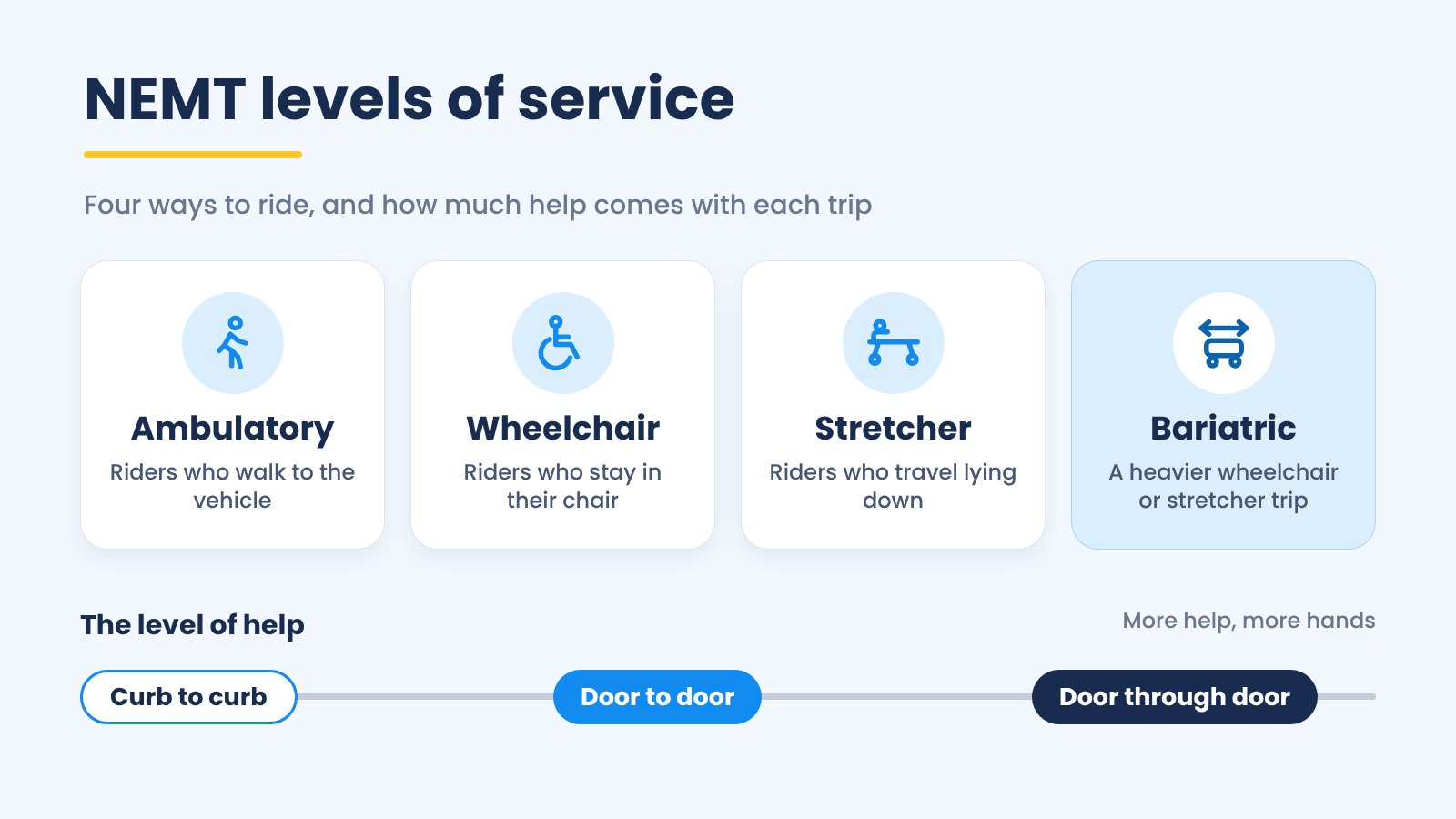
NEMT levels of service sort riders two ways: by the vehicle they need and by the hands-on help the driver gives. The vehicle levels are ambulatory for riders who walk, wheelchair for riders who stay in their chair and stretcher for riders who lie down, with bariatric as the heavier version of the last two. The help runs curb to curb, door to door or door through door. If you can run only one level, run wheelchair: every kind of payer buys it, and a wheelchair van carries riders who walk, too.
An Alabama owner launched in March 2022 on two personal cars, ran almost all ambulatory trips and brought in almost $100,000 from one broker the first year. The first wheelchair van came nine months in. On an industry podcast in 2024, the owner said one thing they’d probably do differently is start with a wheelchair van, “because I could have made so much more money faster.”
I’d tell a new owner the same, because a wheelchair ride is the one families often can’t give themselves. Riders who walk often have rideshare and a family car, so sell ambulatory as the help a rideshare can’t give. Our private-pay guide makes the short case for what to offer families. Here’s the long one: what the levels are and what each pays, each level in the order I’d add it, then a three-question check for your next one.
What are the levels of service in NEMT?
NEMT has one ambulatory vehicle level and three non-ambulatory ones (wheelchair, stretcher and bariatric), and every trip also carries a level of help. No national rule defines any of them. Each state Medicaid program or broker writes its own, and they disagree at the edges: Missouri’s Medicaid manual counts a rider in a manual wheelchair who can stand or pivot on their own as ambulatory.
Here are the four vehicle levels side by side, with what each pays for a 10-mile, one-way trip as of October 2026:
| At a glance | Ambulatory | Wheelchair | Stretcher | Bariatric |
|---|---|---|---|---|
| Who rides | Walks, maybe with a cane or walker | Rides seated in a wheelchair | Can’t sit up in a wheelchair; needs no care on the way | Too heavy or wide for standard chairs, lifts or stretchers |
| Vehicle | Car, minivan or van | Lift, or ramp 30 in. or longer, rated 600 lb; 30 x 48 in. of floor per chair | Stretcher locked to a floor mount | The base level’s van, rated for the weight |
| Crew | Driver | Driver; a second person in some programs | Usually two | Usually two or more |
| Driver training | Passenger assistance | Plus wheelchair securement | Plus stretcher transfers | The base level’s |
| Medicaid, Arizona metro: the most it pays (Oct. 1, 2026) | $19.44 | $26.55 | $64.49 | Not priced |
| Medicaid, Colorado outside nine metro counties: schedule amount (July 1, 2026, to Jan. 1, 2027) | $39.55 | $61.54 | $68.02 | $91.10, with two attendants |
| Posted private-pay price: median (Oct. 2026) | $74.75 | $90 | $249.50 | No median; priced off the wheelchair or stretcher fare |
| Allowed in a van in every state? | Yes, under your state’s for-hire rules | Yes; some states license wheelchair vans | No: Texas, North Carolina and Michigan, for example, require an ambulance or emergency medical services (EMS) license | As its base level |
Both Medicaid rows are fee-for-service schedules from states that price all three levels. Arizona’s metro amounts cover the Phoenix and Tucson areas. Colorado’s apply only to companies enrolled before October 1, 2026. The private-pay medians come from our page of posted prices by level, read October 21, 2026.
The second level is the help. Programs use these names for it:
- Curb to curb: the usual default. The driver stays at or near the van.
- Door to door: the driver helps the rider between the van and the building’s entrance, without lifting.
- Door through door: the driver comes inside, from the rider’s apartment or room to the doctor’s door.
- Hand to hand: the driver hands the rider to staff, family or another responsible person.
Washington’s Medicaid rule has the broker pick one for every trip, along with the vehicle. The two can combine, too: New Jersey’s Medicaid program has an ambulatory level for riders who need door-through-door help.
What is an ambulette?
An ambulette is a state’s word for a wheelchair van, and in some places a stretcher van too. New York’s Medicaid transportation manual uses it for a vehicle with “wheelchair-carrying capacity, stretcher-carrying capacity, or the ability to carry disabled individuals.” Ohio licenses ambulettes for riders “who require use of a wheelchair or other mobility aid,” so an Ohio ambulette is a wheelchair van.
An ambulette isn’t an ambulance. In New York, an ambulette “may not be used as an ambulance to provide emergency medical services.” Under Medicare’s rule, a basic ambulance carries at least two staff, one of them at least an emergency medical technician (EMT-Basic). If the rider needs care on the way, it’s the ambulance’s trip.
Who decides a rider’s level, and what does each level pay?
On a Medicaid trip, the broker or the state assigns the level, often from a clinician’s order or form, and in the programs that say so, pay follows that level, not your van. On a facility trip, the facility books what its clinicians cleared. On a private-pay trip, you decide which levels you offer and what each one costs, within state law.
Virginia, Washington and Missouri have the broker assign the least a rider safely needs. MTM’s Virginia handbook calls it “the least restrictive and most appropriate mode and level of assistance.”
Minnesota’s Department of Human Services told legislators in March 2026 that “payment is based on the individual’s assessed mode of transportation, not the type of vehicle used.” Colorado’s billing manual and a Los Angeles County health system contract say the same, and in Indiana a rider who walks bills at the ambulatory rate, even in your wheelchair van.
On most schedules and price lists we read, each step up pays more, but how much more depends on the payer. Eight of the 15 state Medicaid schedules we’ve read price all three levels. On those eight, a 10-mile stretcher van trip pays a median 2.33 times the wheelchair trip as of October 2026, from 1.11 times in Colorado to 2.81 times in North Dakota.
The other seven leave at least one level without its own rate: Texas pays one trip rate for a taxi or a wheelchair van, and Indiana, Louisiana and Michigan have no stretcher van rate. Before you buy for a level, look up what your state’s Medicaid fee schedule pays for it on a 10-mile trip, or ask your broker for its rate sheet.
Why start with wheelchair?
Wheelchair is the level private-pay callers ask about first, and a wheelchair van can still take riders who walk.
Jing, my cofounder, said on our private-pay episode that private-pay callers first ask whether you can take a wheelchair, and chairs come in flavors. A folding transport chair can ride in a sedan’s trunk. Extra-wide and power chairs are the ones she says to make sure you can handle. Those are the riders a family car usually can’t take.
Facilities buy it, too. At University Hospital in Newark, about 26% of the 6,566 discharge transports in 2025 went by wheelchair van, according to a chart in its 2026 request for proposals.
Per trip, wheelchair usually pays more, but not twice as much: on the posted price lists that show both levels, an ambulatory trip ran a median 71% of the same list’s wheelchair price as of October 2026. What wheelchair gets you is fewer competitors for the ride. A Dallas owner who grew to 11 vehicles in three years told an industry podcast in 2025 how that played out. After adding an ambulatory vehicle every quarter, the owner looked at the numbers in 2024: “if you don’t have a wheelchair, you are not in business.”
A family company in Northern California started with one wheelchair van, then bought two regular vans: “a huge mistake from what we know now because a lot of our clients are wheelchair.” Wheelchair vans, one of the family said on an industry podcast in 2024, still take the ambulatory riders.
One coach’s advice has moved, too. In a 2023 livestream on her own channel, Te’ya Miles, who coaches owners as That NEMT Girl, told owners still testing the idea to try ambulatory in their personal vehicle first. On our podcast in May 2026, she’d changed her answer: “you have to come in with a van that’s going to make you money. And that’s going to be a van with a ramp, not an ambulatory vehicle.”
The catch is the van. A used 2016-2019 wheelchair minivan listed for about $33,000 at dealers in fall 2026, which is why our startup guide calls starting ambulatory-only “the cheapest honest start.” If you’re buying, get a lift or ramp rated for at least 600 pounds and 30 by 48 inches of clear floor for the chair, the federal Americans with Disabilities Act (ADA) vehicle standard. Our vehicle guide covers whether that’s a minivan or a full-size lift van.
When does ambulatory pay?
Ambulatory pays when you sell what a rideshare can’t: help through the door, a wait through the appointment, several riders on one run, or rides where there’s no rideshare at all.
It also comes with the most competition. A Greensboro owner who grew a mostly wheelchair company to five vehicles in about two and a half years said on an industry podcast in 2026, “we want to do what most people can’t do.” With ambulatory riders, the owner said, you’re sometimes competing with Uber, Lyft or family.
An Oregon owner with 44 vehicles, four of them ambulatory, closed the company’s taxi business and sold about 20 cars, the owner told an industry podcast in October 2026: “you cannot make money on ambulatory rides. But we have to do them.” Pay can squeeze it, too. On a demo in July, I described California’s pay as “pretty good for stretcher” and “okay for wheelchair and terrible for ambulatory.”
None of that makes ambulatory a loser everywhere. Rachel Scholler, who ran a Wisconsin NEMT company for 17 years, told us on our pricing episode that her rural contracts paid the same rate for ambulatory and wheelchair. With trips about 70% ambulatory, that was “a huge advantage.” And in a consultation she published in August 2026, Te’ya gave ambulatory-only a pass “in a very rural area,” until Uber gets there.
Where ambulatory pays, it sells one of three things:
- The help. Walk the rider from the door to the van. Minnesota’s Medicaid schedule even pays a little more for it: at most $30.40 for an assisted 10-mile trip against $28.20 unassisted, as of October 2026, for a rider whose home zip code isn’t rural.
- The wait. The Doctor Ride in Charlotte has few ambulatory rides, and those are wait-and-return trips for procedures. “I don’t want to be compared to Uber,” Mac, one of its founders, told us in June.
- The run. “Ambulatory kind of comes down to how well you can pack the trips together,” I told a New Orleans founder on a call in July. I’ve seen people make good money with a big van and an adult day program: eight riders picked up and dropped off every day.
Then make the level of help a choice on your booking page, with a price on each.
When should you add stretcher?
Add stretcher when callers already ask for it, your state allows it in a van, and you can put two people on every trip and charge for both.
In July I did a demo with an Inland Empire owner, one van and a week into running it full time, who’d been handing gurney calls to a partner. “People are coming to you wanting to pay for gurney rides,” I said. “Buy the gurney. It’ll pay for itself pretty quickly.”
Those calls are the first test, because stretcher is a small slice of Medicaid riding: 0.16% of Wisconsin’s completed Medicaid legs in May 2026 and about 2% of Missouri’s 2021 fee-for-service trips. Before you buy, count the stretcher calls you sent elsewhere last month.
Then read your state’s rule. Texas requires an EMS provider license for any stretcher transport, North Carolina treats stretcher work as ambulance service, and Michigan lets only a licensed ambulance carry a stretcher rider. Arizona, Colorado and Florida allow stretcher vans for riders who need no medical care on the way. Our license guide checks whether stretcher trips need a different license in more states, and our Wisconsin guide shows how Wisconsin covers stretcher trips. Even where it’s legal, New York’s and Virginia’s Medicaid rules let a stretcher van carry only oxygen that riders give themselves; a rider who needs the crew to run oxygen or watch them is an ambulance’s trip.
Then staff it. Jeanine Johnson, who runs SailorGirl Transport in Florida, told us on our long-distance episode, “if there is a stretcher involved, it’s two people, whether it’s 5 minutes down the street or 15 hours down the road.” New York’s and Virginia’s Medicaid rules require two, and so does Illinois’s stretcher van license. Minnesota is the exception we found, with no statute or rule requiring a second person. Budget for insurance that covers stretcher loading and unloading, too.
Then price both people: every stretcher trip at about twice your wheelchair price or more. On the posted price lists that show both levels, a stretcher trip ran a median 2.21 times the same list’s wheelchair price as of October 2026. Medicaid won’t always follow, since Colorado’s schedule pays barely more for a 10-mile stretcher trip than for a wheelchair one.
What counts as bariatric, and how do you price it?
Bariatric has no national definition or billing code. It’s a wheelchair or stretcher trip for a rider too heavy or wide for standard equipment, priced by the crew it takes.
Of the 15 state Medicaid schedules we’ve read, only Colorado’s prices it on its own. Since November 1, 2025, an extra-large wheelchair van trip with two attendants for loading and unloading has its own code. The July 2026 schedule pays a $63.70 base plus mileage for it, against a $34.14 standard wheelchair base.
No state rule we’ve read defines a bariatric rider by weight, so the numbers come from equipment, crew rules and carriers’ own price lists. The federal lift standard is 600 pounds, and Michael Shank, who’s sold about 8,500 wheelchair vans, puts a bariatric rider and chair close to 1,000. New Jersey requires a second crew member when a wheelchair rider of 200 pounds or more goes up or down two or more steps. Five Nevada carriers’ filed private-pay tariffs call 350 pounds bariatric and charge a bariatric wheelchair rider 1.48 to 2.27 times their wheelchair price.
On our pricing episode, Jing told the story of a Duet customer’s hospital discharge a couple of years ago: a rider of almost 500 pounds, on a gurney, two hours away, on a Sunday. The provider quoted $2,000, because it took “three drivers minimum or even four” and two vehicles, one for the rider and one for the extra crew. Charge less, the provider said, and the trip loses money.
Facilities tend to expect it. I told an Iowa owner on a call in July to charge more, because “these facilities are used to paying more for bariatric,” and “they’re not going to bat an eye.” Ask every caller the rider’s weight and chair type before you quote, and price bariatric for the crew it takes.
Which levels should you run?
Run a level when the payers you already have ask for it, your state allows it in a van and you can staff every trip, and the price covers the extra people. If you don’t have a van yet, start with wheelchair.
Three questions decide each level:
- Did your payers ask for it last month? Count the calls you turned away for that level. If not, refer this trip and keep counting.
- Can you run it legally in a van and staff every trip? If not, refer or partner, the way the Inland Empire owner handled gurney calls.
- Does the price cover the extra people and gear? If not, raise your price or pass.
Three yeses means add it. Until then, do what I told that Inland Empire owner: “sell it before you can offer it.” On a private-pay call, book the trip, hand it to a partner, and let the calls tell you when to buy.
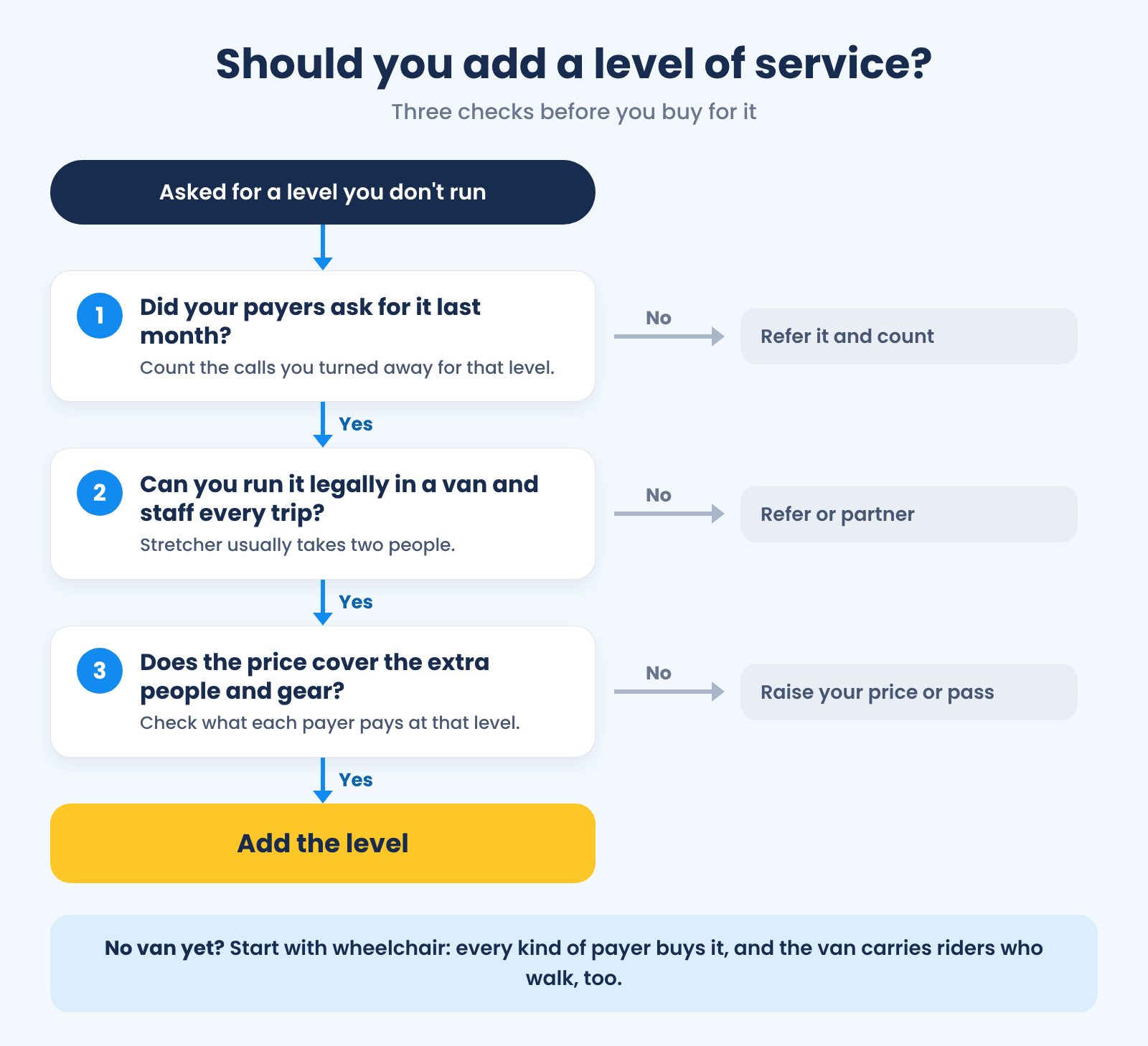
The check can come out ambulatory first, and that’s fine: where a payer pays one rate for both levels, as Rachel’s contracts did, a car earns per trip what a van earns and costs far less.
What changes as you add levels?
Once you run two levels, the daily job is getting each rider into the right van, and the biggest contracts want every level.
Owners describe days to me like this: a stretcher van at 9 a.m., a wheelchair trip at 11, ambulatory at 2, then back to stretcher. “A lot of people solve that by just buying more vehicles,” I said on our vehicles episode in July. A full-size lift van can keep the stretcher aboard and still load a wheelchair, so one van covers two levels.
The Oregon owner put it plainly: “You’re not going to have contracts if they can’t call you for everything. Not big contracts.” And everything means “oxygen. That means stretcher. That means bariatric.”
Getting each rider into the right van is the part of the job Duet’s dispatch board helps with. Every trip in Duet carries the rider’s mobility needs (wheelchair, stretcher and gurney, or ambulatory), so the right vehicle gets assigned the first time. Rider profiles keep what families shouldn’t have to repeat: bariatric needs, ramps or steps at home, a special wheelchair, a Hoyer lift. You still choose the levels, buy and staff for them, and set the prices.
The Alabama owner got that first wheelchair van nine months in. You can find your next level faster: count last month’s calls you turned away, by level. The level that keeps coming up, if it passes the other two checks, is your next one.
NEMT levels of service FAQ
Does Medicare pay for wheelchair or stretcher van rides?
No. Original Medicare “simply does not provide any coverage at all … for any non-ambulance forms of transportation, such as ambulette, wheelchair van, or litter van,” per Medicare’s claims processing manual. A litter van is a stretcher van. Tell a family on Original Medicare alone, before they book, that they’ll be paying for the ride themselves.
What if the rider needs a different level than the one booked?
On a Medicaid trip, call the broker before the ride, not after. MTM’s Virginia handbook, for one, warns that transporting a rider in a way that doesn’t match the authorized level of assistance “may result in non-payment or corrective action.” On a private-pay trip, re-quote at the new level before the van rolls, and add the question that would have caught it to your booking call.
How long does a rider’s assigned level last?
It depends on the program. Louisiana’s managed care manual has a clinician certify its door-through-door wheelchair level for no more than 180 days. Rhode Island’s broker lets a rider use the requested mode for up to two weeks while a doctor completes the level of need form. Elsewhere, ask your broker when a rider’s level gets reviewed.
About the author
James O'Donnell cofounded Duet and leads its sales, partnerships, and growth services. He talks with NEMT operators every week, hosts the NEMT Growth podcast, and answers Duet's sales line himself. More about Duet's founders →
Want more trips and less busywork?
See how Duet runs and grows NEMT businesses in a 30-minute demo.