
Article
How Much Does a NEMT Business Make? Per Van, by Payer
An owner who drives tops out near five trips a weekday. At most Medicaid rates we checked, earning a driver's wage takes seven or more.
By James O'Donnell, Cofounder and COO, Duet ·
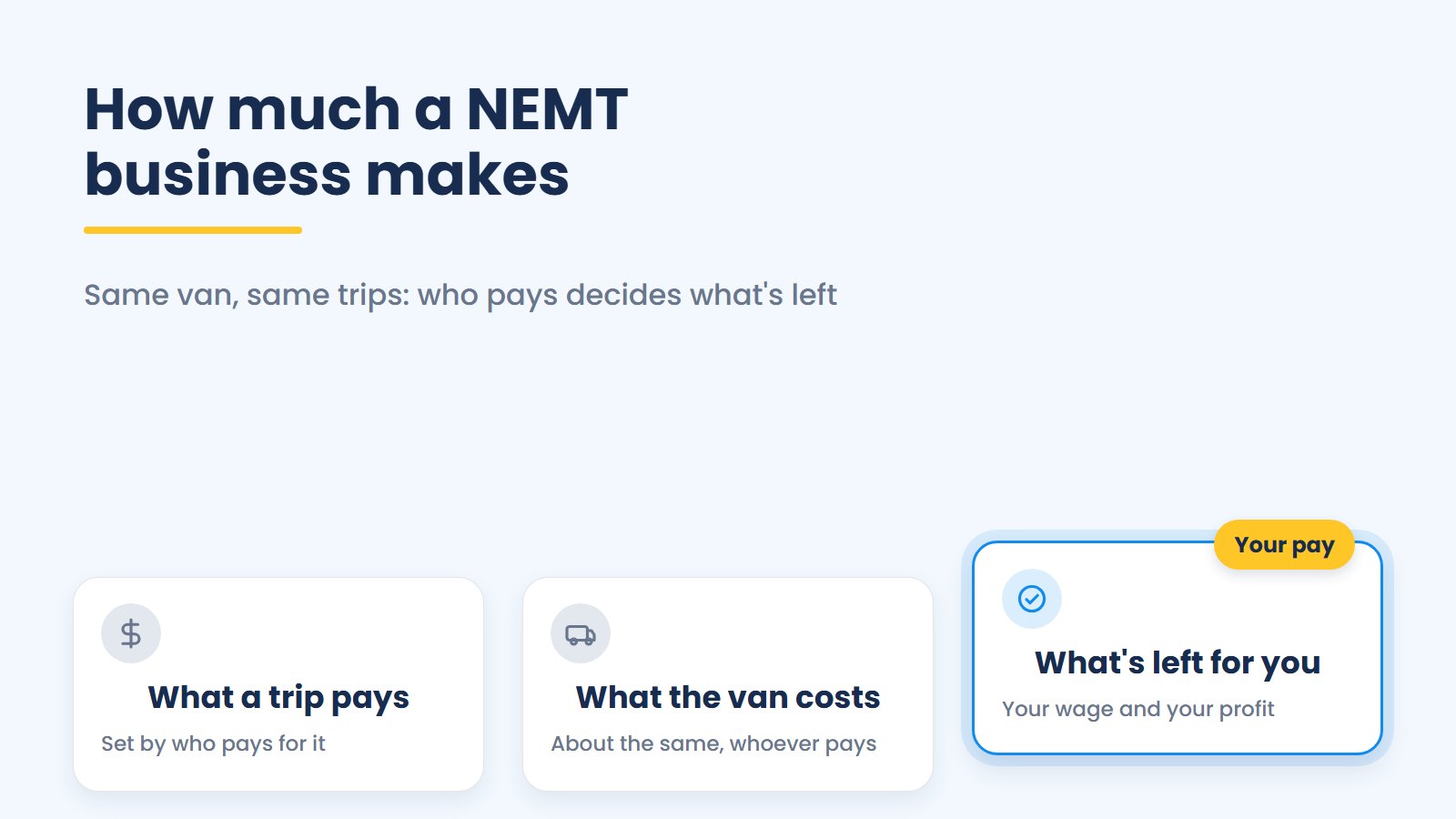
A wheelchair van you drive yourself, running about 100 one-way trips a month, leaves you about $15,000 a year before taxes at a $41 broker rate. At a $71 private-pay price, it’s about $51,000, and at $100 a trip, about $86,000. Those figures come after about $2,900 a month in bills for a new company’s financed van, which stay the same whoever pays. So what a non-emergency medical transportation (NEMT) business makes depends mostly on who pays for its trips.
Tony Jackson, a 35-year NEMT veteran from Orlando, put it plainly: “your wheelchair van should make $500 a day. I don’t care where you are.” He said it on our episode about winning facility contracts, answering a viewer who asked whether a new company should start with brokers or go straight to facilities. Then he added, “So if you think the broker is going to give you $500 worth of wheelchairs in one day, I doubt it.”
His doubt holds up. An owner who drives tops out near five trips a weekday. At most of the Medicaid rates we checked, paying yourself a driver’s wage takes seven or more, and at a $71 private-pay price, about four. Here’s the math in the order the money moves, then what changes when you hire a driver.
What does one NEMT trip pay?
A 10-mile wheelchair trip pays $25 to $44 at seven of the nine state Medicaid rates we checked, and $55 to $125 at most of the private-pay prices we found. The state rates come from each state’s own fee schedule, all listed in Sources, and the private-pay prices from what providers post.
| Who pays | A 10-mile wheelchair trip | 100 trips | When you’re paid |
|---|---|---|---|
| Medicaid, at the state’s published rate | $25 to $44 in seven of nine states; about $55 and $62 in the other two | $2,500 to $4,400 in those seven | Every week or two, after a clean claim |
| A broker, at its contract rate | $41 on one broker’s posted rates | $4,100 | Every week or two, after a clean claim |
| A family or rider, at your price | $55 to $125 at most posted prices we found | $5,500 to $12,500 | Before the ride |
| A facility, at the rate you agree | From the Medicaid rate to $125 or more | Depends on the contract | On invoice, often 30 to 60 days later |
Most Medicaid trips come through a broker or a health plan’s ride vendor, at the rate in your contract. The state’s own rate is what it pays for trips outside the health plans, called fee-for-service, and it’s the best public yardstick. Here’s what it pays for a 10-mile wheelchair trip in the nine states we checked:
| State | A 10-mile wheelchair trip |
|---|---|
| Michigan, outside Wayne, Oakland and Macomb Counties | $25.10 |
| Arizona, Phoenix and Tucson | $26.55 |
| Louisiana | $34.50 |
| California | $35.30 |
| Minnesota, outside rural areas | $39.00 |
| Illinois, Cook and the collar counties | $40.30 |
| Ohio | $44.00 |
| Massachusetts | $55.15 |
| Colorado | $61.54 |
Medicaid isn’t always the low end: Massachusetts’ and Colorado’s rates reach the bottom of the private-pay range.
The broker row in the first table is the one broker schedule we found posted: MTM’s for Rhode Island, effective July 2023 and still the basis its 2026 handbook gives for pay. In DC, the broker paid companies an average of $41.63 a trip in fiscal 2025 for its largest group of Medicaid riders outside the health plans, about 140,000 trips of every kind and length. And with a broker, Tony said, “you are at the mercy of” its rate: “We’re giving you $35 a wheelchair. Take it or leave it.”
Those numbers come from different markets, so the fair comparison is inside one. A company in southeast Minnesota posts $30 plus $2.49 a mile, or $54.90 for a 10-mile wheelchair trip, where Minnesota’s fee schedule pays $39.00 at its non-rural rate. In Los Angeles and Orange Counties, the gap is wider: Medi-Cal, California’s Medicaid program, pays $35.30 fee-for-service, and one company there estimates a one-way 10-mile trip at $110 to $130.
A facility doesn’t automatically pay more. One public hospital in Newark, New Jersey, pays for the rides it authorizes at no more than the state’s Medicaid rate, 45 days after the invoice. And it pays only when 180 days of trying to collect from the rider’s insurance and the rider have brought in nothing. The Doctor Ride, a two-van company in Charlotte, charges one facility $125 a leg for wheelchair trips, with five free miles.
Medicaid and brokers generally don’t pay for a no-show, the drive to the pickup or the wait. On private pay, you can charge for them: one Jacksonville company charges a $65 no-show fee and $50 an hour for waiting. Before you sign a rate sheet, write down what each payer pays for a 10-mile wheelchair trip and what it won’t pay for.
How many trips can one van run?
The benchmark I give new providers in our guide to starting a NEMT business is that a van you drive yourself roughly tops out near 100 one-way trips a month. That’s about five trips a weekday, because you’re also the one answering the phone, scheduling tomorrow and sending the bills.
Some owners push past it with longer days. An owner in Alabama said on a 2024 industry podcast that he brought in almost $100,000 from one broker in his first year, mostly on ambulatory trips, working from morning to evening on his own. That’s what broker volume costs: your hours.
Others run fewer trips on purpose. When The Doctor Ride’s founders came on the podcast in June, they were running their two vans at about two round trips, or four one-way trips, a van a day, with no broker work. On the day they recorded, two round trips and a one-way brought in roughly $800, helped by a wait-and-return ride they bill at $125 an hour. As Mac, one of the founders, put it on our episode with him and Ray: “I’d rather have two, three, four rides a day than eight, nine, 10 and try to make the same amount of money.”
The question isn’t how many trips your van can run. It’s how many each payer makes you run to earn a living. That’s also why it pays to give each vehicle a daily revenue target and check its booked revenue against it every morning.
What does one van cost to run?
One financed wheelchair van costs about $2,900 a month to keep on the road before you pay yourself, using the example from our guide to NEMT startup costs.
| What you pay | A month | How the example gets there |
|---|---|---|
| Commercial auto insurance | $1,450 | $17,400 a year; $1,200 to $1,800 a month is the usual range for a new company |
| Van payment | $614 | A $33,000 used wheelchair van, 20% down, 14% interest over five years |
| Gas | $509 | 2,500 miles at 22 miles a gallon and $4.48 a gallon, the U.S. average the week of Sept. 21, 2026 |
| Maintenance | $276 | 2,500 miles at about 11 cents a mile, the 2025 average for newer vehicles |
| Phone | $15 | A business line |
| Total, before you pay yourself | $2,864 |
In this example, 1,000 of those 2,500 miles carry a rider (100 trips of 10 miles), and 1,500 are empty miles to pickups and back. The maintenance rate is AAA’s. Left out: the general liability policy many brokers and facilities also ask for, a reserve to replace the van, big repairs, software, accounting, marketing and the one-time costs of getting started.
Insurance is the biggest line, and quotes vary widely. Rachel Scholler, who ran a NEMT company in rural Wisconsin for 17 years, was paying about $500 a month per vehicle when she sold, while owners she now coaches get quotes of $1,500 to $1,800. What you pay at renewal follows your claims record and the agent you buy through, as our guide to NEMT insurance explains.
What’s left at the end of the month?
On our example, 100 trips a month in a van you drive leave about $1,200 after the van’s bills at a $41 broker rate, about $4,200 at $71 a trip and about $7,100 at $100.
| One van you drive, 100 trips of 10 miles | $41 a trip | $71 a trip | $100 a trip |
|---|---|---|---|
| Revenue | $4,100 | $7,100 | $10,000 |
| The van’s costs | $2,864 | $2,864 | $2,864 |
| Left for you | $1,236 | $4,236 | $7,136 |
| Left for you over a year | About $14,800 | About $50,800 | About $85,600 |
| Left after paying yourself a median driver’s wage ($3,108) | -$1,872 | $1,128 | $4,028 |
| Trips a month to pay you that wage | About 156 | About 82 | About 56 |
The $41 is the broker rate from the first table. The $71 is the middle of 19 companies’ posted prices in one Oregon county, and the $100 is one Las Vegas company’s filed price. The wage is the national median for NEMT, shuttle and chauffeur drivers, $17.93 an hour in May 2025, or $3,108 a month at 40 hours a week.
The last row takes one more step. Insurance, the van payment and the phone, $2,079 together, cost the same every month. Gas and maintenance come to about $7.85 a trip, at 25 miles a trip counting empty miles, so they rise and fall with the trip count. The row is the $2,079 plus the wage, divided by what each trip keeps after its $7.85: at $41, that’s $5,187 divided by $33.15, about 156 trips.
Two lines fall out of that math. At 100 trips, about $29 a trip covers the van ($2,864 divided by 100), and about $60 also pays you a driver’s wage ($2,864 plus $3,108, divided by 100). Eight of the nine state rates above fall below that second line, and at Michigan’s and Arizona’s, 100 trips don’t even cover the van.
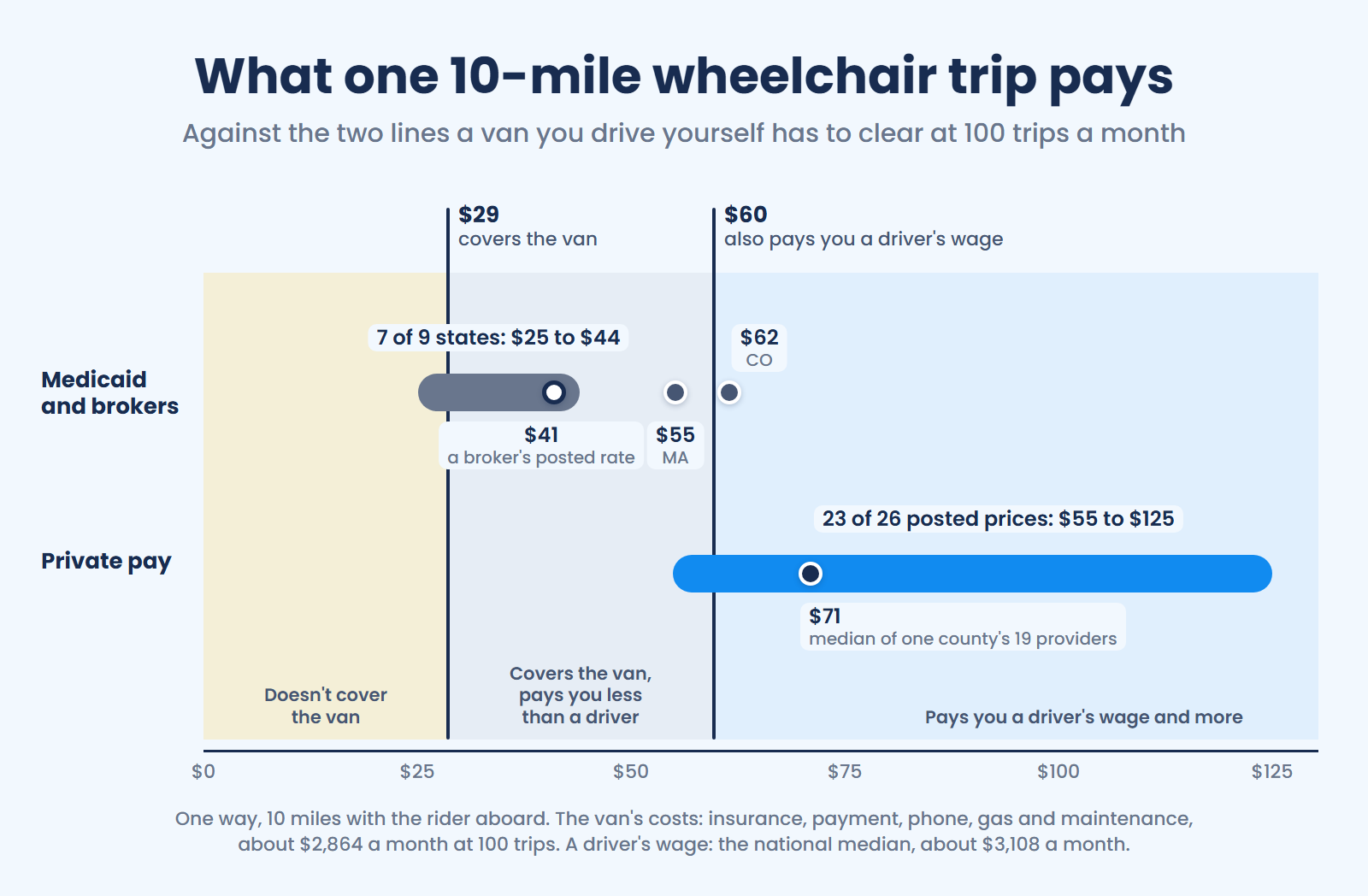
The gap is bigger than the prices suggest, because the van’s costs don’t move with the price. That southeast Minnesota company’s $54.90 is 41% more than the fee schedule’s $39.00 for the same trip, and on this van it leaves you $2,626 a month instead of $1,036, about two and a half times as much.
If your van runs a mix, use your blended rate, the average across every trip. Say your van’s trips are 60% broker work at $41, 20% facility trips at $70 and 20% private pay at $90. That averages about $57 a trip, which takes about 106 trips a month to pay you a driver’s wage.
To find your own two lines, divide your van’s monthly bills by its trips, then add a driver’s wage to the bills and divide again. Your blended rate has to clear the second line for the van to pay you a driver’s wage. And when you set your private-pay price, put it above both the broker’s rate and your own cost per trip.
Doing this on a real book takes revenue split by payer and by trip type (ambulatory, wheelchair, stretcher). I’ve had customers say, “15% of my trips are ambi and like 3% of my revenue is ambi. What am I doing?” Duet’s reports show where revenue comes from by payer and trends by trip type, and you can export every trip and dollar a van brought in to set beside your own bills.
How much do NEMT owners make?
An owner who drives has no separate salary: the $1,236 left at the $41 rate is your whole paycheck for the month, before taxes, about 40% of what the median driver earns. That’s how a one-van company can look profitable and still pay its owner less than a job would. A founder of a two-van company in coastal Virginia said it plainly on a 2026 industry podcast: owners who drive “can say they’re profitable right away because they are the driver. That’s their compensation.”
You’ll see $40,000 to $60,000 a year quoted online for a one-van owner. On our example, that’s about what a $71 private-pay price leaves you, and most of it is your pay for driving, not profit on top of a wage. At a $41 broker rate, it’s closer to $15,000. The first year is often leaner still: one owner-operator said on a 2024 industry podcast that he expected to make $25,000 to $30,000 in his first year on one van, and he made about half that.
Rachel didn’t pay herself at first and kept reinvesting. As she put it on our podcast, “You’re not going to just start out and be making a hundred thousand for yourself right out of the gate.” But Jason Van Horn, one of two financial advisors on our episode about retiring rich from NEMT, called not paying yourself “one of the biggest mistakes,” because otherwise “how else are you going to tell if your business is even profitable.” His fix: pay yourself from the start, out of a separate business account. Either way, count a driver’s wage, about $3,100 a month, as your pay from the first month, even if some of it goes back into the business.
If you’re leaving a job, Jason’s colleague Daniel Baker adds the part people skip: your employer was paying for health, life and disability insurance and a retirement match, and your business has to cover those now. Keeping what you make is the other half. Daniel’s worst case was an owner-operator who grew fast but “didn’t structure anything.” The vans and an office building sat in one LLC with no umbrella coverage, so when their driver was at fault in a fatal accident, “everything was open to that lawsuit,” and the business went under. So this month, ask your accountant or attorney whether your vans, any building and the operation belong in separate companies, and price an umbrella policy with the agent who writes your auto coverage.
What changes when you stop driving?
Once you stop driving, each trip has to cover the van’s bills and a driver before it pays you anything: on our example, about $64 a trip at 100 trips a month.
A full-time driver costs about $3,560 a month at that $17.93 median wage, once you add payroll taxes and workers’ comp. Here’s the same van with a hired driver, with the break-even figured the same way as the trips row above:
| One van with a hired driver, 10-mile trips | $41 a trip | $71 a trip | $100 a trip |
|---|---|---|---|
| The van’s costs and the driver, at 100 trips | $6,424 | $6,424 | $6,424 |
| Left for you at 100 trips | -$2,324 | $676 | $3,576 |
| Trips a month to break even | About 170 | About 89 | About 61 |
A driver has more hours for trips than an owner who’s also selling and billing, so a van with a driver needs to run fuller. My rule of thumb is that a fully booked wheelchair van can bring in over $100,000 a year in most places. Say yours runs 150 trips a month at the blended $57 from earlier. That’s about $102,000 a year, and after the van’s bills and the driver, about $1,700 a month is left for you, about $20,000 a year.
The Virginia founders built their company around paid drivers from the first van, and they’re honest about what that costs. Fourteen weeks in, “payroll’s our biggest expense,” and they expect it to get “really profitable” at “probably about your fifth van.” Rachel, who went from four vehicles to 15 in about three years, puts the line further out: “the margins are so thin, you really don’t start getting a higher profit margin till you have like 10 vehicles on the road.”
The order I recommend comes from Christopher Buell, who grew his first NEMT company to about 11 vans with no broker work. As he laid it out on our episode on calling facilities, get the first van close to full time, hire a full-time driver, then buy the second van and become “the overflow guy” who also does the selling. My trigger for that hire is turning down trips every couple of days.
Is medical transportation a good business to start?
Medical transportation is a good business if you build it on trips you price yourself, from private-pay riders and facilities, and treat broker trips as filler or, at fleet scale, as a volume business.
Rachel built hers mostly on contracts with her county’s managed-care organizations for day-program riders, and kept brokers as a last resort: “I only set my availability at 10% so it just sort of filled in my schedule.” Her profit margin, she said, was “much much higher than the brokers.” When she sold, the buyer wanted broker trips anyway. She warned him, “you might get more volume but you’re working for less money,” and 90 days in he’d stopped, because brokers were “offering 30 to 40% less than what our private rates are.” In a rural market, she said, “we have a little more say in the rates.”
Broker work isn’t worthless, as the Alabama owner’s first year shows. And a company with 20 vans can live on broker trips; as I said on our episode answering a new manager’s questions, “you just got to get in enough volume that the small margin on each broker trip adds up.” The danger is one payer owning you. I’ve seen a 20-vehicle company doing all its work for one broker hit a disagreement on price, go to zero trips and go under.
Private-pay riders cost money to find, too. In the Google Ads we run for NEMT companies, a new rider costs roughly $33 to $67 in ad spend when about 30% of callers book, as our breakdown of Google Ads costs works out. That’s less than one round trip at $71 a leg. In a smaller market, though, ads may bring in only a handful of private-pay rides a month.
Facility accounts are won one building at a time, by calling and showing up, and our guide to winning facility contracts walks through those calls. Broker trips make good filler for the gaps in that schedule, as long as they pay. When one barely covers its gas, spend the hour selling instead: skip the broker trip that earns you $2 and walk into two more facilities.
Back to Tony’s $500 a day: at $41 a trip, that’s about 12 trips; at $100, it’s five. So here’s this week’s test. For each van, take last month’s revenue and subtract its bills, including the driver’s pay if you don’t drive it yourself. What’s left is what that van paid you. If the van you drive paid you less than a driver’s wage, about $3,100 a month, or a van with a hired driver paid you nothing, the fix is who pays for its next trips. Fill more of them at prices you set, from families and facilities.
FAQ
How much does a NEMT driver make?
The Bureau of Labor Statistics counts NEMT drivers with shuttle drivers and chauffeurs, whose median pay was $17.93 an hour in its May 2025 survey, about $37,300 a year full time. Pay runs higher or lower by city, so check local postings. That’s the driver’s wage. The owner gets what’s left after the van and the driver are paid.
Does a stretcher van make more than a wheelchair van?
It can, per day. Tony Jackson’s target for a new company’s stretcher van is $1,000 a day, twice his wheelchair target. I’ve seen stretcher vehicles in Southern California make $1,500 to $2,000 on a good day, where a wheelchair van can be tough to get above $1,000 even then. But moving a rider onto a stretcher usually takes two people, and the insurance usually costs more, so compare what’s left after each van’s costs, not just the price.
What is a NEMT business worth when you sell it?
Usually a multiple of its seller’s discretionary earnings: the profit plus the owner’s pay and the personal expenses run through the business. Small businesses of all kinds that sold for under about $2 million went for roughly two to three times that in mid-2026, and nobody publishes a multiple for closed NEMT deals. Contracts and recurring riders that keep paying without you push the number up. Our guide to selling a NEMT business covers the multiples.
Sources
- Medicaid rates for a 10-mile wheelchair trip: Ohio’s wheelchair van rates ($31 a trip plus $1.30 a mile), Illinois’ non-ambulance fee schedule (Cook and collar-county mileage), Michigan’s NEMT rate schedule (half of a 20-mile round trip), Louisiana’s NEMT fee schedule, Minnesota’s fee schedule as of October 12, 2026, Medi-Cal’s ground transportation rates, Arizona’s rates effective October 1, 2026 (Phoenix and Tucson), Massachusetts’ wheelchair van rates and Colorado’s NEMT rates from July 2026.
- Broker rates: MTM’s Rhode Island Schedule A (effective July 1, 2023), MTM’s July 2026 Rhode Island provider handbook (pay calculated from Schedule A) and the DC Medicaid agency’s answers to the DC Council (an average of $41.63 per one-way trip in fiscal 2025).
- Prices: Washington County, Oregon’s list of licensed providers’ rates (September 2026), a Las Vegas company’s filed tariff (accepted March 6, 2026) and University Hospital’s transportation RFP (April 2026).
- Driver pay: the Bureau of Labor Statistics’ May 2025 wage data (occupation 53-3053).
About the author
James O'Donnell cofounded Duet and leads its sales, partnerships, and growth services. He talks with NEMT operators every week, hosts the NEMT Growth podcast, and answers Duet's sales line himself. More about Duet's founders →
Want more trips and less busywork?
See how Duet runs and grows NEMT businesses in a 30-minute demo.