Article
How to Become an MTM Transportation Provider (2026)
An MTM contract promises no trips. Here's how to apply, what MTM checks and pays, and what decides how many trips it sends you.
By James O'Donnell, Cofounder and COO, Duet ·
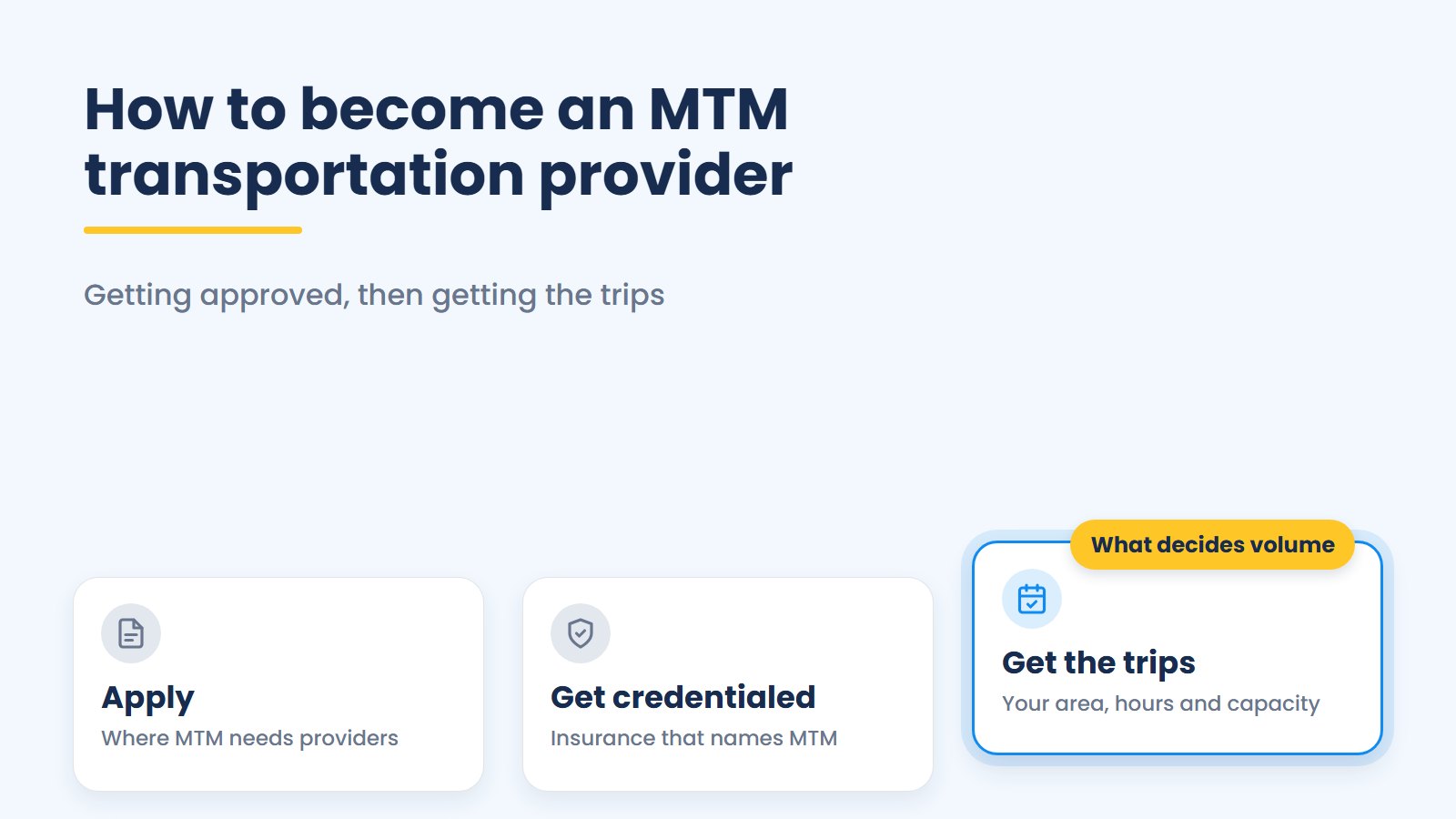
To become an MTM transportation provider, apply on MTM Health’s provider onboarding page if you run a company with several drivers and vehicles; solo drivers with their own car go through Veyo, MTM’s affiliate. Six steps follow: application, interview, contracting, credentialing, training and a first trip. MTM moves quickly only where it needs providers; its Rhode Island page puts the wait for a chance to contract at 8 to 12 months.
In a 2024 video interview, a former provider-network manager who, per the interviewer, spent more than a decade at MTM described a provider that started with three cars. Right away, it told the broker what it wanted: “I want to be everywhere in the state.” By the manager’s account, it grew to 35 vehicles, and the manager hadn’t seen another grow nearly as fast.
An MTM contract promises no trips: MTM sends them by the area, hours and capacity you give it and your current credentials, so that setup decides your volume. The sections follow the path: where MTM runs rides, applying and the wait, pay, MTM’s checks, how trips reach you, what decides how many, and why MTM shouldn’t be your only payer.
Does MTM run the Medicaid rides where you drive?
MTM Health arranges at least some Medicaid rides in 22 states and DC as of late October 2026, plus New Mexico’s Blue Cross plan from November 1, 2026. It’s the statewide broker, the company a state hires to hand out Medicaid rides, in five of them. It’s the broker for fee-for-service riders (those outside Medicaid health plans) in DC and four more states, a county coordinator in Minnesota, and a ride vendor for individual health plans in the other 12. Find your state’s row before you apply:
| State | Where MTM arranges Medicaid rides |
|---|---|
| Arizona | Health plans: UnitedHealthcare Community Plan and Molina Complete Care |
| Connecticut | Statewide broker for HUSKY A, C and D |
| District of Columbia | Fee-for-service and IDD waiver riders, on an extension through Dec. 31, 2026; DC’s Contract Appeals Board denied MTM’s protest of Verida’s award on Oct. 9, 2026, and no Verida start date is published yet; also MedStar Family Choice, through Access2Care |
| Florida | Fee-for-service riders in Regions B to F; health plans: UnitedHealthcare since March 1, 2026, and Molina |
| Hawaii | Health plan: UnitedHealthcare Community Plan, since Jan. 1, 2026 |
| Idaho | Statewide broker |
| Illinois | Health plans: Blue Cross Community Health Plans since Oct. 1, 2026, plus Meridian and YouthCare |
| Iowa | Fee-for-service and all three IA Health Link plans |
| Kansas | Health plan: Healthy Blue |
| Michigan | Four health plans: Aetna Better Health, Blue Cross Complete, HAP CareSource and UnitedHealthcare |
| Minnesota | County coordinator: MTM-MNET runs local-agency rides in 17 counties under two host-county contracts; there’s no state broker |
| Missouri | Fee-for-service, statewide, and all four MO HealthNet health plans |
| Nebraska | All three Heritage Health plans, UnitedHealthcare’s since Jan. 1, 2026 |
| Nevada | Statewide broker for urban members and fee-for-service riders; rural health plan members ride with SafeRide since Jan. 1, 2026 |
| New Hampshire | Health plans: NH Healthy Families since Sept. 1, 2020, and WellSense |
| New Mexico | Health plan: Blue Cross and Blue Shield of New Mexico, from Nov. 1, 2026, replacing Modivcare |
| North Carolina | Health plans: UnitedHealthcare since Jan. 1, 2026, and Carolina Complete Health |
| Ohio | Health plans: AmeriHealth Caritas, Anthem and Humana, whose Access2Care rides were set to move to MTM Health on Jan. 29, 2026 |
| Oregon | Health plan: Trillium Community Health Plan, in Clackamas, Multnomah and Washington counties |
| Pennsylvania | Health plan: PA Health & Wellness lists MTM as a ride line for Community HealthChoices members |
| Rhode Island | Statewide broker |
| Texas | 8 of the 14 Medicaid health plans, Blue Cross and Blue Shield of Texas among them since Oct. 1, 2026 |
| Virginia | Fee-for-service riders since Oct. 1, 2026, and Anthem HealthKeepers Plus members |
| Wisconsin | Statewide, with a move to Verida planned and no date set; also Inclusa’s Family Care members |
The table covers Medicaid only, not MTM’s Medicare Advantage work, and a plan’s row means that plan’s riders, not the whole state. You may read online that MTM operates in 44 states; MTM’s own site says it has networks in “more than half of the United States.” For everyone else arranging rides where you drive, see which broker or plan vendor holds the Medicaid rides in each state.
Three rows can change on their own dates: confirm New Mexico’s November 1 switch on Blue Cross’s provider news, ask DC’s Medicaid agency who runs fee-for-service rides after MTM’s extension, and watch Wisconsin’s vendor page for a Verida date.
Some contracts you’ll read about aren’t MTM’s. Modivcare took over Mississippi’s fee-for-service rides from MTM on June 8, 2024. New Jersey reversed its August 2026 notice of intent to award MTM its statewide contract, and South Carolina’s 2025 intent to award MTM was vacated before a new bid in June 2026.
If you drove for Access2Care or Veyo
If you ran Access2Care trips, call MTM before filling out a new application. MTM’s Access2Care page says Access2Care is becoming MTM Health and that MTM “will continue to work with the same transportation providers as Access2Care.” MTM had completed that purchase by October 8, 2024, after buying Veyo in 2022 and MTBA, an Arizona broker, in 2023; Veyo now recruits MTM’s independent drivers. Access2Care’s member app stopped working for Texas Medicaid plans on May 14, 2026, and the old access2care.net address now forwards to MTM’s home page, so ask MTM which system your trips come through now.
Modivcare providers are in a different spot. Blue Cross plans in Texas and Illinois moved their Medicaid rides from Modivcare to MTM on October 1, 2026, and New Mexico’s Blue Cross plan follows from November 1, 2026. Your Modivcare contract doesn’t come with them: MTM’s contracting step is its own agreement with your company, so you apply like anyone else.
How do you apply, and how long does it take?
You apply to MTM Health online, and the wait depends on whether MTM needs providers where you drive: where it does, it says you’ll hear back quickly, and where it doesn’t, your application waits on file.
MTM’s network page is written for companies “with multiple drivers and vehicles”; volunteers go through MTM’s volunteer driver program, which reimburses mileage. The older address in Google’s AI answers, mtm-inc.net/transportation-management/join-our-network/, still opens that page. If you run one or two vans, here’s the broker’s math as I put it to an owner on a call in July: adding you is “a lot of paperwork for not much increase in my capabilities.”
If you hear nothing after applying, know that MTM says you should. Paul Hynes, MTM Health’s senior director of logistics, said on an industry podcast in September 2026 that applicants “should receive a response email one way or another.” After that, he recommended checking back periodically (“Hey, has anything changed?”), because you might find room to grow by adding a level of service, like wheelchair or stretcher, or more counties.
MTM publishes no national timeline, and the 8 to 12 months on its Rhode Island page is for a chance at a contract, not a first trip. In credentialing, MTM told Wisconsin’s advisory council in March 2026 it approves or denies a driver within 3 to 5 business days of a complete, accurate upload. And MTM’s 2026 Virginia handbook won’t let a driver carry riders until training is done. You may read that MTM approval takes 45 to 90 days, or credentialing 6 to 10 weeks. Neither figure cites a source.
Nobody can skip the line for you. Owners ask me on calls whether I know someone at a broker who can get them in, and I told one in Jacksonville in July that I have nobody inside MTM “who can expedite my favorite transport provider.” Some markets are simply full. A Kansas City owner-operator said in a June 2026 video that MTM called the market there full when the owner asked about rides while starting out. The owner moved into facility work instead, as our guide to becoming an MTM provider in Missouri tells it.
When MTM’s representative calls for the interview, ask which plans and counties need providers, which levels of service are short, and when driver training is. In a slow market, plan for Rhode Island’s wait, with private-pay and facility work that can carry the vans for 8 to 12 months.
What does MTM pay, and what’s in the contract?
MTM sets rates contract by contract, and the only rate sheet on its state provider pages, Rhode Island’s, effective July 1, 2023, pays $41.00 for a 10-mile daytime wheelchair trip. Its standard agreement promises no minimum number of trips and leaves volume to MTM.
MTM’s provider pages for nine other states say rates are set with each provider individually. In Rhode Island, the rate sheet prices each one-way trip by loaded miles, the ones with a rider aboard. A daytime wheelchair trip’s base of $28.50 covers the first five, then each mile pays $2.50, so 10 miles come to $41.00:
| 10-mile trip on Rhode Island’s sheet | Ambulatory | Wheelchair |
|---|---|---|
| Daytime, pickup within 40 miles of where you keep your vehicles | $26.50 | $41.00 |
| Appointment between 5 p.m. and 4:59 a.m., pickup within 40 miles | $30.50 | $47.00 |
| Daytime, pickup more than 40 miles from where you keep your vehicles | $34.36 | $48.86 |
Compare what Medicaid’s published schedules pay for a 10-mile trip in your state.
MTM’s 2023 provider agreement form, posted by Pennsylvania’s Department of Human Services, sets the rest:
- Pay: clean, uncontested invoices within 30 days of online submission. MTM’s Wisconsin page says it pays there weekly, by direct deposit.
- Claims: a claim submitted more than 90 days after the trip, or outside a different window MTM’s client sets, isn’t paid. Virginia’s handbook allows six months.
- Rate changes: MTM can amend the agreement, rates included, by written notice, and the change stands unless you reject it in writing within 30 days.
- Ending it: a three-year term either side can end on 30 days’ written notice, and MTM can end it at once if its own contract with the state or plan ends.
Negotiate the rate, not the terms: MTM’s 2014 FAQ for DC providers, still linked from its DC page, said its contract follows the state’s requirements and can’t be changed. Before you sign, find the rate-change and termination clauses, and calendar a date a year out to ask for a new rate sheet.
What does MTM check before your first trip?
MTM checks four things before your first trip: insurance that names MTM, each driver’s record and training, each vehicle’s inspection, and your company’s licenses and papers.
MTM’s state provider pages ask for general and auto liability with MTM listed as certificate holder and additional insured, and most add workers’ comp. The agreement form adds an endorsement giving MTM specific notice if a policy is canceled. The limit depends on the state page:
| MTM state page | General and auto liability |
|---|---|
| Missouri | $2 million each |
| Rhode Island, Nevada, Oregon (Trillium) | $1.5 million each |
| Minnesota, Idaho | $1 million each |
| Wisconsin | $1 million combined single limit for both |
| Virginia | Full coverage as Virginia sets it, no dollar figure |
| Iowa, Connecticut | No dollar figure |
| MTM’s 2023 agreement form | $500,000 minimums |
Idaho’s 2023 handbook still says $500,000, so confirm your number with MTM’s representative. Then get a quote at that limit, MTM named both ways, before anyone asks. Our guide covers how much coverage you need and who sets the bar.
For drivers, Virginia’s handbook asks for age 21 or older and two years of driving experience, no more than two chargeable accidents or moving violations in three years, background and sex-offender registry checks, and training before the first ride. The training is PASS (passenger assistance), HIPAA and defensive driving, plus first aid and wheelchair securement where they apply. CPR isn’t on the list. Two California owners said in a 2024 video that MTM asked for something they hadn’t seen from any other broker, a random drug-screening program. MTM’s agreement form requires one, and its Rhode Island handbook wants random screens covering more than 25% of drivers a year.
In Virginia, every vehicle gets MTM’s inspection before it carries anyone and every six months after, with a sticker on the rear passenger-side window. Every employee takes fraud, waste and abuse and HIPAA training each year, per MTM’s onboarding page. Virginia’s company profile wants your business license, DMV operating authority (and federal authority if you cross state lines), an NPI (the national provider number) and rosters of drivers and vehicles with expiration dates. Some states also want you enrolled with Medicaid; our guide to the state’s half of the approval and keeping credentials current covers that.
How do MTM trips reach you once you’re in?
In Virginia, MTM’s 2026 handbook offers each trip seven days before the appointment to providers whose capacity, hours, trip distance and credentials fit, opens what’s still available on its Marketplace at five days, and has dispatchers calling at four to five.
Some trips skip the offer and go straight to a set provider: standing orders, the recurring rides already tied to one provider; riders with a required provider on file; and facilities that run their own transportation or use one sole-source provider. The handbook expects you to hand a trip you can’t run back to MTM at least 24 hours before pickup.
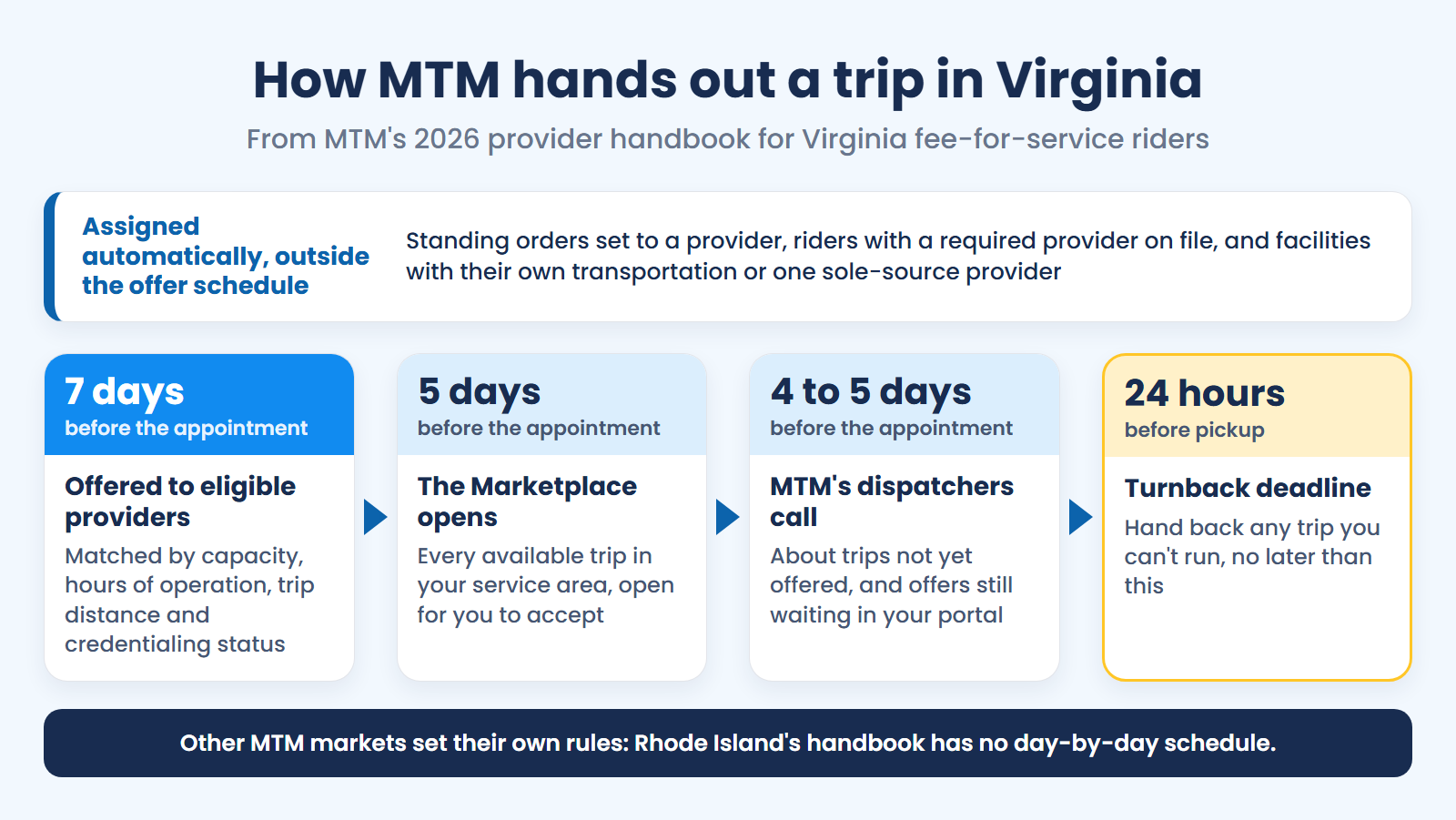
Trips arrive in MTM Link, its provider portal and driver app, or in dispatch software that connects to it. Other MTM markets run their own rules. Rhode Island’s 2026 handbook has no day-by-day schedule. There, turnbacks are due at least 24 hours before the appointment, never on a same-day trip, and a trip you take from the Marketplace can’t be turned back at all. Idaho’s 2023 handbook lets you refuse a trip within 24 hours of getting it, up to 48 hours before the appointment.
Standing orders are the steady part. After a year on workers’ comp trips, a Beaumont, Texas owner “got with MTM,” the owner said in a 2025 video interview, and for the company’s Medicaid dialysis riders, “we have the standing order for the entire year.”
On a call in July, an operator at a Florida-based company whose biggest broker is MTM described the order it plans in. Set each driver’s schedule about a week out, then “I then go in MTM and I accept a bunch of trips,” then fill the gaps. MTM’s onboarding page lists Duet among the dispatch platforms MTM Link works with, and MTM trips land on the Duet dispatch board, on the same calendar as your private-pay and facility trips. You still credential with MTM, accept or turn back trips on MTM’s clock, and answer to MTM’s on-time and turnback standards.
What decides how many trips MTM sends you?
MTM sends trips by the setup you give it: the contract promises no minimum, so your service area, hours, capacity and levels of service route the offers, and your on-time and turnback record keeps them coming.
MTM’s agreement form says it picks providers on factors such as “quality, service availability, and competitive pricing” against other providers in the area. And MTM’s onboarding page says its system won’t assign trips to a provider whose credentials aren’t current.
In Virginia, MTM’s standards are on-time performance above 95% and re-routes, MTM’s word for turnbacks, under 0.5% of trips. Providers at 95% on time or better in a quarter share a pool funded by the liquidated damages MTM collects across its network. Three infraction points suspend your Marketplace access until they come off. Rhode Island’s bar for turnbacks is looser: under 3.99% rates green.
The three-car provider worked the setup side. The broker helped it set up depots around the state, let it pick its work and gave it Marketplace access. Then the provider started calling the broker’s dispatchers, “very consistently,” for unscheduled rides near a driver who’d be out there the next day. That provider got to 35 vehicles. Paul Hynes put it from MTM’s side: let your vendor account manager know you want to grow and make yourself useful and available, because “it is remembered,” and good performers are “who we want to grow with.”
To get offered more trips:
- Give MTM the widest service area, hours and capacity you can actually cover, since those settings are what its offers match against.
- Keep turnbacks near zero, under Virginia’s 0.5% bar and never inside 24 hours of pickup.
- Check the Marketplace daily (in Virginia it opens five days out) for trips near drivers already on the road.
- Tell your vendor account manager about each new van, level of service or county the week you add it.
Should MTM be your only payer?
MTM shouldn’t be your only payer: its contract can end on 30 days’ notice and health plans switch brokers, so build private-pay and facility trips beside it.
Plans move both ways: the Texas and Illinois Blue Cross plans moved to MTM, while Community First (April 1, 2025) and Texas Children’s (December 15, 2025) moved their Texas Medicaid rides from MTM to SafeRide. Brokers change hands too, as Veyo, MTBA and Access2Care did; our tracker of 2026’s broker changes has this year’s switches.
My cofounder Jing Zhu said on our 2025 episode about succeeding in private pay that some customers get “90 or 100%” of their trips from one broker. The risk, in Jing’s words: brokers “can get acquired, they can merge,” and the new broker may not like your rate. Even MTM’s Paul Hynes told applicants to keep looking for “other sources of trips,” naming private pay and nursing homes. Start with pricing and finding private-pay riders and winning facility work.
None of this makes MTM a bad door: where it holds the contract, standing orders and the Marketplace can keep vans busy week after week. Some markets just don’t need another provider, whatever you do. Book your first private-pay or facility trip before your first MTM trip, and keep MTM to a share of your schedule you could lose on 30 days’ notice.
Before you call MTM, write down the counties, hours and vans you can give it next month. That’s the company MTM routes trips to, and the three-car provider’s version fit in one sentence.
FAQ
What does MTM stand for, and is MTM Transit the same company?
MTM stands for Medical Transportation Management, the name the company was founded under in 1995, and it took the name MTM Health in 2025. MTM Transit is the separate brand for MTM’s transit operations. Ride companies apply to MTM Health’s provider network.
How do you reach MTM’s provider team?
MTM’s contact page lists no national provider line and sends contracted providers to their vendor account manager. Some state pages list contacts: Virginia’s provider line is 866-810-8302, and Wisconsin’s vendor account team takes email at providerswi@mtm-inc.net. MTM’s 2026 Rhode Island handbook lists a 24/7 provider hotline, 888-597-1180. The 888-597-1189 number on MTM’s Access2Care page is for riders, not providers.
Does MTM pay for the drive to a pickup?
Not by the mile on Rhode Island’s rate sheet, which pays loaded miles, the ones with a rider aboard, though a pickup more than 40 miles from where you keep your vehicles pays a higher base and per-mile rate. Idaho’s 2023 handbook says MTM figures paid miles with its GPS-based mileage system, by the shortest distance from pickup to final destination, whatever route you drive.
About the author
James O'Donnell cofounded Duet and leads its sales, partnerships, and growth services. He talks with NEMT operators every week, hosts the NEMT Growth podcast, and answers Duet's sales line himself. More about Duet's founders →
Want more trips and less busywork?
See how Duet runs and grows NEMT businesses in a 30-minute demo.