Article
NEMT Business Plan: A Free Template Built on Trips (2026)
Show a lender trips times rate, by payer, starting when each payer's money arrives. Here's how to build that plan, with a free template.
By James O'Donnell, Cofounder and COO, Duet ·
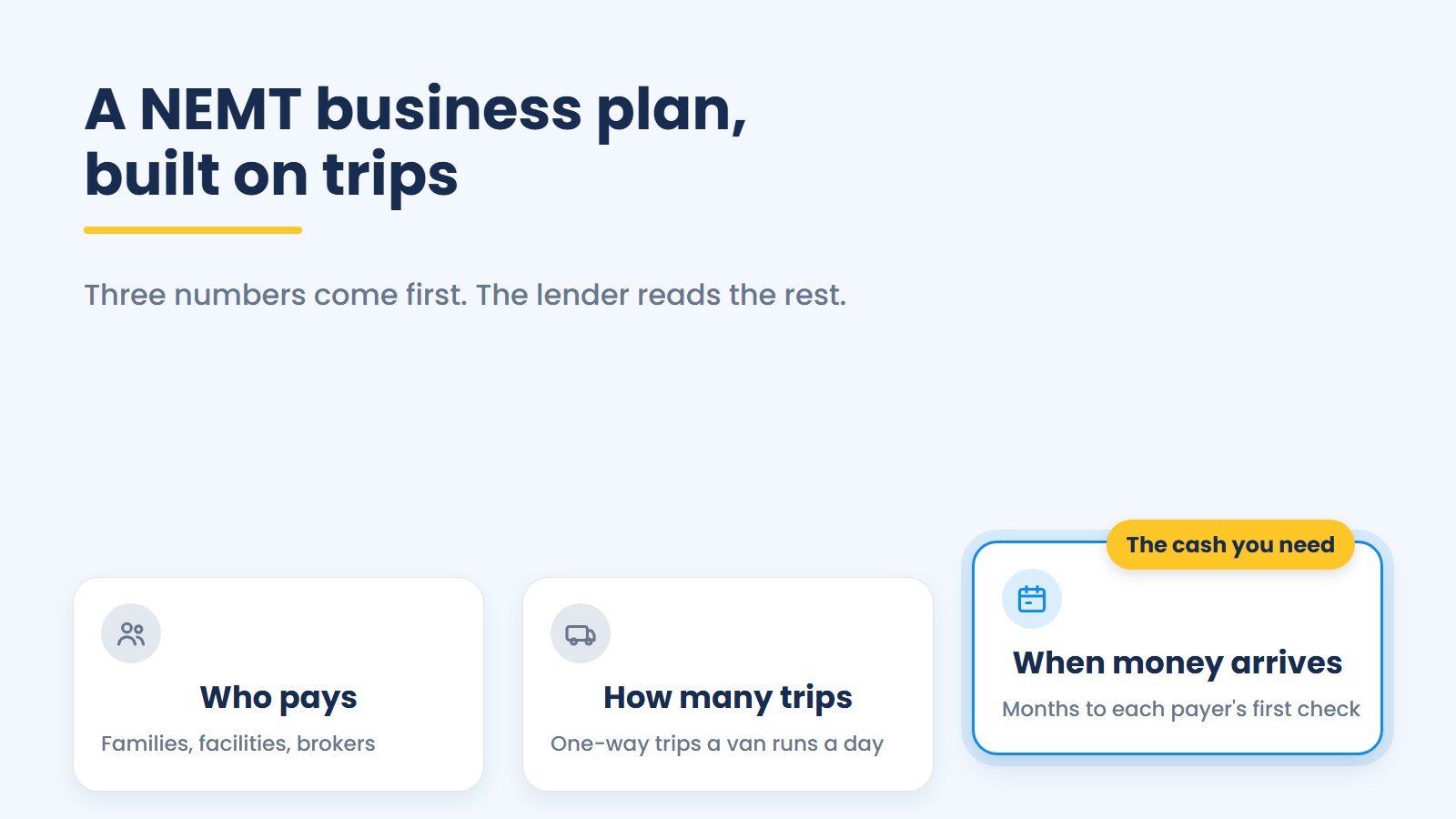
A non-emergency medical transportation (NEMT) business plan has the same sections as any plan a lender reads. The numbers that decide it come from trips: who pays for each one, how many one-way trips each van runs in a day, and how many months pass before each payer’s money arrives. Build those three first, and the rest of the plan is arithmetic.
A Santa Cruz, California owner looked at buying NEMT companies, got to see their books and built a projection from them to take to banks. He got a business loan. Seven months after his first trips, he told a 2025 industry podcast, his one vehicle was “averaging between like two to five trips a week.” He’d hoped for three vehicles by then: “When I wrote my proforma, I think maybe I thought I would have been there by now.” Early on, the loan had also paid full-time drivers his trips didn’t cover. “I was just burning cash,” he said.
A plan can be good enough for a bank and still wrong about the months. So build your plan’s revenue from trips by payer, starting when each payer’s money arrives, not when the van does. That timing decides how much cash you need.
A lender reads a plan front to back, starting with the summary. I’d build it back to front, starting with the numbers. This guide goes in that order: whether you can borrow, who pays, how many trips, when the money lands, your cash by month, what to ask for and what to change if it doesn’t work. The written sections come last, with a free Excel projection and Word template along the way.
Do you need a business plan to start a NEMT business?
You need a business plan when you borrow from a bank or an SBA lender, so first ask a lender whether you can borrow at all. A former Small Business Administration (SBA) microlender, in a January 2026 interview on a startup coach’s YouTube channel, said a lot of founders do it the other way. They plan a 10-vehicle, million-dollar start, then “go to the lender with this plan that they’ve spent months and months on, and the lender’s like, ‘Yeah, we would never do that.’” The most common mistake, he said, is “just waiting too long to get that kind of lender feedback.”
The first question is who can borrow. SBA’s rules for its 7(a) loans, its main loan program, and its 504 loans, for real estate and long-lived equipment, are SOP 50 10 8.1, in force since Oct. 1, 2026. Under them, every direct and indirect owner of a business borrowing through either program must be a U.S. citizen or U.S. national whose principal residence is in the United States or its territories. Green card holders, visa holders, refugees, asylees and recipients of Deferred Action for Childhood Arrivals (DACA) are ineligible. SBA microloans have required every owner to be a U.S. citizen or U.S. national since April 1, 2026.
His own list starts with a down payment, then a decent credit score (“650 or above for SBA” is his rule of thumb; SBA’s own rules set no minimum) and industry experience. Without the first two, he said, “the best business plan … doesn’t really matter.”
SBA’s 7(a) Small rules don’t ask for a “business plan” by name. A 7(a) Small loan ($350,000 or less) made on projections needs “12-month projections, including supporting assumptions.” SBA’s planning guide is plainer: “To increase your chances of securing a loan, you should have a business plan, expense sheet, and financial projections for the next five years.”
Not every lender asks, and not every owner borrows. An equipment-finance sales director, interviewed on the same channel in April 2026, said, “I don’t really think any of our programs require a business plan.” She still wants the numbers: “At least know how much you plan to make per vehicle per month, how much money that’s going to bring in through your account, and when.” And a Macon, Georgia owner who used a lot of her own money told Zenpath Radio in 2023 that “A business plan is not essential” unless you’re going to the bank for a loan.
This week, call one SBA lender or a community development financial institution (CDFI), a Treasury-certified lender for low-income communities, and ask what it needs from a business with under a year of revenue.
Who will pay for your trips?
Every trip in your plan needs a payer by name, because brokers, facilities and families pay different rates on different clocks. The former microlender saw the opposite a lot: revenue that just climbs, $30,000 one month and $35,000 the next, with nothing to show what’s driving it. Show “how many trips I did here’s my rate per trip,” he said, or “the lender is just going to think you pulled it out of thin air and usually you did.”
A broker is the company a state or health plan hires to assign Medicaid rides, and it pays a contract rate after a clean claim. Facilities like nursing homes, rehabs and hospitals book rides and pay on invoice. Families pay your price themselves, before the ride. What each pays for a 10-mile wheelchair trip is in our breakdown of what one NEMT trip pays.
Our 12-step guide to starting a NEMT business sets one test before you sign for a van: write down who will pay for its first 100 trip legs a month, by name. The plan is that test in writing.
You can start without broker trips. Ray and Mac of The Doctor Ride, who walked through building their business from day one on our podcast, call their first year “99% private pay,” meaning families and facilities. Their first broker trip came in September 2026, their one-year mark.
So before you write another section, name them: the broker that serves your county and whether it’s taking new providers, the facilities that would book you, and how families will find you.
How many trips will one van run in its first months?
Far fewer than it can run, so plan month one at a small fraction of the ceiling. For a van you drive yourself, the benchmark I give new providers is about 100 one-way trips a month at most, about five a weekday, because you’re also answering the phone, scheduling tomorrow and sending the bills. Count a round trip as two. Paul Muench, a Phoenix operator with an accounting degree, put it plainly on our panel at NEMTAC Transform 2025, an industry conference: “It’s an A leg and a B leg.”
The first months run far below that. A one-van owner in Charlotte told me on a demo in July that his first three or four months ran “three, four trips a month.” The Doctor Ride ran 5 rides in its first month and 104 in its 13th, on two vans by then. They don’t say whether a round trip counts as one ride or two.
Start your month one at a small fraction of 100. The example below starts at five.
When does each payer’s money arrive?
Private pay arrives before the ride, facility money a month or two after it, and Medicaid money only after enrollment, credentialing and a pay cycle. Most private-pay providers I talk to take a card at booking and charge it at least 24 hours before pickup, or send a payment link that has to be paid by then.
Tony Jackson, an Orlando operator with 35 years in the business, bills facilities net 30 (due 30 days after the invoice) with a 15-day grace period. “You’ll get your money in about 45 days,” he said on our October 2025 episode about facility contracts. Some buildings want longer. An operator on the same NEMTAC panel said, “now they’re asking for net 90.”
Medicaid money waits on three clocks. First the state enrolls you, in states that enroll van companies (Georgia, Pennsylvania and Virginia don’t, for broker work). North Carolina processed clean applications in 16 to 22 days from July to September 2026, per NC Medicaid’s provider enrollment page. Next the broker credentials your company, drivers and van, on a clock no broker we’ve checked publishes end to end. Then comes the pay cycle: under Modivcare’s February 2024 Mississippi provider manual, it pays clean invoices twice a month, within 30 days of receiving them.
Some states run far longer: as of October 2026, California law gives its Medicaid agency up to 180 days to decide on an application. Your state’s clock is in our guide to how long it takes to become a Medicaid transportation provider.
In your plan, put the first broker dollar after your state’s enrollment time, the broker’s credentialing and about a month of pay lag.
What does a one-van plan look like, month by month?
Say you start with one financed wheelchair van you drive yourself and count each payer’s money when it arrives: cash bottoms out about $20,400 below zero in month 4, and the launch cash is earned back in month 13. Wait on broker trips alone, starting in month 7, and the low point is about $31,600, in month 8.
The costs are the ones our startup-cost and revenue guides use: $16,735 of launch cash, including the down payment on a $33,000 used van and $4,350 of insurance due at signing. Then come a $614 van payment, ten insurance installments of $1,305, a $15 phone line and about $7.85 a trip in gas and wear. Insurance renews in month 12 with another $4,350 down, assuming the same $17,400 premium.
The trips are the example’s own assumptions. Private pay starts in month 1 at $90, paid before the ride. Facilities start in month 2 at $70, paid two months later. Broker trips start in month 4 at $41, once enrollment and credentialing clear, paid a month later. Each climbs over three or four months to 20, 20 and 60 trips a month, 100 in all, the blend from our guide to what a NEMT business makes.
| Example month | Trips: private / facility / broker | Cash in | Cash out | Cash position |
|---|---|---|---|---|
| Launch | - | - | $16,735 | -$16,735 |
| 1 | 5 / 0 / 0 | $450 | $1,973 | -$18,258 |
| 2 | 10 / 5 / 0 | $900 | $2,052 | -$19,410 |
| 3 | 15 / 10 / 0 | $1,350 | $2,130 | -$20,190 |
| 4 | 20 / 15 / 20 | $2,150 | $2,366 | -$20,406 (lowest) |
| 5 | 20 / 20 / 40 | $3,320 | $2,562 | -$19,648 |
| 6 | 20 / 20 / 60 | $4,490 | $2,719 | -$17,877 |
| 12 | 20 / 20 / 60 | $5,660 | $5,764 (insurance renewal) | -$1,971 |
| 13 | 20 / 20 / 60 | $5,660 | $2,719 | +$970 (launch cash earned back) |
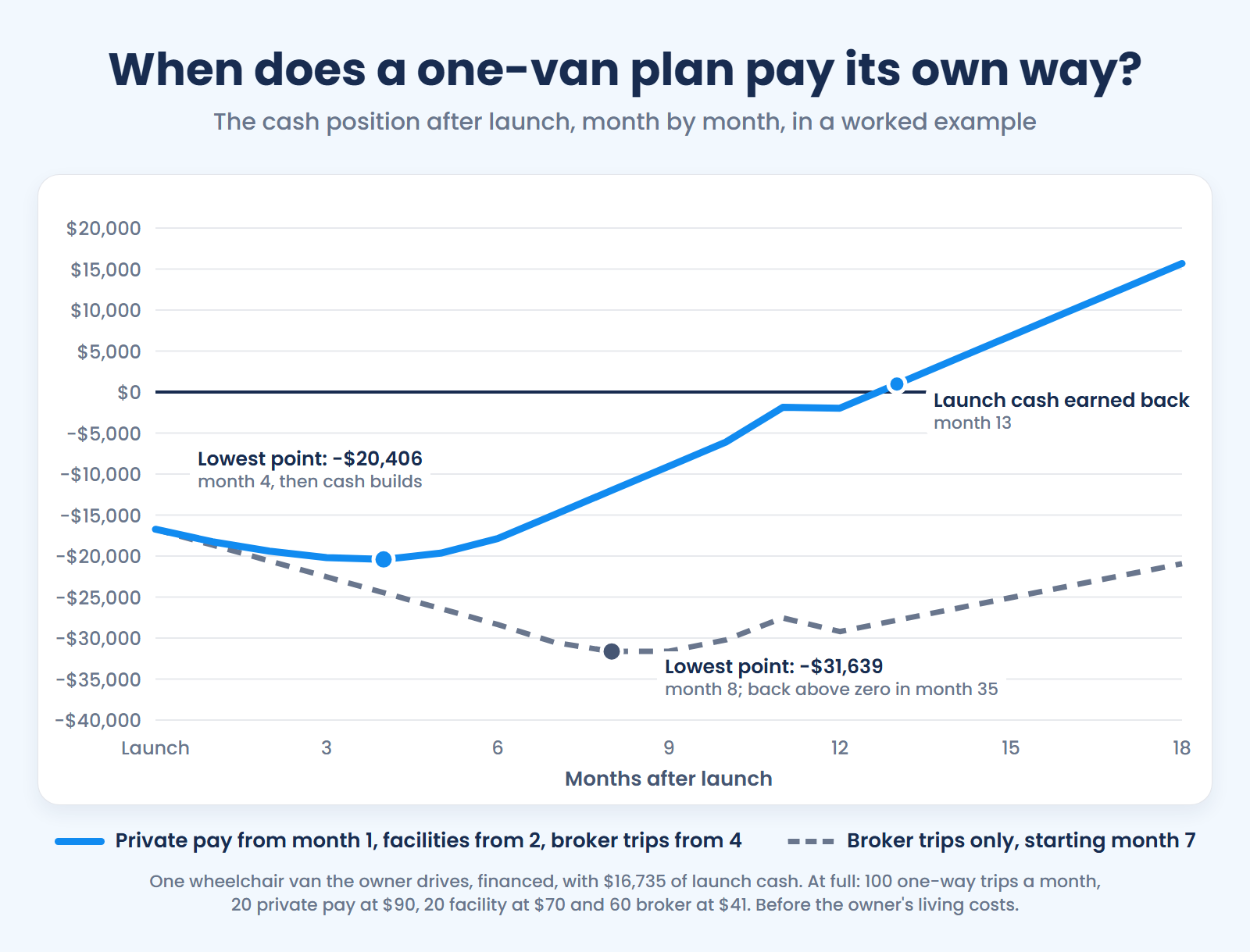
The van earns $3,670 in month 4, but only $2,150 comes in, because the facility and broker money is still on its way. From month 5 on, more comes in than goes out, except at each yearly insurance renewal: month 12 dips $104 when the $4,350 comes due.
The dashed line is the same van running only broker trips at $41, starting in month 7 and climbing to 100 a month over three months, like the example’s broker trips. By month 6, before its first trip, it has spent $28,339, the same total our startup budget gives for launch cash plus six months of bills. It bottoms out at $31,639 below zero in month 8 and doesn’t climb back above zero until month 35. The wait sets how deep the hole goes, and the $41 rate sets how slowly it fills.
The example pays you nothing, so your living costs aren’t in it. At full, the van leaves about $2,800 a month before your own pay. Draw a driver’s wage of $3,108 a month from month 1, and the cash never climbs back above zero in the workbook’s 36 months. The example also leaves out general liability, software, a reserve to replace the van, big repairs, accounting and marketing. And its trips reach 100 a month sooner than the Santa Cruz owner’s, the Charlotte owner’s or The Doctor Ride’s.
Real years are lumpier. Ray and Mac posted The Doctor Ride’s first 13 months on their YouTube channel in October 2026. Six came in under $5,000 in revenue, including a slump from December through March, and they “didn’t even crest back up above 5,000 a month in revenue until April,” around when their second van arrived. The 13 months add up to $90,645.
The free NEMT business plan projection workbook (.xlsx) runs this example by default, with no email needed. Its tabs are your plan, 36 months month by month, three years, and where each example number comes from. To use it:
- Copy your launch cash, van payment and insurance from our NEMT startup budget spreadsheet (.xlsx), and add any other bills and your own draw.
- For each payer, enter the pay per trip, first month, months to reach full, trips at full and months from trip to cash.
- Set one driver’s monthly trip ceiling and your gas and wear per trip.
It returns the cash to line up, the lowest month, the first month cash in beats the bills, the month the launch cash is earned back, and three years with loan coverage. Run it with your own quotes this week and write down your lowest cash month.
How much should you ask a lender for?
Ask for enough to carry you through your projection’s lowest month, launch cash included, plus a reserve. In the example, that low point is $20,406: the $16,735 of launch cash plus $3,671 that the first four months run short. The van itself sits on its own $26,400 equipment loan (the $33,000 van with 20% down), so the $20,406 is the cash you need on top of that loan.
Size the reserve by running the workbook slower. Start every payer two months later and give each twice as long to reach full, and the example’s low point deepens to $26,539 in month 7, with the launch cash back in month 19. That extra $6,133 is a fair floor for a slow clock. Then add what you’ll live on until the business pays you.
Part of the money has to be yours. Under SOP 50 10 8.1, a Standard 7(a) or 7(a) Small loan to a business with a year or less of revenue needs an equity injection. That’s your own money going in, “at least 10 percent of the total project costs.” SBA counts “all costs required to become operational, regardless of the source of funds,” so it’s 10 percent of the whole start, van included. Cash you didn’t borrow counts toward it. SBA Express loans, up to $500,000, leave it to the lender, and microloan lenders set their own.
The lender also checks debt service coverage: whether the business’s cash covers its loan payments. For a 7(a) Small loan made on projections, SBA wants 1.10 times within a year of funding, counting the payments on all business debt, the new SBA loan included. In the example, the cash covers the van payments 3.0 times in year one, but only before you pay yourself. Take a driver’s wage of $3,108 a month for yourself, and the cash doesn’t cover them at all in year one and covers about half of them in year two.
In the former microlender’s experience, 10 percent down is “the bare minimum,” and lately he’s seen startups “in an industry that’s tough” asked for 20 or 25 percent. And the equipment-finance director’s company offers working capital, “but we don’t offer that to startups.” A Spring Hill, Florida owner told Zenpath Radio in 2022 that her biggest mistake was “underestimating the amount of working capital I needed to have when I started.”
Loan types, microloans and the grants that exist are in how new owners pay for a NEMT startup.
What if the numbers don’t work?
If your projection’s low point runs deeper than your cash plus what you can borrow, change the plan before you sign for a van. The Santa Cruz owner changed his staffing, not his vehicle count. After three or four months of covering drivers’ pay from the loan, he switched from full-time drivers to part-time. He had “a loan for the next 6 months,” with pay for himself built in that he hadn’t touched. And he planned “to withstand 12 to 18 months and get to the other side of it and hopefully there’s volume at that point.” At seven months he still had one vehicle, and he said, “It’s working.”
Notice the gap between his 12 to 18 months and the example’s month 13. The example assumes facilities start booking in month 2. For him, “the trust building with facility admin is taking probably a lot longer than I would have ever anticipated.” If your facilities come slower, you earn your launch cash back later: start them in month 6 instead of month 2, and month 13 becomes month 15.
Four changes close the gap between what the plan needs and the cash you can raise:
- Lead with private pay and facilities. In the example, the three-payer plan’s low point is $11,233 shallower than the broker-only plan’s, which also waits until month 7 for its first trip.
- Spend less on the van. If a lender will finance an older $20,000 van the same way, the example’s low point drops to about $16,000, with the launch cash back in month 11.
- Keep your day job until enrollment clears. Your paycheck covers the months the plan can’t.
- Wait. Save more, or line up trips with names on them before you buy.
None of these creates demand, and neither does a plan. What I tell new owners: please don’t buy vehicles before you have any trips lined up.
What goes in each section of a NEMT business plan?
SBA’s business plan guide lists eight sections for a traditional plan, and in a NEMT plan each one answers a lender’s question about your trips. Write them last, in the order a lender reads them:
| Section | What the lender does with it | What a NEMT plan says |
|---|---|---|
| Executive summary | Reads it first, to decide whether to read on | Who pays, trips by month 6 and 12, your ask, your lowest cash month |
| Company description | Checks you can legally run the trips | Each license, permit, enrollment and policy, with its status and date |
| Market analysis | Checks the trips exist where you’ll run | Your county: Medicaid members, adults 65 and older, people with disabilities, facilities by name, competitors’ prices |
| Organization and management | Looks at who will run it | Owners; who drives, schedules, bills and sells; your experience |
| Service or product line | Checks revenue comes from real rates | Levels of service and your rate by payer, dated |
| Marketing and sales | Checks every trip has a source and a start date | How each payer’s trips arrive: broker application dates, a facility call list, how families find you |
| Funding request | Matches your ask to your projection | The low point plus a reserve, and your own cash in |
| Financial projections | Reads the assumptions, then checks loan coverage | Monthly cash by payer, with every assumption written out |
For the market section, two owners show the work. A Fairfax, Virginia owner told Zenpath Radio in 2022 that she looked up residents 65 and older and people with disabilities in her area, on what she believes was the Census Bureau’s site. The Spring Hill owner, writing hers for a loan, reached out to other providers to see “what they’re charging” and “how booked they are.”
For the projections, paste the workbook’s summary and write every assumption out in a sentence. Ask your lender how far out it wants them: SBA’s guide suggests five years, with the first year by quarter or month, a 7(a) Small loan made on projections needs 12 months by rule, and the workbook gives you three years by month. The former microlender’s reason: “there’s a loan committee member that’s an accountant somewhere probably and that accountant wants to know how did you come up with this?”
SBA’s list has no operations section, so the template adds one: your van, your drivers’ screening and training, insurance, and the software you’ll schedule, dispatch and bill with. For that last line, Duet is free while you run fewer than 100 trips a month, with nothing feature-locked. Past 100 trips, usage pricing kicks in, and most providers pay less than $50 per active vehicle a month. Winning the trips and writing the plan are still on you.
Before you send it, get a free read from a volunteer SCORE mentor or your local Small Business Development Center (SBDC), which offers no-cost business consulting.
The free NEMT business plan template (.docx) follows SBA’s eight sections and adds the operations section and an appendix, with no email needed. Each section says what the lender does with it and what to write for NEMT, and shaded boxes and tables carry the one-van example.
The Santa Cruz owner found his real numbers seven months in. You can find yours before you buy the van. Take one page for month one and write down every trip you expect, who pays for it and the month its money lands. If you can fill that page in, the lender won’t think you pulled it out of thin air, and the rest of the plan is arithmetic. If you can’t, that’s your answer for now.
FAQ
How long should a NEMT business plan be?
As long as the lender needs to check your numbers. SBA’s guide describes two formats. A traditional plan “can be dozens of pages long,” and “Lenders and investors commonly request this plan.” A lean plan is “typically only one page,” though “Some lenders and investors may ask for more information.” If you’re borrowing, write the traditional one and keep each section to what the lender checks. If you’re paying cash, a one-page plan and the projection workbook may be all you need.
Should I pay someone to write my business plan?
You can, but know two rules for SBA 7(a) loans first. A 7(a) lender may charge reasonable fees for packaging your application, and SOP 50 10 8.1 says those services include “preparing a business plan, cash flow projections, and other documents related to the application.” Up to $2,500 per loan, it doesn’t have to document the work, and it has to tell you in writing that you’re “not required to obtain or pay for unwanted services.” Fees you pay an agent or adviser also don’t count toward the cash you have to put in. Whoever types it up, the trips, rates and dates have to come from you.
Can grants go in a NEMT business plan?
Only grants you’ve already won. SBA “does not provide grants for starting and expanding a business,” and the U.S. Department of Agriculture’s Rural Business Development Grants say “For profit entities, individuals and individual businesses are not eligible to receive grants under this program.” A grant you have won, with no payback or clawback during the loan, can count toward your equity on a 7(a) loan. So put a won grant in as cash, and don’t build the van on one you haven’t won.
Can I get the template as a PDF?
The template is a Word file so you can type into it. When it’s filled in, save a PDF copy from Word for the lender, and keep the Word file for the next time your quotes change.
About the author
James O'Donnell cofounded Duet and leads its sales, partnerships, and growth services. He talks with NEMT operators every week, hosts the NEMT Growth podcast, and answers Duet's sales line himself. More about Duet's founders →
Want more trips and less busywork?
See how Duet runs and grows NEMT businesses in a 30-minute demo.