Article
Best Patient Transport Scheduling Software (2026)
Two winners for two very different kinds of facility, and the trade-offs behind every pick.
By James O'Donnell, Cofounder and COO, Duet ·
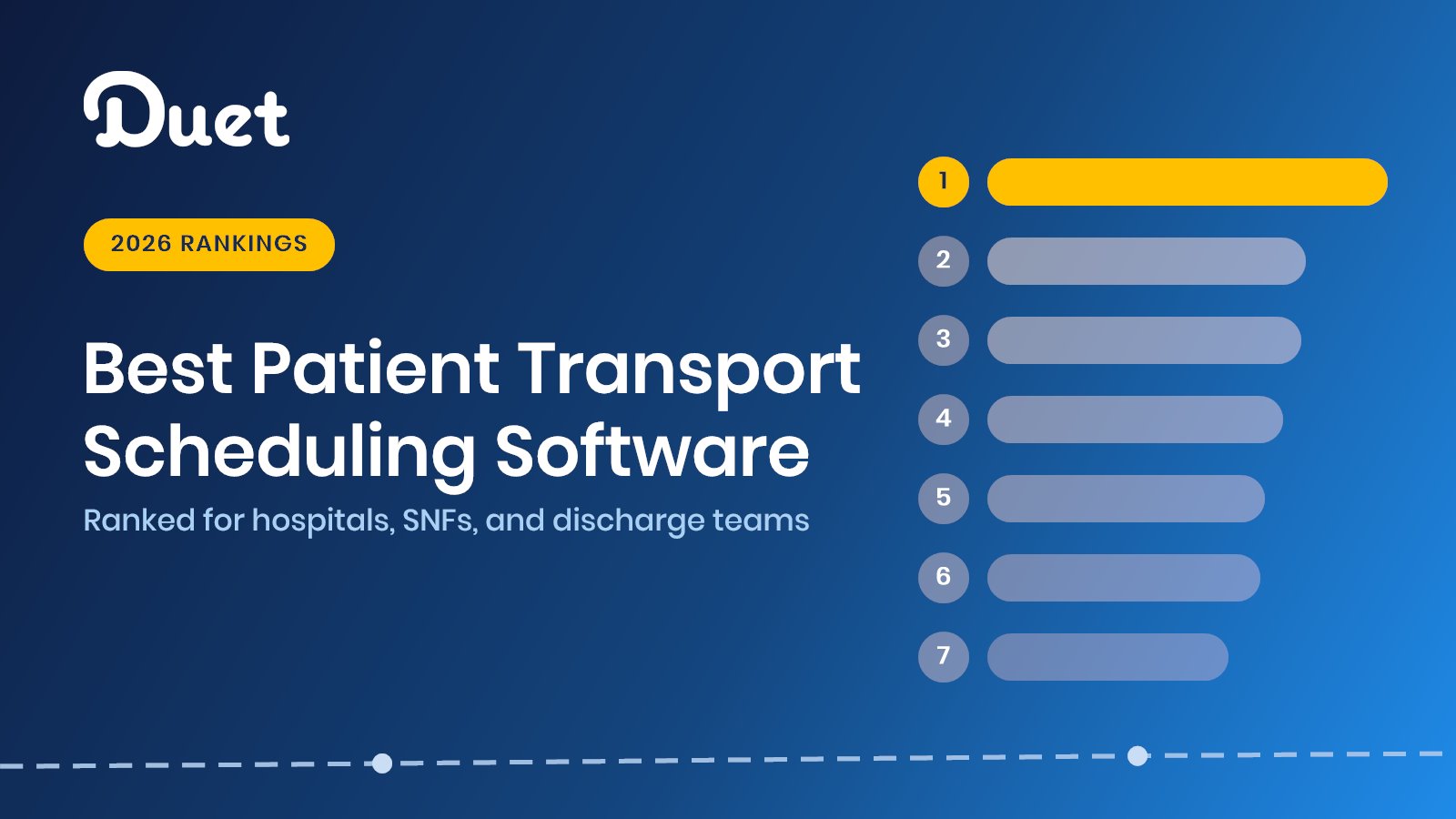
The best patient transport scheduling software in 2026 depends on what your facility moves. The short version:
- Ryde Central is the best paid option. The most complete platform for hospitals and nursing facilities that send everything from rideshare to ambulance trips to a roster of vendors, with the paperwork built in.
- Duet’s facility portal is the best free option. Learnable in a minute, and the pick when your trips are mostly wheelchair, stretcher, and ambulatory rides with local NEMT providers.
- Roundtrip, VectorCare, Ride Health, and Kaizen Health follow, each with a real strength and a real gap.
If you arrange patient rides, you know the current system: call the transport company, leave a voicemail, call the second company, wait for the callback, while a patient sits in a bed the unit needs. This software ends that loop. We ordered the options rather than scoring them, because a transfer center and a 60-bed nursing home need different things.
What patient transport scheduling software is, and what it isn’t
It’s the tool a facility uses to request, schedule, and track outbound patient rides: discharges, transfers, dialysis and clinic runs. It comes in two shapes.
- Standalone platforms your facility signs up for. They sit above several transport vendors and get each trip to a provider by broadcasting it to your own vendor list (Ryde Central), sending it to a marketplace (Roundtrip, VectorCare), or handing it to a coordination team (Ride Health, Kaizen Health). You pay for the platform, usually on a quote.
- Portals that come with a provider’s dispatch software. Your provider gives you a login and your request lands on their dispatch board. Usually free, and each reaches one company. Duet’s portal is one of these.
Out of scope: Medicaid brokers, rideshare-only programs, and in-hospital porter systems.
The ranking at a glance
| Rank | Platform | Best for | Cost to your facility | Levels of service |
|---|---|---|---|---|
| 1 | Ryde Central | Hospitals and SNFs sending ambulance through rideshare trips to a vendor roster | Quote-based | Ambulance, stretcher, wheelchair, bariatric, rideshare, air |
| 2 | Duet Facility Portal | Facilities whose trips are wheelchair, stretcher, and ambulatory rides with local NEMT providers | Free | Ambulatory, wheelchair, stretcher; ambulance where the provider runs it |
| 3 | Roundtrip | Health systems that want a nationwide marketplace with prior authorizations handled | Quote-based | Rideshare, medical sedan, wheelchair, stretcher, ambulance |
| 4 | VectorCare | Health systems that want transport, home health, and DME in one Epic workflow | Quote-based | Ambulance, wheelchair, gurney, sedan, rideshare |
| 5 | Ride Health | PACE programs and health plans that want a managed service | Quote-based | Ambulatory, attendant-assisted, door-through-door, bariatric |
| 6 | Kaizen Health | Systems and plans that want a coordination service rather than software alone | Quote-based | Rideshare, wheelchair, non-emergency ambulance, courier |
| 7 | Your provider’s own portal | Facilities with a reliable transport company on modern dispatch software | Usually free | Whatever that one provider runs |
How we ranked them
Six questions, in the order they matter to the person booking the ride: what it costs your facility; which levels of service it covers; how much effort a booking takes; what you can see once the trip is booked; how many providers it reaches and what happens when the first one declines; and whether the physician certification statement gets handled in the flow or by another call.
Duet builds the portal at number two, and we’ve tried to be as plain about its limits as everyone else’s. Claims come from each vendor’s own site and press releases as of September 2026.
1. Ryde Central
Best for: hospitals and transfer centers that send ambulance, stretcher, wheelchair, and rideshare trips to more than one vendor, and skilled nursing facilities that want the same control.
Ryde Central automates the ordering, routing, and tracking of patient transport. Staff pull the patient’s details from the EHR in one click (Epic, MEDITECH, Cerner, and PointClickCare are named integrations), answer a short questionnaire, and submit; the company claims a 60-second request and a 15-minute training. It checks medical necessity, generates the physician certification statement and payer forms automatically, and stops staff from ordering a more expensive level of transport than the patient needs.
Then it does the part no phone can. The request is broadcast by text and email to your tier-one providers, who accept, reject, or propose a different time. If nobody takes it, it escalates to tier two. Counter-offers are accepted or rejected automatically against policies you set. Accepted trips flow into the provider’s dispatch software through integrations or an API; rideshare runs through Uber and Lyft. Both sides see status in the portal, with text and email updates at each milestone, plus real-time chat.
Levels of service run from ambulance through stretcher, wheelchair, bariatric, and rideshare, with air listed as well. In Ryde Central’s case studies, the University of Maryland Medical System says ordering went from 45 minutes to a click, Fairfield Medical Center cut booking time by about 95 percent inside Cerner, and Bayhealth cleared a documentation problem that had been holding up nearly nine in ten requests. Ryde Central completed a SOC 2 examination in May 2026.
What to know: pricing is quote-based with no public price list, so ask early. It’s built for facilities that manage a vendor roster; a nursing home with one van company will find the setup more than it needs. And it’s not a dispatch system, so your vendors keep their own, which is how ambulance companies want it.
2. Duet Facility Portal
Best for: nursing facilities, rehabs, senior living, adult day centers, and hospital units whose rides are ambulatory, wheelchair, and stretcher trips with local NEMT providers.
Duet’s facility portal comes with Duet’s NEMT dispatch software, which more than 100 transportation providers run. A provider on Duet gives your staff a login. You book the trip directly, see every upcoming trip you’ve booked, and track the ride on the day it runs; the request lands on the provider’s dispatch board with nothing re-entered and nobody on hold. If you can book a rideshare, you can book with your provider. It supports ambulatory, wheelchair, and stretcher trips, standing orders for dialysis-style schedules, and rebooking a past trip in a couple of clicks. You can add the authorization number, see the trip cost before you send it, message the provider in the portal, and run reports on the trips you’ve booked.
One portal can reach several providers: if more than one of your transport companies runs on Duet, you connect to each from the same login. Riders and families can get browser-based live tracking links too, so “where’s the van” gets answered before anyone calls. The cost is nothing: free for your facility and free for the provider, with no contract on either side.
What to know: it reaches the providers you connect, one at a time; you choose who gets each trip rather than broadcasting to a roster, so the levels of service are whatever your providers run. It doesn’t pull from your EHR, so you type the trip in, about a minute’s work. Once submitted, details lock for facility users and changes go through the provider.
How to get it: ask the NEMT providers you already use whether they’re on Duet. If none are, contact Duet or call (650) 780-3465 and we’ll connect you with Duet providers in your area.
3. Roundtrip
Best for: health systems and plans that want one nationwide marketplace across many transport companies, with prior authorizations handled.
Roundtrip, founded in Philadelphia in 2016, pairs a booking platform with a credentialed marketplace. A coordinator books a ride and providers in the area offer an ETA and claim it; Roundtrip claims booking in under three minutes and no-show rates under four percent. The marketplace covers rideshare, medical sedans, wheelchair vans, stretcher vans, and ambulances. Staff can obtain prior authorizations in the platform, and patients get text or voice reminders. An Epic integration built on FHIR launched in August 2025, alongside Oracle Health, Meditech, and athenahealth. Named customers include Johns Hopkins, MD Anderson, and Geisinger.
What to know: pricing is quote-based and unpublished; transport companies join free and are paid by Roundtrip, which sits in the middle of the transaction. It’s aimed at hospitals and plans with no skilled-nursing edition, the physician certification statement workflow is on its roadmap, and there are no public user reviews.
4. VectorCare
Best for: health systems that want discharge logistics beyond rides, meaning transport plus home health, DME, and SNF bed search, inside Epic.
VectorCare, a San Francisco company founded in 2011 as Medlert, calls its category patient logistics. Requests go in through the web, an API, or a SMART on FHIR app inside Epic launched in November 2025. Its engine broadcasts each request to your contracted providers at once, captures bids and ETAs, and routes by fastest ETA, preferred vendor, or lowest cost. Service types named for hospitals are non-emergency ambulance, NEMT (wheelchair, gurney, and sedans), and Uber and Lyft. Physician certification statements get electronic signatures in the flow, and vendors are credentialed and scored. VectorCare claims more than 2,500 facilities and names CommonSpirit, Tenet Health, and UC Davis Health.
What to know: it’s the one platform here with public reviews, and they’re mixed: 3.8 out of 5 from eight reviews on the shared Capterra, GetApp, and Software Advice listing, praising the escape from hold music and complaining about lag and long forms. Pricing is quote-based; directories list a pay-as-you-go model of a few dollars per accepted request that VectorCare itself doesn’t publish. It’s a lot of platform for a single facility.
5. Ride Health
Best for: PACE programs and health plans that want a managed service with a 24/7 team watching every ride, mostly ambulatory and wheelchair.
Ride Health, based in New York, is a coordination platform wrapped in operations. You book; a Ride Success team monitors every trip around the clock across a network of in-house and third-party fleets. Service tiers run from independent ambulatory through attendant-assisted, door-through-door, and bariatric, with recurring rides supported. Facilities get real-time tracking, ETA updates, automated patient reminders, and dashboards, with Epic, Cerner, and athenahealth named as integrations. Customers include Baylor Scott & White, ArchWell Health, and CommuniCare.
What to know: stretcher and ambulance levels aren’t named on the current site, so this isn’t the tool for a transfer center. The deepest documentation is written for PACE programs, no physician certification statement handling is described, and neither pricing nor public reviews exist.
6. Kaizen Health
Best for: health systems and plans that want a coordination service rather than software alone, for rideshare, wheelchair, and non-emergency ambulance rides.
Kaizen Health, a Chicago company led by founder Mindi Knebel, is a technology-enabled brokerage, in the Center for Health Care Strategies’ words. Kaizen verifies the ride, assesses what the patient needs, and matches it to a partner, from rideshare and taxis through wheelchair-accessible vehicles and non-emergency ambulances. MTM Health, one of the national Medicaid brokers, is an investor. Named customers include Northwestern Medicine, the University of Chicago, and Lurie Children’s.
What to know: stretcher transport isn’t named, no EHR integration is documented beyond a general claim, and neither pricing nor public reviews exist. Its website is kaizenhealth.org; the similarly named .io site belongs to an unrelated company.
7. The portal that comes with your provider’s dispatch software
Best for: facilities that already have a reliable transport company running modern dispatch software.
Most dispatch systems now ship a facility portal, and the pattern is the same everywhere: your provider creates your login, you submit a request, and you watch the status move from dispatched to complete, sometimes on a live map. For NEMT providers, RouteGenie’s Facility Portal adds rate quotes and trip messaging, Bambi’s shows accepted trips on a map, MediRoutes handles requests and recurring schedules with a where’s-my-ride link, and CTS TripMaster’s TripPortal lets facility staff request rides for riders.
What to know: each portal reaches exactly one transport company, so a coordinator with four vendors ends up with four logins, and nobody publishes what facilities pay, though the provider usually carries the cost. You don’t choose this option; your provider does. If yours already has one, use it. For which dispatch systems are best for the providers themselves, see our ranking of NEMT dispatch software. Duet’s portal is one of these too; it’s ranked second because it’s free on both sides, connects to several providers from one login, and was designed for the facility user first.
Also worth a look
- Onward combines its own attended rides for lower-acuity patients with the transport partners you already use.
- MedTrans Go offers a facility portal for sedan, wheelchair, and stretcher trips plus interpretation and delivery services, but names no customers or integrations yet.
- DocGo’s Dara Transport Network covers every level up to critical care inside the EHR, but DocGo is also the largest provider on its own network, so it’s a vendor’s ordering platform rather than a neutral one.
How to choose
- A transfer center or hospital sending ambulance-level trips to several vendors: Ryde Central first; Roundtrip or VectorCare if you’d rather use a marketplace than manage your own roster.
- A nursing facility, rehab, or hospital unit with wheelchair, stretcher, and ambulatory trips: Duet’s facility portal, today, for free. Ask your providers whether they’re on it.
- A health plan or PACE program buying rides for a population: Ride Health or Kaizen Health.
- One transport company you trust, on modern dispatch software: use their portal and stop calling.
Whichever you pick, ask five things in the demo: who pays and how much; what happens when no provider accepts; whether you can see the vehicle live; how the physician certification statement gets signed; and who answers when a discharge goes sideways at six on a Friday evening.
Questions facility staff ask
What is patient transport scheduling software?
Software a facility uses to request, schedule, and track patient rides with outside transport companies. Standalone platforms like Ryde Central route each request across several vendors; provider portals like Duet’s connect you to one company’s dispatch board. Both replace the phone calls.
Is there free patient transport scheduling software?
Yes. Duet’s facility portal is free for facilities and providers, and the portals built into other dispatch systems are usually free to facilities too. The standalone marketplaces charge the facility or health system on a quote.
Do these platforms replace our Medicaid broker?
No. Broker-assigned trips still run through the broker, which picks the vendor. These platforms handle the trips where you choose the vendor: facility-paid discharges, private-pay and insurer-paid rides, and interfacility transfers. Roundtrip will also obtain prior authorizations.
How long does setup take?
A provider portal takes minutes: your provider adds your facility and you book the same day. Standalone platforms take weeks to months, because your vendors need to be loaded and credentialed and an EHR integration has its own timeline.
Which platforms handle stretcher and ambulance trips?
Ryde Central, Roundtrip, and VectorCare list ambulance. Duet’s portal covers whatever its provider runs, usually ambulatory, wheelchair, and stretcher, and ambulance where the provider offers it. Ride Health’s tiers stop at door-through-door and bariatric; Kaizen Health lists non-emergency ambulances but not stretcher vans.
About the author
James O'Donnell cofounded Duet and leads its sales, partnerships, and growth services. He talks with NEMT operators every week, hosts the NEMT Growth podcast, and answers Duet's sales line himself. More about Duet's founders →
Want more trips and less busywork?
See how Duet runs and grows NEMT businesses in a 30-minute demo.